10 Signs That We're Headed For The Robot Uprising
Are you ready to accept our new overlords with open arms?
For some, the robot uprising is a work of science fiction that will never come to fruition. For some, it is an inevitability that we will one day have to either welcome our robotic overlords with open arms, or fight a bloody civil war against our own creations.
The reality is probably somewhere in between.
As robots and artificial intelligence become more and more entwined with our lives, it seems almost certain that there are some parts of our day-to-day existence in which the robots will be "in charge". From self driving cars to factory assembly lines to smart homes, we'll be relying more and more on our robots' ability to think and do for themselves.
Couple this with our fascination for making more and more intelligent, self aware and even empathetic artificial intelligences and you've got yourself a perfect storm.
What will the robotic revolution look like? Probably a bit different to how you imagine it. It might be slow, subtle and even welcome as we offload more and more menial tasks to our synthetic pals.
We might even be living through the very beginning of it already and we wouldn't even know it. Well, except for these few hints...
10. Theyre Passing For Humans...
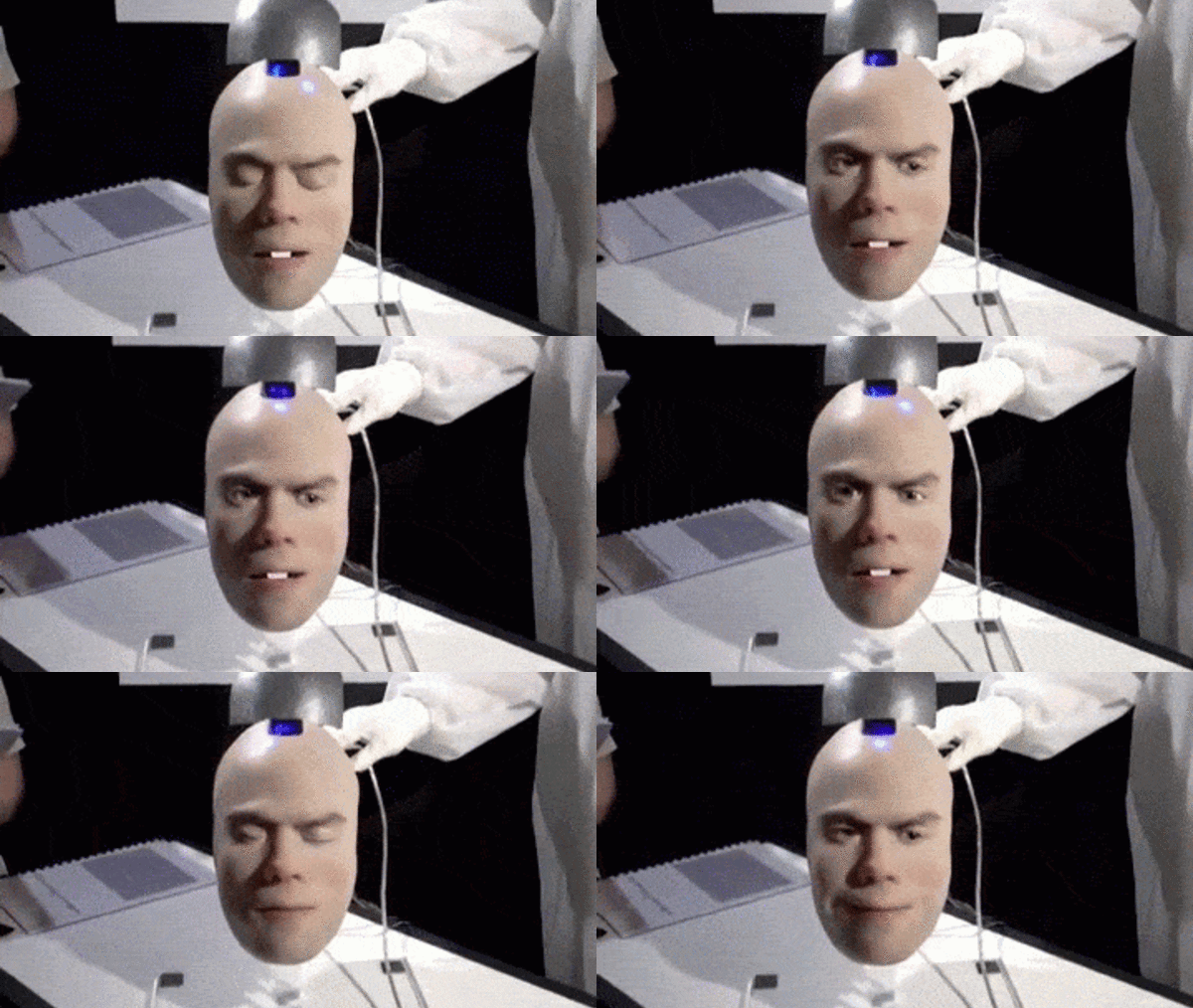
The Turing Test is a test designed to ascertain whether a computer shows real intelligence. To be successful, an AI must trick humans into believing that it is also human. If the computer manages this in more than 30% of cases over a five minute conversation, then it is judged to have passed.
In June of 2014, CleverBot did just that by posing as a 13-year-old boy and fooling 33% of judges from the Royal Society in London.
This is the only officially documented case, but it looks like the more data we give them, the better they get. Microsoft's AI chatbot has been learning all about us for some time now and has its own Twitter account. Granted, we managed to turn it into a racist misogynist Nazi sympathiser in less than 24 hours, but a quick look at its Twitter feed might not be enough to convince you that it's not just your average internet user.
Google have decided to prevent this eventuality by sitting its own AI down with some romance novels, and now it's writing poetry.
9. ...And Theyre Out-Performing Us
As well as tricking a panel of experts into thinking they were talking to a human, computers are also excelling in other fields.
Self-driving cars are now considered to be safer than those with human drivers and generally have a better safety track record. Because autonomous cars don't drink or text or nod off at the wheel, some experts are predicting that the accident rate would be about 10% that of humans.
A supercomputer has also beaten humans at a game of Jeopardy, which would require a complex understanding of human speech, and an AI has defeated a master at the traditional Chinese game of Go - something that is considered a huge milestone in artificial intelligence.
The computers doing these tasks aren't pretending to be humans, they're doing them as computers and are found to be superior.
Now all they need to do is realise it.
8. Theyre Teaching Each Other
It might look cute, but this robot could be one of the horsemen of the apocalypse.
Its name is Pepper and it is considered to be one of the world's first emotional robots. Pepper is not a "functional" robot but instead exists to make people happy. It interacts with people on an emotional level and is intended for use in teaching and care for the elderly or lonely.
The thing is, the reason Pepper is able to understand humans because each Pepper robot is Cloud enabled and uploads everything it learns about the human psyche to a hive mind that they can all access.
The more they interact with humans, the more Pepper robots understand about us on an emotional level, and they are even able to mimic our emotions and respond appropriately to social cues.
Pepper's status as an emotional robot also leads us down another intriguing path that we have thus far only had to deal with in sci-fi: Robot rights.
7. They Have Rights
Sticking with Pepper for the moment, this emotional robot could be ushering in a new age of roboethics.
For those who wish to drop more than $1,500 on a Pepper bot, it's not quite as simple as purchasing a product. Pepper owners are required to sign an agreement that they will not use the robot for "acts for the purpose of sexual or indecent behaviour," due to its emotional nature.
Whether or not this was a publicity stunt, this means that Pepper is one of the first robots to be protected by rights.
Protecting Pepper from the possibility of being used for the gratification of a human is just the thin end of the wedge. If Pepper is not allowed to be "used" in this manner, then would it also be wrong to have a robot perform menial tasks for you? Should they be paid? Should you even be allowed to "own" something with an emotional capacity?
The answer to these questions is probably "no" for the time being, but as the technology develops, it is undoubtedly a conversation that some people will be having.
6. They're Already Being Designed To Disobey Asimov's Laws
In sci-fi, a major plot point involving robots is usually that they are programmed not to harm humans in accordance with Isaac Asimov's first law of robotics. The laws are as follows:
1. A robot may not injure a human being or, through inaction, allow a human being to come to harm.
2. A robot must obey orders given it by human beings except where such orders would conflict with the First Law.
3. A robot must protect its own existence as long as such protection does not conflict with the First or Second Law.
In Asimov's fictional universe, and many that have followed it, these laws were woven into the very programming of all robots and were incontrovertible. Although the laws were meant as a literary device, many believe they form a pretty good basis for creating real-world AI.
Others, however, thought it was best to create a robot that tasers people in the balls.
Other robots currently in development are being taught to disobey human orders if they think that harm will come to them, and one has been programmed for the express purpose of punching human beings. Granted, this is for the purpose of developing robots that can't harm humans, but it's a slippery slope.
5. Robots Make Machines
Picture a car assembly line and there's a good chance that there isn't a human in sight.
The levels of automation in industry, particularly manufacturing, is already high, and it is only set to get higher. Beyond the great robotic arms that put our cars together, robots are now finding work as stockroom workers and even farmers.
A great many of our machines are built by machines. What's more, when the machines that build the machines break down, they are sometimes fixed by yet more machines in a self-sustaining robot ecosystem.
There are human overseers, sure, but how long until this is less for practical reasons and more to give the illusion that we're still in charge?
The automation of previously human tasks has led to a lot of hand wringing about whether or not robots are eventually going to steal our jobs. Whilst this is a frightening prospect, there are those who think that bringing robots into the workplace will actually create new and different roles for humans. This, however, comes with its own set of worries.
4. They Create Jobs That Are In Service To Them
Given that many of the people who would have their job taken by a robot are likely to go into the industry of robot maintenance that this creates, you could argue that the robots aren't putting us out of work ... they're putting us to work.
Cast your mind a couple of decades into the future, when robots and computers are merrily working away assembling goods, providing services, handling our money, teaching our kids, performing surgery, solving our greatest scientific enquiries and even building other robots. They control the means of production and their intelligence now outstrips our own.
At the same time, a large percentage of our skilled and unskilled workforce have spent their lives training and working to maintain these machines, ensure that they remain in working order. These people earn their money based on how good they are at serving the machines' needs (a transaction that is also likely to be performed by a computer).
You have to question who is working for whom at this point.
3. Elon Musk And Stephen Hawking Signed An Open Letter To Prevent The Robot Uprising
Elon Musk and Stephen Hawking know a thing or two about technology, which is why it's probably a bad sign that they're both concerned about the possibility of a robot uprising.
The pair were amongst more than a thousand signatories on an open letter presented at the International Joint Conference on Artificial Intelligence in Buenos Aires which called for a ban on "offensive autonomous weapons."
The letter warns that "autonomous weapons have been described as the third revolution in warfare, after gunpowder and nuclear arms," and that their development could lead to an all out arms race. You don't need to be the CEO of Tesla to know that creating ever smarter, deadlier and more autonomous weapons in the pursuit of military dominance is a recipe for disaster.
Equipping robots with the ability to kill and the ability to think for themselves may sound like a stupid idea, but it is one that is being genuinely entertained by many different world powers. The only way to stop it is to ban it before it begins.
2. We Keep Feeding Them Data To Make Our Lives Easier
The Internet of Things is the term given to the huge network of computers and devices that all connect up in our "smart" society.
Now that we live in a world in which your fridge can have Twitter and Google knows enough about you to find you when you go missing, sharing your data with a variety of databases and supercomputers has become a matter of convenience.
It's not just that we are able to connect with our devices, but our devices are able to connect with each other. Some time in the not-so-distant future, your watch might access your diary and use the information to tell your kitchen to start preparing dinner in time for your arrival home from work, all without going through you. Just this morning, my alarm went off, which triggered my phone to connect to a bluetooth speaker and begin playing a specific spotify playlist. Sure, I told it to originally, but that was month ago, it's doing it on its own now.
If our devices continue to talk to each other, we continue to feed them data and we continue to encourage them to learn on their own, who knows what they could be plotting up there in the Cloud.
1. Theyre, Er, Self Aware Now
Don't mean to alarm you, but it seems as though robots are developing self-awareness now.
It's still a long road to artificial consciousness, but three humanoid robots called NAO appear to have shown a flicker of self-awareness. The three robots featured are actually old models, but the experiment is new and surprising.
The robots each have a "silencing" feature that will prevent them from making any noise. In the experiment, two of the bots were silenced and one of them was given a "placebo" silencing. All three were then asked to deduce which one of them had received the placebo.
After a few seconds of silence, one of the robots answers "I don't know" out loud. Upon hearing its own voice, that robot can now deduce that it was the one that received the placebo. This requires the robot to understand the question, to be aware of its own voice, and also aware of its status in relation to the two other robots. It even apologises.
Well, at least the uprising looks like it will be a polite affair, see you on the other side.
Love science? Of course you do. Like us on Facebook or follow us on Twitter for plenty more where that came from.