13 Real Places That Look Like Straight Up Fantasy Worlds
Come with me, and we'll be in a world of pure imagination...
Some of the greatest literary minds have devoted their lives to dreaming up breathtaking imaginary worlds.
Turns out they needn't have bothered.
Look beyond the chewing gum spattered pavements of everyday life, and you'll find a kaleidoscope of magical worlds more fabulous than Elton John's patronus.
From rainbow streaked mountains to caves that sparkle like the literal galaxy, take a look at the real life places that put Neverland to shame.
13. Waitomo Caves, New Zealand
Nope, this isn't a scene from the upcoming Avatar movie. These caves on the north island of New Zealand are home to a species of glowworms Arachnocampa luminosa, which are only found in New Zealand.
The Glowworm Grotto was discovered in 1887 by Mori Chief Tane Tinorau and an English explorer named Fred Mace. The pair were punting through the caves by candlelight when they stumbled across a cave that looked like the night sky.
You can see the spectacle for yourself on one of the guided tours, many of which are conducted by the descendants of Chief Tane Tinorau himself.
12. Salar De Uyuni, Bolivia
Looking for all the world like the gateway between heaven and earth, the Salar de Uyuni salt flats in Bolivia become mirror-like during the rainy season when they are covered by a thin layer of perfectly still water.
These are the largest salt flats in the world and alternate between looking like the actual sky, and the heaven version of King's Cross at the end of Harry Potter.
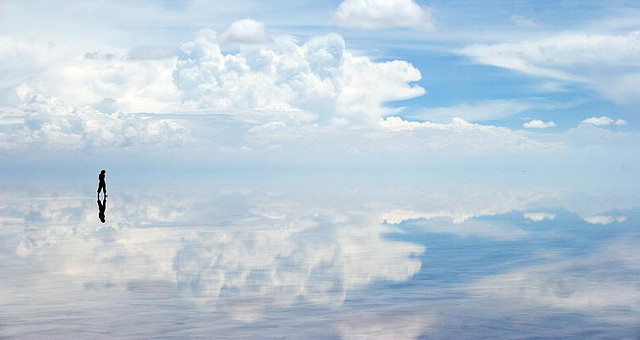
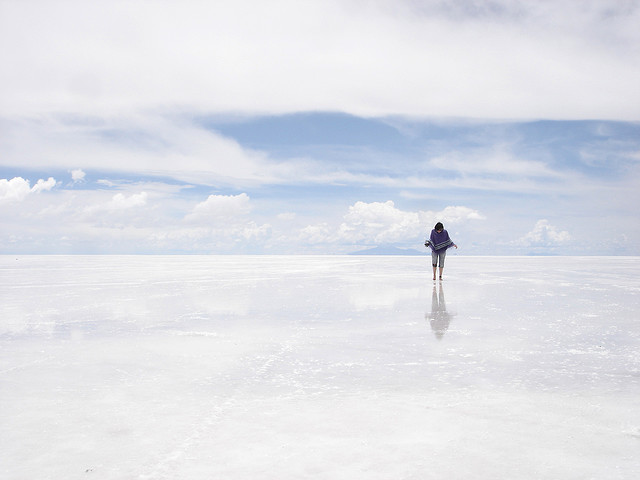
The flats are all that remain of an ancient prehistoric lake. The surrounding mountains prevent any kind of drainage, so the lake has simply evaporated away, leaving its salt behind.
11. Camel Thorn Trees, Namibia
It doesn't really matter how many times you see this image, you can never quite wrap your head around the fact that it's an unedited photograph first time around. Looking at it from a different angle helps to break the illusion a bit.

This shot was captured by photographer Frans Lanting whilst on assignment with National Geographic magazine. The effect is created by the intense early morning sunlight falling on the sand dunes that surround the Deadvlei clay flat, whilst the basin in the foreground is still in shadow.
Astonishingly, the image is unprocessed, save for a graduated filter that reduces contrast.
10. Geometric Frozen Pond, Switzerland
Looks like someone forgot to turn their graphics settings up to high.
Whilst it's not quite certain why the water froze to look like the batmobile, some of the theories posited include extremely slow freeze time, causing the ice crystals to grow to an enormous size and the presence of some kind of mineral in the water creating the shapes.

Either that of it's a screenshot from an early Tomb Raider.
9. Red Beach, Panjin, China
You'd be forgiven for mistaking these wetlands for an alien world, but they're actually in China.
The ruby tint of the landscape is caused by a type of grass called Suaeda salsa. It is one of the few species of grass that can thrive in highly alkaline soil and deepens to a blood red hue as it matures.
Incidentally, although this is an entirely earthly phenomenon, those folks over at NASA think that there could be planets out there with this kind of bright red scenery. The exoplanet Kepler-186f orbits a star that gives of very red light, and scientists think that the plants would evolve a deep red hue to match.
8. Mount Grinnell, Montana, USA
Believe it or not, this peak in the Glacier National Park, Montana is actually a dull sort of grey.
This image was captured by photographer Harry Lichtman as the rising sun seemed to set it ablaze.
It turns out that the Glacier National Park is actually some kind of magical fairytale land, as the lakes are also filled with these brightly coloured rocks that are definitely-maybe giant jellybeans.

7. Zhangye Danxia Geopark, China
Speaking of magical rainbow lands of wonder, get a load of these kaleidoscope mountains in China.
The streaks of colour are formed by layers and layers of sedimentary rock being laid down over millions of years, back when dinosaurs were a thing, and then pushed up by the same tectonic activity that gave us the Himalayas.
The best time to capture the vibrant colours is right after rainfall, when the brightest hues can be seen.
6. Dark Hedges, Northern Ireland
No, this is no Middle Earth, but it is the Earth's next best thing - Northern Ireland.
This beautiful row of trees was planted by the Stuart family way back in the 1700s, making this scene older than the United States of America.
Unsurprisingly, this particular stretch of road has been featured in the HBO blood 'n' boobs fest, Game of Thrones, doubling as the King's Road in season two.
5. Lake Hillier, Australia
You know that manky medicine your mum used to give you when you had an upset stomach? This is where they get it from. Probably.
The pink colour is caused by a microorganism Dunaliella salina. This little bug reacts with the salt in the lake and causes it to produce a red dye.
The colour is permanent and will stay Barbie pink even if you take it away in a container. Amazingly, the water is apparently perfectly safe to swim in.
4. Rainbow Eucalyptus, Indonesia
Created on the same day as butterflies, rainbows and gay pride, the eucalyptus deglupta, or rainbow tree, is the only eucalyptus that is native to the northern hemisphere.
The effect is created when patches of bark shed at different times. The freshly shed patches are bright green and eventually mature through blue, purple, orange, maroon and eventually brown. Like a black eye, but prettier.
Weirdly, this tree is commonly cultivated in plantations for the purpose of making white paper.
3. Pillars Of Light, Wyoming
These light pillars are an effect created by the reflection of light through tiny ice crystals in the air.
A least that's the line they feed you, because this is obviously the Dust from Phillip Pullman's His Dark Materials.
This can occur with any kind of light and, incredibly, it has even been known to project the street map of a town onto the sky. You know, like magic does.

2. Cave Of Crystals, Naica, Mexico
Okay, either this picture shows a cave of giant crystals in Mexico, or it depicts a troupe of teeny tiny explorers, making their way through a piece of magnified house dust.
The caves contain some of the largest crystals on the planet, some of which are nearly 40 feet in length, weighing 55 tons.
Temperatures can reach a sweltering 58°C with 100% humidity. This means that the surrounding air is actually warmer then the membranes of your lungs so, as you breathe in, moisture condenses against them and begins to fill them. A potential killer.
1. Avenue Of The Baobabs, Madagascar
Despite looking like they've been lifted straight out of a children's book, these Baobabs are very much alive and well in Madagascar.
Some of these gargantuan trees are up to 800 years old. There was a time when these trees stood in a thick forest on the island, but population and agriculture led to the majority of them being cleared.
Incredibly, the trees are not protected and these last living monuments are under threat from deforestation by, presumably, soulless maniacs.
Want to write for What Culture Science? Click here to find out how you could get paid to write about what you love.
Love all things science? Like us on Facebook or follow us on Twitter for your next fix.