8 Quirks You Might Have That Are Actually Super Rare
Are you actually part fish?
Humans are a weird bunch.
Granted, all humans are around 99.9% genetically identical. Most of us have a few limbs, a face and plenty of shared behaviours and customs, but in that little 0.1% there are plenty of little quirks, oddities and differences too, some of which are super rare.
You might have lived your whole life with a weird feature or ability that you thought everyone had. Some of these are as mundane as being left handed - something only 10% of the population share - but plenty of rare quirks are much weirder and more wonderful than that.
Some are evolutionary throwbacks, some are peculiarities of our big, complex brains and some are just straight up superpowers.
If you have any of these, you could genuinely be one in a million (although you knew that already, right?). Most or just cool party tricks to mildly entertain your friends, but there are some that could indicate something interesting, or even worrying, about your genetic makeup.
One harmless mutation, for example, offers us a glimpse into your evolutionary past, but something as innocent as tickling, could well land you in a psychiatrist's office.
So, are you actually a secret mutant?
8. Super Recognisers
Never forget a face?
If you're constantly recognising minor characters in films and picking out strangers in crowds, you might be a Super Recogniser.
Around 1-2% of people are thought to have the power to retain faces to an almost spooky degree. The phenomenon was known as far back as Roman times, and even modern police forces are beginning to recognise the skills that these people have to offer. The Metropolitan Police reportedly used the super recognisers to trawl CCTV footage of rioters in order to make arrests.
Most people can recall around 20% of the faces they see, but those with this particular superpower could manage as much as 80%. The ability seems to be unique to human faces, as those tested in studies didn't perform nearly as well as remembering flowers.
This is an ongoing area of research, and you can contribute by taking a super recogniser test yourself, here.
7. Palmaris Longus
This one is not so much some you have as something you don't.
The palmaris longus is a vestigial tendon in the forearm. Its purpose varies in the animal kingdom, some use it to draw back their claws, others, such as orangutans, use it when swinging through trees. In humans, it does precisely nothing. This makes it a popular candidate in reconstructive surgery, as it can be removed with no ill-effects.
The palmaris longus in humans is variable, and the most common variation is that it's missing entirely. Around 14% of people won't have one.
You can check yours by touching your fingers and thumb together and flexing your wrist. If you don't have one, the good news is that you might be some kind of higher-evolved being. The bad news is that doctors won't be able to use it to put you back together, should you ever suffer a horrible accident.
6. Ear Wiggling
Can you wiggle your ears? Chances are that you started doing it the moment you read the heading.
If so, then you're in the minority, as it is estimated that only around 10-20% of people can move their ears on demand.
Ear wiggling is a vestigial trait, left over from when our evolutionary ancestors were able to swivel their ears to pinpoint sounds - much like modern dogs and cats do. It's controlled by the auriculares muscles, but it's not entirely clear why some people can do it and some people can't (to be fair, ear wiggling is not high up many researchers' lists of priorities).
Some think that it's genetically inherited, others think that it can be learnt, some think that we're all born with the ability, but some just lose it as they grow up. One study even suggests that, whether or not you're a wiggler, the muscles will try their very best to move your ears in response to sound, even if only by a millimetre or so.
5. Vestigial Gills
Don't freak out, but you might have gills.
Fossil records show that the human ear developed from the same structures that give fish gills. For most people, the only evidence of this are the tiny bones that reside inside you lug holes, but some of us could carry even further clues to our fishy heritage.
During early development, both human and fish embryos have a structure known as pharyngeal arches. In fish, these turn into gills, but in humans they develop into ears. Sometimes, however, things don't quite knit together the way they should, and you can be left with a preauricular sinus - or a little dimple in front of your ear.
If you have one of these, you're one of the 1-10% of people who does. It also appears more commonly in those of Asian or african descent.
Congratulations, these are your gills.*
*Disclaimer: please do not attempt to breathe water through your preauricular sinus
4. ASMR
Weird question: have you ever been watching somebody do something very carefully and experienced pleasurable "brain tingles"?
ASMR, or autonomous sensory meridian response, is a sensory phenomenon. It has seen a surge in popularity of late, with thousands of "trigger" videos posted to youtube and reddit designed to set you off. Enthusiasts can spend hours surfing through the weird, whispery videos in search of the perfect trigger.
Eye examinations, aura cleansing, haircuts, even just crinkly wrappers - in a certain group of people, these set off a series of intense, pleasurable tingling sensations which are described as originating in the brain.
Due to its relatively recent surge in fame, there has only been one published scientific study on the phenomenon to date. There are many theories as to what is behind the sensation, some believe that it has something to do with grooming behaviours in mammals. Interestingly, the study revealed that there might be a link between ASMR and synesthesia, which make sense if you think about it.
Mention this to a room full of people and some will know exactly what you're talking about, even if they don't know the name, the rest will think you're a straight up weirdo.
3. Synaesthesia
Quick, what colour is Thursday?
If you just made this face then never mind, but if you were able to answer without even thinking about it, you might be a synaesthete.

Estimates for how many people experience synaesthesia vary wildly , from 1 in 200 to 1 in 2000. This is probably due to the fact that it's difficult to pin down.
Synaesthesia is basically a mix-up of the senses. Most commonly, people will experience things like words, numbers, days of the week and even musical notes as having different colours or shapes. Other variations might mix up sound and taste, smell and touch or any other sensory combinations.
True synaesthetes will actually experience the two sensations at once. For example, when reading the letter 'A', they will literally see the colour red. In empirical tests, some synesthetes have been able to do things like immediately locate the 2s in this group of 5s due to their different colour.
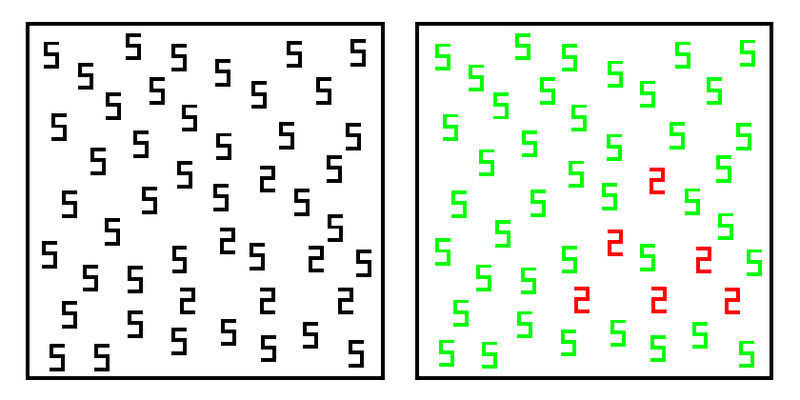
A related form of the condition (some call it Ideasthesia), the stimulus will bring about a perception-like experience. This means that, while you might not be able to locate all the 2s, you will experience a mixture of sensations vividly in your mind's eye (or nose or ear or whatever), much to the bafflement of your non-synesthetic friends.
It's red, incidentally. Thursday is red.
2. Supertasters
"Picky eater" is such a judgemental term, would you not prefer something like "SUPERTASTER" instead?
Much cooler.
A supertaster is someone who, oddly enough, tastes things with much more intensity than others. Women are more likely to be supertasters, as are those from Asia, South America and Africa and it is estimated that around 25% of people fall into this category.
Although it's not totally clear what causes it, scientists reckon its related to the presence of the TAS2R38 gene and an increased number of tastebuds.
Supertasters tend to steer clear of foods like kale, coffee, grapefruit juice, liquorice and anything with a strong, often bitter, flavour. Supertasters might drink less alcohol, due to its often bitter taste (good thing), but might also eat fewer vegetables (bad thing).
To be clear, supertasting might cause picky eating, but not all picky eater are supertasters. That's a whole different kettle of fish. Which they probably wouldn't eat.
1. Tickling Yourself
It's one of those bizarre facts of life that it's impossible to tickle yourself.
Whether you shrivel up the moment someone touches your neck, or remain stoic in the face of a tickler's advances, the major factor that makes tickling so ticklish is the element of surprise. The brain is programmed to rank the movements of others as more important that your own, and people attempting to tickle themselves in brain scanners (because science leads us to weird things like that), show virtually no associated brain activity.
Apart from one group of people.
Unfortunately, if you've been reading this thinking, "but I can definitely tickle myself", you might want to get yourself analysed, as scientists think that it could be an indicator of schizophrenia.
Something to do with the schizophrenic brain makes the person less able to differentiate between external and self-produced movements, making it possible for them to tickle themselves.
Incidentally, if you hate being tickled, you can use neuroscience to your advantage. As they begin to tickle you, place your hands over those of your adversary, it tricks your brain into think you're doing it, and the sensation stops.
Does science make you tingle in your special place? Like us on Facebook or follow us on Twitter for plenty more.