10 Inside Jokes You Missed In Superhero Comics
Inside jokes in superhero comics that probably flew straight over your head, faster than a speeding bullet.
 DC ComicsWe wanna say the comic book industry is home to the some of the most inside baseball finagling this side of the MLB, but the term "inside baseball" might be a little too inside baseball. The phrase refers specifically to a detail-oriented approach to the minutiae of a subject, which in turn requires such a specific knowledge about what is being discussed that the nuances are not understood or appreciated by outsiders (thanks Wikipedia), which is pretty much how all superhero comics operate. You need to have an extensive knowledge of their history to get the most out of them or, in some cases, to even follow what's going on. To read a modern superhero comic is to be a curator of seventy years of a funnybook museum whose smallest, seemingly insignificant item you could be called upon to recall at any given moment. Who's that obscure supervillain? What thirty-year-old storyline are they talking about here? What's a Life Model Decoy? These are all questions to which true fanboy know the answer without even thinking. With such long, convoluted continuities to draw upon, the superhero comics of the Big Two - DC and Marvel, that is - are densely packed with references, in-jokes and nods to past stories. The majority of us have been trained, from years of reading these things, to not only spot these fleeting references, but also to understand them. And we do a good job, for the most part. Still, there are some inside jokes that will pass under our collective radars. These are put there by writers, artists, and even editors as little asides to amuse themselves, or even to make a point; not detail-oriented minutiae on the subject of superheroes, but references to the behind-the-scenes goings on in the comic industry. Creative teams have sneaked in parodies of their peers' work, protests at editorial decisions and even secret messages for other comics professionals. These are the most inside of inside baseball, the inside jokes in superhero comics that probably flew straight over your head, faster than a speeding bullet.
10. The Question Is Not A Watchmen Fan
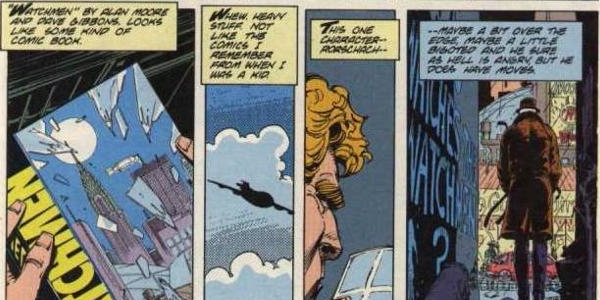 DC ComicsTo give an example that's not exactly subtle, but has some layers to it the more you know about the inner workings of mainstream comics: The Question thinks Rorschach sucks. On a surface level, the events of The Question #17 are a fun ribbing of Alan Moore and Dave Gibbons' classic graphic novel Watchmen, which the fictional anti-hero reads on a plane ride. Inspired by the hyper-violent vigilante's methods, The Question decides to adopt some of them to his own crime-fighting activities - with mixed results. He starts talking to himself, and people begin to think he's crazy. He drinks heavily, and then spends the night curled up on the bathroom floor with his head in the toilet. There's even a non-too-subtle sequences where he leaps through the window of a bad guy's hide out, referencing...well, multiple occasions when Rorschach does the same in the pages of Watchmen. That goes about as well as you'd expect jumping unarmed into a lion's den would, as the villains chase him through the snow and corner him. When asked if he has any last words, The Question replies: "Yeah. Rorschach sucks." So we guess writer Dennis O'Neill just wasn't as taken with the groundbreaking miniseries and its breakout character as most comic fans of the time were? Well, maybe, but actually the whole thing is infinitely more self-referential than that. Y'see, Watchmen started life as a pitch Alan Moore made where he wanted to take the superhero characters DC had recently acquired from Charlton Comics. The company decided they had plans for them, so Moore simply decided to make all the characters in Watchmen analogues of the Charlton heroes: The Comedian stood in for The Peacemaker, Dr Manhattan on Captain Atom, Silk Spectre on Nightshade and Rorschach on...The Question. Except, being Alan Moore, he was going to push each character to their logical conclusion, meaning The Question's amoral anti-hero status became Rorschach's borderline psychopathy. So in The Question #17, the character is literally rejecting this interpretation of himself. So meta, much commentary, wow.
9. Young Justice's Worst Nightmare Is Being Other DC Characters
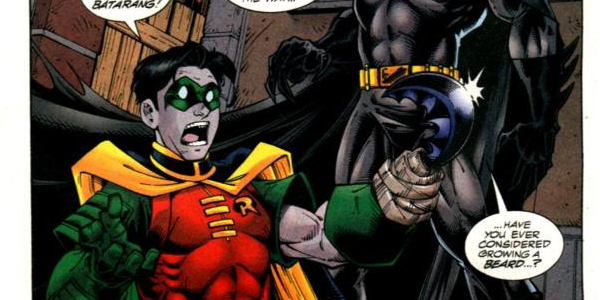 DC ComicsSadly long out of print, Peter David and Todd Nauck's Young Justice series was a dazzling antidote to the grim and gritty house style that most other DC Comics had adopted in the nineties. Inspired by comics like Watchmen, as a matter of fact. Spinning out of the Justice League miniseries World Without Grown-Ups - which does what it says on the tin - it was like a pared down, comical spin on the Teen Titans as Robin, Superboy and Impulse (basically Kid Flash) teamed up to...well, mainly have sleepovers and talk about girls, until Red Tornado started sending them on superhero missions and introduced Wonder Girl, Secret and Arrowette into the fold. Young Justice's main draw was how different it was to the majority of the big DC titles of the time. This was the era of The Death of Superman, of Gotham City being decimated by earthquakes in No Man's Land, and writers trying to introduce "mature" elements in a ham-fisted fashion that spoilt the big, colourful, escapist fun of cape comics. In that landscape, Young Justice was loudly and defiantly anti-darkness, instead embracing teen culture - with plenty of pop culture references that are probably way past their sell by date now, if they weren't then - and telling stories that were as big, bright and enjoyable as life tends to be when you're powered mainly by hormones and zit cream. David and Nauck made their intentions with the series clear in the first issue of the Young Justice ongoing, in a series of full-page splashes illustrating the worst nightmares of Robin, Superboy and Impulse. First Batman's sidekick has the scenario above where his left hand is eaten by cockroaches and it's replaced with a Batarang, then Superboy grows fiery angel wings, whilst Impulse finds himself shedding personalities and costumes as fast as he can run (ie very fast). Then they all wake up, sat in a circle in their sleeping bags in the Bat Cave. Typical anxieties you'd expect from teen superheroes, right? Except all those are commentaries on things happening in comics at that very moment: Aquaman had just been rebooted as a dark, conflicted character who lost his hand and replaced it with a hook, Supergirl became an angsty "Earth-Bound Angel" with fiery wings, and Marvel even got a look in as Impulse spoofed the publisher's inability to come up with a consistent characterisation for the Hulk (made explicit by one of Impulse's imagined other selves: big, burly, and threatening to...well, Flash, rather than smash). The characters quickly dismiss these worries and carry on having a whimsical, comic book-y time.
8. A Fond Farewell To Bob Harras In Universe X Spidey
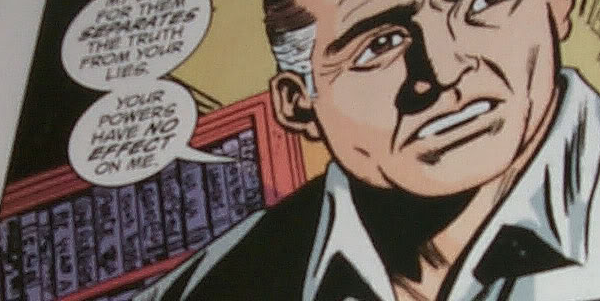 Marvel ComicsWe've covered this one before in our list of the most controversial banned comic books, but it's just too delicious not to include. There were mixed feelings when Bob Harras left his position as Marvel's editor-in-chief. Harras's tenure at the top of the publisher's editorial food chain was...controversial, to say the least. He oversaw storylines like the Clone Saga, which very nearly destroyed the Spider-Man character, and when he wasn't exerting his will to make sure terrible comic books got produced he was being a total a-hole to everyone he came into contact with, from freelancers to stockholders. One particularly aggrieved employee was Al Milgrom. Milgrom had done basically every job in his time at Marvel; since he got his start in the early seventies he had been a writer, penciller, inker, and even an editor himself. During Harras's time as EIC Milgrom was working mainly as a freelance inker for the company, and it was in that capacity that he snuck a little dig at his old boss into an issue of Universe X: Spidey, a spin-off of the company's long-running alternate reality line Earth X. It's not clear what Harras had done to so infuriate Milgrom - in fact it wasn't even clear why Harras had left Marvel in the first place - but the veteran Marvel employee nevertheless stuck it to him with great zeal, hiding in plain sight the message "HARRAS HA HA, HES GONE, GOOD RIDDANCE TO BAD RUBBISH HE WAS A NASTY S.O.B." This one may have been missed by most readers, but Marvel editorial were certainly aware of it. In fact they planned to remove the message before it even went to press, yet somehow forgot about it and so they had to recall and pulp thousands of copies of the comic that contained the message still. Milgrom, meanwhile, was let go by the company for his little act of rebellion, meaning he lost all of the benefits and pay increases he'd earned after working on contract for years. We guess Marvel then realised Harras actually was a nasty SOB, and hired the inker back.
7. Green Lantern Burns Jim Shooter (Literally)
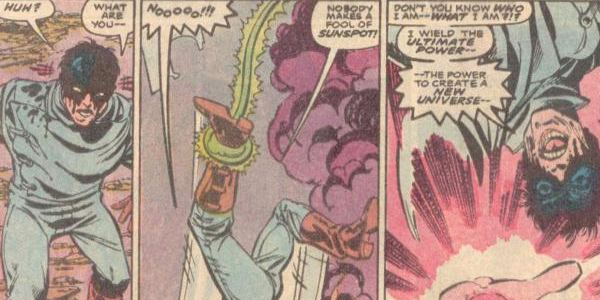 DC ComicsSpeaking of controversial editors, Marvel seemingly had a gift for picking them. Long before Bob Harras arrived on the scene, the bullpen was lorded over by one Jim Shooter, widely regarded as a totally narcissistic jerk-wad with his head shoved where the sun don't shine. And we don't mean an alternate Earth that doesn't have a sun. One former Marvel employee who shared this opinion of the company's editorial overlord was artist John Byrne, who had jumped ship after years working on the X-Men title, drawing classic stories like The Dark Phoenix Saga. In 1987's Legends #5 the best Green Lantern, Guy Gardner, tussles with new villain Sunspot in a story by Len Wein, John Ostrander and Byrne. Sunspot is a tall, rake-thin guy with dark hair whose powers are ill-defined but his intentions to remake the universe in his own image are very clear, since he walks around yelling them whilst talking about how great and all-powerful he is. Seems like kind of a narcissistic jerkwad, if you ask us. Thankfully Guy takes care of him in no time, using his power ring to first explode him with a petrol tanker and, when that doesn't do the job, to start disintegrating his limbs. Pretty hardcore, and it only stops because he gets called up to go help Doctor Fate. So where's the inside joke there? We didn't say it before, but besides having the narcissistic jerk-wad thing in common, Jim Shooter was also a tall, rake-thing guy with dark hair whose intentions to remake the universe in his own image were at the time very clear, since he walks around yelling them whilst talking about how great and all-powerful he is. This multi-page sequence in Legends #5 is John Byrne and friends literally burning Jim Shooter at length for being an awful person. Note that if all that was perhaps a little too subtle for the average comics reader who probably didn't even know who Jim Shooter was, let alone what he looks like, the script makes it all the more obvious: at the time the editor was overseeing his pet project, the New Universe, a separate line to the regular Marvel continuity set in a more "realistic" world. Shooter wrote the flagship character, Star Band, who coincidentally lived in his own home town of Pittsburgh and had similar ill-defined powers to Sunspot. The "ultimate power to create a new universe", no less.
6. Excalibur Makes Fun Of Crossover Events
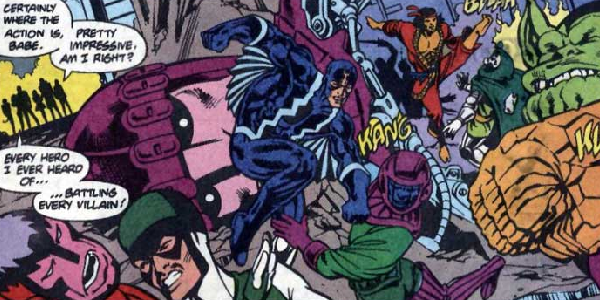 Marvel ComicsFor something that was a little more obvious but a little less openly hateful, you need only look to Chris Claremont and Alan David's Excalibur #14 from 1989. Excalibur were (are?) the British equivalent of the X-Men, a mash-up of characters like, er, Captain Britain and X-deserters like Kitty Pryde and Nightcrawler that sorta works. Their adventures were rather charming in their own way, and became further separated from the concerns of the major X-books by going on a multidimensional adventures in the Cross-Time Caper storyline. In this particular story the team found themselves on yet another alternate Earth, this time one where the reality's supervillains had teamed up to send a calculated assault upon the world's superheroes, which saw many of the bad guys slugging it out with goodies they wouldn't usually cross paths with. In fact, when the team come across this world's Captain America, he tells them not to "restrict yourselves to your usual, traditional foes. Idea here's to mix-and-match, take on people you wouldn't ordinarily fight", if it wasn't already clear enough. The heroes and villains are caught in an never-ending, no-holds-barred battle, which means that there's a huge complex housing changing rooms and spare costumes, multiple people "playing" the part of Wolverine, and the whole things is presided over by a couple of shadowy figures who live in a building that looks suspiciously like Marvel's New York offices. Anyway, before Excalibur can figure out what's going on they have to escape the reality before Galactus destroys it for being too silly. So what's going on in this? Well, it's an obvious jab at the ridiculousness of company-wide crossover events, something which we're all sadly used to now but was a burgeoning trend back in the late eighties. DC had had their Crisis on Infinite Earths and Marvel their Secret Wars a few years before that, but this was the time when things kicked into high gear, with stories like Atlantis Attacks, Inferno and Acts of Vengeance, all of which get name checked here. A little good-natured ribbing from Claremont and Davis, one that's more obvious now crossovers rule everything around us.
5. The 52 Writers Are DC Villains
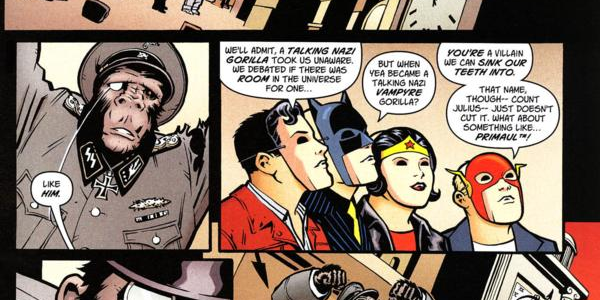
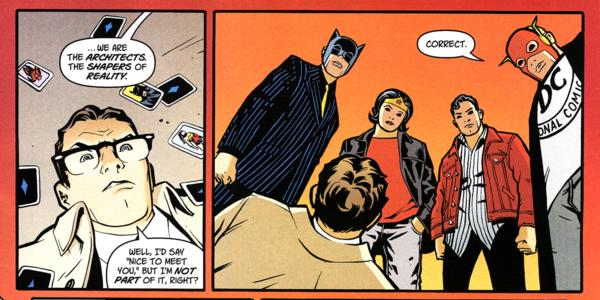 DC ComicsThe inside jokes on our list so far have varied in their levels of subtlety. Brian Azzarello and Cliff Chiang bring us lower than ever before with their back-up stories in Tales of the Unexpected #1-8, which sees Doctor Thirteen in conflict with the Architects of the DC Universe. Both figuratively and literally. Architecture and Morality is an in-universe equivalent of a DC editorial meeting, as an ancient force called the Architects determine which fictional characters should remain a part of the universe and which simply don't belong. We follow the story of forgotten DC characters like caveman Anthro, Golden Age throwback Genius Jones and the swashbuckling Captain Fear, who sail a ghost ship across the high seas away from a huge four-headed monster who tries to crush their boat between its gigantic hands, bellowing that it was "nothing personal" but they "never loved" the characters. If that wasn't obvious enough then in the next story they reappear, this time as four separate beings who look like regular guys wearing masks of DC heroes and evangelise about the need to reinvent the universe constantly so it can remain current and survive. So clearly this is all referring in a very self-conscious way to the people who work behind the scenes at the publishers, but who exactly? And why? Well, this was around the time of Infinite Crisis and 52, two huge continuity-fixing crossover events that slimmed down the history and characters of the bloated DC Universe and aimed to make it all a lot easier to deal with. At the expense of characters who were all but erased from existence, principally caused by those books' writers. Those writers? Grant Morrison, Mark Waid, Geoff Johns and Greg Rucka. The foursome whose heads appeared on the hydra-like Architect we first see, and then are drawn as they actually look in real life, albeit with their faces concealed behind some of the company's flagship characters, and ones they all worked on: Batman, Superman, Wonder Woman and The Flash. So this is a story all about how the DC Universe has been rewritten, starring the people who actually rewrote it in real life. Our brains hurt. What level of Inception is this?
4. Jim Starlin Protests Marvel Editors In Warlock
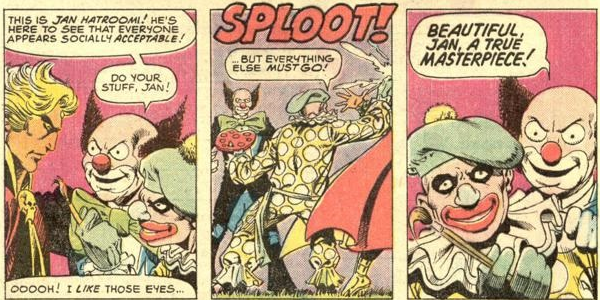 Marvel ComicsThe Architects were another bit of light hearted, self-referential fun between friends. That is very much not the case in Jim Starlin's Strange Tales #181, where the long-suffering writer/artist protested the very editors he was feeling pressured by within the comic he wanted him to change. Starlin's Adam Warlock was the epitome of seventies comics, taken far and away from Stan Lee and Jack Kirby's original creation into being an experimental space opera with a cyclical timeline inspired by psychedelic sci-fi writers like Michael Moorcock. With flares. Starlin's work was about as far from the character's origins and Marvel's house style as it was possible to get. Where now the House of Ideas publishes comics drawn in a wide range of styles, in the seventies they tried to keep a consistent look across all of their books, which is why pretty much all Silver Age stories look the same. This became even more of a hardline rule amongst some editorial shuffling that saw Stan "The Man" Lee take the overruling publishers position, leaving John Romita Sr in the vacated seat of Art Director. Whilst all this was going on there was some a flurry of assignments and resignations, with Roy Thomas, Len Wein and Marv Wolfman all occupying various editorial positions briefly before leaving, purportedly under duress. At least that's how Jim Starlin saw it, watching his friends depart the publisher and furious because he assumed it was down to the same editorial pressure he felt he was under whilst working on Warlock. That's why Strange Tales #181 sees the cosmic hero put in a virtual reality where the villainous Lens Tean and Jan Hatroom try to give him a radical redesign so he fits in better. Lens Tean and Jan Hatroom being imperfect anagrams of Stan Lee and John Romita, obviously. Because he hadn't quite made his point, Starlin also through in stand-ins for Wolfman and Wein being forced to throw pies at a Thomas analogue, who dared stand up for creator rights, and ends the story with aggrieved workers for Tean dumping huge piles of rubbish on top of each other, occasionally reaping diamonds amongst the garbage. And you thought Aesop's Fables were head-slappingly obvious in their messages.
3. Wolverine And Punisher Parodied In Doom Patrol
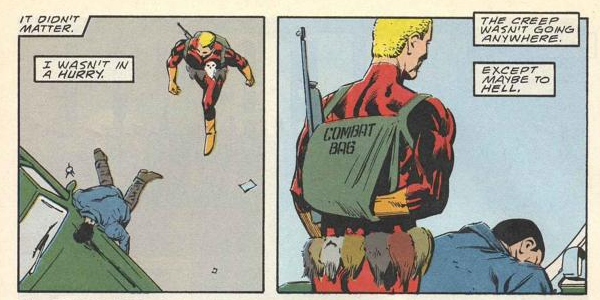 DC ComicsHis appearance as one of The Architects wasn't the first time Grant Morrison appeared in a comic, as he wrote himself into his stories for Animal Man, The Invisibles and Seven Soldiers. Which isn't so much an in-joke as some of the off beat, hippy, pretentious stuff that Morrison is known for, and will continue to do so long as he writes a big DC event every once in a while. Sometimes he gets bored of putting his baldy head onto the page, though, instead turning his sights on other comic characters and parodying them within the comics he pens. Which is what happened with his dadaist take on the Doom Patrol, the team of weird superheroes that inspired the X-Men. Specifically, Doom Patrol #45, which introduces a brand new character: the Beard Hunter! His MO may be unique, but a lot of other things about this guy seemed familiar. His narration took the form of a "War Journal" wherein he referred to each of his targets as punks - repeatedly, in fact - and hunts them down brutally for their perceived crimes. When we first see him he's on a rooftop, a histrionic series of thoughts going through his head, clad in a two-colour skin-tight outfit and staring at his enemy down the barrel of a gun. It's an obvious parody of Frank Castle - The Punisher of Marvel Comics - and it is hilariously spot on, from his righteous fury (which is rendered even more ridiculous when the people he's after are beard owners rather than violent criminals) to his speech patterns. That's a neat little joke, glided further by the Beard Hunter's use of the phrase "I'm the best there is at what I do", mocking the tough guy personality of Wolverine along with the Punisher's. On top of it all, Morrison gives Alan Moore a shout out in the form of a portrait hanging in the Bearded Gentleman's Club of Metropolis the grizzled anti-hero is drawn to.
2. Jack Kirby Makes Stan Lee A New Gods Villain
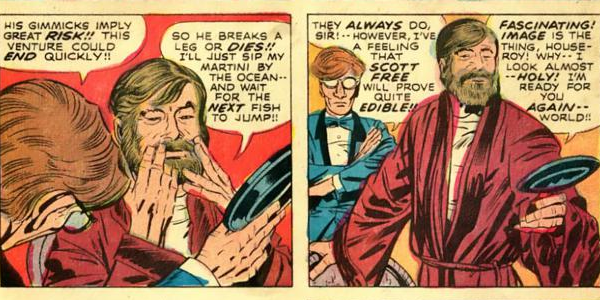 DC ComicsJim Starlin isn't the only high-profile creator that Stan Lee's gotten on the wrong side of over the years (sorry, but The Man does seem like kind of a bad person). What might be shocking is just who he managed to inspire the ire of in this case, as Jack Kirby is Lee's number one partner in crime. With Lee writing and Kirby's dynamic pencilling, the pair created every major character within the Marvel Universe, including the Hulk, the Fantastic Four and the X-Men. Kirby's impact on Marvel Comics, and his role in their great success and market dominance, can't be ignored. Well you'd think not anyway, but Marvel certainly tried their best, denying the artist any royalties from the characters he helped invent and blocking him from having any creative control over his work. Frustrated, he finally departed the House of Ideas in the seventies to sign an exclusive contract with their Distinguished Competition. A major coup for DC, the company agreed to giving Kirby everything that Marvel denied him: he was given free reign to create a whole new part of the publisher's shared universe, and was assured that the rights to the characters would remain with him for time immemorial. With this new-found freedom Kirby's first move was to take out his still seething anger at the way his former employers had treated him. Well, his first move was to construct the insanely over-the-top Fourth World, a space bound part of the DC Universe populated by colourful space gods, including cosmic escape artist hero Mister Miracle. It was in the sixth issue of this character's title that he launched a full-blown offensive at Marvel and, specifically, his former creative partner and friend Stan Lee. Mister Miracle #6 introduced new villain Funky Flashman, a greedy former slave owner who hopes to bring his dilapidated plantation back to life by putting on a disguise and strong-arming Mister Miracle into letting him be his agent, taking all of the money he makes for his escape artist performances. That disguise, of long hair and a beard, is identical to Stan Lee's seventies look, and if you still can't get it from that when Flashman's house comes burning down he can't help but admire the "MARVEL of contrast" between the black smoke and the red fire. The MARVEL of contrast. MARVEL. IS BURNING DOWN. BECAUSE OF STAN LEE'S GREED.

1. Chris Claremont Tears Apart The Avengers Writers
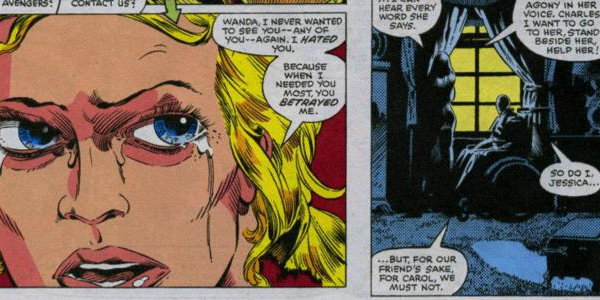 Marvel ComicsRather improbably, Carol Danvers has become one of the most popular characters in modern Marvel comic books. Formerly a second stringer best known for not sticking with a code name and giving X-Man Rogue her powers, she has since taken up the Captain Marvel mantle and inspired a whole new generation of fans (nicknamed the Carol Corps) in a brilliant series written by the immensely talented Kelly Sue Deconnick. Which is a rather happy ending for a character whose publication history is less than rosy. Prior to the Kelly Sue refit, Carol Danvers' most well-known story was also one of the worst, most offensive pieces of garbage that Marvel ever saw fit to publish. In an eighties Avengers story that, really, it's unbelievable anybody signed off on - let alone multiple people - and was instantly controversial. Carol becomes mysteriously pregnant, with no memory of who knocked her up. Quite unexpectedly she gives birth the very next issue, only to find her baby has just as quickly grown to adulthood. Turns out that this kid, Marcus, is also his own father; he had brainwashed Carol into loving him, impregnated her, then wiped her mind. Basically her super-roofied her. Horrific, right? That's exactly what our reaction would be. But we're not the Avengers, who greeted the news that Carol was pregnant with glee (despite her confusion as to the identity of the father), and are just as happy to see her brainwashed again and off to live in space with her son/boyfriend. Aw, it's nice that she's found someone, isn't it? They know the whole story, by the way, and still let their team mate and friend go off with a guy who has used evil technology to force her to love him. Carol A. Strickland wrote an article in fanzine LOC later that year expressing her dismay about the article, and it's breezy treatment of serious issues like consent, which is still worth reading. One person who definitely was reading, and was similarly incensed by the rape of Ms Marvel, was writer Chris Claremont. In a follow up story the next year, he used Carol's return from Marcus' clutches as an opportunity to yell at the idiots who let it happen in the first place. In the pages of Avengers Annual #10, she's having at it with her team mates, blaming them for everything that happened and asking why they hadn't helped her? Really, though, the words were Claremont's, aimed at the editors and creative teams who presided over the original story. Why did they think this was a good idea? What were they thinking? It's a bravura piece of writing, and even more so when you know it's not just Carol Danvers that's speaking her mind, but Chris Claremont too.