10 Most Tragic Deaths In The History Of Marvel Comics
Curse you, Brian K Vaughan.
For costumed heroes, death is waiting around every corner. And sometimes Death, the Marvel Universe's own physical manifestation of the Grim Reaper, is literally waiting around the corner from you, with her on-again, off-again boyfriend Thanos. Still, the good thing about dying in a comic book is that it's rarely - if ever - permanent. In his essay "Dead And Recovering Nicely..." veteran superhero scribe Peter David bemoaned the fact that writers had shot themselves in the foot by bringing back fan-favourite characters too often, to the point that they've robbed themselves of the ability to tell meaningful stories about death - since there's always the unspoken postscript that whoever just carked it will be pushing up daisies for a month, three months tops.
"So-and-So is dead?" David writes. "No! Shock follows shock, as So-and-So returns (usually accompanied by a cover illo of the hero saying, 'It can't be! Youre dead!', thereby proving that super-heroes never read comic books or they wouldn't be surprised by this sort of thing)." We mean, he does have a point. Comic Book Death has become such a cliche at this point that that's actually the name of a genre trope. With all due respect to Mr David, however, we disagree with him on some points. In fact whilst it's often the fanboys' fervent connections to characters that will see them rise from their graves sooner or later, that same personal entwinement with an offed superperson can also make their demise incredibly poignant, dramatic, or upsetting, even if you know deep down it's not going to last.
Marvel Comics have got a fair old amount of deaths to choose from, and all. Whatever title you read - whether you voraciously consume everything the company publishes or have been a stickler for Spidey and Spidey alone for decades - death will have come to your little town at some point. Yet another thing that comic books have in common with soap operas (which David picks up on too) is the ingenious cruelty of killing off a beloved character. Even the most hardened, cynical of readers can't help but shed a tear when the Reaper comes for their favourite heroes, and they've had to endure a good fifty years of these so far!
Since we're masochists, we went into those archives to pick out the ten most tragic deaths in the history of Marvel comics.
10. Victoria Hand
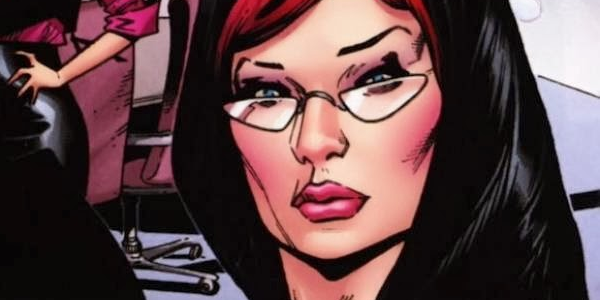
Former head of SHIELD Victoria Hand was on of the best recent creations in the Marvel Universe. You don't often get creative teams coming up with totally new characters, especially when the Marvel sandbox already includes so many toys with which to play - and besides, whenever a new character does get introduced, they're either killed off immediately in a red shirt fashion, or they're so naff that nobody bothers to use them again. Hand stood out from her ill-fated peers because she was really freaking cool, and despite only debuting in 2008, quickly became an essential part of the muky behind-the-scenes SHIELD stuff which keeps the superhero universe ticking over.
She even got adopted into the Marvel Cinematic Universe with her appearances on the Agents Of SHIELD TV show, which isn't bad for a character with a fraction of the history of Nick Fury. But then Hand appeared fully formed, an engaging character from the start, with appearances in Invincible Iron Man and New Avengers rocketing her from an accountant to the head of SHIELD (at the expense of a girlfriend, but whatevs). Okay, so it turned out that was mainly a plot by Norman Osborn to destroy the organisation from within, and her methods since then were sometimes suspect - Spider-Man notably never revealed his secret identity to her, because he didn't trust her - but dammit she got results.
Victoria Hand was a morally complex and refreshingly progressive character for Marvel, which made it all the more heartbreaking when just four years after her first appearance, she ended up six feet under. Whilst possessed by magician Daniel Drumm, Hand was forced to kill to kill Daimon Hellstrom and Jennifer Kale, before Doctor Strange could subdue her. She got sent to the astral plane, where Drumm murdered her. She got buried in the backyard of the Avengers Mansion, has a statue of her then in her memory, and we have something in both our eyes now...
9. Colossus
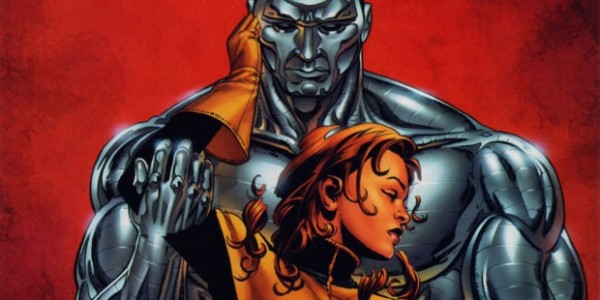
The strangest superheroes of them all are not strangers to heroic sacrifices. In Giant Size X-Men #1 they immediately lost one of their new members, Thunderbird, who died taking down a plane that was attacking the rookie team. Nearly everybody who has fronted Charles Xavier's rag-tag group of mutants has fallen at some point, eventually resurrected through psychic, cosmic or magical means. Death is at its most fluid and common in the X-Men books, but that didn't stop us from being totally grief stricken at the passing of Peter Rasputin, better known as the hulking metal-covered Colossus.
Colossus was part of the Giant Size X-Men team, too, introduced in the comics way back in 1975. From there readers had watched him grow from a simple Russian farmhand amazed both by his powers and his new American home, having crushes on Storm and writing letters to his parents back home, to a fully-fledged X-Man who had sort-of relationship with fellow teammate Kitty Pryde, welcomed his little sister Illyana (better known as Magick) to the School For Gifted Youngsters, and survived the numerous catastrophes and crossovers the teams have been put through.
All of them except the Legacy Virus. A slightly ill-thought-out metaphor for the AIDs epidemic of the eighties and nineties, the Virus was one that targeted the mutant gene specifically, and was fatal in almost all cases. It killed off a fair bunch of minor X-Men supporting characters including Illyana, and went on for years until Beast managed to synthesize a cure. Unfortunately it could could only be made airborne with the death of its first user; with his personal stake and heroic heart, Colossus injected himself with the cure, and saved thousands of lives at the cost of his own. PRETTY SAD, GUYS.
8. Karen Page

It became a running joke, especially after Frank Miller took over writing duties, that blind attorney by day, blind vigilante by night Daredevil had the absolute worst luck of anybody in the Marvel Universe. The people producing his book seemed to delight in torturing the poor old Matt Murdock, putting him through immense physical and mental violence at any given opportunity, to the point that it's been a really big deal that the current Daredevil title is surprisingly chipper and upbeat. The guy's deserved it, c'mon. Why not let him smile for the first time in his horrible existence? Thing is, we think there's somebody in the Daredevil comics who actually has it worse than the title character. Step forward, Karen Page.
Poor old Karen. First appearing in Daredevil #1 as Matt Murdock's legal secretary and possible love interest, as time went by she went from one-dimensional eye candy to something much worse. See, we're good people, and even we wish she'd stayed as a mostly-silent part of the wallpaper! Her father turns out to the supervillain Death's-Head, she breaks up with Matt after finding out he's a masked vigilante, she's been kidnapped and brainwashed by every two-bit villain going, she got addicted to heroin and start acted in porn, and then after finally cleaning herself up finds out she's HIV positive. Actual HIV, not the Legacy Virus.
Not that Karen actually dies due to AIDs-related complications, though. Oh no. Distraught, she seeks out her former lover in a church in New York where Daredevil happens to be doing battle with Bullseye, his arch enemy and murderer of his other former lover, Elektra. Deciding to go two-for-two, Bullseye kills Karen too, before she can give Matt the bad news. So that's basically a tragedy piled on top of a lifetime of over tragedies. Karen Page's tragic death sundae. Doused in tears.
7. Captain Marvel
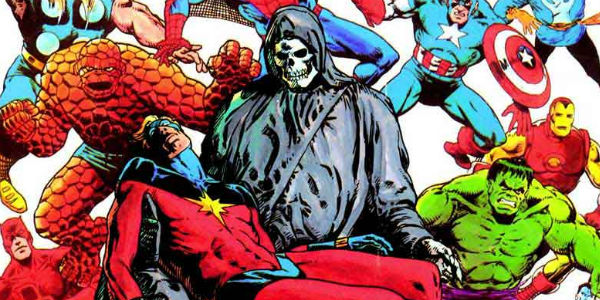
Regardless of whether you believe the urban legend that he was created mainly for copyright reasons (which is perhaps half true), the valiant Kree warrior Mar-Vell - hey, that sounds kinda like... - quickly became a vital part of the Marvel Universe, playing a key role in the Kree-Skrull War, the first big Avengers crossover event, where he became linked with Rick Jones, the sort of Forrest Gump of Marvel. Thanks to his connection with Rick Captain Marvel became a major player for a little while, headlining the cosmic band of titles that the publisher started to put out in the seventies, principally lead by Jim Starlin. It was Starlin who made Captain Marvel into the hero he became and, ultimately, the one to mete out his downfall.
Before all that, though, Mar-Vell did have some pretty neat adventures. There were plenty of times he teamed up with the Avengers, Spider-Man and other costumed so-and-sos who were mostly earthbound, but it's his time amongst the stars that still dazzle to this day. Thanks to the intergalactic menace of Thanos he was upgraded to Protector Of The Universe, and had a hand in creating half of the Guardians Of The Galaxy along with it. He sorted out basically every occasion Thanos got hold of enough power to decimate the whole of existence, including destroying the Cosmic Cube.
Despite all these fantastical adventures, it was eventually cancer that killed Captain Marvel. Cancer that came from a toxic nerve gas released after fighting a bad guy called Nitro, who looks like Magneto except with Voltorb's powers, and slowly ate away at the superhero as it does in the real world. Despite seeking out some of the more bonkers possible cures on offer as a comic book character Marvel does succumb to the disease, in a full length graphic novel called The Death Of Captain Marvel which is really bloody depressing. And very good. And tragic.
6. Bucky
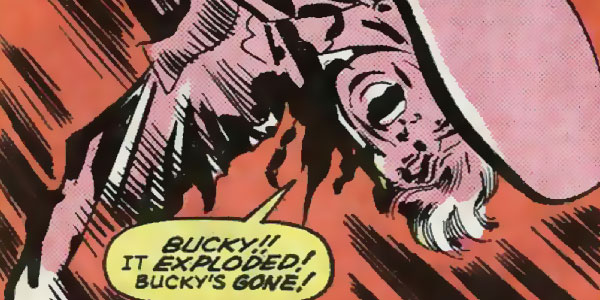
Even with the loosey goosey approach to mortality that resulted in the coinage of Comic Book Death, there have always been two characters that readers knew would never come back from the grave. One of those was Bucky, Captain America's wartime sidekick who seemingly died in their last adventure, clinging desperately onto a Nazi drone plane armed with a bomb. Bucky managed to stop the drone from reaching its destination but was killed in the explosion, whilst Cap found himself catapulted into the freezing waters of the North Atlantic, waiting to be thawed out in twenty or so years by the Avengers.
Fanboys remained certain that Bucky would never return because the guilt Steve Rogers felt over his best friend's demise was one of the most interesting and unique aspects of the character. As Captain America he was the infallible and virtuous icon of truth, justice and the American way; in his superhero guise, he carried on that tradition; in his personal life, however, Rogers was just a guy who had let down his friend when it mattered most. As time went by we were all convinced that Bucky would never come back, to the point that when all the Winter Soldier debacle went down it was a genuine surprise - at that point Private Barns had been MIA for over five decades.
This is one of those deaths that's actually become more poignant thanks to its undoing. The fate of Bucky had haunted Cap and his readers for half a century, a surprisingly mature and violent end to a partnership that began in the much more innocent and bloodless early days of comic books. Finding out that he hadn't actually died, and what had happened to him in the intervening years instead, was somehow even more tragic than if he had been lost in that drone explosion, way back in 1945.
5. Gertrude Yorkes

Hoo boy. This one's going to be difficult to write. Runaways is one of our favourite (and eternally underrated) titles here at WhatCulture's comics section - it's just there, next to the gaming section, no through that door, yeah it might have been the caretaker's closet once - and that's mostly down to the wonderful, horrible Brian K Vaughan. Now best known for his indie titles like Saga and Ex Machina, the one thing that has coloured Vaughan's writing career, besides the consistent quality, is that he is a complete monster who makes you fall in love with characters only to cruelly snatch them away. Seriously, he keeps doing it and we keep falling for it. If only his stories weren't so darn good...
That was the case with Runaways, a loose team of Californian kids who found out their parents were actually a supercriminal dynasty called The Pride, who controlled all illegal activities in LA and frequently sacrificed young girls in order to satiate the otherworldly beings that gave them their power. It was a none-too-subtle metaphor for the way teenagers tend to hate and misunderstand their parents, but it was a great one, and seeing this mismatched collection of adolescents trying to figure out both their burgeoning superpowers and their hormones was a delight.
Perhaps most delightful was Gert, the slightly geeky, slightly chubby brains of the operation who didn't have any powers to speak of. We mean, besides her psychic link to a giant velociraptor from the future. Gert, along with boyfriend Chase (whose own power was "a poor upbringing"), formed the heart of the team, after initially being pretty cynical and tough to read. Her development as a character and relationship with Chase served to make it all the more tragic when she gets murdered protecting her squeeze from a new incarnation of The Pride. Curse you, Vaughan, you've done it again.
4. Uncle Ben
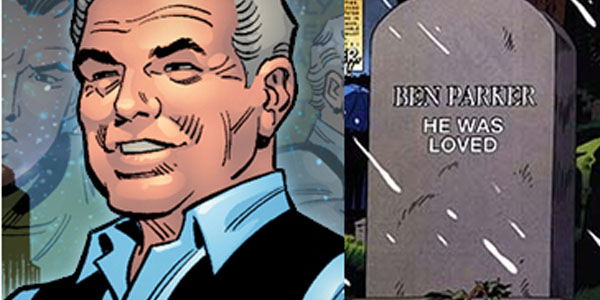
Remember back there when we said there have been two characters that Marvel fans could always bet would never be resurrected? The company may have gone back on Bucky but, thankfully, they have never undone one of the most tragic and, arguably, one of the most important deaths in their history. Were it not for the accidental murder of Peter Parker's Uncle Ben by a mugger, then his nephew might never have learned the lesson of "with great power, there must also come, great responsibility" and taken up the mantle of your friendly neighbourhood Spider-Man. Which would have spared us of ever having to watch Spider-Man 3, of course, but the webhead has done enough good in his career that we're willing to let that slide
Uncle Ben's death, whilst important, doesn't get away with not being totally heartbreaking, however. We only meet Ben for a handful of pages in Spidey's surprisingly short origin story in Amazing Fantasy #15, but makes enough of an impression for the panel of Peter mourning his death to really get you right here (we're slapping our chest in a manly way right now, readers). Flashbacks have since filled in some of the details of the uncle and nephew's relationship, revealing Ben as an unfailingly kind and loving man, who was adored not only by his family but by the community at large.
Ben's death is tragic not only because of who he was, but what he represented. Peter Parker was already an orphan, the death of his parents - who may or may not have been spies? We can't really remember at this point - necessitating his aunt and uncle raising him. Ben became his new father figure, and to lose him as well, and for it to be sort of Peter's fault? That's...well, that's enough to turn anyone into a snivelling mess. Which is probably why he keeps that mask on all the time. Nobody needs to see Spider-Man cry.
3. Charles Xavier

The Avengers vs X-Men crossover event was either totally epic or an epic fail, depending on who you talk to, but there's no mistaking that it made for some huge changes in the status quo of both teams. Sparked by the return of the Phoenix Force, an interplanetary fiery god...thing that likes to bond with powerful people and turn them into planet-destroying maniacs - we suppose as an immortal, immutable essence of destruction you have to fill your days somehow - that this time had it sights set on X-Man Hope Summers, the battle suffered casualties on both sides. The mutants, still smarting by Avenger Scarlet Witch's curing the majority of their population, refused to give Hope up without a fight. As it turned out, the worst fatalities happened to the X-Men themselves.
Now, Charles Xavier has died before. Sometimes it's faked (because he's a jerk), sometimes it's the result of some time travelling shenanigans that all get ironed out eventually (like Age Of Apocalypse) and sometimes it's a for real death...which will eventually get undone, obviously, but so far that hasn't been the case with Avengers vs X-Men. Under the semi-control of the Phoenix Force having intercepted it on the way to his future daughter or whatever Hope isn't, Cyclops kills his longtime mentor and father figure, the man who practically raised him, when he is confronted about what he's going to do with his interplanetary death powers. Fair question, we reckon. Scott Summers didn't think so.
The effects of this death are still being felt, within the X-Men titles and beyond. It's basically fuelled the first year of All-New X-Men, Uncanny Avengers and Uncanny X-Men, as Cyclops and the Jean Grey School split into separate factions and everybody remains really, really mad at Scott Summers for killing Professor X. Despite all his own dodgy antics, Xavier represented the hopeful, pacifist paragon for a future where mutants and humankind get along. Seeing him murdered, and by the guy he treated like a son? Pretty tragic, guys.
2. Gwen Stacy
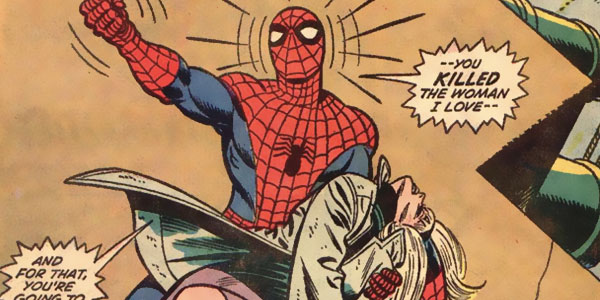
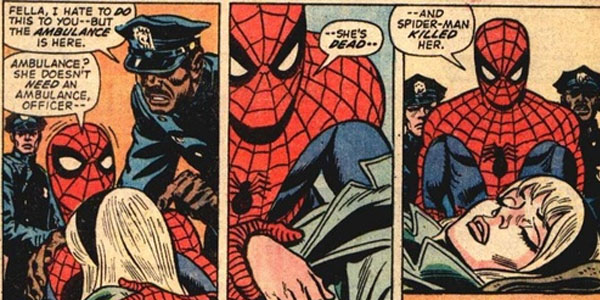
Uncle Ben's death is the one that sent Spidey on his way to becoming one of the greatest heroes of his generation - or at least one of the most unlucky - but it was Gwen Stacy's murder at the hands of the Green Goblin that really defined Peter Parker's superhero career forevermore. There are so many levels as to why The Night Gwen Stacy Died is so flipping tragic, and we're going to go through all of them methodically like we're sadistic sociopaths, as it's the only way we can without having to lie down in the dark for a while and think about things, before calling all those closest to us and letting them know we love them. But then that's just us.
The first thing are the circumstances under which Gwen met her maker. The Green Goblin has been torturing Spider-Man for years, keeping one up on the rest of the web head's enemies by knowing his secret identity pretty much from the off. Norman Osborn is a total jerk, one who delights in torturing Peter Parker whenever he gets the chance, frequently turning his nemesis' already messy life into a living hell. Making it personal felt like Osborn had crossed a line, the unwritten code of honour between enemies. That it was also Gwen Stacy, the first true love of the young Peter Parker's life who should suffer the consequences of dating a superhero, made it even worse.
But perhaps the cherry on top of all this tragedy is that we still don't actually know how Gwen died. There's been endless debates ever since the comic was published back in 1973, with most settling on the accepted explanation that the sheer velocity of being hurled from the Brooklyn Bridge was enough to kill her, or that the Goblin had already done the deed before Spidey could get there, ensuring his victory over the hero.
What's troubling, however, and something that has haunted both Spider-Man and his fans for decades, is one little thing. One little piece of onomatopoeia that appears in the scene, a sound effect that accompanies Peter desperately grabbing Gwen's leg as she falls, a little "SNAP" that appears next to her thigh as the webbing clings onto it. Some people think that's just the sound of the web attaching itself to her - others think its the sound of her neck snapping at the sudden stop. Which would mean Spidey himself killed her. Oh, yeah, it wasn't tragic enough, you had to go bring that possibility into it. Thanks, nerds.
1. Jean Grey
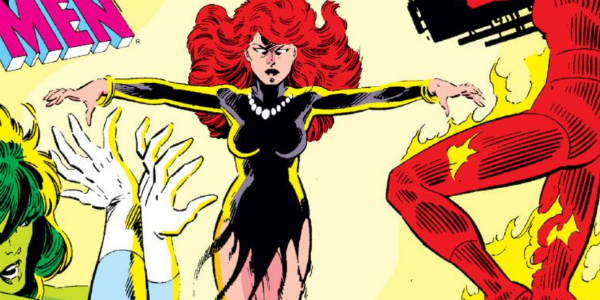
If Gwen Stacy is the most defining death of the Spider-Man books, a superhero whose whole career is based on people around him dying, then Jean Grey is undoubtedly the same for the X-Men titles. There are a lot more dead mutants, for one thing, and Jean Grey has died a lot more times than Gwen Stacy has. We're going to focus on one particularly tragic death here, though.
No, not the time Magneto infiltrated the X-Men whilst pretending to be new mutant Xorn, went mad and murdered her when she tried to stop him. No, not when she was erased from existence by Thanos. No, not when Wolverine stabbed her to death. No, not when she submerged herself in a glacier when possessed by the Phoenix Force. Nor the time Sentinels killed her. Or Apocalypse. Or that other time with Wolverine. Or when she crashed a spaceship.
Obviously we're talking about The Dark Phoenix Saga, that X-Men classic about how dangerous women are when they discover their sexual agency. And that sexual agency is manifested in the form of a big fiery cosmic presence that allows you to destroy entire civilisations in the blink of an eye, which we're pretty sure isn't normal. Following Jean's supposed death in that spaceship she was chosen and resurrected by the Phoenix as its new host, boosting her already impressive psychic abilities and letting her do all the cosmic fire stuff as well. Unfortunately it was timed with Jean being coaxed to the dark side by the nefarious Hellfire Club, during which time she destroyed an inhabited star system. Woops.
Put on trial for mass genocide by the Shi'ar empire (the aliens who all wear feathers for some reason), Jean and her fellow X-Men are ordered to fight to the death against their accusers' greatest champions. Ultimately Jean chose to end her own life, terrified of what the Phoenix Force might get her to do next. She explains her choice to her long-suffering and tearful husband Scott, before activating Shiar weapons and vaporising herself. It hardly matters that the many deaths of Jean Grey have become a running joke in comic book fandom - this is still one of the most tragic endings to any character we've seen.