10 Most Tragic Deaths In The History Of DC Comics
Stop all the clocks, cut off the bat-phone...

Stop all the clocks, cut off the bat-phone. Prevent Krypto from barking with a juicy bone. Silence the Green Lanterns and with muffled drum, bring out the super-coffin, let the mourners come.
They're bright and colourful and mostly meant for kids but man, do superhero comics involve a lot of death. As bad as Marvel are for killing off people willy nilly, their Distinguished Competition might actually have them beat for the sheer number of tragic deaths they've chronicled in the pages of their comics over the years.
They may have created some of our most treasured pop cultural characters but boy, they're sadists when they want to be. There's any number of geeky pursuits that are put under inquisition with the question: can they make you cry? Right now everybody seems to be more concerned with a video game's ability to make you all weepy but, for our money, nothing has the humble superhero comic beat.
Sure, Gone Home tugged at our heartstrings, and there are you celebrated literary "graphic novels" which tell you some depressing true life tales. But fans will certainly have shed a tear or two over the untimely passings of spandex-clad saviours and the people who love them. They're larger-than-life stories, and death is rarely permanent, but that doesn't stop us from getting emotionally involved to the point of genuinely mourning the demises of some of the characters on this list.
So let invisible aeroplanes circle overhead, scribbling in the sky that they are dead, as we open up some old wounds and raise a toast to ten of the most tragic deaths in the history of DC Comics.
10. Alexandra DeWitt
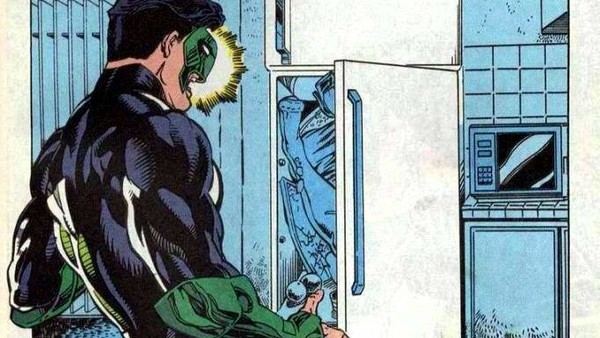
This first death was so traumatic that it inspired a whole new coinage in the comic book lexicon. Gail Simone was just a concerned fan when she started the Women In Refrigerators site following the events of Green Lantern vol. 3, #48. She would later go on to pen some of the more sensitive portrayals of female characters in the notoriously male-lead DC Universe which, on the evidence of this, was more than necessary.
Kyle Rayner was the third character to hold the title of the main Green Lantern, following the Golden Age's Alan Scott and fan favourite Silver Ager Hal Jordan being dismissed for going crazy and murdering half a universe. Kyle was a very different kind of Lantern.
Rather than the stoic heroism of Alan or the Han Solo charm of Hal, he brought a bit of a Bill & Ted flavour to the role. Well, maybe not quite that stupid - although we're still not 100% on how he pronounces "Socrates" - but there was certainly something of the Californian surfer dude to this new Green Lantern, and the tone of his solo title was accordingly petty light.
Which obviously couldn't last. So, whilst he's off dealing with some bright cosmic threat, Kyle's new girlfriend Alexandra gets slaughtered by the villain Major Force, who then stuffs her body in the apartment fridge. It's still a shocking scene to his day, even with the cultural context of Women In Refrigerators. This was just supposed to be a bit of fun! Nobody was meant to get hurt!
Targeting a loved one especially radically shifted this new Green Lantern's approach, and probably put us on the road to seeing Hal Jordan replacing him.
9. Superman
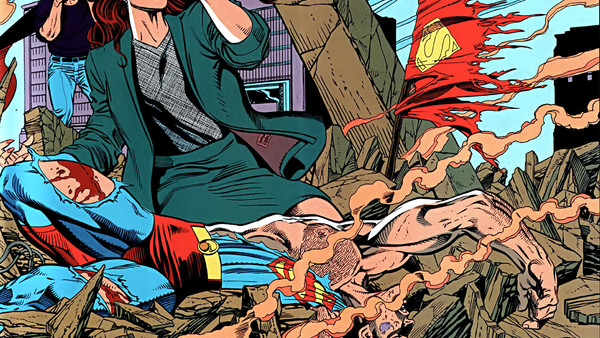
The death of the Man Of Steel himself made national news when it happened, way back in that heady decade we call the nineties. Obviously we all knew that it wasn't going to last - even those of us not cynical and jaded enough to be intimately familiar with the concept of "comic book death" realised that DC weren't going to kill of their biggest character, especially one who is such a cultural icon, recognisable (and bankable) worldwide.
Still, marketing ploy or otherwise, their gamble worked out and we all went out to buy the Death Of Superman miniseries - and its many, many tie-in issues - in our droves. There was a particular poignancy about the murder of the last son of Krypton. Since the Crisis On Infinite Earths series which had reset his history, Clark Kent had finally managed to "come out" as Superman to his long-term romantic interest Lois Lane, before proposing to her - which she gladly accepted.
Everything seemed to be coming up Superman, and following a rocky decade of trying to make this decidedly sunny character into something befitting the grim grittiness of Batman or Watchmen, it really suited him. Which couldn't last, obviously.
In practice, The Death Of Superman was actually not all that great of a series. The way the hero got taken out - bludgeoned to a pulp by new villain Doomsday - felt pretty cheap and boring, and the pacing was all off.
The fallout and genuine grief people felt about this paragon of pop culture, this icon of American values, being killed off, though? That was real, and it was long-lasting, both in the public consciousness and in the Superman comics too, as his supporting cast tried to deal with the tragedy of losing their greatest champion, their closest friends, their one true love.
That's pretty sad, right?
8. The Question
The Question was never meant to be a big deal. The invention by Steve Ditko, the man who co-created Spider-Man with Stan Lee over at Marvel, faceless private eye Vic Sage would have indeed vanished into obscurity when his publisher suffered its own untimely demise.
At the eleventh hour, however, DC stepped in to buy up all of Charlton Comics' properties for bargain basement prices and then... kinda sat on them for a while. Briefly it looked like they might let Alan Moore use some of their superhero acquisitions for his Watchmen series, with fan-favourite Rorschach being created to take the role originally earmarked for the Question.
Eventually the character had a resurgence in a series by Dennis O'Neil through the eighties, which cemented his place amongst DC's enormous rotating supporting cast of characters - not strong enough to carry his own book, but cropping up in other character's titles and earning himself a miniseries here and there. No doubt thanks to the Ditko and Rorschach connections the Question built up something of a cult following himself, with readers and within the industry.
Like many of the publisher's lesser-known characters Vic Sage became an important part in the weekly series 52, where the universe tried to deal with the year-long disappearance of its biggest superheroes. This is a different Sage than we were used to, however. Gone was the iffy moral boundaries and unpleasantness of previous portrayals, replaced with a dry wit and sympathy he deployed in training longtime Batman character, detective Renee Montoya, to replace him as The Question.
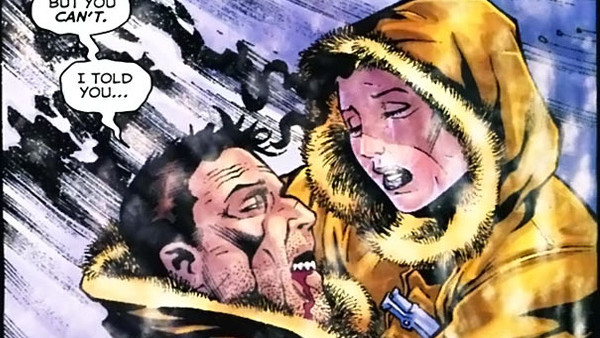
Vic's relationship with Renee - and his newfound charm - made it all the more hard to take when he dies of lung cancer at the end of the series.
7. Aquababy
Once upon a time, DC Comics was a safe space. Nothing bad ever happened there (besides the murder of Bruce Wayne's parents and the destruction of Krypton and and and), and certainly nothing of any consequence. Any seemingly major changes to the status quo were normally undone as quickly as the next issue, with the events of the previous instalment of World's Finest being written off as a hoax, dream or imaginary tale.
Or sometimes it would claim to have not been any of those things, when really it was sort of a combination of all of them. Comics, everyone! All that changed with, surprisingly, an Aquaman comic. Whilst the character seems to be going through something of a career renaissance as of late - rumour has it that he'll play a key role in the upcoming Superman V Batman movie, and writer Jeff Parker's current run in the comics is spoken of highly - he's been something of a joke for a pretty long time.
He is a guy who wears a scaly suit and is the owner of such amazing superpowers as "being able to talk to fish", after all. Back in the day, though that didn't matter. The goofiness was sorta shared across the board with all his fellow Justice League members. It was just how it was. A simpler time. Which made it all the more tragic when death visited his home.
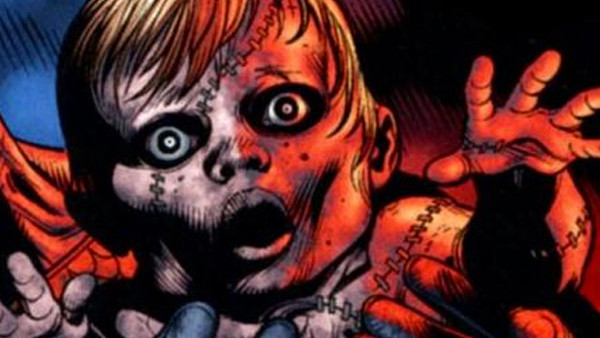
For a while there Aquaman ruled happily alongside wife Mera and son Arthur Jr, otherwise known as Aquababy. It was all rather quaint. Like an underwater Waltons. Now imagine there was an episode of The Waltons where a child got murdered. That's what Aquaman's arch nemesis Black Manta did, locking the kid in a box to suffocate to get back at his enemy. Pretty messed up. Pretty tragic too...
6. Elongated Man
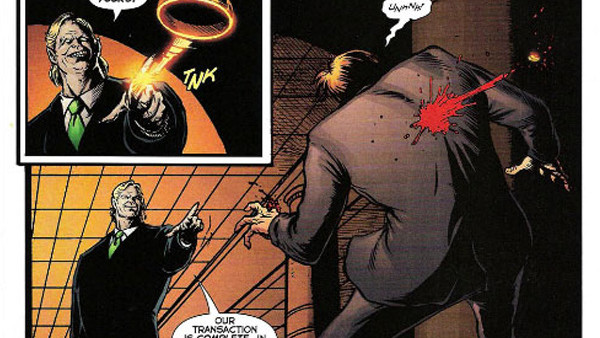
And if there's somebody who knows tragedy in the DC Universe, it's Ralph Dibny. Which isn't a sentence you expect to write about a superhero better known as Elongated Man, who has the ability to stretch any part of his body (snigger).
Like Aquaman, Ralph was mostly left to enjoy his masked vigilante lifestyle without any sort of consequence or the dread spectre of death following him around like a bad smell - which is good, because his super-sensitive nose would've smelled it coming a mile off. Or perhaps not, as in the pages of Brad Meltzer's pretty terrible DC whodunnit Identity Crisis, he wasn't quick enough to stop his beloved wife Sue from being murdered. And just when she found out she was pregnant, too. Yeesh.
Elongated Man was another victim of the 52 series which seemed less like an opportunity for writers to bring back some of their favourite obscure characters and more like a chance to kill them off. Ralph's story in 52 is all about dealing with his grief over his wife's death, going through any number of methods of trying to resurrect her.
Sure, people die all the time in DC Comics, but they come back plenty too. Sadly for Ralph that was not to be, as he gets murdered by mystical villain Neron, who chucks Dibny's own wedding ring through his heart so fast it comes out the other side. Dang. Pretty tragic, huh?
Guy spends a whole year trying to come to terms with his own wife's untimely death, only to wind up murdered himself. At least this particularly upsetting killing off has a silver lining: one of the various spells Ralph tried ensured him and Sue would be returned to each other, and technically they are - as ghost detectives! Which totally should have become an ongoing series, but for some reason didn't. And yet DC are still publishing Red Hood And The Outlaws. We ask you.
5. Stephanie Brown
Can you believe that it took 73 years for a woman to draw a Batman comic? That's pretty crazy, especially when you consider it's only this year that the character's celebrating his 75th anniversary. As bad as the people making the comics are at the whole equal opportunities thing, it's not like the Dark Knight himself is smashing any glass ceilings. We mean, figuratively.
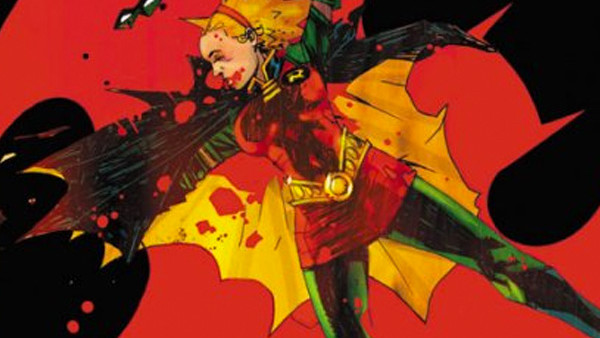
Batman always seems to be jumping through windows without getting hurt. Maybe he actually does have a superpower? Anyway, that's besides the point. The point is that finally, in the early noughties, we got the first ever female Robin. We guess Bruce Wayne had just never checked that wing of the orphanage when scoping for new wards before. Stephanie Brown wasn't like previous Robins in other ways, besides the differing number of X chromosomes.
Originally appearing in 1992 under the guise of the Spoiler, Stephanie didn't wait to be asked by Batman to fight crime - she did it of her own volition, creating a secret identity mainly in order to ruin the plans of her villainous father the Cluemaster. Hence the name Spoiler. She didn't, like, sit on Twitter and tell people the ending to Game Of Thrones episodes.
That would just barely constitute a one-off gag comic, not an ongoing series. Which Stephanie eventually earned, becoming a recurring character and love interest in the Robin solo book. Eventually she even took Tim Drake's place as Batman's sidekick. For, like, a fortnight, before she was killed off unceremoniously during the course of the War Games crossover.
Which kicked off a massive hoo-ha as the character's many fans thought that was an entirely ignoble death for one of the best female characters DC had ever published, and she never really got chance to make the Robin title her own. Eventually this all got retconned out of existence, but we were pretty cut up about it at the time.
4. Blue Beetle

The Blue Beetle name is something of a poisoned chalice. Which is not something you should drink from. Did you not see Indiana Jones & The Last Crusade? At worst, you'll go all weird and skeletal and then explode in a shower of bones and dust.
At best, you'll either get cancelled (by Charlton Comics again!), shot in the head, or everybody you know and love will get killed instead. It's really a now-win situation. Obviously, you do get your hands on some magical scarab-derived superpowers and a cool suit, but is that really worth it for all the pain and emotional turmoil that comes part and parcel of being a Blue Beetle?
Nowadays the name is used by teenager Jaime Reyes, but the most famous and beloved character to fight crime as the Blue Beetle was definitely one Ted Kord. Again given life by former Spider-Man mastermind Steve Ditko, the second Blue Beetle - nobody really remember the original, Dan Garrett, so there's no reason you should either - possessed a genius-level intellect and was a gifted athlete.
Also he flew around in a bug-shaped spaceship which was totally rad, and had a lot of goofy adventures with his best friend Booster Gold, as chronicled in mostly-humorous series like Justice League International. Like Aqualad and Elongated Man, it was this inherent goofiness that would prove to be Ted Kord's undoing. Or would it least make it all the more upsetting once he got bumped off.
Blue Beetle didn't even survive long enough to meet his maker in the pages of 52, as so many other second stringers did: his fate befell him during Countdown To Infinite Crisis, where he is captured whilst infiltrating the nefarious Checkmate organisation and then shot in the head by its leader, Maxwell Lord. Poor Ted. He was just trying to help.
3. Various Robins

At this point does anyone really understand how Bruce Wayne keeps being allowed to adopt kids. Orphanages across Gotham City - we assume there's a fair few, considering what a horrible crime-ridden cesspool the place is - should have WARNING posters with the smug billionaire playboy's face on them, reminding staff that this guy isn't allowed any more children.
People still haven't clocked on that this guy is secretly Batman, but they should probably have wondered by this point what keeps happening to all these youngsters he spirits away, never to be seen again. Even if they don't clock that they're becoming Robins, they should notice that something fishy is going on.
The first sidekick to fall in the line of duty was Jason Todd. Now some might argue that this one wasn't particularly tragic; in fact, 5,343 readers made that argument. That was the total number of people who rang in to vote that the second Robin meet a sticky end at the hands of The Joker in the pages of A Death In The Family.
Jason was almost universally reviled by fans at the time, but let's still counting the death of a child (even a slightly overzealous and annoying one) as pretty tragic. What is inarguable, however, is that the death of Damian Wayne was a total tragedy. Uncontested. Indisputable. And this kid was, if anything, even more overzealous and annoying than his predecessor.
Yet over time we all warmed to this long lost son of Batman, the result of a past dalliance with the assassin Talia al Ghul. The fact that we'd been so won over made it all the more crushing when he was murdered in cold blood by his own clone, under orders of his own mother. Man, that is cold.
2. Jonathan Kent

Superman's adoptive father is like the DC Universe's equivalent of Marvel's Jean Grey. In other words: he just keeps dying. And being resurrected. And dying again.
Is this what the circle of life is all about? Another victim of DC's constant continuity resets, the simple Kansas farmer who found a baby Kal-El in a field and raised him like he was his own son doesn't have luck that stretches to him being alive. Even when his kid has superpowers. Now that is unlucky. Whilst certain parts of the Man Of Steel's origin story remain immutable - doomed planet, desperate scientists, last hope, kindly couple (as All Star Superman puts it) - the fate of the Kents is ever changing.
In the Golden Age they both died not long after Clark's high school graduation, which meant their foster kid could move to Metropolis with no tricky connections to his hometown of Smallville. After the Crisis On Infinite Earths event this got changed so both remained alive to watch their son become Superman, only for Jonathan to die following an attack by Brainiac.
In the original film, along with Jeph Loeb and Tim Sale's Superman For All Seasons, Pa Kent succumbs to a heart attack. In current continuity, both Kents were killed by a drunk driver. Much like Jean Grey, the sheer amount of times Jonathan Kent has passed away doesn't rob any such instance of its power - it's the first big heartbreak Clark Kent suffers, and the first time Superman really fails.
Oh except in Zack Snyder's Man Of Steel, where he dies completely unnecessarily and thus it has not emotional weight. Seriously. It's like some Independence Day-level nonsense.
1. The Flash
Barry Allen was not having a great time of it. The second Flash finally married his girlfriend, Iris West, only for her to be killed by his arch enemy Professor Zoom. After the long and arduous process of getting over the loss of Iris and courting another woman, Zoom tries to pull the same trick again - only for Barry to catch him before he can do the deed, snapping the villain's neck in the process. Because he's dealing with this situation, the Flash doesn't attend his own second marriage, and his fiancee goes insane as a result of the presumed rejection.
Then he gets put on trial for the murder of Professor Zoom and, really, doesn't have much of a leg to stand on. Then a bunch of time travel shenanigans happened, Iris got brought back to life, Barry had his name cleared, and everything was good again! Right? Right? Yeah, sorry, wrong.
Because the final issue of The Flash solo series may have ended with Barry and Iris sharing a tender moment, but it was also thick with references to the speedy superheroes impending death. Living in the 30th century - where, it turns out, his first wife hails from - works out pretty well for the Allens for a little while. Certainly helps Barry beat the murder rap, living thousands of years in the future.
Except, a few weeks into their wedded, non-murdered bliss, Crisis On Infinite Earths had to happen. The fictional DC Universe has always been something of a mess, a tangled web of alternate realities and Earths that have housed many different versions of its key characters through the years.
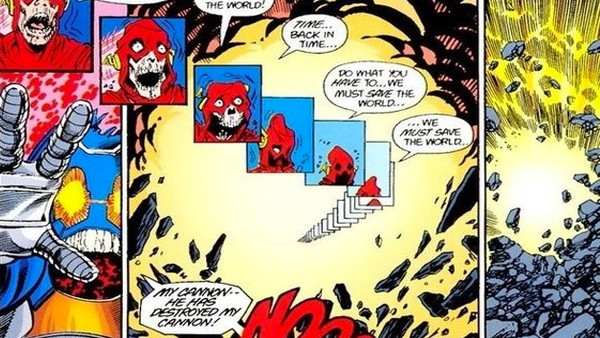
The first Crisis was an attempt to tidy things up a little, whilst also providing an epic, blockbuster superhero story. Which also meant a lot of people died. It's the demise of Supergirl that often gets brought up - and used as the cover image on all subsequent reprint collections of the story - but Barry Allen's that was the most tragic. Having managed to make it through the most trying period of his superhero career, The Flash has finally found happiness - only to have it torn away from him. Undeterred, he vows to sort things out and return to his beloved. Which doesn't work out.
As the villainous Anti-Monitor releases a weapon that will destroy the whole universe it's Barry's intervention - sucking up all that bad mojo with the speed force - which saves everyone. It just kills him in the process. A heroic sacrifice, but a bloomin' upsetting one.