10 Most Controversial Italian Exploitation Film Directors
 Italy has frequently been at the forefront of European cinema as a trendsetter in the annals of exploitation cinema. Without Italy, we wouldn't have the Mondo film or Gialli. Who else would have supplied us with Amazonian cannibals, nasty Nazis or demented nuns in such a pleasing manner? Italy has always been awash with cinematic talent. And it is a country that doesn't mind doing sexy, doing off beat, to be a little daring. The amount of wonderful exploitation directors has ensured that Italy has produced some of the most amazing horror films, cult oddities, documentaries and pornos. I have listed the foremost Italian exploitation film directors that I can think of.. If you have a particular Italian director that you admire that I have missed out, please let's have a discussion below.
 10. Bruno Mattei (1931-1997)
 Those of you who read my reviews will know that I am not a fan of Bruno Mattei. However, he is an important film maker to discuss in terms of Italian exploitation cinema - as he represents the very nadir. Mattei got his start in film making editing a few hundred films in the 1960s-70s. His 'big break' came directing 20 minutes of hard core porn inserts for Jess Franco's 99 Women. He quickly jumped head first into directing - exploiting whatever fad was going on the fringes of Italian cinema. For example - in the late 1970s trend for Nazisploitation, Mattei directed several similarly themed films including SS Girls. When nunsploitation was a hot commodity, he directed The Other Hell. After Caligula was released, he made a couple of very derivative films. He also exploited the WIP genre (Women in Prison) with titles such as Violence in a Women's Prison. He somehow managed to secure Laura Gemser to star in that film. Diabolical zombie movies were also a special of Mattei's - just have a look at Zombie Creeping Flesh which flagrantly lifts the Goblin penned score to Romero's Dawn of the Dead! Another notably dire movie of Mattei's that has a measure of fame is Rats: Nights of Terror. It is predictably a pile of crap. Mattei died in 2007 of complications relating to a brain tumour. In total, he made 45 very low budget movies that he himself said he wished he could direct them all again as they are 'ugly'. God bless him, he tried his best, but his films are truly awful. There is already a cult surrounding Bruno Mattei, with people dubbing him 'The Italian Ed Wood'. These fans enjoy his films' weak direction, terrible acting and pitiful special effects. They may love him because he is so bad but I have to draw the line somewhere among all the crappy films I watch. And that line is Bruno Mattei.
9. The Castiglioni Brothers (1937-)
 It is very hard to gain information about Alfredo and Angelo Castiglioni. They seem to be currently embroiled in archaeological projects concerning parts of Africa and they look like experts in what they do - having published over 15 books on African archaeology. All very respectable, but back in the day the Castiglioni brothers produced some of the most extreme content ever committed to celluloid. This was in the shape of five Mondo movies concerning Africa - Africa Segreta (Secret Africa), Africa Ama (Uncensored Africa), Magia Nuda (Mondo Magic), Addio Ultimo Uomo (The Last Savage) and Africa Dolce e Selvaggia (Shocking Africa). The latter two films are notable for their extreme content. Addio Ultimo Uomo is widely considered to be one of the hardest films to sit through as we watch the 'savage' Africans play out tribal rituals, fight each other, prepare their dead for burial, carry out castrations (both male and female), kill and eat animals along with a host of other things. It is vile but engrossing in a weird sort of 'What kind of horror is going to pop up next?' kind of way. Shocking Africa really takes the biscuit for being a virtually unwatchable parade of horrors that makes Faces of Death look like Coronation Street. You can feast your eyes upon: Female circumcisions done to very young girls with a rusty razor blade, little boys being circumcised as well, a woman having a snake shoved in her vagina to increase her fertility, the castration of a camel, atrocities committed against animals, fearless fooling around with scorpions and deadly snakes, extreme body scarification, the beating of a mentally ill man by village elders. These two films are among the most extreme ever filmed. For me, the only film that trumped them was Prosperi and Jacopettis' Africa Addio. Given their subsequent interest in African archaeology, perhaps the Castiglioni brothers were only showing us the truth about aspects of African tribal life that as unpalatable as they may be, do exist. There is not much simulated footage in their films which makes them even harder to watch and renders a movie like Brutes and Savages or Savage Man, Savage Beast, comedic in the face of real horrors.
8. Massimo Dallamano (1917-1976)
 Born in Milan, Massimo Dallamano began his career in cinema as a cameraman for documentaries and commercials in the 1940s. After the war, he started work as a cinematographer including Sergio Leone's Fistful of Dollars and For a Few Dollars More. A pretty impressive achievement indeed for Dallamano, who began his directorial career with another Spaghetti Western called Bandidos. Happily for us fans of Italian sleaze, Dallamano extended his range into erotica and Gialli. In 1968 he made the underrated Giallo - A Black Veil For Lisa. He followed this up with an adaptation of Venus in Furs - starring the delightful Laura Antonelli as sizzling, sexy, sadistic Wanda. A further adaptation of another book - Dorian Gray - marked Dallamano as a stylish and inventive director. Before he sadly died in a car crash aged only 59, Massimo Dallamano directed the amazingly good Giallo - What Have You Done to Solange? In the Giallo canon, this one must be up there in the top ten, and very probably in the top five films. It is a twisted tale of a married school teacher whose schoolgirl lovers start turning up dead. Dallamano's tragic death robbed Italian cinema of a very special talent.
7. Umberto Lenzi (1931 - )
 Umberto Lenzi is a bit of a Renaissance Man whenever it comes to Italian cinema. Born in Southern Tuscany, he has directed crime films, war movies, Westerns, spy films, peplum but it is his horror work we are mostly concerned with. Lenzi was one of the first directors to jump into the Giallo scene with entries such as Orgasmo, Paranoia, Eyeball, Oasis of Fear and Seven Bloodstained Orchids. He proved he could craft a good horror film with The Man From Deep River - it is this picture in particular that would spark off the Italian cannibal film mania. Lenzi claims to be proud of this film but prefers his crime films and his war films. He generally has a dislike for his horror films. Nevertheless, this disdain for horror didn't stop him from returning to the cannibal genre once again to exploit the success of Cannibal Holocaust. Cannibal Ferox was Lenzi's answer to Deodato's massive hit. In it there was much cruelty to animals and sections of seriously OTT violence. Like many of its cannibal brethren, it ended up a Video Nasty. He explored the genre again with Eaten Alive! (often referred to as Cannibal Holocaust 2). Those heady days of cannibal munching have now passed and Lenzi has directed a couple of low budget horror movies that are nonentities. The films that he holds in the highest regard of all his movies are generally not known outside of Italy. He will always be Umberto 'Cannibal Ferox' Lenzi to fans of Italian sleaze. This may dismay him but at least his notoriety is assured for all time.
6. Ruggero Deodato (1939-)
 Hands down, Ruggero Deodato will forever be burned in the minds of exploitation cinema fans as the director of notorious Video Nasty - Cannibal Holocaust. This will always be his crowning achievement. He cut his teeth in Italian cinema working under Roberto Rosselini and Sergio Corbucci. As a fully fledged director, he helmed a lot of comedies, musicals and thrillers during the 1960s. Deodato left the big screen for a number of years to shoot commercials. He made a return in 1977 for The Last Cannibal World starring British actress Me Me Lai - an injection in the arm to the cannibal subgenre. In 1979, with a budget of $100,000, Deodato returned to the cannibal subgenre with the grand daddy of all cannibal movies - Cannibal Holocaust. The resulting film provoked widespread controversy in many countries. It was banned in Britain for nearly 20 years. In his native Italy, Deodato had to parade the actors of Cannibal Holocaust around a courtroom to prove they hadn't been killed on camera. He also picked up a lot of flak over the animal snuff in the film - receiving a four month suspended sentence for his misdemeanours. Deodato's film making license was revoked but somewhere along the line he had created yet another Video Nasty - the most censored film in all of the DPP's list of 39 prosecuted films - House on the Edge of the Park. This film featured a typecast David Hess as a sadistic killer, who terrorises a bunch of yuppies with his hapless partner in crime Giovanni Lombardo Radice. Two further interesting Deodato films include Off Balance: Phantom of Death and The Washing Machine. Phantom of Death is an excellent Giallo starring Michael York, Edwige Fenech and Donald Pleasance. Michael York is a brilliant pianist who has a wasting disease that prematurely ages him. He takes his rancour out on the women around him. The Washing Machine is the torrid tale of three sisters' tangled love lives and murder. An astonishingly diverse and talented man, Deodato has recently directed TV series and comedies. He had a cameo in Hostel 2 where he cannibalised a young man. This must have been in recognition to his cannibal film infamy. I don't think Ruggero Deodato is especially proud of Cannibal Holocaust, but putting that aside, he has made other important exploitation and Giallo films and can be widely praised for his services to Italian horror films.
5. Sergio Martino (1938-)
 Sergio Martino is an incredibly talented film director who has worked in Comedy, Westerns and Sci Fi. But it is for his sterling talent as a horror and Giallo director that he earns a place on the list. Born in Rome in 1938, Martino began his cinematic career as an assistant to his writer/producer brother Luciano. He had a small role in the making of Mario Bava's SM horror masterpiece - The Whip and the Flesh. His directorial debut was a then fashionable Mondo movie called Mondo Sex. Whenever the Giallo first came of age, Martino directed several masterpieces that frequently featured the very beautiful Edwige Fenech who was then married to his brother. His Giallo efforts include: The Strange Vice of Mrs Wardh, Your Vice is a Locked Room and Only I Have the Key, The Case of the Scorpion's Tail and perhaps his finest film - Torso (The Bodies Bear Traces of Carnal Violence). Torso is often cited as having an influence on the development of the American slasher film. It was a fantastic achievement for Martino as it works well as a straight horror film and also plays magnificently as one of the most menacing and polished Gialli. Martino worked with many exploitation stars in his hey day - including George Eastman and Ivan Rassimov. He also collaborated with the most important Giallo writer of the age - Ernesto Gastaldi. Another quintessential Martino film is Mountain of the Cannibal God which starred Ursula Andress and Stacy Keach - two very flashy names for a cannibal picture. But it will most likely be his Gialli that Sergio Martino will be remembered for and revered for. At times his talent was close to Bava's and Argento's and whtever the outcome, his films were always interesting.
4. Gaultiero Jacopetti (1919 - 2011) and Franco Prosperi (1926-?)
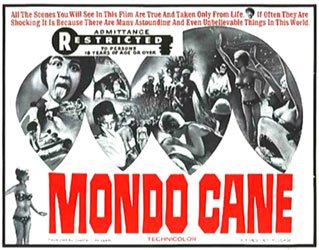 The godfathers of the Mondo movie - by virtue of their feature film Mondo Cane which shows us bizarre goings on from around the world sarcastically contrasted with Western society's actions - Jacopetti and Prosperi were a formidable team in Italian exploitation cinema in the 1960s. Not much is known about Franco Prosperi but Gaultiero Jacopetti was certainly a colourful figure. During the Second World War he helped Allied troops in their invasion of Italy. He worked as an editor (in the world of journalism) and helped start up Italian magazine L'Espresso before moving on to making the documentaries we know and love so well. Jacopetti was also an infamous bounder. He once seduced an underage Gypsy girl and another time spent 3 months in a Hong Kong jail after trying to abduct two underage Chinese girls. In terms of movies, Jacopetti and Prosperi delighted the world with a smoking chicken in Mondo Cane (literally translates as - it's a dog's life) and started the whole Mondo 'shockumentary' fad. Russ Meyer would film Mondo Topless and John Waters - Mondo Trasho. Inevitably Mondo Cane 2 appeared from Jacopetti and Prosperi followed by Women of the World in 1963. In 1966, Africa Addio was released. This jaw dropping film chronicles the end of colonial rule in Africa. I cannot make my mind up as to whether is a brilliant film, or loitering around a toilet. Jacopetti and Prosperi were accused of staging executions in front of the camera, but were not charged. They were nearly killed by mercenaries during the course of the film and they took many risks to film the explosive action of post-colonial Africa. However the racial bias of the film is firmly in favour of the colonials and the resultant product is an inflammatory piece of rhetoric that is downright insulting in its treatment of Africans. The duo gave us one last shockumentary in 1971 - Addio Zio Tom (Farewell Uncle Tom). Presumably stung by accusations of racism from Africa Addio viewers, Jacopetti and Prosperi filmed Addio Zio Tom as a retrospective staged pseudo-documentary about the American treatment of African Americans before slavery was abolished. I think it is trying to be sympathetic to black Americans but it is so over the top, it becomes downright insulting. The film was made in Haiti and in the end credits Jacopetti and Prosperi thanked Haitian dictator Papa Doc for his cooperation (thank you for lots of underpaid actors) Whatever their political and racial biases, we wouldn't have the Mondo film without Jacopetti and Prosperi. They truly invented a classic, if salubrious, subgenre.
3. Joe D'Amato (1936-1999)
 Joe D'Amato was the name that Aristide Massaccesi assumed for the bulk of his career (for his most well known films in any case) which spanned the best of 200 film productions. This was because he had - in his young career - built up quite a reputation as a competent cinematographer and he wished to preserve that. His pseudonym - Joe D'Amato - would soon become a by word for the best and the worst excesses of Italian subterranean cinema. He entered into the horror/Giallo arena with Death Smiles Upon a Murderer. Later in the 1970s Joe D'Amato began to direct a series of 'Emanuelle' films starring the beautiful Laura Gemser as the eponymous globetrotting photo journalist who gets into all sorts of sexy hijinks. These films included Emanuelle in America, Emanuelle and the Last Cannibals. D'Amato also directed two hardcore porn/horror hybrids Porno Holocaust and Erotic Nights of the Living Dead. It was clear by now that he would spend his directing career in Exploitation at best and porno at worst. D'Amato made two interesting and fairly successful entries into the world of straight horror - Buio Omega (Beyond the Darkness) and Anthropophagus. Buio Omega, with its savage gore and necrophiliac overtones, has a considerable cult following and is probably D'Amato's most successful film. Anthropophagus achieved brief notoriety as a Video Nasty in Britain but was not as successful as Buio Omega. In his career in the 80s and 90s, D'Amato directed over 100 hardcore porn movies under many pseudonyms. However, one of the highlights of his career (and he knew it too because he used his real name for the film) was acting as producer on Michele Soavi's slasher masterpiece - Stagefright - Aquarius. In January 1999, D'Amato died suddenly of a heart attack in his home in Rome. He was only 62. His career will be exalted by cult Italian cinema fans who enjoy his mishmash of horror and erotica. Fans of extreme cinema revere D'Amato for his more out there films - Buio Omega and Emanuelle in America. His vision was certainly a sleazy one, but the man had great talent as a cinematographer and producer. His name will forever evoke fond memories among fans of Italian exploitation cinema for his exotic oeuvre.
2. Tinto Brass (1933-)
 Giovanni Brass - or Tinto Brass as we know him - is a prominent Italian director within the field of erotica. His most notorious film is Caligula which earned him critical revulsion, which is quite unfair to Brass as it is primarily Bob Guccione's fault that the film turned out as bizarre as it did (he inserted about 8 minutes of hardcore porn into the film to sex it up). Nevertheless, Caligula has gained quite a cult following and Brass has plenty of excellent erotic films under his belt. One of Brass' most famous films is Salon Kitty - an erotic drama about a Nazi brothel. This film helped to kick start the Nazisploitation cycle but it is a much classier affair than the many films that sought to imitate it. Tinto likes to say "I put a big c**k and balls between the legs of Italian cinema". With films such as Frivolous Lola, All Ladies Do It, The Key, and Paprika, Brass explores various aspects of erotica. He seems to be fond of voyeurism and takes a Jess Franco approach to his actresses' buttocks and pubic hair - virtually fetishising them with his camera work. Since suffering an intercranial bleed in 2001, Brass has not been especially active in cinema, mind you he is 80 years old now. He can look back on his career with a smile.
1. Lucio Fulci (1927-1996)
 The name - Lucio Fulci - usually provokes a highly positive response among fans of Italian exploitation cinema. The man was/is a legend with lots of impressive films under his belt. Fulci was born in Rome and studied medicine at university. He didn't get to doctor status because he decided to become an art critic. Fulci then got involved in the world of Italian cinema - first as a screen writer and then he directed, in the 1960s, a fair amount of Italian comedies which are not available outside of Italy (apart from One On Top of the Other/Perversion Story). In the 1970s, Fulci tried his hand at Gialli - directing two genre classics - Don't Torture a Duckling and A Lizard in a Woman's Skin. The former was quite a scandal because it seems to be attacking the Catholic Church by having a murderous priest who kills little boys. Fulci always called himself a Catholic despite the controversy he instigated with his films. In the late 70s/early 80s Fulci entered a golden age of horror film making with films such as Zombie Flesh Eaters, The Beyond, House by the Cemetery, City of the Living Dead. These fantastic gory horror films gained Fulci international acclaim from the horror community. At the same time, some of his films gained notoriety through their violence against women and sleazy tone. The New York Ripper is probably the best example of critical revulsion fired at Fulci - to this day, the film's misogyny and lurid plot still have the power to get the critics' knickers in a twist. For one man, an awful lot of his films were banned in Britain in the early 1980s Video Nasty scare. I think this only served to heighten the cult surrounding his films. The heyday of the early 1980s would fade when Fulci became seriously ill with hepatitis, cirrhosis and diabetes from 1984 onwards. He still worked as a director but there is little doubt that his health woes were affecting his competence as a director. Apart from Cat in the Brain (which I personally loved but most people hate) he directed nothing of worth during this period of ill health. He tried desperately to hide how ill he was so he could keep on making movies. Fulci suffered a fair amount of tragedy in his life. Frequently accused of misogyny - he claimed to love women, however he received some terrible blows concerning the women in his own life. His wife committed suicide and his daughter died in a car crash. Fulci had a dislike of Dario Argento and for a long time slagged him off and refused to work with him. He was jealous of the 'respectability' of Argento's films and his critical success. Fulci thought the critics deemed him a horror 'hack' with no imagination. Towards the end of his life he dropped his grudge against Argento and the two men decided to collaborate on a project called The Wax Mask in 1995. However, Fulci died in 1996 before production had a chance to get started. Fulci died of complications related to diabetes. His work will probably never gain widespread critical acceptance (although there has been some critical acclaim afforded to Don't Torture a Duckling - in my opinion, his greatest work). However his cult within horror movie fans will surely continue to grow. The Beyond, in particular, is admired so greatly by Quentin Tarantino that he engineered a cinema re-release of the film. Fulci always thought poorly of himself and believed he would be a mere 'postscript' in Italian cinema. He would be amazed by the size of his international fan base and the warm regard they have for his films. Yes he directed much nonsense but his greatest films are shining jewels for the horror fan to feast upon.