12 Striking Similarities Between The Iron Man And The Dark Knight Trilogies
 The Dark Knight and Iron Man trilogies have been two of the most popular, most important series in the history of superhero movies. Each franchise has enjoyed immense box office success and more critical acclaim than films in the genre typically receive. They are also responsible for some of the most grounded superhero storytelling ever seen onscreen. It should come as no surprise, then, that there are many similarities between all six films. This list examines 12 of the most interesting examples. Do not expect a simple rundown of the common traits between the characters of Tony Stark and Bruce Wayne that already exist in the comics. Everyone knows they're both billionaires with awesome tech. Instead, this list is comprised of commonalities in the pacing, plot points, story structure, and creative choices made in each series. Be forewarned, this article contains MAJOR SPOILERS for Iron Man 3, so if you are either of the two people who have not yet seen the film, you may want to wait until you get back from the theater to click "Next." For those of you who've seen all of the films in each trilogy, let's begin!
12. Nonlinear Origin Stories
 In Batman Begins, Bruce Wayne is shown as an adult experiencing a nightmare from his childhood. He awakes inside a prison, meets Ducard, and makes his way to the League of Shadows' mountain hideout. All of this happens before the audience learns how he got there in the first place. In Iron Man, Tony Stark is enjoying a fun conversation during a car ride with soldiers in the Middle East when his convoy is attacked. In the process, the audience sees Tony suffering what looks to be a mortal injury. The story then jumps back to show how Tony got there. Director Jon Favreau was never shy about his fondness of Batman Begins and was likely influenced by it when deciding on the pacing for Iron Man. The nonlinear structure allows watchers of both films to get sucked right into the action and feel immediately engaged. This makes the backstory portion of each picture much more palatable.
11. Unwittingly Attending Superhero Camp
 Bruce Wayne stays at the ominous headquarters of the League of Shadows in accordance with his own free will. While there, he begins learning the power of legends and symbols. This experience will lead him to the creation of his Batman persona. After being attacked, Tony Stark wakes up in a cave and realizes he's been imprisoned. He does not share Bruce Wayne's feeling of freedom, but it is during his confinement that he learns the error of his ways and builds a crude Iron Man suit to free himself and a friend. Developing the Mark I leads Tony directly to creating a more fully-realized Iron Man. In both examples, the heroes are inside terror cells and fed false information regarding who is really in charge, but more on that later.
10. Trial By Error
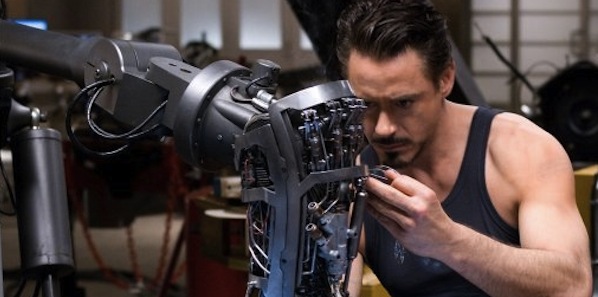 In Batman Begins, Bruce Wayne pieces together his batsuit with the help and expertise of Lucius Fox. Bruce knows he'll need armor, obviously, and borrows a suit from Wayne Enterprises' Applied Sciences division for some "spelunking." It is only after his first jump off a rooftop that he realizes his need for a means by which to glide and uses memory cloth for a cape. Tony Stark's construction sequence is played with much more comedy in Iron Man. He records himself conducting various weapons and flight tests with hilarious results. His Mark II suits looks great at first, but proves vulnerable to frost and difficult to land gently. Each failure is punctuated with the comical use of a fire extinguisher, but eventually leads to the development of the very effective Mark III. One key difference here is that Tony develops his own tech while Bruce takes what he needs from his own company. This gives Tony more credibility in the "Who's the bigger genius" debate, but it's difficult to argue against Bruce Wayne's efficiency. In any event, both men are shown to be well on their way to becoming the great heroes fans know them to be.
9. The Mentor Betrays The Mentee
 When Bruce Wayne was lost in his journey to study the criminal mind, Ducard pulled him out and put him on a path. In Ducard, Bruce saw a mentor and father figure to take the place of his deceased biological father and Alfred, whom Bruce had left behind in Gotham. Bruce even saved Ducard's life after defeating the man Bruce thought was Ra's al Ghul. Later, Bruce and the audience were shocked to learn that Ducard had been the real Ra's al Ghul and thus the real threat all along. Obadiah Stane did not teach Tony Stark how to fight criminals, but he was a father figure charged with guiding the younger Stark and the family company after the death of Howard Stark. No audience member gasped, but Tony was surprised to learn that Stane had been double-dealing under the table to terrorists. Worse yet, Stane was the one who arranged the original attack on Tony that left the latter with shrapnel in is chest. Betrayal is hardly a concept that is unique to these two films, but the similarities in how each betrayal was structured are worth mentioning. In both cases, young men suffering from the loss of their respective fathers were preyed on by those they should have been able to trust. These examples help explain why it's so hard for Bruce and Tony to allow anyone to get too close.
8. Interrogation Scenes
 In The Dark Knight, a key scene takes place in an interrogation room where The Joker lays out his entire philosophy, which is in complete contradiction with that of the man sitting across from him, Batman. The Joker predicts Batman's fall from grace and the reasons behind it. Much of what The Joker says eventually turns out to be quite accurate. In Iron Man 2, Tony Stark confronts the incarcerated man who just attacked him, Ivan Vanko. During their conversation, each man gets a chance to prove his genius. In his own attempt at villainous philosophy, Vanko suggests the world will cease to believe in God (Stark), now that Vanko has made him bleed. These scenes, while similar, clearly differ in their level of effectiveness. The interrogation in The Dark Knight is one of the most memorable scenes in the history of the genre. Its Iron Man 2 counterpart is not due to a less interesting villain and the failure of the film to properly follow up on Vanko's statement. Favreau was aping TDK director Christopher Nolan, but forgot to actually show the audience any hint of Stark's fans questioning their belief in their hero.
7. Haunted Heroes
The Dark Knight Rises begins with an emotionally stunted Bruce Wayne. The death of Rachel Dawes was also the death of Bruce's vision of a normal life. He had no idea how to move on with his life and buried himself within the walls of his own mansion. He became a recluse and the person who cared most for him, Alfred, could only watch as Bruce wasted years of his life. Iron Man 3 begins with a very anxious Tony Stark. He is suffering from symptoms of posttraumatic stress disorder after going through a war and nearly dying in The Avengers. Tony becomes a recluse in his own right, burying himself inside his garage. He tinkers away, building more and more suits while incidentally chipping away at the foundation of his relationship with Pepper Potts. These are great examples of the obsessive nature of each character. They are also fascinating explorations of the effects being a superhero has on one's mental health. These similar situations are approached from their own unique perspectives, but the key effect remains the same. The emotional vulnerability of each character makes him more relatable and easier for the audience to connect with.6. Villains Using Parlor Tricks
 When Bruce Wayne thought he met Ra's al Ghul in Batman Begins, he found the League of Shadows leader (Ken Watanabe) seated on a throne, adorned in fancy robes. Bruce's mentor, Ducard (Liam Neeson), even answered to the man on the throne, appearing to be a devoted disciple. In the end, it was all a "cheap parlor trick" to disguise the fact that Ducard was the real Ra's al Ghul. In Iron Man 3, Tony Stark and rest of the world thought the Mandarin was the long-bearded man (Ben Kingsley) making threats and pointing out American hypocrisy on television. After all, he looked like a stereotypical terrorist. To the chagrin of many comic book fans, though, this character was not the Mandarin; he was a washed up, drug addicted actor. Aldrich Killian (Guy Pearce) was the real Mandarin, pulling all the strings behind a shield of anonymity. The Ducard surprise was ruined for many when the script for Batman Begins leaked a week or so before the film's release, but the Mandarin twist caught almost everyone off guard. Still, one could make a very strong case that these two switcheroos are the biggest surprises in the history of the genre. It's hard to create a sense of mystery when fans generally know who the bad guy is based on the comics, so it is a credit to each film for finding a clever way around the audience's expectations. There are, however, some interesting social issues raised by the construction of these reveals. In each case, a non-white character from the comics was originally shown to be portrayed as non-white on film, only for a white actor to be the villain all along. Given the predominantly white casting of these films (because the characters are predominantly white), this is a valid concern to be raised. To be fair, Ra's al Ghul's racial background is not completely clear in the comics and the Mandarin, a Chinese character in the source material, was never shown to be Chinese at all in Iron Man 3. If one ever has the opportunity to ask Shane Black, it would be interesting to know if Killian's design of the Mandarin fitting the mold of what a white person believes a terrorist would look like is a commentary on a white comic book writer and a white artist creating the Mandarin based on racially offensive Chinese stereotypes. Social questions aside, these are both great surprises and risks like these should be taken more often. That said, it would be nice to see studios and directors take risks that actually expand casting diversity in superhero films.
5. Humbled Heroes
 Despite being out of the game for eight years, Bruce Wayne believes he is still just as good of a Batman as he ever was in The Dark Knight Rises. He discounts Alfreds warnings about Bane, thinking he can just fight harder like he has before. Instead, Bruce Wayne loses everything. First, he loses his longtime friend and adoptive father, Alfred. Then, Bruces money is stolen. Finally, Batman loses a fight, enduring a brutal beating at the hands of Bane. Bruce is stripped of his cape and cowl, falling from grace as he is sent down into an underground prison where he must rebuild his body and rediscover his will to live in order to comeback and stop Bane. An over-inflated ego is nothing new for Tony Stark, but he takes things to a new level in Iron Man 3. After Happy Hogan is injured in a bombing (kind of like Batman coming back after Gordon was shot), Tony Stark publicly calls out the Mandarin. If that wasnt enough, Tony even provides the Mandarin with the formers home address and waits for an attack. Tony gets his wish, as the Mandarins soldiers destroy Starks Malibu home and Tony literally sinks to the bottom of the ocean, left for dead. He escapes, barely, but still suffers a fall from grace of his own, literally dropping out of the sky and landing in what might as well be the middle of nowhere. He loses his digital companion and confidant, JARVIS, and his Mark XLII suit, which runs out of power. Tony has also lost his confidence. While a garage in Tennessee is more comfortable than an underground prison, Tony Stark has to rebuild his mind, body, and armor in order to comeback and defeat the Mandarin. Knocking these characters off of their respective purchases was an effective way for each film to legitimize the danger they were in while drawing yet another emotional investment from the audience. Combined with emotional troubles already plaguing each man, these plot elements are brilliant summations of the total cost of being a hero on the level of Batman or Iron Man. Then, and only then, can the true measure of their sacrifice be appreciated.
4. Meddling Kids Become Mentees
 In The Dark Knight Rises, a young police officer named John Blake shows up at Wayne Manor and tells Bruce that Blake knows he is Batman. Blake gained this knowledge because of a shared emotional experience with Bruce. Both men had seen a parent or parents murdered before their eyes. Blake challenges Bruce to start paying attention to the details of his own life and helps Bruce see that Gotham needs him to be Batman again. Over the course of the film, Bruce educates the young Blake on the meaning of Batman and even teaches him how to use some of The Dark Knights weapons. When Bruce Wayne retires at the end of the film, he leaves Blake the coordinates to the cave that holds all of Batmans gear, suggesting John Blake will be the original Batmans successor. Tony Stark never gave up being Iron Man for eight years and the world knows he is a superhero, so there is no I know who you are scene in Iron Man 3. He does, however, meet a young fan of his work who helps him get back on his feet. Enter Harley, an adolescent boy who might as well be a younger, poorer Tony Stark. In Harley, Tony sees much of himself. Harley is an inquisitive, smart-mouthed boy who loves to tinker with technology (which is a potato gun, in Harleys low tech case). Both have absentee father issues, though Harleys are quite literal. Tony rightfully assumes Harley is being bullied, because Tony probably was, and gives Harley a weapon the boy can use to stop it, not unlike the mini-mine Batman handed John Blake. Like John Blake did to Bruce Wayne, Harley pushes Tony Stark and helps him in his journey back from despair to take down the Mandarin. There is much more levity in this relationship than the one in The Dark Knight Rises, but the comparison holds up. There is no Batcave at the end of Iron Man 3, but Tony refurnishes Harleys dismal garage with top of the line tech at the end of the film, leaving the boy with the means to become the worlds next great mechanic, if he so inclines. Both John Blake and Harley have become polarizing characters. Fans can argue back and forth about whether they love or hate these characters, but they each add value to the story being told in their respective films. They help ground the heroes and show the inspirational impact Batman and Iron Man have respectively had on the people they fight to protect. It is great to see characters like Blake and Harley paying that inspiration forward when the heroes need it most since that is what many fans whove been inspired by Batman, Iron Man, or any other superhero would love to do, if such an opportunity could ever exist in real life.
3. Women Save The Day
 After rebuilding his body and his legend, Batman comes back to Gotham and defeats Bane in a fight at the end of The Dark Knight Rises. A surprise attack from Talia, whom Batman only knew as Miranda Tate, however, gives Bane the opportunity to avenge his loss by killing a bound Dark Knight. All hope appears lost until Catwoman blasts Bane into oblivion with a canon on the Batpod. Bruce Wayne is saved by his love interest, Selina Kyle. In his final confrontation with Aldrich Killian (the real Mandarin), Tony Stark appears to have defeated his foe after blowing up the Mark XLII armor with the villain locked inside. Killian returns, though, ready to eliminate Stark permanently before Pepper Potts, whom Tony thought was dead, reemerges to save her man. Pepper destroys Killian in an admittedly violent manner, bringing the conflict to a close. Similar moments like these are emblematic of the favorable light each series has cast on female characters. Tonys one night stand in the first film and a few gogo dancers aside, the Iron Man series has done a very good job in showcasing strong female characters, especially Pepper Potts whose strength reached its literal and figurative peak in the last film. The Dark Knight Trilogy also did well in this regard, showing women in positions of power like strong-minded assistant district attorney Rachel Dawes, League of Shadows boss Talia, and the aforementioned Selina Kyle. Not every female character in a superhero film has to be a scream queen waiting to be saved. It is a great change of pace to see these series flip the script and show women claim victory over the villains that are usually their tormentors in these films.
2. Viewing Villains Through The Lens of Terrorism
 Both the Dark Knight and Iron Man trilogies have adapted their villains to fit within modern sensibilities. In post-9/11 culture, it is not hard to imagine a super-villain being perceived as a terrorist. As the most grounded franchises in superhero films, these series explored those things their audience would fear most and allowed their villains to prey on those emotions. Ras al Ghul attacking the worlds greatest city and trying to kill millions of innocent people all in the name of some imagined greater good is something that would commonly be associated with terrorism. The Joker blowing up hospitals and murdering public officials qualifies as well. People like Talia and Bane would certainly be considered terrorists for holding an entire city hostage with a nuclear bomb. Tony Starks path to becoming Iron Man began when a terrorist cell kidnapped him. Ivan Vanko had a personal vendetta with Tony Stark, but it was taken to a much more frightening level when his attacks were staged at very public events like a race and the Stark Expo. The Mandarin, the fake one at least, played right off the imagery most see in their minds when picturing a terrorist. Aside from his aesthetic, he was appearing on television taking credit for bombings and making new threats all in the name of punishing America for its sins. In truth, what these villains were doing in their respective films was not all that different from the crimes theyve all perpetrated in comic books. The Joker has long been a mass murderer and Ras al Ghul has attempted large-scale planet cleansings on a number of occasions. There is just a new label attached to these activities now. It is a valid concern to wonder whether or not the use of terrorist labels will eventually date these films, but it might have been an even bigger missed opportunity for the people making them to ignore what worries their audience. Using terrorism as part of the means to explain or classify the actions of characters like Bane and the Mandarin was a wise choice that grounded the films and made comic book bad guys feel much more authentic and far more threatening than they had ever been. The Joker does not exist, nor does the Mandarin, but the films in which they appear suggest they could, and that is frightening.
1. The Heroes Are More Than The Costumes They Wear
 Ever since he began wearing a cape and cowl and fighting crime in Gotham, Bruce Wayne unwittingly developed a dependency on his Batman persona. In The Dark Knight Rises, Bruce Wayne has lost his sense of self because Batman is not needed when the film begins and Bruce does not know how to move on. One of the major themes of the entire film is Bruce Waynes rediscovery of his will to live. In truth, it is not just about a will to live, but a desire to have a life beyond Batman and beyond the pain Bruce has used his alter ego to fight. It takes several months, but Bruce Wayne is ultimately successful in returning as Batman to eliminate one last threat to Gotham and then retire. In retirement, Bruce is satisfied with knowing that he has created an enduring symbol of all that can be good in Gotham and imparted his knowledge and resources to a worthy successor in John Blake. Tony Starks dependence on Iron Man starts out as being much more physical. The arc reactor in his chest that powers the suit also keeps shrapnel from piercing his heart. Tony was already famous, but once he confessed he was a superhero, Iron Man became the star. This made it harder for Tony to separate himself from his alter ego, even when he could operate the suit without actually being inside it. As Tony tells Pepper in Iron Man 3, the suits are a part of him. His armor has been the cocoon that hid Tony away, protecting him not just from physical harm, but also from having to deal with his emotional challenges. The suits are a welcome distraction from his posttraumatic stress disorder and relationship problems with the woman he loves. Only when Tony Is forced to work without his armor is he able to confront his demons and overcome them. He rediscovers his identity on a fundamental level and comes to realize what he values most in Pepper and their relationship. He removes his physical dependence on the arc reactor in his chest and, by extension, his dependence on the suits. He is Tony Stark; he is Iron Man, with or without the armor. Obsessive drive is not uncommon in great men, fictional or otherwise. This can turn something remarkably positive into something incredibly harmful. Bruce Wayne and Tony Stark nearly destroyed their lives when they lost themselves within their heroic personas. It is a testament to their strength and determination that they were able to will themselves into saving the day while creating a better life for themselves and the people they care for. What similarities have you spotted in the films, readers? Let us know in the comment section below!