Chinese New Year: 10 Amazing Chinese Movies
 There is no cinema more underappreciated than that of Chinese cinema. So often, Chinese cinema, here meaning that of Hong Kong, Mainland China and Taiwan, has been associated with cheesy B-movie icons that people like Quentin Tarantino revere. And there is no problem with revering those wu xia (martial arts) films as they are quite a lot of fun and fill the quota for violent films. But, they do not highlight some of the mastery that has been exhibited by some truly talented Chinese filmmakers. Films from mainland China were often times censored and had to fall under the restraints of the Communist Party and the Cultural Revolution. It wasnt until the 1980s when films started to flourish their without much Communist propaganda. The Fifth Generation of Chinese filmmakers was the nickname given to this new crop of visionaries which included Tsui Hark and Zhang Yimou. Meanwhile, the more liberal and westernized Hong Kong and Taiwan were able to strive under creative freedom spurning brilliant directors such as Wong Kar-Wai and Ang Lee. The films that are counted on this list is by no mean indicative of the vast nature of Chinese films as many great movies do not make it over to the Western markets. But, what is on here are ten films that can give a good sense of what Chinese cinema is all about with a good mixture of artful dramatic films and the classic wu xia films that have become the stereotype of Chinese films. Here are obvious films that are amazing that I left out for no real good reason than wanting to talk more about certain films. There are many more movies that can be included in the list and that are why there is a comment section. Crouching Tiger Hidden Dragon, Farewell my Concubine, Once Upon a Time in China, Chungking Express, Drunken Master 2, Raise the Red Lantern, Hard Boiled, and Enter the Dragon
10. Iron Monkey
 There are a myriad of films about the Chinese folk hero Wong Fei Hong. Think of him as the Wyatt Earp, in American terms, of China. There are numerous stories and legends about him that may or may not be true but fully assembles into a great mythic hero. Iron Monkey gives a different take on the legend. It tells the tale of Wong Fei Hong as a child before he became an icon in the history books. Here, Wong Fei Hong is seen as child following another mythical, and from all accounts fictional, hero of The Iron Monkey, a Robin Hood or Zorro type figure. Its a refreshing take on the character that has been depicted numerous times by showing him less than perfect like a lot of his previous films. He is playful and innocent, getting into childhood shenanigans while being sternly disciplined by his father, played by the great Donnie Yen. Directed by the fight choreographer Yuen Woo-ping, the fight scenes are an exquisite piece of art that uses practical stunts as an avenue of expression. Before there was the fluidity of Crouching Tiger Hidden Dragon there was Iron Monkey.
9. Kung Fu Hustle
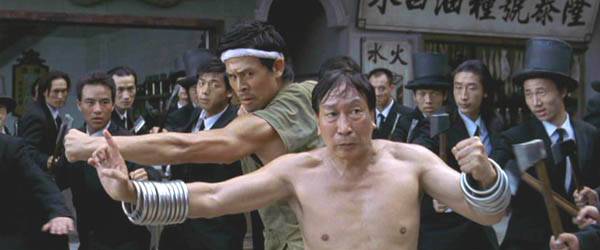 Stephen Chows Kung Fu Hustle is an underrated masterpiece. It is not that people have not seen the film and enjoyed the film but film goers do not see the brilliance of this satire on classic wu xia pictures effectively with Western slapstick from Charles Chaplin to Bugs Bunny to old gangster films. This combination of styles and homages leads to some of the most fun one can have at a movie theater. Think of Kung Fu Hustle as a perfectly made stew in which all these ingredients are put together to make one delectable dish. A lot of the credit has to be given to Stephen Chow who never had the respect of a Jackie Chan. His action and martial arts are as exquisite as Chan and his comedic styling goes above just the usual martial arts slapstick, poking fun at the genre as a whole rather than playing a man in an extraordinary circumstance. People criticize this film for its lack of substance or gravity when compared to a Hero or Crouching Tiger Hidden Dragon but there has been no movie as creative and skilled at bending genres since Quentin Tarantinos Pulp Fiction.
8. Police Story
 One of Jackie Chans first lead roles in American cinemas was in The Protector. Now being a director of many films himself already, Jackie Chan was said to have such a terrible time in this American cop film that he decided to go back to Hong Kong to make what a real police drama should be. The result is one of the best action cop film on par with Lethal Weapon and Die Hard. Police Story was able to have both emotional depth and comedic levity that only Jackie Chan can bring. Here in all his glory are the best of his stunts including running down a huge hill and a sizzling mall scene as well as some of his best comedic moments including a slapstick chopstick, phone routine. No one ever gives credit for how much of an auteur Jackie Chan really is. Not only does he direct his own films, but he stars, writes and does the stunt choreography in them as well. His natural charisma is no wonder that he became the biggest Chinese, crossover star since Bruce Lee. The influence of Police Story not only in Chinese cinemas but in Western cinema is quite apparent. Brett Ratner looked upon Police Story many times in making Jackie Chans biggest American hit Rush Hour and Bad Boys 2 took the shanty town chase scene directly from Police Story.
7. Eat Drink Man Woman
 Ang Lee is probably the most celebrated Chinese director for Western audiences. Unlike a Tsui Hark or a John Woo, Lees sensibility was able to translate to western terms. That is probably due to the fact that he was trained as a filmmaker in America. His films runs the gambit of genres from his take on the wu xia film, Crouching Tiger, Hidden Dragon, Sense and Sensibility and the CGI epic Life of Pi. But his most celebrated film is the emotional drama, Brokeback Mountain and that is where his strengths lie. That is clearly evident if you go back to Lees earliest works in China especially the wonderful Eat Drink Man Woman. The central conceit of Eat Drink Man Woman is the emotional relationships centered on food. From two generations, a chef contemplating retirement and his three daughters struggling with relationship issues gives a dynamic look on both modern Taiwanese life and the universal idea of relationships and generational struggles. Lee masterly combines romance, drama and comedy with really poignant looks at these three sisters. Their characterization is so dynamic and unique that its hard not to fall under the trapping and joy of being with this family despite all their flaws. This was later remade into the Spanish themed Tortilla Soup.
6. Infernal Affairs
 During the 2007 Academy Awards, William Monaghan won the Academy Award for best adapted screenplay for The Departed which was misattributed to the Japanese film Infernal Affairs when Infernal Affairs was in fact a Hong Kong film. Starring Andy Lau and Tony Leung, who are two of Chinas great actors, Infernal Affairs is an intense police drama about deception, doubt and the inner turmoil of living a lie. If you seen The Departed, you will be shocked but how lackluster that film seems compared to the much more tightly compact film that is Infernal Affairs. It combines the look of and styling of a Michael Mann and John Woo film though its engaging visuals through digital film. Andrew Laus cop thriller was said to have single handedly lift Hong Cinema from its creative stand still and for good reason as there is no film as complex and taut like it. Lau and Leungs lack of interaction together is as intense as the titillation of the Robert De Niro and Al Pacino relationship in Michael Manns Heat. And when they finally do meet, it is just as satisfying and shocking. All my problems with The Departed comes from the fact that Infernal Affairs made the film as perfect and compact as possible. This film was able to take an old worn out genre from movies and TV and inject it with creativity and life.
5. Come Drink With Me
 The classic Shaw Brothers wu xia films were less like a film filled with fighting but rather action scenes as a dance. Coming from the tradition of Peking Opera, the fight scenes in 60s and 70s Kung Fu films are fluid and visually enthralling if not fake looking. But, that does not mean they were any less great. Come Drink with Me is the perfect example of that. In fact the star of the film, Cheng Pei-pei, is not only a female protagonist, but was trained as a dancer. This is, by all means, the culmination of all classic Chinese cinema especially in terms of wu xia films which is all about mood and setting and atmosphere. Director King Hu, the master wu xia films, is able to create the mythical hero of the Golden Swallow, a female protagonist which is ever so rare in these types of films. Cheng Pei-pei, using her experiences as a dancer, is able to show grace and mystique in her moves. The elegance that she brings to her role is what makes the film excel as it does have its moments of being over longed such as these interludes of songs. But, the influence of this film is evident from Bruce Lee to Jackie Chan, so much so that there have been rumors for years that Quentin Tarantino was thinking about doing a remake of the film for the Weinstein Company.
4. Drunken Master 2
 Lar Kar-leung is a master of wu xia films including his masterful 36th Chamber of the Shaolin. In the original Drunken Master, Jackie Chan had not fully found his comedic sensibility and truly how to perform yet. 16 years after the release of the original Drunken Master, these two great Chinese icons decided to bond together to create Drunken Master 2 or The Legend of the Drunken Master in North American release. Once again this is a story of Wong Fei-Hong as he fights the evil foreigner, a storyline that populates a lot of Chinese films. The drunken boxing technique is marked with grace and virtuoso physicality that proves my theory that Jackie Chan is the last great silent star in that he embodies the type of comedy that Buster Keaton and Harry Lloyd represent. But, Drunken Master 2 does not simply just include comedic fight scenes as Chan and Kar-leung were able to infuse some dramatic moments into the film. The final fight scene is every bit as intense and hard hitting as a Nicolas Winding-Refn film. This is one of Chans rare films that show how truly great he is in the art of martial arts as well as accurately portraying his comedic sensibility. This is Chans defining film and the film that will be his legacy long after he passes.
3. Hero
 It is inevitable for every Chinese director to try their hand at a wu xia film. John Woo recently did the epic Red Cliff and Wong Kar-wai did Ashes of Time and The Grandmaster. But, the best of the auteur directors making wu xia films has to be the Jet Li vehicle, Hero. This film has the grandness of a Classic Hollywood epic, the colors and textures of an MGM Technicolor musical and the action that only Yuen Woo-Ping could bring. Zhang Yimou, mostly known for his dramas such as Raise the Red Lantern and The Red Shorgum, was able to get out of his comfort zone to make a masterpiece in Chinese filmmaking. Told in a Rashomon style format, it is another tale of revenge and love split into many parts with many allegories. That is the depth that Hero embarks with it ambitious story. And it is through the superb cast that the film is able to pull it off. Jet Li is an underrated dramatic actor with his western roles always limited because of language barriers but it is through this film that he is able to showcase the inner turmoil needed. The supporting cast is populated by familiar names and faces such as Donnie Yen, Tony Leung, Maggie Cheung and Zhang Ziyi to give gravitas to each role, making for a complete visual and emotional masterpiece.
2. Devils On The Doorstep
 Watching a lot of Chinese films, there is a familiar pattern within all the plots especially in terms of revenge and the foreign invasion. China, for as large of a country it is, went a long time being an isolationist country. Thus the usual mantra in a lot of Chinese films is how evil the foreigner is. It takes a brave man like Jiang Wen to go against the grain by making a film sympathetic, to a sense, of the Japanese during the Japanese invasion during World War 2. Take it this way; this film was so controversial that China banned Jiang Wen from directing a film in China until 2007. But, Wens satire isnt exactly about how great the Japanese were. In his beautiful black and white film, he is satirizing how media have perpetuated the notion of the evil foreigner while the Chinese simply went on as the submissive oppressed. And the fact of the matter is that this is able to carefully walk the tightrope of a horrendous tragedy with comedic slapstick moments. Think of a less optimistic opening and darker version of Life is Beautiful. He builds the relationship between Chinese peasants who captured a Japanese soldier and looks upon that dynamic with irony and it says a lot about Chinese sensibilities in this underrated classic.
1. In The Mood For Love
 Wong Kar-wai, a name that has populated numerous posts on this list, is in my opinion the best Chinese filmmaker of all time. This product of the Hong Kong new wave movement is able to use Christopher Doyles amazing cinematography to tell smaller stories of love and passion in the most original way. His magnum opus is In the Mood for Love. The second film of an informal trilogy, that includes days of Being Wild and 2046, Kar-wai pays homage to Douglas Sirk in this melodramatic tale of infidelious lovers in 1960s Hong Kong. The year plays an important part as it comes near the forefront of change in both Hong Kong and China. Just as Hong Kong began to become more modern, China began to go through the Cultural Revolution. All of this is on backburner as Kar-wai formulates this visually striking film that is a dagger to the heart emotionally. Under the pounding strings of Shigeru Umbayashis score, this tale of lovers is true, ethereal and passionate. Rich in all places, this was the only film that appeared in Sight and Sound poll for the best movies of all time from a Chinese country and one of two films from the 2000s to appear on the list. It is no wonder with how great this masterpiece is.