The Great Serial Killer Films #1: MEMORIES OF MURDER (2003)
Cinema has exploited the serial killer - both fictional and non-fictional - to varying results. Here, we showcase the best of this brilliant sub-genre.
There's something instinctively appealing about the serial killer film: The exhaustive and often overwhelming journey its protagonists must face; the terrifying notion of an unstoppable force ready to strike at any time; the relentless pursuit of clues and evidence; an insight into the mindset of somebody driven to murderous acts; the dark and twisted mise-on-scène. Cinema has exploited the serial killer - both fictional and non-fictional - to varying results. Here, we showcase the best of this brilliant sub-genre.
#1. Memories of Murder (2003)

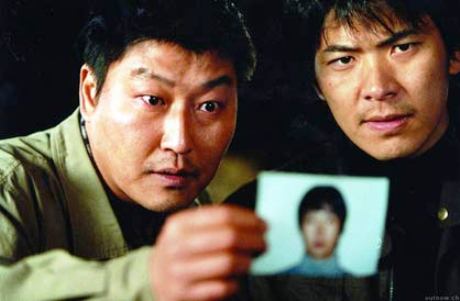 Emotionally complex and densely plotted, Memories of Murder should also be admired for the little details. In one brilliantly dark sequence, Park Man-doo and his partner Cho Yong-koo (Kim Roe-ha) drag a suspect to an interview room and attempt to beat a confession out of him. When blood splatters on Cho Yong-koos shoe, Park Man-doo throws a rag onto the desk, presumably to clean it off, only for it to be revealed as a boot-cover for his partner's shoe. Cho Yong-koo resumes the violence, shoe protected. But for all the films intention to show bumbling procedure and questionable ethics, the characters ultimately come off as troubled victims of their circumstances. These cops dont know any better, and its a notion that only serves to haunt them, especially when they might be looking a killer right in the eye and cant prove a thing. Theyre constantly resulting to embarrassing theories, exemplified during one scene in which Park Man-doo tries to convince the others that the killer has no pubic hair because no traces were found at the crime scenes. He takes to the bath house and surveys the naked men, only to realise how ridiculous an idea it was. The detectives also manage to beat fake confessions out of innocent men on a couple of occasions, which nudges at the legitimacy of previous criminals they've put away - how many should have walked free? Their inadequacy is put to further scrutiny when a city detective, Seo Tae-Yoon (Kim Sang-kyung), arrives to aid the case. His methods are intricate and innovative compared to those of Park Man-doo and Cho Yong-koo, but he soon finds himself on the cusp of insanity as the killer strikes again and again.
  The atmosphere conjured by images of thin alleyways, dark tunnels and makeshift villages is truly moody, and provides the film with an unsettling backdrop that emphasises the killer and his crimes. Memories of Murder also utilizes great camerawork, with brilliantly executed long takes and beautifully framed shots of the landscape that exists to taunt the detectives. Other highlights include a heart-pounding chase sequence, a comical scene at a karaoke bar, and a tense showdown with the potential killer in a train tunnel. Memories of Murder grants comparison to David Finchers Zodiac in its pursuit of the seemingly impossible. Like that movie, it isnt merely a telling of facts about a serial killer, but a brilliant meditation of police procedure and investigation in general. It is built with several moods in place, and like the case at hand, proves to be interchangeably satisfying and frustrating. As with the crimes that these detectives are forced to confront, this is a film you wont shake from your memory in a hurry. Exactly the directors intention, perhaps. Next time: Se7en (1995)