10 Video Games With Questions You Won't Want To Answer
Breaking your mind in the most satisfying way possible.
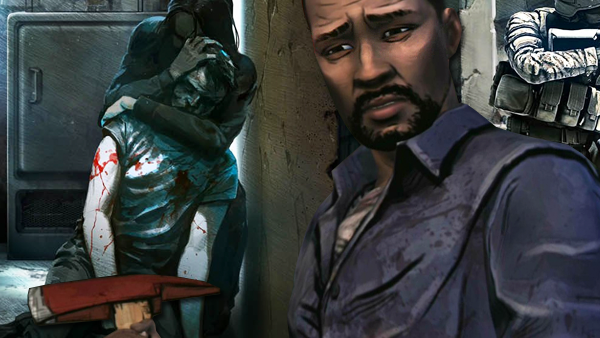
Whether it be an immaculately written story penned by a talented writer, series of revealing cutscenes or a glorious combination of the two, gaming has the unique ability to put you slap-bang in the middle of the action.
Down to taking far longer to get through than your average film or book, as a visual medium replete with actors, sound design, world architecture and intended pace, a team of creatives can load a given game with all sorts of takeaway messages and philosophical musings.
The best titles usually do this subtly, underpinning the biggest set-pieces or obvious emotional beats with wider world-impacting ramifications. Of course there's scope for expository dialogue and more direct messaging - the Metal Gear franchise built an entire brand on rooting the player to the spot and educating them on everything from politics to genome therapy - but I maintain the outright finest games are a blend of the two.
Whether said game gives you a choice to act is also up for debate. As you'll find across these examples, sometimes it's imperative for the player to be forced into taking action, and others, just living with a set of consequences can be way more powerful.
10. Is Your Family More Important Than Someone Else's? - Papers, Please

A game everyone should play to gain a more empathetical understanding of immigration processes, Papers, Please tasks you with evaluating a number of peoples' visas and papers, so they can enter the "glorious nation of Arstotzka".
Though deliberately inspired by Soviet Union Russia, dehumanising foreign bodies into statistics is a universal, impactful concept.
In a genius move, you're not just stamping passports and checking people for contraband - every penny you make goes towards housing or medical aid for your own family. Soon you'll come across husbands and wives where one half doesn't have everything in order - do you let them go through and risk a pay cut, or stick to the law? What if your child, partner or parent is sick, and needs the money?
Papers, Please pulls no punches, and there are repercussions either way.
As the game goes on, the stakes increase. It's only a few hours in where you're given a gun and told to fire upon anyone making a last-ditch effort to cross the border. There's a financial incentive to upholding the state's directive... but you might just find yourself feeling incredibly hollow at the same time.
9. Could You Steal, Maybe Kill, To Stay Alive? - This War Of Mine

Inspired by the Siege of Sarajevo from 1992-96, 11 bit's depiction of civilians struggling to rebuild and get by in any war torn province is genuinely eye-opening.
Essentially a survival game with light stealth elements, it's on you to figure out how to get through the day and night. Rubble will need clearing, food cooking and general mental states maintaining, but at night, you get the choice to venture out into the city.
Here is where things get very dark. Hospitals are sure to have medical supplies - but will also be more populated. The same goes for shopping malls and churches for provisions and even weapons, but there are residential areas to pilfer too.
An elderly couple, a family already terrified and holed up in their rooms - expansion The Little Ones added children to the mix, just incase you weren't morally fractured enough. The more desperate or somewhat villainous you play, the more your characters will feel the effects - even committing suicide if they feel the ends don't justify the means.
8. Is Organic Life Inferior To Machines? - Mass Effect

Though its divisive, oh-dear-god-what's-happening ending went down in gaming history as a dud, the core question at the heart of the Reapers' purpose is more than worthwhile.
Set up as a mass extinctive force triggered every few millennia as a galaxy-wide reset button, they operate off the back of the idea that life isn't worth living, if it's not always optimal. Controlled by the Catalyst (Starchild), Mass Effect 3 posits that on a long enough timeline, synthetic life will always rebel against natural life, and thus, by wiping the board, everyone gets a fair chance again.
It's the nuclear option in-world, but taps into the idea that life should always be streamlined. That the errors and bumps along the way - however violent - are "unwanted", and should seek to be purged.
Mass Effect 1 also tackled this through Saren; the villain of the piece who actually thought he was doing all of us a great favour. Saren's solution to the Reaper apocalypse was to assimilate people into Geth, thereby "saving" them through conversion, as a machine body would assumedly be more efficient.
7. Is Nuclear Annihilation Inevitable? - Metal Gear Solid: Peace Walker
- Spoilers for MGS: Peace Walker -
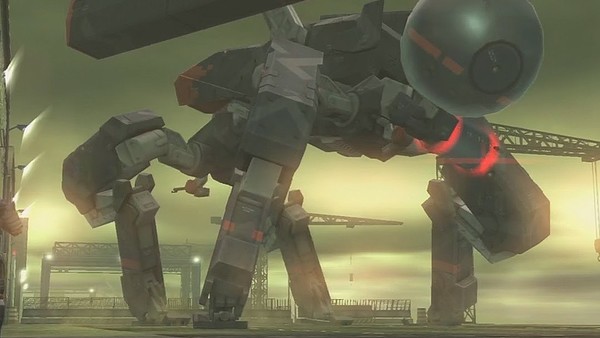
Peace Walker is easily the most underrated of all the Metal Gear games, centred on the Cuban Missile Crisis and nuclear warfare, both tackling the moral ramifications of what it means to pull the trigger on catastrophic actions.
In real life, the bombs dropped on Nagasaki and Hiroshima came not from a President or planner, but two pilots, Charles Sweeney and Paul Tibbets, who would comment to varying degrees as to how being directly responsible for this action weighed on them over the years.
With that in mind, what if the human element could be removed? Here, the Peace Walker mech and A.I. program is designed to retaliate against any initial nuclear strike automatically, circumventing the thought processes and judgement calls that go into continued nuclear war. Character Hot Coldman (yes, really) states that nuclear deterrence is not a viable model for the longterm as humans will ultimately protect their own species rather than follow through on what they've created, which is one hell of a "you've made your bed, now lie in it" fatalistic comment.
Through Hideo Kojima's lens, the only thing keeping us all from going extinct is empathy towards one another - a trait that as we've seen in the past, isn't as ironclad as we'd like.
6. Is Your Want Greater Than The Needs Of The Many? - The Last Of Us
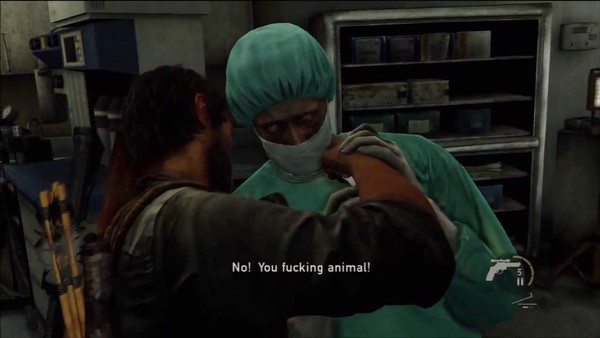
Similar to Papers, Please but more on an individual basis without the element of choice, The Last of Us forces you to embody a character that actively slaughters a population-saving surgeon to reclaim his surrogate daughter.
The core of the matter is Joel's burgeoning love for Ellie, and how - when told she'll have to die to fulfil a procedure to cure humankind - he can't let this happen. Joel fundamentally makes a selfish decision; it is objectively worse for humanity that they can't be cured of the Cordycep virus, and yet, we totally see where he's coming from.
Imagine if your partner, child, parent etc. was the key to humanity's salvation, and even before you could say goodbye, you're given the news of never seeing them again.
Does the wider world's thanks comfort your loss, or is that person irreplaceable to the point of taking action?
5. How Far Would You Go To Save Your Child? - Heavy Rain

Flawed in the script and voice department it may be, but Heavy Rain's portrayal of father Ethan going through hell to save his son is a mighty enjoyable, semi-relatable tale.
Across the game he's tasked with everything from driving at high speeds into oncoming traffic to severing fingers to even executing someone, all to prove a level of love and devotion to his son, in front of the Origami Killer.
At any point you're free to walk away. Heavy Rain has a number of endings depending on what state Ethan is in and how far down the torturous rabbit hole you went.
Say what you like about David Cage, at least in this he really made us make nerve-wracking decisions with real consequences.
4. Your Job, Or Your Friend? - A Way Out
- Spoilers for A Way Out -
A game that forces you to play the whole thing in split-screen co-op, if you do so in-person with someone like a partner or best friend, that bond starts to take on a life of its own.
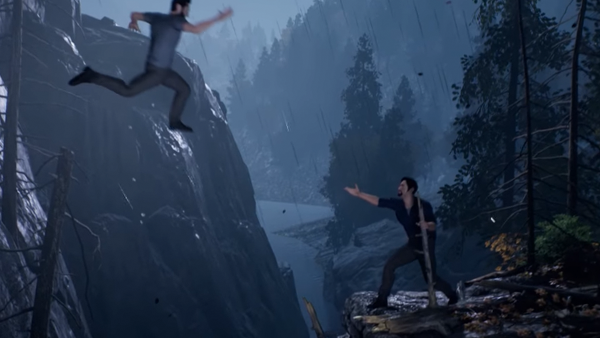
All of which is why - when character Vincent is revealed to be a cop looking to bring Leo in after working together to kill a mob boss - it shatters everything, setting up a final third where both heroes are on opposite sides of the thin blue line.
Brilliantly you're given ample opportunities to fight it out in-game, doubling as frantic real life conversations around whether the person playing Vincent will let Leo go, or for the latter player, fight for their life.
We can extrapolate this into everyday situations, too. In any given moment of choice, be it career-oriented or anywhere else, do you go with what will make you happy, or can you obey what's being asked?
3. Could You Kill A Child As "The Right Thing To Do"? - The Walking Dead
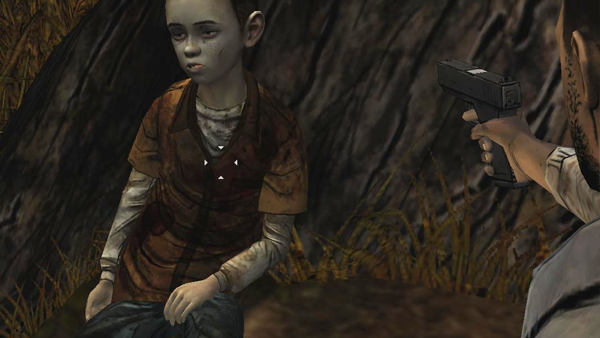
A staple of zombie fiction is analysing humanity by comparing it to the slovenly hordes baying for brains, though by creating this juxtaposition - the notion of "I know I'm not them" - where does it end?
2013's The Walking Dead parsed this out through childlike innocence in a world gone south. At many opportunities you're given the option to shield 10 year-old Kenny "Duck" Jr. from the realities of the zombie apocalypse, even playing with him or talking about anything other than death whenever possible.
Then... he gets bitten, and everyone knows what has to happen next.
Short of making some comment on what to do with a catatonically ill patient if they're trapped in their own body, its deemed best to put Duck out of his misery before he fully turns - though the parents have an understandably hard time doing so.
At this point you can step in, if you want to, but is it what's right for the child, the parents, or those around you?
2. Would You Die For Your Country? - Metal Gear Solid 3: Snake Eater

Said to be Hideo Kojima's best-written instalment in all of Metal Gear's history, Snake Eater's tale of a turncoat soldier revealed to actually be undercover the whole time is a solid foundation for an extrapolation of patriotism and duty.
Where A Way Out asks you to make the choice, Snake Eater unfurls an entire setup where character The Boss is forced to take the blame for a rogue nuclear detonation - after initially being sent to deliver the warheads in the first place - only to then die by the hand of player-character Snake, so America's government could save face.
The ultimate fulfilment of enlisting and dying for your country, Kojima plays it out through the mentored relationship between Boss and Naked Snake. We the player are just as green and new to survival in the jungles of Russia as Snake, and finding out we have to "step up" to take out the person we revere as a powerful teacher is possibly Metal Gear's finest moment.
Most gut-wrenching of all is seeing Snake's final salute at Boss's grave. Only a handful of people know the truth of her sacrifice, rather like the many individual, real-world war stories that have contributed to you being able to read this article today.
1. Do You Trust Humanity Not To Repeat The Mistakes Of The Past? - Horizon Zero Dawn
- Spoilers for Horizon Zero Dawn -
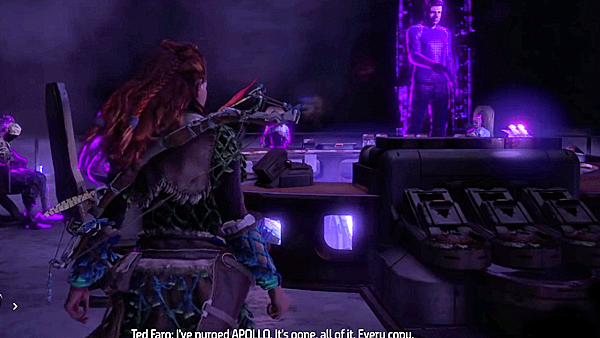
My personal favourite question in any game, Horizon's final few twists establish that upon receiving the knowledge that humanity was doomed to a viral robot-caused apocalypse, Faro Automated Solutions' Ted Faro put together "Operation Enduring Victory": A way to archive all the world's knowledge and human history for an appropriate point in the future, to be accessed by swathes of test tube babies after the machines had died out.
However, having a change of heart, Faro purges all the records at the last minute, removing any semblance of a populace and dooming the future human race to start all over again.
Faro states that a future race of humans would be better off not knowing the failings of what went before, and it's a fascinating question:
Would you leave behind footage and plans of nuclear weapons or Agent Orange gas, hoping people will learn to never replicate such things... or have you just provided the means to do so?
Do you trust humanity, yourself, not to make the same mistakes if given the same information?