15 Most Disappointing Video Games Since 2000

Come in, sit down. It's okay, we've all been through a lot together.

You'd think in 2014 when we're all firing off opinions into the nether like some sort of rant-based observational warship in the oceans of Twitter, we'd of learned to curb our expectations a little. These days the metric of opinion is either 'the best thing ever!' (usually typed in capital letters) or the experience at hand is only slightly more preferable to the bubonic plague. But how can you keep a level head when you're being assaulted from all directions by a constant stream of bright colours, explosive PR buzzwords and visuals that somehow always find some new way to make past experiences look enticing again? Franchises like Assassin's Creed and Call of Duty have ran themselves into the ground thanks to annual releases playing too much on the more forgiving among us who inevitably reconcile to thinking "Okay, just one more, then I'm done!" - only for those same people to realise they've pretty much bought the same thing again. Although those two examples are fairly recent, the issue of thinking you're buying into one thing only to subsequently end up with another goes back for as long as there's been trailers created for anything. When it comes to games we always want to champion a new property, as although there's something to be said about games sticking to formulas they've perfected, you just can't beat a completely new franchise coming right out the gate and nailing every aspect of its production in the execution. That being said, these are not those times, the following entries are compiled from a collection of disappointed feelings that stem from things such as misleading marketing campaigns, broken gameplay mechanics, bad graphics... and everything in between.

15. Watch Dogs

You had one job: Make our new consoles feel worth it. So let's get Watch Dogs out the way, as it's easily the most recent example of what appeared to be the entire online blogosphere rallying behind a title, only for the final product to conjure the sort of fan-fury reserved for major sporting events. What caused the major public outcry from everyone was twofold: Firstly many of us decided we were going to invest in the shiny likes of the PS4 and the Xbox One purely off the back of this high-tech GTA-tinged extravaganza back when we first saw it at E3 2012. A release date was then set for November the following year and all was well, as the new consoles were also arriving around the same month too. That date was then cancelled, and a much further off change of May 27th was now what we were staring at - albeit after the majority of us had pre-ordered or bought the new consoles. This didn't matter though, right? Surely the extension was just to further refine the gameplay, graphics and bugs? Nope, it was to tack on some ridiculously Saints Row-esque minigames, the most sellable one - Ubisoft thought - was that of controlling a giant mechanical spider around the city whilst your character was on a 'digital high'.
As if the sinking realisation that the game could have been released the year prior wasn't enough sans these inclusions, the state of the graphics in the final version were quite considerably worse than what was originally shown. Ubisoft ensured us that the downgrade was made to ensure the game ran smoother, but when PC owners delved into the game's code and found a way to restore the game to it original - much better - state, the whole thing turned into a farce. It's one thing to change your game for the supposed greater good, but it's something else entirely when the fans themselves prove you wrong, and do your job better than you not weeks after release.

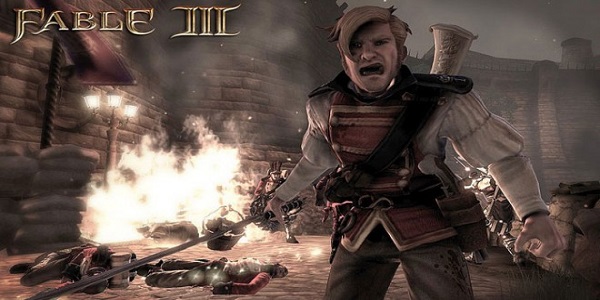
14. Fable 3

You had one job: Don't remove features. Visionary motormouth Peter Molyneux is one who divides people like a hype-knife through gaming butter, but for many even after the original Fable didn't live up to some of its lofty claims, part two came in and was one of the best RPGs of the generation. Surely it's just a case of part three wrapping it all up nicely, right? Wrong, Fable 3 was an absolute mess in everything from core features being removed to a story that didn't just go off the rails, it practically buried itself at the bottom of the cliff in pointless last-minute gameplay mechanics. In Fable 2 we were given a dog companion; something that Molyneux made a huge deal of as you never controlled him directly, instead he reacted to your actions and would get stuck into combat, becoming an obedient best friend or a hound from Hell depending on what you did. In Fable 3 none of this mattered, as where before you and your pooch were tied together in a compelling narrative with the world reacting around you, Fable 3's "Now you're the king!" intro left us with nowhere to go. That was just one aspect of where things felt a little off, as in addition we had a cack-handed map system that saw you trying to relate strange minimalist dioramas of towns to their real life counterparts, whilst also literally walking around in a room that represented what was previously a very accessible inventory menu. It was a case of forced iteration on the part of Molyneux and his team at Lionhead, and in trying to fix things that weren't broken in the first place, we got a overproduced mess that appealed to nobody.

13. Grand Theft Auto IV

You had one job: Make a bigger, shinier version of the GTA formula. Now obviously it must be said that GTA IV is still a phenomenal game, and stands alone as a great entry in the Rockstar pantheon as when they tried to do something a little bit different with one of their own IP's, rather than starting off a whole new franchise. For many though (as we covered over here) the Niko Bellic-fronted foray into more serious territory is the one that they just couldn't get on board with. Let's take Niko himself to start with, as even though he was another fully-voiced protagonist who also had a few humorous one-liners, come the game's end he was utterly unmemorable thanks to an overall attitude that didn't really seem to engage with the people around him. Niko wasn't all to blame though, the list of annoyances would go on to include some shockingly difficult driving mechanics, the character of Roman ringing you up every few minutes to hang out, and an overall tone that just didn't 'feel' like GTA. It was too dour, too melancholy and just too boring. Even the soundtrack itself and the DJs within didn't have the personality of San Andreas or especially Vice City, although people would come to refer to the series' new direction in relation to that of Saints Row as "Michael Mann to Michael Bay", this instalment might have worked better as spin-off, rather than the main sequel to part three.

12. Haze

You had one job: Deliver a system-selling FPS on Sony consoles. After Halo landed on consoles and ushered in the first-person revolution, Sony was looking to label anything as a "Halo-killer." It was a great buzzword and sounded suitably badass to any fanboys wanting to lay their eggs in the big blue Sony basket, but when the first games labelled with that term were the supremely boring Killzone titles, all eyes then shifted to Free Radical's Haze to deliver the goods. Once again the label proved to be the kiss of death as the former Timesplitters developer kicked out a game that was caked in terrible textures, a barely-engaging plot and an overall 'feel' that didn't even begin to make the most of the powers that were advertised. It was a shame, because people really wanted to get into Haze. It had a pretty slick aesthetic with some neat armour setups, and with the core gameplay mechanic revolving around jacking up on a substance called 'Nectar', in the game's lore it blocked out all sorts of nasty visuals. You could play dead to avoid being seen - before then jacking up yourself to jump higher, reigning death down from above in glorious slow-motion. Sadly when the final product played like a tech demo, that description was more fun to read than Haze ever was to play, and Free Radical would go on to become acquired by Crytek, redeeming themselves somewhat by helping out on both Crysis 2 and 3.

11. Star Wars: The Force Unleashed 2

You had one job: Give us much more physics-based mayhem. Long before George Lucas would sell off his favourite cash cow and allow other people to expand on the story, he would have a hand in developing 'Starkiller'; the naffest-named hero this side of Blobert. Taken as canon, the first game told the story of Darth Vader taking a random child under his wing who's powers he sensed from an early age before raising them to become his apprentice - although in the end the two of them would end up taking each other on regardless. It was a fantastically enjoyable third-person romp through a few memorable locales that took the very idea of having force powers and cranked the dial past 11; you could actually pull a Star Destroyer straight out of the sky with your bare hands at one point. So what happened for the sequel? How did they attempt to top this universe-expanding narrative and the accompanying setpieces? They released five very short missions that reeked of initially being downloadable content for the first title, as a fully-priced product. It was one of the laziest examples of game design seen in years, and when the levels themselves only had a few moments you'd want to bother to repeat, this was traded in in the thousands within weeks.

10. Too Human

You had one job: Make Norse Gods-in-space enjoyable. What do you get when you take Norse mythology, high-tech laser-looking weapons and a proven developer who gave us the pioneering Blood Omen: Legacy of Kain as well as the Metal Gear Solid remake, Twin Snakes? An insurmountable mountain of hype to climb over, that's what. With a third-person combat system the nearest comparison of which is Blade 2 or Jet Li's Rise to Honour - in that the right analogue stick is mapped to your attacks rather than the camera - you might have already gotten a sense that there was a colossal stinker amongst the game's otherwise stellar marketing pitch. Inevitably the finished product didn't deliver on the idea of a high-tech viking adventure, instead stilted graphics and movement purveyed every nook and cranny, with a death animation that was so long it gradually grated on players so much that it was often vastly preferable to just turn the game off altogether than wait for another reboot. Designer Dennis Dyack should have been up there with the other notable names in the industry like the aforementioned Peter Molyneux thanks to his work on fostering the Legacy of Kain series, but instead Too Human was such a lead weight, it dragged him too far under to even be recognised.

9. Metal Gear Solid 2: Sons Of Liberty

You had one job: More Solid Snake. Wait, put the pitchforks down, there is a method to this madness. Judging by the polarising effect mentioning MGS 2 in a group of gamers always has, it's safe to say there's a largely unspoken contingent of fans who are waiting to rant their eyebrows off at just how ludicrous the opening premise of Sons of Liberty actually is. This is thanks to creative overseer Hideo Kojima, who following one of the most positively received games in history alongside establishing the quote-worthy Solid Snake as one of the best new characters - then decided to replace him with a spindly, white-haired effeminate fop called Raiden. His justification behind doing so was to give the Snake character a completely different perspective, and the only way to do so was switch control over to someone who was the total opposite of what we wanted. Whether that's genius or not is up to you, but the thing that really cheesed people off was that Snake's short section in the game was actually completely missable if from the first menu screen you mentioned you hadn't played the first game. In addition to this if you happened to pick the wrong option, the game's lengthier chapter would open up with a masked Raiden being referred to by a certain codename. Yes, the codename was of course 'Snake', meaning Kojima was quite directly trolling people regardless of whether they 'unlocked' the first proper Snake mission or not. It was enough for some to be tarnished on the game right from the start, and as MGS 2's plot went off the deep end in terms of crazy characters and events, it's still a title that divides any who played back on release.

8. Uncharted 3

You had one job: Create more memorable set-pieces. Uncharted 2 is easily one of the greatest games of all time. a landmark achievement for interactive entertainment, Naughty Dog put together a blockbuster for the ages that could easily rival that of film. By matching the fun adventure-stylings of Indiana Jones with the exploration-gameplay of Tomb Raider, the whole package was sealed with a bow courtesy of an exemplary cast who brought every character to life perfectly. So we had one fun first game and an industry-defining second iteration, you'd be forgiven for thinking we'd be getting either more of the same or something that would have at the least a good handful of talking points. Instead although U3 isn't 'unplayable' or anything resembling a 'bad game' on an objective level, there was just a feeling of going through the motions when completing its various tasks and quests. The Uncharted series has great gunplay and melee combat to a certain extent, but it thrives on the ability to create the sorts of overblown summer blockbuster-set pieces we see every year in movies, and putting you directly in the middle of them. Part two gave us a marvel of game programming in a level set on a moving train, as well as a gunfight aboard a fleet of speeding jeeps, whereas although U3 delivered a fantastic scene aboard a sinking ship, it just didn't have the narrative drive and weight behind the explosions that its predecessor did.

7. Resident Evil 6

You had one job: Don't copy Gears of War. Here we're going to go for part six, but many fans cite five as the one that put them off the franchise thanks to a reliance on shotguns and punching zombies rather than white-knuckle thrill-rides. Resi 4 is still touted as the game that allowed titles like Gears of War to flourish - as previous stop n' pop cover-shooter Kill.Switch completely failed at exactly the same gameplay back in 2003. But in taking that idea of putting you in increasingly action-based scenarios, Resident Evil would move away from its roots and more into a weird hybrid of what the series used to be, and what the movies became. By the time part six rolled around Capcom had fully embraced this idea, putting quick-time events behind major cutscenes so you were hammering away like a gibbon trying to force animations to play out whilst having firefights break out every five minutes. Firefights between you...and the zombies. Yes, although many have said that infected creatures are not worthy of the 'zombie' title as they're not the living dead, regardless in RE6 we saw the hordes take up arms and cover, trading shots with the inflatable-arms of meathead Chris Redfield. All-in-all Resi couldn't even do these levels well as the gameplay systems put in place through part four were never meant to handle Gears of War-style firefights and flanking manoeuvres, leading to a franchise completely devoid of any identity that played like a bizarre RE4 mod from seven years prior.

6. Beyond: Two Souls

You had one job: Don't overdo the supernatural stuff. For all the things director David Cage does well - that not being very many depending on your thoughts on Fahrenheit/Indigo Prophecy and Heavy Rain - he thoroughly pooped the bed when it came to Beyond: Two Souls. Set to easily remedy the bad voice-acting complaint levied at Heavy Rain by starring Ellen Page and Willem Dafoe, Beyond was supposed to be a deeply emotional and moving experience surrounding Page's character Jodie as she is forced to grow up whilst tethered to an invisible spirit. Cage's first major release Fahrenheit had an impeccable premise - especially for the time - as morale choices in games were far from common. Playing as a man who'd murdered another whilst in a trance, it left the different ways to escape up to you, although come the end all that was thrown out the window as the narrative into a really bizarre Matrix-esque story. Revolving around you being 'The One', you then fought a magical tramp on a rooftop before stopping the world from being overtaken by techno-aliens. As you do. Heavy Rain fared better at wrapping up a narrative without relying on supernatural garbage to tie things together, but with Two Souls Cage returned to the absurd once again, animating such ludicrous scenes as a demon within a sandstorm you had to run away from, and a final supposedly moving moment where Jodie chose her life-partner from a menu.

5. Brütal Legend

You had one job: Deliver on the trailers. There are some people in the industry who can do no wrong, and as much as in every other instance this would be true for Tim Schafer the way he advertised and promoted Brutal Legend all the way up to just before release was damn-near misdirection. The game itself still has one of the best premises ever concocted; you play as a muscled-up heavy metal roadie named Eddie Riggs (voiced by Jack Black) who after taking up a position with a godawful pop-metal outfit who sound like One Direction on guitars, magically gets transported into a universe where old school metal artwork and culture is brought to life. Featuring Ozzy Osbourne as your sage weapon-provider, a soundtrack comprised of everything from Motörhead to Mastodon and gameplay that appeared to be God of War hack n' slash with guitars, how could it possibly fail? Well, by having the majority of the game actually be a real-time strategy game, that's how. In a move that's still praised for the sake of originality, you control the troops and the battlefield overall by manoeuvring Eddie in a manner similar to that of the Dynasty Warriors games. There is some hacking and slashing to be had, but most of the time you'll be trying to round up troops to send somewhere else before sprinting off to protect a structure you need to stay up, only it to fall apart, sending you back to the very start again. It was agony, and when you had characters, cutscenes and weapons that were bursting with character and originality, seeing it all effectively go to waste in such a missed opportunity was heartbreaking.

4. Aliens: Colonial Marines

You had one job: Make it playable. We should have known better, being there was never a good aliens game prior to this, and the complete lack of a demo or in-game footage in the lead-up to release was very telling of a developer not confident in what they were about to put out. However what appeared to be a lack of confidence turned into a full-blown attempt at stealth camouflage, as the final product we collectively held and interacted with was barely anything resembling that which was advertised or talked about, with explanations nowhere to be seen. Side-by-side screenshots of the game only a few months apart showed a drastically different state in each - with the 'newer' version actually looking so downgraded you'd swear it was released on the previous generation of hardware. It wasn't just the graphics either, not soon after release people tried in vein to find something, anything that was a saving grace to the increasingly terrible production value, and instead came across all manner of hilarious bugs and glitches - the most asinine being an Alien that was stuck in an animation that appeared to make him tap-dance.

3. Mass Effect 3

You had one job: Wrap up the loose ends. Until Watch Dogs took its crown, this was the go-to game for en masse hate-a-thons throughout the last few years, but not entirely because of its ending. ME3 tends to get thrown under the bus (and reverse-parked over) due to the absolute train-wreck that was its final half hour or so, but even from the start there were a few things that just felt a bit amiss about the entire experience. In an attempt to flesh out your Commander Shepard character, Bioware opted to let them speak for themselves in far more scenes, whereas before you'd chosen every dialogue choice and meaningful action. It was done because one of the main parts of the narrative was Shepard's relation to a young boy at the start of the game who appears to be killed by the alien Reapers, who he/she then has recurring nightmares about. However this doesn't exactly seem like the right sort of behaviour for a militaristic space marine, who if you so chose was a total hardass when it came to their crew, punching journalists for asking too many questions and throwing other characters out of windows for not cooperating. It was an element to the overall story that just didn't sit well with the previous game's allowance for open-ended exploration and realisation of character, something that was further compounded by a release-day bug that didn't recognise some peoples' previous saves, meaning they couldn't carry over their established characters regardless. Throw in a host of graphical glitches where character models would sometimes not load in and make it look as if you were talking to thin air, an animation system that jolted between one state and the next and an overall plot that actually made you feel bad for exploring the galaxy, and part three's problems were far greater than just the ending.

2. Dead Island

You had one job: Deliver on the emotional trailer. We were all fooled once, but never again. Just the other week at Gamescom we finally saw a bunch more in-game trailers of upcoming titles, but at E3 nearly all the latest reveals were comprised of CG showcases, hinting at what the final game will look like, but not showing it in action. Let's be eminently clear; CG trailers are absolutely pointless now. Outside of serving to very slightly raise an eyebrow in terms of "Hm, that looks cool" it's always followed immediately by "...I wonder how it'll play." The reason behind this utter lack of faith in them comes from a handful of titles showing their games off in ways that they couldn't possibly deliver on, but with Dead Island it was something far more passionate. https://www.youtube.com/watch?v=ialZcLaI17Y Opening with the shot of a deceased little girl, the entire thing then plays out in reverse, showing how she fell from a great height after being bitten by a zombie and attacking her father - who was himself dealing with the horde in an extremely gory manner by swinging a fire axe around. We all came away from this very affecting piece of footage convinced that DI was going to be an incredibly moving and visceral tale that would test us to our breaking points when it came to dealing with family members and the surrounding enemies. It did neither very well thanks to a shoddy broken-feeling combat system, and characters you knew you were supposed to care about, but thanks to a pace that fired you from one location to the next it was harder keeping track of what was going on, never mind anything else.

1. Devil May Cry 2

You had one job: Keep the series' style and character. Like an entry into an established movie canon that everyone just discards when it gets back on track, DMC 2 took one of the most responsive, lightning-fast combat systems ever put to game... and slowed it down. It also thought that if one of the biggest selling points of your original title was a character called Dante - who was full of one-liners, animated exchanges and cocksure swagger - you should introduce an alternate person to play as, whilst making sure the hero himself retains nothing about what made him so memorable in the first place. The franchise would re-engage the ridiculous with part three in the first few opening cutscenes, but for DMC 2 we journeyed to a series of bland, black n' grey cityscapes, along with huge expansive arenas that still had the same small enemies wandering around for the most part. Capcom did introduce a badass wall-run move that let you flip off vertical surfaces to blast demons from above, but it wasn't enough to save a game whose entire feel just came across as what the original game might look like if all the fun and personality had been sucked out of it. Are there any other titles we've missed that totally deflated you? Let us know in the comments!

Gaming Editor
Gaming Editor

WhatCulture's Head of Gaming.