The Legend Of Zelda: Breath Of The Wild Review - 9 Ups & 1 Down
You've not played an open-world game like this.

Iterating on one of the most time-tested, influential and all-round popular gaming formulas of all time is never an easy thing. It’s why Nintendo have mostly stayed true to the template they established for The Legend of Zelda back in 1991’s A Link to the Past, though that gets around the fact, that the inaugural 1986 original had far more open-ended aspirations.
Enter Breath of the Wild, an entry in the series that revitalises those core foundations and rebuilds them anew. If you can imagine a world where the original Zelda was a one-off, and after 30 years, Nintendo decided to resurrect what would then be an ‘old classic’ to give it a new lease on life, Breath of the Wild is that game.
Yes, it takes the lessons learned from how Nintendo would iterate and innovate over time, but going forward, if we ever talk about how a game or franchise is ‘rediscovering its roots’, Nintendo have provided a new industry standard on how to do so.
As you've no doubt seen from the overwhelmingly positive press coverage, Breath of the Wild is fast-becoming the best-reviewed game of all time, but how does that break down into what really works and what needs calling out?
Down
1. Combat Can Occasionally Show Its Age

There's just one slight negative, but let's get it out of the way.
So, in a world where Dark Souls nigh-on perfected third-person combat or other titles such as The Witcher 3 and Horizon Zero Dawn have all manner of dedicated dodge buttons and rolls, the 3D Zelda-standard 'four-way evade' system that was first established WAY back in 1998's Ocarina of Time can feel incredibly outdated when going up against tougher or more agile enemies.
Atop the fact that there's almost nowhere for you to go when a larger creature takes a swing other than learn to parry or dodge at just the right moment based on their specific animation, even locking on itself has a habit of targeting a creature across the room instead of what’s right next to you. During one particular fast-paced boss battle, it was all too easy to lose track entirely, and being said foe could fell Link in one hit, it resulted in some supremely cheap-feeling deaths that were entirely the fault of the game refusing to do what was asked.
For the vast majority of time these things aren't an issue, but when Breath of the Wild really wants to keep you on your toes and go sword-to-shield with a hulking boss or series of lightning-fast encounters, there's a chance its very own systems will be the death of you.
Ups
9. A Love Letter To Fans

Without giving away too much - because it's really best experienced going through yourself - let's just say Breath of the Wild has direct ties to both the last 30 years of its own in-game history, and to all sorts of fan theories and prevailing think-pieces the most hardcore Zelda-lovers have put together.
Putting you in the shoes of an amnesiac Link and marrying your own inquisitive nature as to the status of Hyrule and its inhabitants, you're free to ask questions on things you "should" know - the perfect setup, considering this is the Switch's launch game and millions of newcomers will be playing.
Nintendo playfully acknowledge the fourth wall, celebrating the mythology and literal 'Legend of Zelda' both in-game and in the real world. Specific memories are locked to places in the environment, providing an entirely different way to play the game if you're less interested in immediately stopping Ganon, and would rather attempt to put Link back together.
From the reworked core themes and sound effects you'd pick out from a crowd to all manner of unlockable outfits, secret characters and locations that walk the line between being awesome easter eggs and functional in-game components, Breath of the Wild has been built from the ground up to do The Legend of Zelda (in-game and out) the utmost justice.
8. Physics-Based Powers & World Design

When it comes to changing the 'Zelda formula', gone is the need to gate off parts of the environment behind a specific item or unlockable. Yes, there's a tutorial to get you started, but once you've got your handy Sheikah Slate loaded up with all its basic functions, every last part of the gargantuan world around you is open for business.
Because to be fair, "See that? You can climb it!" has become an open-world catchphrase, but BotW gives its landscape real consequence, mixing a stamina-dependant climbing, swimming and traversal system with a number of elemental and physics-based powers. All of these feed directly into how you'll approach enemy camps and underground puzzle Shrines (the new Dungeons), allowing you to tap into a more experimental mentality when deciding what to do.
Want to set fire to a pile of wood, then use a Kokro leaf to blow the flames into some exploding barrels? Feel free. How about grabbing a boulder with your levitation power, dangling it above a boss and dropping it straight on their head? All the in-world 'elements' react as they should, opening up the playful nature of any interact-able scenario more than any other entry in the franchise.
7. Addictive Puzzles Are Perfectly Designed
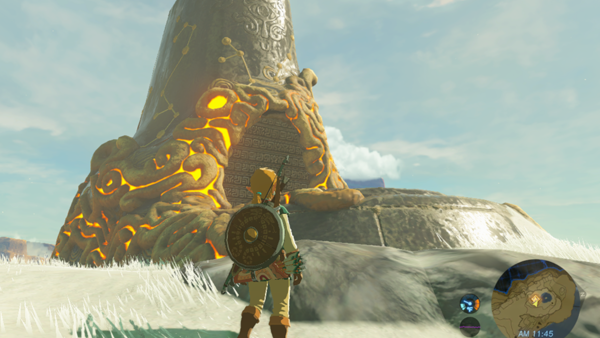
What's a Zelda without puzzles?
For decades we've gotten all too familiar with collecting specific keys and opening specific chests, being rewarded with key items and moving on - it's the Zelda way, dammit.
Breath of the Wild says "pish posh" to such an assumption, as Director Hidemaro Fujibayashi has redesigned the very way we think of - and interact with - puzzles overall. Now they're bite-sized underground Shrines, all only being around 15-30 minutes long (depending on if you get stuck) and ranging from motion-controlled carnival game-type scenarios, to combat trials or using combinations of your base powers.
There are around 100 of these in total, all dotted around Hyrule, all found by either finding the high ground and looking for their glowing shells, or listening to your forever-pinging Sheikah Sensor. Point being, as the Switch is built for home console gaming and portable play, these Shrines fit the bill whether you've got 30 minutes or 30 hours to spare.
6. Reinvents The Idea Of An Open-World

Think of the open-world genre as a template. Every single developer looks at it as an excuse to parse out collectibles, mission start prompts and all sorts of 'optional side content' to fill your time. In essence it's a lot of time wasting, and unless you really have a lot of time on your hands, you'll never see all of these things through.
In BotW, the world feels like one big, traverse-able 'level'. Thanks to how your Sheikah Slate can push and pull every part of it and how you're free to stealth-crouch, climb over or blast your way through the rest, there's an unparalleled degree of freedom to Link's agency from front to back.
MGS V: The Phantom Pain certainly tried this too, letting you tackle missions from any direction - but they were still very specific 'pockets' of the world where these missions occurred. Yes, Breath of the Wild has Bokoblin camps, cities, villages, Shrines and more to find and discover, but to even get there requires a degree of play and interaction that completely reworks the purpose of such a large, detailed environment.
5. The Right Way To Do Survival Mechanics
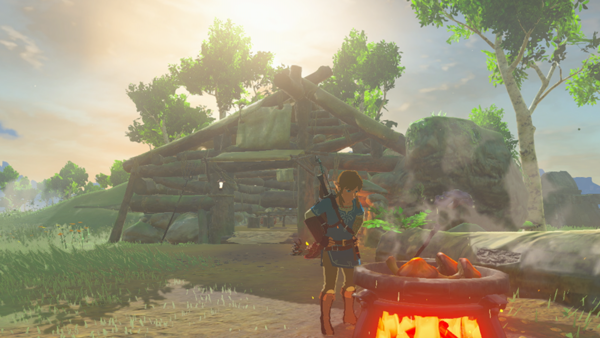
Some survival games really want their 'harsh, enduring' worlds to ravage the player's time, killing them thanks to a random weather event or ensuring an enemy gets the upper hand because they've ran out of a crucial component.
Not here. Glance to the bottom of the screen and you’ll immediately know the time of day, the temperature and how much noise you’re making. These factor dynamically into monster aggression, weather or environment-inflicted damage and the ability to pull off stealth kills respectively - all things you'll need to make it through increasingly greater swathes of the environment, specifically to the north east.
Crafting and cooking also feature, and that subtle twist on established Zelda norms - turning every creature and environmental object into something that can be combined and consumed - instils a sense of preparation and player agency that thanks to how seamless it all is, feels almost unmatched.
4. Some Of The Best Boss Battles This Generation

It wouldn't take much to rank high on the list of awesome boss battles this generation, because it feels as though everyone aside from the Souls/Bloodborne series and Nioh have all but given up including them.
Still, even those games' fantastically intense duels of wit and nerve-wracking proficiency pale in comparison to how Nintendo do their boss fights.
We've seen lateral thinking used in many past Zeldas, but in conjunction with your environment-tinkering powers, the more precision-focused way Link controls and the ludicrous amounts of stat-boosts and potions you can activate to gain the upper hand, it brings about a sense of planning, forethought and in-the-moment improvisation that'll challenge you to actually think like Link.
3. There Are Some Heavy Shadow Of The Colossus Vibes

Once you're out in the world, you'll be tasked with finding up to four Divine Beasts. I say 'up to', because you can just make a beeline straight for Calamity Ganon and fight him with a tree branch and goodwill if you so desire (which I guarantee someone will on launch day).
Regardless, if you want to tackle Ganon with some decent reinforcements, that means tracking these hulking, ancient creatures and battling them. Each fight is twofold, and whilst the second stage always features some of the best puzzle and environmental designs in the game, the former is a straight-up Shadow of the Colossus-style, "I'm just a tiny spec taking this huge thing down" sequence.
Needless to say they're always thoroughly epic, providing brilliantly worthwhile talking points amidst a sea of dynamic open-world design.
2. It Can Be BRUTALLY Hard, But In The Most Rewarding Sense

In the words of Grey Fox, "I've been waiting for this pain!"
Indeed, for years the Zelda franchise has mostly eschewed ball/ovary-breaking difficulty in favour of targeting the widest market possible.
Well scratch that, because in going back to the franchise's 1986 roots - which is to say, the notion of the game saying, "Go on then, figure it out!" - there's nary a moment in Breath of the Wild where if you're not careful, you'll be brought down in seconds.
Whether it be harsh weather conditions chipping away at your health if you've not prepared some hearty meals or drank the right potions, random enemy 'heavies' that will one-shot you in the middle of combat or over-agile bosses you'll need to conjure a trial and error pattern to defeat, 2017's Zelda doesn't give a f**k about giving you anything of a 'helping hand'.
As such, you will die. A lot. All as the game tries to tell you, "Hey, maybe you should go explore and rank-up more". Breath of the Wild is the 'gamer's game', just like its Great-Great-Great (x11) Grandaddy was when it was a lad.
1. A Guiding Hand, Forever Invisible

Here's how you know a game is on another level of being immaculately hand-crafted: No matter where you go or how much you think you're wandering off the beaten path, the developers have already accounted for it.
Breath of the Wild executes on this masterfully. Following the tutorial you're given free reign to pick a direction and head in it, knowing that the overarching goal - save for seeking out the Divine Beasts - is just to literally "Become the hero of Hyrule", however you can.
Despite this freeform nature, Nintendo have still peppered the environment with NPCs introducing you to integral parts of the lore, remarking on Link's past adventures or giving you a way to unlock a remaining power or heart/stamina canister/extension. It always feels like these encounters and sense of progression is your own, but thanks to Nintendo's skill at development and the time taken to perfect Breath of the Wild, each and every possibility has been pre-thought out, providing a guiding magician's hand to all your adventures, yet one you'll never truly see.
--
Are you picking up a Switch for Zelda? Let us know in the comments!