10 Biggest Unsolved Mysteries In Science
Getting stuck into the universe's greatest secrets.

Science is all about solving riddles, answering questions and generally demystifying this crazy old universe.
So far, we've not done a bad job. We've peered into the furthest reaches of the universe and delved into the weird world of atoms; We've decoded the building blocks of life itself and built a civilisation that has managed to actually leave its own planet with nothing more than a big tin can and lots of flammable fuel.
We've come a long way since ancient times, since Galileo pointed his telescope at the sky in the 16th century, Newton sat under an apocryphal apple tree in the 17th, Darwin formulated his theory of natural selection in the 19th and Einstein started blowing minds in the 20th.
The 21st century, it turns out, is shaping up to be just as exciting in the world of science.
Science loves answers, but it loves questions even more and there are still some mysteries that the universe is not quite ready to give up. These are the big questions and, we can assume, they have big answers. Yes, perhaps a little bit of uncertainty is always healthy, but we'll be darned if we're not going to at least try.
So, what exactly are those scientists thinking about all day?
10. Why Does The Placebo Effect Work?

The placebo effect is usually used in a critical manner when talking about things like homeopathy. We usually use it to imply that people are being tricked or stupid. The thing is, that the placebo effect isn't just in the mind - it genuinely appears to heal the body.
It even works when the patient knows it's a placebo.
In one study, patients with IBS were knowingly prescribed a placebo, and 59% saw an improvement in their symptoms. Placebos also work as a powerful painkiller and, what's more, they seem to be getting more effective.
As many as 90% of recent trials from new pain medication in the States have been canned, due to the lack of evidence that they work better than a placebo. In the last couple of decades, pain meds have gone from being rated as 27% better than a placebo, down to just 9%.
It's thought that the expectation of the power of placebo is feeding into its efficacy, creating a self-fulfilling prophecy. The only problem is that we have absolutely no idea how.
9. How Do Plate Tectonics Work?

Bet you thought we'd got this one all figured out, right?
People used to think that the continents sort of drifted about the ocean, occasionally crashing into each other and raising a mountain range. Then, this theory was transformed into plate tectonics, with massive sections of the Earth's crust moving about on a subterranean ocean of magma.
So far, so GCSE Geography.
HOwever, the main sticking point is that we don't actually know what causes this movement. It was generally thought until quite recently that they were drifting on some kind of convection current in the Earth's mantle, but so far none of our models based on these theories can predict or match tectonic movement to a satisfactory level.
8. Where Did Life Come From?

We can be pretty sure by now that life has arisen on planet Earth. The only question is how?
How do you get from a random chain of chemicals to you, reading this? There are plenty of theories.
Essentially, at some point nearly 4 billion years ago, strings of molecules came together in even bigger strings of molecules, creating amino acids which eventually formed DNA and ultimately life. This is all great, but nobody is quite sure how or why that happened in the first place.
Some think that lightning striking the primordial soup was enough to kick start the whole affair, some think that the organic molecules were delivered from meteors (although that just explains how they got here, not how they formed), some think life originated in deep-sea vents at the bottom of the ocean. Some think that metabolism came first, some think genes came first.
This is just the thing, everybody has a theory, but nobody knows for sure. The main problem so many scientists seem to be having is that the formation of life just seems so unlikely, particularly to the extent that we see around us today.
7. What Causes Cancer?

If you believe the papers, you'd probably come to the conclusion that everything causes cancer, but the reality is that we just don't know.
We know how cancer occurs. Random genetic mutations occur in the cells, causing a runaway duplication effect and leading to a tumour, but experts have so far failed to agree on why this happens. In a controversial study in Science magazine, researchers took all of the research and evidence related to the causes of cancer, and were pretty much forced to conclude that it's largely down to luck.
We all know, for example, that smoking can give you lung cancer, but how is it that some people can smoke for their whole lives and remain cancer free? The chance of getting lung cancer as a smoker is 18 times higher in smokers, but not all smokers will get it, and not all non-smokers are safe, so it doesn't cause it in the same way that pushing a ball down a hill will cause it to move.
It's not exactly solid cause-and-effect stuff.
Figuring this out is arguably a priority for this generation, but at the moment it's practically a case of "well something's gotta get you."
6. Why Do We Sleep?

For all of our scientific progress, the best answer most scientists can give to the question, "Why do we sleep?" is "Because we get tired."
Quite why we evolved the need to completely switch off all consciousness for hours at a time is a mystery. It's thought that sleep has something to do with memory consolidation, brain plasticity, and it's an opportunity for you body to get a bit of repair work done, but as far as we know, there's no good reason why a good night's sleep should restore your energy and make you feel so refreshed.
As far as we know we convert our food into energy, but no matter how much you eat, you wouldn't be able to stay awake indefinitely.
We know that it's definitely something we need to do, as those who don't sleep will eventually grind to a halt and, if kept awake for long enough, you simply die.
5. Where Is Everyone?

One of the biggest questions scientists face today, is where exactly are all the aliens?
The observable universe is 92 billion light-years across, stacked with billions and trillions of galaxies, stars and planets - all of which are apparently devoid of any signs of life. We scan the skies from a planet positively bursting at the seams with rich and diverse life and wonder just where all the aliens are at.
This is what is known as the Fermi Paradox.
Given the sheer size of the universe, and given what we know about the resilient and adaptive nature of life, there are those who think that extraterrestrial life forms are a virtual inevitability.
There are so many different possible answers to this question, from the Great Filter to the Zoo Hypothesis, that they could fill their own article, but whether the answer to "Do aliens exist?" is yes or no, either answer will change the world.
4. Why Is There Stuff?

Or, more specifically, why is there more matter than antimatter?
As far as we can figure out, matter and antimatter are supposed to be equal and opposite and, when they meet, they should annihilate one another, leaving nothing behind.
However, a quick glance around you now will demonstrate that this has not happened and, what's more, there seems to be a lot more matter floating around than antimatter.
One possible solution for this could lie in a little subatomic particles called mesons. B-mesons are made of quarks and anti-quarks, but there is evidence to suggest that B-mesons decay slightly slower than anti-B-mesons, meaning that it's possible that some B-mesons survived the interaction and tipped the balance in favour of a matter universe.
3. What's Up With Gravity?

Gravity obviously works. Its the reason you're a person stood on a planet and not a cloud of disparate atoms, smeared across a sparse vacuum.
There are a lot of things about gravity that don't make sense. How is it generated? Why doesn't it have an opposing force? Is it actually a particle?
We can't really answer any of those questions using our current models and, for now, many scientists just go with "it works because it does" when factoring it into their calculations.
Our incomplete knowledge of gravity has gotten us pretty far, but neither the Newtonian nor relative models of gravity can adequately explain how the phenomenon is generated.
Quantum field theory attempts to answer many of our questions about gravity. Just as electromagnetic forces are delivered by photons, QTF predicts the existence of a "graviton" that delivers gravitational force, but for now the particle continues to elude us.
2. What Is Dark Matter?
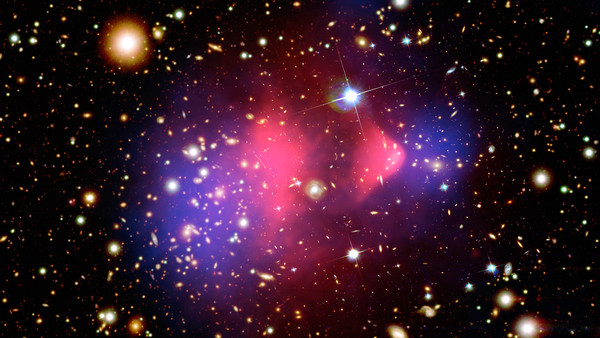
Dark matter accounts for about 85% of the matter in the universe ... and that's pretty much all we know about it.
It neither emits nor absorbs light anywhere on the electromagnetic spectrum, it is completely invisible to the naked eye and specialised telescopes, you can't touch it taste it or smell it, yet we know it's there.
Whilst we can't observe dark matter directly, we can see its effects throughout the universe. We can see the gravitational forces that it exerts on galaxies, causing them to cluster, and even the gravitational lensing that occurs as it bends spacetime around it. Scientists have even been able to map its distribution throughout the universe.

All without a bally clue what the stuff is. As far as we're concerned, the only property it has is mass.
When combined with the equally unhelpfully enigmatic dark energy, the two account for somewhere in the region of 95.1% of the mass-energy content of the universe. Everything else we see and experience is made up of the other 5%.
1. Why Does Time Flow In One Direction?
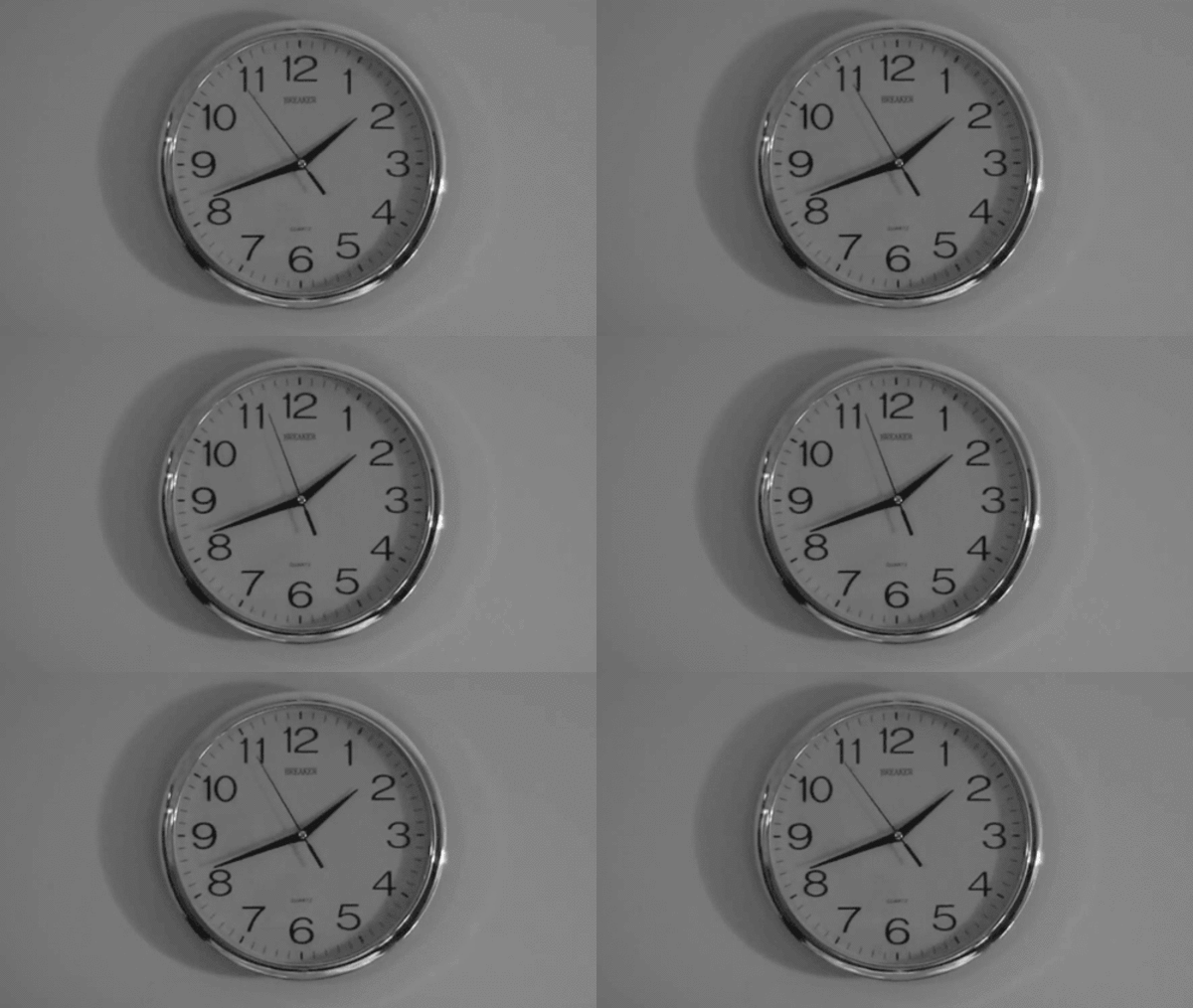
According to relativity, there's no real distinction between space and time - yet we definitely experience them different in our day to day lives.
We are not free to roam around the time dimension in the same way we do with the spatial ones, instead we're forced to move through it at a rate of roughly one second per second.
The thing is, there's nothing in the laws of physics that suggest it has to be this way. The laws don't differentiate between the past and the future but, if this is the case, why can't we remember the future?
The prevailing theory in this field is that it's because of entropy - or the probability of a system to progress towards disorder. It's the same reason why you can run a piano through a woodchipper and get wood chips, but you can't run it backwards and get a piano.
Maybe once we crack this, we'll know once and for all whether time travel is possible, but for now it remains a mystery.
Does science make you tingle in your special place? Like us on Facebook or follow us on Twitter for plenty more where that came from.