10 Things You Need To Know About SpaceX
SpaceX could be the future of space travel, but who exactly are they?
Space Exploration Technologies Corporation, SpaceX for short, is a private aerospace technology company based in California. Basically, they build rockets. Good ones. It was founded in 2002 by a guy called Elon Musk (who, by all accounts, is some kind of peculiar savant, but more on that later), with the basic vision of creating simple, commercially viable and reusable spacecraft that could be sent into space multiple times, much like commercial airliners. SpaceX is currently in the process of changing the face of space travel, as the first ever private company to successfully launch into orbit and recover a spacecraft, the first private company to send a craft to the ISS and the first private company to launch a satellite into geosynchronous orbit. Whereas space travel has so far been the domain of governments, SpaceX are paving the way to a more commercial vision of space exploration. So, how exactly are they doing this? Here are the things you need to know about SpaceX.
10. It's A Pretty Cool Place To Work

9. Elon Musk Inspired RDJ's Iron Man

8. And He's Retiring To Mars
The effect of Elon Musk's quiet and reserved personality is that when he says things like "I would like to retire to Mars", you're inclined to take him seriously. This is not as insane as it sounds. SpaceX currently has its sights pretty firmly fixed on Mars at the moment and by the time the 44-year-old Elon Musk is ready to retire, the chances of him having found a way to get himself to Mars and settle down are actually pretty good. This is largely because, unlike most other aspiring space geeks, Elon already has a spaceship. Whether, by the time he retires, Musk will be able to take the rest of humanity out to the stars with him, or whether he just plans to one day climb into his rocket and leave us all behind remains to be seen. Hopefully it's the former, but the latter would also be a pretty spectacular exit strategy.7. It's A Private Company That Has Achieved More Than Whole Countries
6. Putting People On Mars

5. The Gadgets
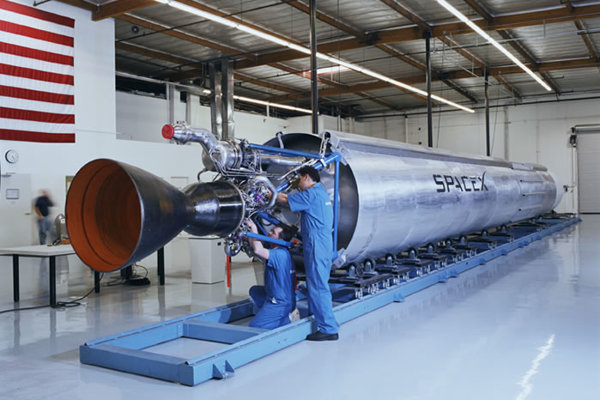
SpaceX build spacecraft and, what's more, they're pretty damn good at it. They have an ever expanding range of rockets to suit your every need. The main players include: Falcon 1: SpaceX began modestly (well, as modestly as one can when building rockets) with the Falcon 1 - named after the Millennium Falcon. This was by no means the biggest or most advanced rocket ever, at 21 metres tall, but most of its innovations were cost-based. Elon Musk sees the future of space travel hanging in the balancing of the books. Here was a rocket designed to get payloads into space more cheaply than ever before. It was powered by one of SpaceX's own inventions: The Merlin. The Merlin: The Merlin engine was designed to go hand in hand with the Falcon family of spacecraft and is one of the most advanced in the world. With a thrust-to-weight ratio (i.e. how much it can lift compared to its weight) of 165:1 it outstrips the competition by a country mile. It also powers the Falcon 9 Falcon 9: Following the success of the Falcon 1, which took SpaceX into orbit, in 2008 the Falcon 9 ushered them into the pro arena. At 68 metres tall, the Falcon 9 is over three times the size of its predecessor. It is capable of carrying 13 tons of gear into orbit. This was a serious step up and showed the world that SpaceX were a force to be reckoned with. Falcon Heavy: The Falcon Heavy, due to launch in 2016, is as though someone gave the Falcon 9 steroids and a Red Bull. This beast has three "first stages" (the bit with the engines) and a grand total of 27 Merlin engines. When it eventually launches, it should be able to take up to 2,000 tons into orbit, more than twice the amount of any other rocket, and will do it at about a third of the price that the ULA (the United Launch Alliance) currently offers for half the payload. Dragon: The Dragon is about the size of a Land Rover and is designed to transport cargo into space. It is launched by the Falcon rockets and is partially reusable. It is currently contracted by NASA to ferry cargo to the ISS and its two holds (pressurised and unpressurised) can carry about 6 tons of gear.4. Quadrupling The Number Of Satellites In Orbit

3. Manned Space Travel
As well as cargo missions and hordes of satellites, SpaceX are throwing themselves into the realm of manned space flight. As the Space Shuttle programme ended in 2011 and its successor, the Space Launch System, has been repeatedly been pushed back and delayed with a current estimated finish date of some-time-in-the-next-decade (2021 was the last solid number), the United States don't actually have any means by which they can put astronauts into space at the moment. With the US space programme now barely limping into orbit using borrowed Russian spacecraft, the entire enterprise hangs in the balance of maintaining good political relationships with the countries that own all the rockets. This is not a particularly secure strategy, demonstrated in a tweet by the Russian Deputy Prime Minister after the US brought sanctions against them, suggesting that the Americans deliver their astronauts to the ISS using a trampoline in future. To try and avoid this eventuality, NASA have had to go private, splitting a budget of $6.8 billion between Boeing and SpaceX for crewed launches. Seeing as the big, government run hitters are currently somewhat out of the game, this leaves the market is wide open for some next-generation manned spacecraft.2. Dragon 2
