10 Worst Doctor Who Villains Of All Time

These baddies will have you reaching for the memory worm!

It's a surprise to exactly no one that Doctor Who has accumulated a vast treasure trove of murderous monsters and humanoid foes. But not all of these villains have been entirely effective. When a Season 1 foe such as Kal the caveman from the tribe of Gum is compared with, say, the Aztec High Priest of Sacrifice, Tlotoxl, from only a few weeks later, the deficiencies of the palaeolithic pest become hard to ignore. Similarly, when the evil wizard, Kalid, from Time-Flight is stacked up against the giant pink snake that was the Mara in the very same year's Kinda, even the decidedly ropey serpent scores a win. With that said, let's embark on a quest through the most god-awful enemies the Doctor has ever faced to single out the worst of the worst, the lamest of the lame and the silliest of the silly. But don't expect this list to feature merely risible alien animals or incidental characters. To qualify for this list a foe must be an intelligent, scheming villain. No slythers, shrivenzales or giant clams genetically engineered by Davros here. No sir, no matter how funny they are. Naturally, plenty of Whovians will disagree with these choices, but that's not a bad thing. By the end of this list, though, rest assured that you will be need a memory worm or a Black Archive memory filter, just so all recollection of how terrible these characters were can be wiped away forever! You have been warned.

10. The Headless Monks

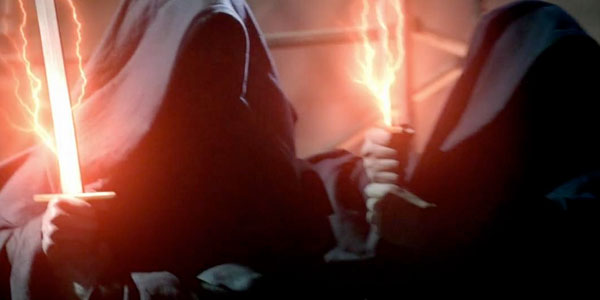
What would a fan rather see, a monster that's a good idea but that's not done entirely effectively, or a monster that's realised well but that's not very exciting? As far as 'enemies that sound great on paper but look so-so' go, the list is nearly endless. The original Silurians had seams plainly visible on their backs and the giant fly at the end of The Green Death is a visual effects disaster, but these creatures are still fondly regarded because the concepts behind them are great. Who doesn't love intelligent dinosaur people and oversized insects? The Order of the Headless first seen in the prequel for A Good Man Goes To War firmly fall into the other category. There's nothing wrong visually with how they're depicted but, goodness, they're dull. Basically, these villains are monks with flaming swords who shuffle around very slowly. They do have an excuse, though. They don't have any heads and are, presumably, remote controlled by the Papal Mainframe. No wonder they're so bumbling.

9. The Slitheen

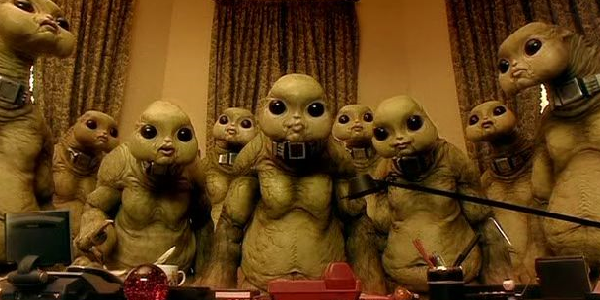
The family Slitheen are one of those foes that polarise fandom. For some, the contrast between wide-eyed, almost child-like faces and more monsterish bodies with razor-sharp claws is a design triumph. For others, the flabby paunches and puerile farting caused discontented muttering rather than the hoped-for adoration. At least they could run, an ability not often granted to Doctor Who villains. Following their appearances in Series 1, the Slitheen were transferred over to The Sarah Jane Adventures. Inevitably, due to that programme's lower budget, the Slitheen were less well executed there. They didn't return to Doctor Who until becoming members of the Alliance against the Doctor in Series 5's The Pandorica Opens. And the last mention of the Raxacoricofallapatorians on screen was as part of the fleet surrounding Trenzalore in the 2013 Christmas special, The Time of the Doctor, although they were never actually seen in that story. Despite all the efforts to promote the heck out of the Slitheen, children and adults alike never seemed to fully embrace them. Even in stories like Boom Town, where they had good dialogue and great acting, the sight of their awkwardly lumbering forms was enough to destroy most viewers' willing suspensions of disbelief. Many Whovians would agree that the Slitheen were a failed experiment in monster making and shouldn't be revisited any time soon.

8. Grandfather

Series 7's The Rings of Akhaten contains many good elements, such as the Eleventh Doctor's long and much loved speech to the planet-sized parasite god. But the story also contains a truly dreadful enemy for the Doctor. No, it's not the Vigil or even the mummified alarm clock in the glass case. It's the aforementioned planet-sized parasite god, the one the locals call "Grandfather". Huge monsters the size of planets or stars have been done before in science fiction generally and in Doctor Who specifically (in Series 3's 42, for a start), but it's not the scale of the villain that's the problem. It's the crudely drawn smiley face. As if the absurd face on the gas giant alien wasn't bad enough, the creature also can't communicate. Most stories featuring a vast intelligence facing off against the Doctor provide a way for the villain to somehow interact with the hero - by possessing another character, usually. But Grandfather can't manage even that, forcing the Doctor to keep up both sides of the conversation all by himself. Yes, it results in a beautifully worded soliloquy, but it also feels a lot like the Doctor is trying to bore the "god" to death, and he's running the risk of subjecting the audience to the same fate, too.

7. "Mr Clever" (The Cyber Planner)

Series 7 provided another frustratingly bad villain in the episode Nightmare in Silver. No, not the Cybermen equipped with farcical super-speed (what was that about?!), but rather the Cyber Planner occupying nearly half of the Doctor's brain, otherwise known as Mr Clever. Leaving aside the unfortunate fact that Matt Smith tried to create easily distinguishable performances for the Doctor and Mr Clever by making them both quick-talking and emotionally intense, there's the issue of whether a Cyber Planner should even be so volatile. Previously, Cyber Planners were depicted as entirely emotionless, just like the Cybermen themselves (The Invasion, The Wheel in Space, etc). In this story, however, viewers were introduced to a Planner that was more in thrall to its feelings than the typical human. The Planner even put an entire Cyber army on hold seconds before the completion of a planetary takeover, just so it could win a chess game that it was only playing to keep the Doctor occupied whilst its army got into position. Making the Cyber Planner so foolishly emotional fundamentally changes a key element of the Planner, of course. What's next? Bringing back the scheming, manipulative Macra as mindless beasts? Oh, wait...

6. The Krotons

Audiences got their first look at the crystalline Krotons as they battled Patrick Troughton's Second Doctor in their eponymous four-part story, first broadcast from December 1968 to January 1969. Due to the highly unfortunate fact that, at the time, it was the only complete four-parter left in the archives for the Second Doctor, it wound up being repeated on the Beeb in 1981, bringing the unsteady-on-their-feet foes to the attention of a whole new generation of fans. If only Tomb of the Cybermen had been recovered sooner... There's not much wrong with the ideas behind these Bob Holmes-scripted villains, it's only the execution of the costumes that falls short (the Krotons are actually really good in the Eighth Doctor novel Alien Bodies by Lawrence Miles, where visuals are not a problem). When the Krotons are standing still and viewed close up, they look like the crystals they're supposed to be, and their spinning heads are certainly fun. But when they're called on to move a bit, well... that's when the problems start. Doctor Who foes are often slow (mainly because the monster operators can't see well enough out of the costumes to move normally!), but the Krotons take it to a whole new level. Oh dear.

5. The Nimon

The Fourth Doctor faced many unconvincing enemies during his long tenure. Mandrels, Marsh People, the hand of a giant vampire, a cuddly giant rat... the list is quite extensive, but in the 1979/1980 serial, The Horns of Nimon, he encountered an enemy that took the proverbial biscuit for looking cheap. The Nimon was - not to put too fine a point on it - a guy in platform shoes with an absurdly unconvincing bull head. Their crowning glory of light-up horns didn't quite convey the sense that these aliens were supposed to be like the Minotaur. Rather, it made the Nimon look like something out of a deranged disco-esque pantomime. It didn't help that they moved around incredibly slowly with arms and legs akimbo in a manner that can only be described as "blind zombie acting". Many fans have a soft spot for this story because they like a good laugh, and the combination of the slowly lurching Nimon and the deliberately OTT Graham Crowden as Soldeed (the humanoid villain of the piece) are undeniably amusing. If laughter is the best medicine, The Horns of Nimon is the super-antibiotic of televised Doctor Who. But come on, let's face it. The Nimon look pathetic.

4. Professor Zaroff

Professor Zaroff, played by Joseph Furst, was the personification of a mad scientist. His plan, which makes Missy's "Bananas!" scheme in Series 9 look comparatively tame, was to drain the oceans of the Earth into the planetary core and crack the Earth open like an egg, thereby destroying all life on the surface. And Zaroff wanted to do this because, well... killing the human race is the ultimate dream of power for scientists, apparently. Now that's bananas. It took the Second Doctor all of 5 minutes to put a stop to Zaroff's nonsense in 1967's The Underwater Menace. Shortly before Zaroff drowned in his flooded lair, he cemented his place in Doctor Who infamy by screaming, "Nothing in the world can stop me now!". Chortle worthy? Oh, yes. Scary? Not so much.

3. The Kandy Man

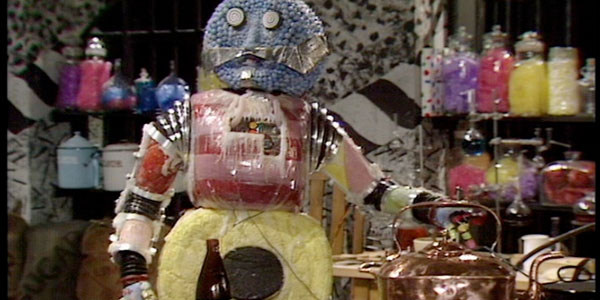
1988's The Happiness Patrol saw a killer robot dressed up like confectionery. Because, during this era of the programme, that's just the sort of thing that happened. There's no need to say any more about why this villain is so bad. The fact that it looks like Bertie Bassett is enough, right? Interestingly, writer Graeme Curry's original idea for the Kandy Man was for him to be human, albeit with candy cane glasses. Perhaps that would have turned out better. Sometimes, insisting that every story needs a robot or an alien doesn't help the final product. Let's move on quickly!

2. Kroagnon, The Great Architect

There are a couple of potentially good ideas floating around in the morass of utter bilge and twaddle that is 1987's stunning Seventh Doctor debacle, Paradise Towers. Sadly, Richard Briers's turn as Kroagnon, the Great Architect, possessing the body of the petty Chief Caretaker, isn't one of them. Briers opted to put on a slurred, zombiefied voice for the scenes in which the psychopathic architect of Paradise Towers is inhabiting the Chief Caretaker's flesh. The result is certainly distinctive. But not in a good way. How could this villain get any worse? Well, by having the crazed architect murder his way through an entire tower block with the aide of spectacularly naff looking cleaning robots, that's how. After a few minutes of watching this tripe, viewers may feel like joining the block's residents in being "unalive". But wait, it gets worse...

1. The Abzorbaloff

Admit it, after the last few picks were all from classic Who, it was looking like the revived series was off the hook, right? But proving that NuWho can beat the classic series in any contest for the worst Doctor Who villain ever, the Abzorbaloff from Series 2's Love & Monsters takes the top spot! Given the production team had to combine a Doctor/companion-lite episode with the inclusion of a Blue Peter design-a-monster competition, there may have been no saving the result. But even with these limitations, the script for Love & Monsters does contain much to admire. Undercutting all of the pathos, however, is comedian Peter Kay in a deeply unflattering monster costume. Thank God he at least wore a thong. What did you think of this list? Are there any other awful Doctor Who villains that should've been included? Join the conversation in the comments section below!

In this post: 
Doctor Who
 
Posted On: 
Contributor
Contributor

Mike has lived in the UK, Japan and the USA. Currently, he is based in Iowa with his wife and 2 young children. After working for many years as a writer and editor for a large corporation, he is now a freelancer. He has been fortunate enough to contribute to many books on Doctor Who over the last 20 years and is now concentrating on original sci-fi & fantasy short stories, with recent sales including Flame Tree, Uffda, and The Martian Wave. Also, look for his contribution on Blake's 7 to "You and Who Else", a charity anthology to be released later this year. You can find him on Tumblr at https://www.tumblr.com/blog/culttvmike