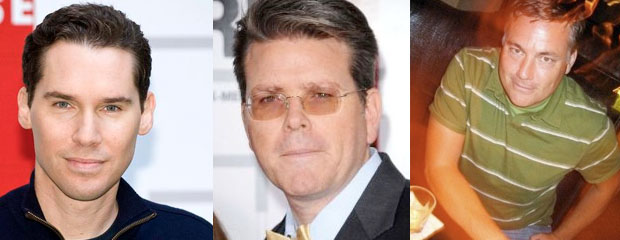
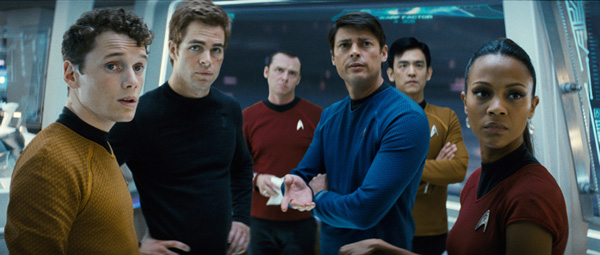
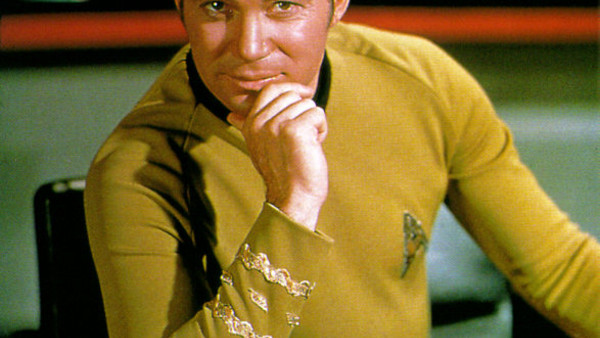
Star Trek fever is starting to grip us here at Obsessed With Film as the sequel to J.J. Abrams' impossibly brilliant 2009 franchise reboot gears up to film this summer. Add to that, soon our very own Simon Gallagher will beam up an essay on his own desire to see a new Star Trek TV show put into production and what he hopes it might revolve around. As coincidence would have it, this may turn out to be perfect timing as Trek Movie (thanks to /film for passing on the link) have gotten their hands on an actual Star Trek TV proposal for a show that might have been but sadly wasn't. If you've been following Trek Movie closely lately then you will have no doubt heard Star Trek: The Next Generation's Jonathan Frakes talk about a show that X-Men and Superman Returns director Bryan Singer had been plotting in the middle of the last decade for a new series revamp but before he actually got around to pitching it for real, Paramount had struck a deal with Lost creator J.J. Abrams and a Star Trek movie was put into production instead. Now extensive details of what would have been have been revealed and for hardcore Trekkies, this kind of information carries a wealth of interest for us to consider what our beloved franchise might have looked like if things had been different. It's a great "what if", and is a must-read below... Titled Star Trek: Federation, the idea for the show originated from a Seattle sushi dinner discussion in late 2005 between Singer, his Usual Suspects writer Chris McQuarrie and Robert Meyer Burnett (director of Free Enterprise and long time Singer collaborator). At the time Singer and Burnett were deep into production on Superman Returns which would open in theatres the next summer but they had taken time out to meet with McQuarrie to discuss the WWII Hitler assassination project which McQuarrie would agree to script and would eventually become Valkyrie. You have to remember that at this time, just after the show Enterprise had been cancelled, there was no Star Trek production of any kind in the works for the first time in 17 years, so naturally fans of the show who had Hollywood clout were talking through ideas of what they could potentially pitch as it was open season at Paramount and CBS. During a loose discussion for what all three men would want to see a new Star Trek TV show become, very quickly the idea to actually create a new pitch that Singer's Bad Hat Harry production company could work on, based on a pilot script by McQuarrie, directed by Singer and with Burnett as Executive Producer, was hatched. Burnett would spend the next several weeks drafting a series proposal and he courted Geoffrey Thorne (writer of episodes of Voyager and Deep Space Nine and some non-canon Star Trek books) to together put some ideas onto paper. Together they wrote a 25 page outline document for a 'series proposal' for Star Trek: Federation that would be set in the future, the year 3000 to be exact, and would exist in the same continuity as all previous Trek films & TV shows but would depict a Federation in considerable decline. Influenced by the fall of the Roman Empire, the pitch would acknowledge that "television storytelling had evolved" and the five-act story structure of a regular Star Trek show would be dismissed for "more complex serialized stories." The plan would be to tell "compelling stories about our world today" but in the guise of Star Trek, as Gene Roddenberry had originally envisioned for the first series.
Let STAR TREK breathe. Let it return to the marketplace in the hands of people willing to write the sort of stories that confront and entertain todays audiences. Lets grapple again with the issues of the day- issues of diversity, government power, gender frictions, a controversial war on foreign soil, and a host of other things. Embrace modern television storytelling techniques. Most importantly, as with the original STAR TREK and THE NEXT GENERATION audiences must recognize the world they live in today in the far-flung future, then take the shows concepts and lessons with them back into their everyday lives.
The idea would be not to reboot the continuity but set the new series so far into the future that they could shake up the universe as much as they wanted;
The great strength of STAR TREK is the very Universe in which its set. The Characters. The Starships. The Aliens. The stories. Gene Roddenberry himself provided the perfect example how to create a wildly successfully new STAR TREK series Acknowledge whats come before, but then set your stage far enough in the STAR TREK future when everything old is new again. Turn the STAR TREK Universe upside down. Shake vigorously.
Star Trek: Federation would be set in the year 3000 and the 'Federation' in the title would actually refer to a different United Federation of Planets but problems were afoot;
Utopia as a goal is like the fire in a nuclear engine. Utopia in practice is stagnation; its dry rot; eventually its death. Which is precisely where we find the United Federation of Planets a few centuries after the last Age of Discovery.
In the year 3000, the alien races would shape up like this; Earths Humans have become "fat and happy" but this has led to complacency where humans are "giving up exploration for incremental colonization and focusing more on the rightness of their own cultural view over all others" Many younger members of the UFP have left, eschewing this "human-centric" Federation Vulcans have been disengaging from the Federation and have reunified with the Romulans, spending most of the last 3 centuries focused on creating a new "joined society" overseen by two "quasi-religious clerics who rule according to logic and what is best for their unified peoples, combining Romulan Machiavellian politics with Vulcan logic. Bajorans have withdrawn from the Federation to become insular in order to focus on their religion and communing with the Prophets. Bajor is now "like a planet sized Tibet", handing over all temporal concerns to the Ferengi The Klingons have undergone a "massive reformation" moving away from their Viking-like brawling to become a "civilization of warrior mystics" akin to the Tang Dynasty), now flying "sleek" and "serene" ships and while they maintain diplomacy with the Federation they have returned to expanding the Empire via conquest The Cardassians have transformed into a "society of artists and philosophers" who now "walk the path" and are now dedicated to a philosophy with "the view of the galaxy as a place created solely to test the faithful." The Ferengi are no longer a "joke" but have become "quite powerful". Equality for females (including a female Nagus) is "the only concession they have made to progress" and with "the Greater Federations cashless society as a restriction, the Ferengi Alliance is now able to shine in its full capitalist glory." The Ferengi are also making big bucks marketing the Bajoran religion around the galaxy, including pilgrimages to the Bajoran Wormhole. Starfleet has been reduced to a "mere peace-keeping force" protecting fringe worlds from aliens and from fighting each other, with starships are old and spread out too thin A new enemy in this timeline would be a 'powerful' and 'ruthless' enemy known as 'The Scourge' who "confronted the Federation ship USS Sojourner at what became a key pivot point. The ship along with two colonies are lost and the sole survivor will become a key player in the future of the Federation". Our lead character would have a familiar name;
Lieutenant Commander Alexander Kirk is the only survivor of the Sojourner Incident, as its come to be known in the press. And he has no clear memory of the events themselves. Attempts to help him remember cause him to become irrational and violent. All he has is images of carnage and death and a hidden malevolent presence lurking behind it all. When called before his superiors, he paints a picture of the enemy that is scarcely believed and which, if true, might tip the already fracturing Federation Alliance into true collapse.
From there Kirk is kicked out of the active command and the Vulcans, Bajor and others pull out of the Federation leaving it with only twenty systems and surrounded by The Klingons and almost every other race. This would all be the backdrop of the new series that would revolve around the building of a new U.S.S. Enterprise, put into motion by a new and motivated female Admiral Nelscott who knows her history and what that ship's name means. It would be the first Enterprise built in three centuries and whose mission publically would be to 'explore great news worlds, etc' on voyages of discovery but secretly would be to find out the true intentions of The Scourge and just who they are. The officers of the new Enterprise, would look like this, in order of the chain of command; Captain Alden Montgomery: Human and the "perfect Starfleet officer" who is "The Captain America of the Federation" but who unfortunately gets killed off early on, leaving room for Commander Alexander Kirk: (X-O and 3rd in command) Reinstated for the new mission Kirk is described as having a "checkered past" with an "aggressive manner" who is thrust into leading the mission after Montgomery and first officer get killed and is able to deal with it well, but is "total crap at PR aspects of job." He alone (even though he doesnt understand it) "possesses information vital to Enterprises true mission." Lt. Cmdr. Chel Forlaan (Security Chief): A female Ektosi (a feline species) who has "cat-like" grace, temper and insight with natural hand-to-hand combat capabilities akin to Jem Hadar or Klingon. Joined Starfleet for the "fun", posesses a "mercurial nature" which initially makes her ill-suited to security chief. Biggest flaw is "intense curiosity which sometimes overpowers her." (get it? shes a cat!) Lt. Cmdr. Sergei Kenyatta (Com & Political Officer): A genetically enhanced human "Alpha" from Proxima Centauri, with a perfect physique along with mental enhancements. Described as gifted in math, linguistics, technology, and diplomacy, yet struggles with personal relationships. The 76th Distillation of Blue (aka Diz) (Chief Engineer) a member of a gaseous species from the gas giant Penumbra who use "motion suits" to interact with the rest of the "solid" universe. For the show Diz would look like "a slender male humanoid" in the suit, but he can also appear in his gasous state or even change to a solid or a liquid, but he is "not a shape shifter." Described as a fantastic engineer who is more at home with machines than with other people. Dr. Felicity Chen: A cybernetically enhanced physician based on (now safely evolved) Borg technology. Many medical instruments are built into her, so no need for tricorder. She can use her "nanospines" to heal injuries, but there is a personal cost to her. She still has to wrestle with her own humanity M.A.J.E.L.: The sentient Enterprise computer (Multitronic Architecture Junction/Interactive Energetic Library) that runs the ship and his a personality of her own, including emotions. The new Enterprise would be "something bigger than Voyager, but nowhere near the size of The Battlestar Galactica" and would include new features; The Central Core: an open shaft at the center of the saucer where all corridors intersect in an open area, which would act like a "town square" for the ship Mobile Mission Modules: standard habitats which can be customized for various missions about the size of a bus Landing Envelope: Force-field projector that can shoot down to a planet giving landing parties an atmosphere even on hostile planets (apparently originally conceived for TNG). Singularity Engine: Enterprise powered by microscopic black hole (like TNG Romulan ships) Cloaking Device: Document suggests this might be a possibility and could help with covert mission stories, but makes telling combat stories difficult CGI would be suggested for some of the larger sets and environments. The first four episodes were planned out; 1. The Widening Gyre:
Alden Montgomery encounters another planet where the inhabitants have destroyed themselves in an orgy of violence. Admiral Nelscott orders him to put together his crew for the fast-tracked Enterprise project, leading Montgomery on an origin story recruiting mission picking up various staff, including Kirk who is no longer in Starfleet and doesnt want to join, but is the only person who has dealt with The Scourge (forcing Montgomery to "Shanghai" Kirk).
2. The Blood-Dimmed Tide:
Kirk and Dr. Chen explore a found small alien obelisk and deal with the crew of the Enterprise who have become victims of the violent "Scourge", including the Captain.
3. Mere Anarchy:
The Enterprise chases a larger alien obelisk through space, eventually leading them into hostile Klingon space.
4. The Ceremony of Innocence:
Kirk, now trapped in the obelisk with some Klingons, gets to the bottom of the mystery only to find out the Obelisks are tied to the Preservers (from TNG) who had seeded the galaxy with the building blocks of humanoid DNA.
The pitch teases where it could go next;
So, the riddle of the Sojourner Incident is solved and the threat of the obelisks is removed (apparently) but at great cost. Frictions between the Federation and the Klingons have never been worse. The internal fissures are growing wider based largely on Enterprises secret mission and Admiral Nelscotts lies to cover up that mission with the council. And, of course, lots and lots of people died. Whats next for the survivors of these events? Tune in next week, folks.
Singer's team had already commissioned a logo for the show, designed by Trek veteran Mike Okuda (top of the post) but simply bad timing meant their show could never be pitched. The only thing ever written was this proposal which in the end nobody at Paramount/CBS would get to read. The outline was finished in January 2006 but Singer wanted to wait a couple more months to get Superman Returns into theatres but before that, Paramount had announced the new Star Trek film under the guidance of J.J. Abrams. Despite the potential that CBS could still go ahead with the TV show as a separate cannon, Team Singer decided the battle was over. A shame too that bad timing would scupper Star Trek: Federation as it does sound like an intriguing show brimming with potential and promising ideas. Singer and his team seemed to outline much of what we would want from a new show - a break from the dated old Star Trek style of storytelling, a return to the Roddenberry era-Trek agenda, moving the plot so far into the future that they could do things different but respect and not change what went before. All these things are positives. Whether any of these ideas end up in Bryan Singer's Battlestar Galatica film that he has been trying to get off the ground for the past two years is anyone's guess. The whole pitch certainly sounds BSG-esque, but I just wonder now that these documents have been made public whether CBS might get the idea to put a new Trek show into production? Surely TV is eventually where Trek will end up again? As good as Abrams' movie was and the promise of what is to come so exciting. Don't we miss new weekly Trek?
Matt Holmes is the co-founder of What Culture, formerly known as Obsessed With Film. He has been blogging about pop culture and entertainment since 2006 and has written over 10,000 articles.
 Star Trek fever is starting to grip us here at Obsessed With Film as the sequel to J.J. Abrams' impossibly brilliant 2009 franchise reboot gears up to film this summer. Add to that, soon our very own Simon Gallagher will beam up an essay on his own desire to see a new Star Trek TV show put into production and what he hopes it might revolve around. As coincidence would have it, this may turn out to be perfect timing as Trek Movie (thanks to /film for passing on the link) have gotten their hands on an actual Star Trek TV proposal for a show that might have been but sadly wasn't. If you've been following Trek Movie closely lately then you will have no doubt heard Star Trek: The Next Generation's Jonathan Frakes talk about a show that X-Men and Superman Returns director Bryan Singer had been plotting in the middle of the last decade for a new series revamp but before he actually got around to pitching it for real, Paramount had struck a deal with Lost creator J.J. Abrams and a Star Trek movie was put into production instead. Now extensive details of what would have been have been revealed and for hardcore Trekkies, this kind of information carries a wealth of interest for us to consider what our beloved franchise might have looked like if things had been different. It's a great "what if", and is a must-read below... Titled Star Trek: Federation, the idea for the show originated from a Seattle sushi dinner discussion in late 2005 between Singer, his Usual Suspects writer Chris McQuarrie and Robert Meyer Burnett (director of Free Enterprise and long time Singer collaborator). At the time Singer and Burnett were deep into production on Superman Returns which would open in theatres the next summer but they had taken time out to meet with McQuarrie to discuss the WWII Hitler assassination project which McQuarrie would agree to script and would eventually become Valkyrie. You have to remember that at this time, just after the show Enterprise had been cancelled, there was no Star Trek production of any kind in the works for the first time in 17 years, so naturally fans of the show who had Hollywood clout were talking through ideas of what they could potentially pitch as it was open season at Paramount and CBS.