10 Alternative Happy Endings To Universally Hated Wrestling Storylines
The Director's Cut.

Imagine a world in which the dominant market share enjoyed by WWE was challenged. Even slightly.
It's difficult to conceive that the current landscape, in which McMahon family drama takes precedent over the minor tribulations of the roster 17 years after it reached its nadir, would remain in vogue. If a company of New Japan's critical success had the money and nous to challenge it, WWE might have to listen to its fanbase - instead of triggering them into fury, promising change, and failing to deliver over and over and over again. Instead, New Japan is unable to reconfigure its streaming service for western audiences, and unwilling to deviate from tradition or strategy to truly maximise the immense potential of Wrestle Kingdom 12.
Not that it really matters; WWE has reigned supreme for so long that the coffers alone condemn us all to a WWE made by WWE made for WWE. The worst of it is that WWE itself had a golden opportunity to create competition for itself - and p*ssed it away with a spiteful, ego-driven golden shower...
But we can, erm, but dream.
10. The Admin War Between Mick Foley And Stephanie McMahon

The Reality:
RAW Commissioner Stephanie McMahon hires Mick Foley as her General Manager ahead of the 2016 Draft, ostensibly so he could run the show day to day - but in reality, it allows Steph to indulge in her favourite pastime: castrating those under her charge in lengthy, tedious segments with no real conclusion. Stephanie, true to form, castrates Foley in lengthy, tedious segments. Why, we still don't know: if anything, she has more creative influence over Foley 'IRL', despite this continuation of the reality-leaning 'Authority' storyline. Steph low-blows him off TV in March of this year. He's not been seen since.
The Alternative:
WWE resolves the dispute by booking a WrestleMania 33 match between two representatives chosen by each authority figure - with the winner securing RAW for their advocate. This way, two performers receive the elusive rub of standing up to Steph and avoid the meaningless black hole that is the André The Giant Memorial Battle Royal, thus securing an eye-catching performance on the most visible stage.
Besides which, Stephanie is soon written off television, anyway - which renders the preceding eight or so months even more pointless.
9. Short Circuit

The Reality:
Bray Wyatt interferes in the climax of Dean Ambrose's brutal blood feud rubber bout with Seth Rollins at Hell In A Cell, depriving fans of the classic reckoning with which pro wrestling sold tickets for decades and decades. In their PPV encounter, Bray Wyatt didn't so much defeat Dean Ambrose as the match literally blew up in Ambrose's face; after misjudging the length of a cable, the monitor Ambrose introduced as a weapon blew up in a plume of smoke. This allowed Wyatt to snatch the win, the momentum gathered by which led him nowhere at all.
The Alternative:
Ambrose wins the Hell In A Cell match, alleviating the blue balls and providing him with a career moment, and not another MacGuffin in WWE's relentless soap opera. Since Bray Wyatt is headed for a date with the Dead Man at WrestleMania 31, he wins the TLC match set up on RAW the next night - and not through sheer luck, since it portrayed him as a chancer, and Ambrose as a moron. Then again, he loses cleanly to 'Taker in an underwhelming match, so it's not as if any of this matters.
Maybe "don't treat the full-time roster as stupid afterthoughts" should be a general rule of thumb.
8. War, And Then Peace

The Reality:
Prior to WrestleMania 25, Randy Orton becomes wrestling's preeminent psychopath through concussing old men, taunting their traumatised daughters, and terrorising their husbands. The Legend Killer reassumes his killer aura, thus priming him for a big babyface turn in the ensuing months. Violent home invasion angles continue to set the scene, but the bang dissipates to a whimper as Triple H somehow contrives to fashion a boring, methodical, heat-free Triple H match from the most over-the-top exciting Road to WrestleMania in an age. He wins, and puts Orton over a month later at Backlash, when it doesn't count for nearly as much.
The Alternative:
Don't do wrestling in reverse, basically; the straight singles match between Triple H and Randy Orton was typical, "logical" WWE storytelling employed when it was least logical to do so. In this alternate timeline, Orton puts Trips through hell, costing him the WWE Championship but saving him from the embarrassment of failing to reach the heights set by The Undertaker and Shawn Michaels
Randy Orton gets over; Triple H staves off accusations of big match failure; the fans aren't bored into submission.
7. The Amicable Divorce

The Reality:
The Wyatt Family first disband just a year after arriving on the main roster in what is a very questionable move. Even more questionable is the nature of the divorce; instead of the tried-and-true dissent, dissolution and decider model that engulfs most factions, leader Bray Wyatt simply elects to set Luke Harper and Erick Rowan free. It is a benevolent move for a heel - or a terminally dumb one for a heel unable to win even with their help. Perhaps he realises they are a hindrance, and frames it as a favour to avoid a two-on-one kicking. Or maybe it is a dumb decision WWE quickly retcons. Anyway, Luke Harper stays Luke Harper and Erick Rowan becomes good at everything - classical guitar playing, winemaking, Rubik's cube solving - except pro wrestling.
The Alternative:
Actually fill gaping TV time with a suitable storyline since WWE, in the words of Stephanie McMahon, is no different to the great works of Shakespeare. Engineer dissension within the ranks. Luke Harper remains the most talented wrestler of the three, so he turns face on Rowan here, gets the remaining crowd on side, and becomes the super-agile spectacular big man that he is by eventually vanquishing a returning Wyatt.
Book the break up of a faction. It's not hard.
6. THAT Survivor Series '17 Main Event

The Reality:
Triple H secures his big, mandatory WrestleMania match with Braun Strowman at Survivor Series '17, having taken deluded credit for securing victory - even though that credit isn't quite as deluded as it is framed. Triple H, when not recuperating from the knock that should have given him pause to enter the match at all, is the central figure. So many full-time stars are dimmed elsewhere. Strowman doesn't eliminate three members of the opposing team to get Braun Strowman over; he does so to secure "his" (read: Triple H's) Triple H match.
The Alternative:
The conclusion of the match is still structured to build towards Triple H Vs. Braun Strowman - a subplot WWE map without depicting the popular NXT promotees as p*ssants. Triple H cockily tags in at Strowman's expense without his consent, creating tension. Then, when Triple H screws Kurt Angle before Kurt Angle gives away his physical limitations, Strowman enacts revenge by booting Trips all over the arena.
Then, in order to get to the planned finish, Finn Bálor overcomes the odds to secure victory for his brand, becoming the only logical Royal Rumble opponent for Brock Lesnar in the process. As time of writing, no RAW act is a strong enough storyline threat.
Best send for Triple H, then.
5. The Not-So Prodigal Son
The Reality:
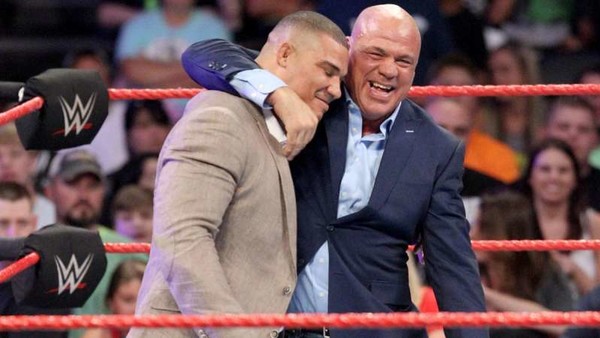
After an Attitude Era-style storyline, Jason Jordan is revealed as Kurt Angle's secret son earlier this year - to zero fanfare. The angle itself is so matter of fact and so difficult to accept that the mystery becomes mystifying in short order. The resulting arc is even more difficult to accept than a biological impossibility; Jordan doesn't become a vainglorious faux-babyface, even though he is literally related to the template; he simply becomes a bratty, vegetable-chucking rapscallion with a flair for earnest whining.
It's no wonder Booker T doesn't know what to make of him.
The Alternative:
Jordan is immediately reimagined as a snivelling beneficiary of nepotism. He receives the easiest route to "championship opportunities" imaginable, engineered by a well-meaning but involuntarily corrupt General Manager, taking it all in with a smarmy grin begging for comeuppance. He feigns injury under threat of real competition. The fans receive some sort of clue as to how to actually receive the Jordan character, since "proud son" is several notches below naff even under the benchmark "baloney, fudge and mustard" WWE babyface principle.
The heel turn should have been foreshadowed within an inch of its life. Instead, bizarrely, WWE tries to actually get the Jordan-as-babyface bit over. Nepotism and the inability to suspend disbelief are double-barrelled triggers for fans. This is WWE's dual strategy to get Jordan over.
4. Twice In A Lifetime

The Reality:
Three consecutive WrestleManias are essentially wasted by reinforcing a message long drilled into the psyche of the WWE fanbase: John Cena is the be all and end all. At WrestleMania XXVII, he loses to The Miz following the interference of The Rock. One year later, 'Once In A Lifetime' happens, and Cena loses to the Rock in a dirty strand of the clean finish in that he loses, more so than Rock wins. Then, at the conclusion of an unnecessary three-year arc, CenaWinsLOL.
The Alternative:
Once In A Lifetime.
The Rock (logically) doubts Cena's supremacy after The Miz cleanly defeats him in Atlanta, creating both an actual headliner (as opposed to a glorified headliner), and a reason for the WrestleMania XXVIII main event - which Cena wins, negating the need for both retconned premise and regurgitated retread. The Rock does perform at WrestleMania 29 - and suffers a loss to CM Punk, preserving his enthusiasm for the business in the process.
We are spared the most pointless rematch in living memory, spared the demotions of two full-time talents, and WWE still gets to make the most money it has ever made from a single show.
3. The Invasion

The Reality:
The WWF buys WCW for peanuts after the league finally succumbs to the slowest suicide mission ever piloted. This is fantasy booking writ large; despite lacking the real marquee names, who elect to wait out their cushy contracts, the novelty is surely enough to prop up short-term business. The massively lucrative 'Invasion' pay-per-view isn't sold on the strength of a Goldberg or a Hulk Hogan in a WWF ring, after all, but the last embers of the brand's value - which the WWF stubs out, laughing, under the catastrophic ego massage that is "proving" they had won the Monday Night War. Which they'd already done by winning it.
The Alternative:
Diamond Dallas Page debuts as Diamond Dallas Page, not a perverted stalker. Booker T isn't treated as a punchline to The Rock and a perennial loser (of handicap matches, no less). WCW is treated not as an impotent joke but a genuine threat, and as its own lucrative entity manned by a separate creative crew, thus fulfilling the desire for competition upon which Vince McMahon apparently thrives. Essentially, just do the blindingly obvious and make obscene money through doing the blindingly obvious.
Buy cake. Eat cake.
2. Booker T: From Convict To Geek

The Reality:
Triple H denounces Booker T, number one contender to his World Heavyweight Championship, as a convict with "nappy hair" ahead of their WrestleMania XIX marquee match. Booker is one of "those people," and thus undeserving of carrying the flagship brand as its hero. The racist cheap heat bit is despicable stuff, but it all becomes retrospectively palatable with the catharsis of Booker's eventual triumph...
...only, that doesn't happen; Triple H waits 23 seconds to successfully pin Booker with the Pedigree, thus reinforcing the very dubious idea that he is biologically superior to Booker. This isn't 2017 liberal hysteria reshaping the perception of history; this is the message delivered at the time - a feel-good wrestling story ending in pure nihilism, like the ending of South Park's Stanley's Cup - without the darkly comic irony.
The Alternative:
Booker T wins. This was the only logical conclusion to the story. The entire narrative thrust, in all its ugliness, is predicated on Booker's victory. When the ending did not materialise, neither did Booker as a babyface star. Put over as a babyface, Booker makes his company some money, and we are also spared the egotistical tedium that is Trips' "reign of terror".
We don't lose a win-win scenario because Triple H thinks he is as good as Ric Flair was in 1989.
1. The Summer Of Punk, Part II

The Reality:
CM Punk, after threatening to run away from WWE with the Heavyweight Championship intact following the events of Money In The Bank 2011, returns after just eight days into a foul sh*t-storm of shocking booking. He pins John Cena at SummerSlam following dodgy officiating - those Special Guest Referees never work out, which is convenient for the deadening churn, if nothing else - before Kevin Nash acts upon the instructions of Kevin Nash and "sticks" him. Kevin Nash is too physically knackered to put Punk over, not that that is the priority: before WWE realises that Punk is rather popular, Alberto Del Rio is given the rocket for which Punk provided the fuel, John Cena is spared a pin at Hell In A Cell, and Triple H engineers a Triple H match before retconning it in days.
The Alternative:
Punk does defend the WWE Championship in New Japan Pro Wrestling. Punk does defend the WWE Championship in Ring Of Honor. Punk does live up to his self-created status as an iconoclast, thus embodying the sorely-needed change WWE needed (and still needs), becoming The Man. Not the 434 day-reigning recipient of compensation; The Man.
Instead, the wheel spins with identical spokes...