10 Steps WWE Took To Become The Most Toxic Wrestling Company Ever
"We're not wrestling, Jim."
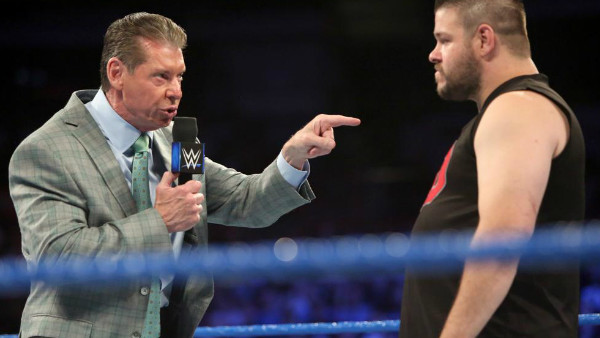
WWE is an astonishing entity.
It's often impossible to determine how it became the monopoly it exists as today. WWE actively resents its fanbase. It flaunts all acceptable workplace laws. At its very worst, it is a nightmare for fandom and personnel alike. While the recent philanthropic drive obscures it, the toxic underbelly, fattened through success and pressure, is a constant. Mauro Ranallo doesn't work 1,152 miles away in Florida because he enjoys the tax benefits.
This toxic culture, which rears its ugly head on an at-least annual basis, has much, nearly everything, to do with Vince McMahon. This is a man with a documented size fetish, a gutter-level sense of humour, a slave-driving work philosophy, and a documented aversion and or ignorance to otherness. He had to be made aware of the existence of Asian pornography to be convinced of signing Gail Kim in the early 2000s. That he couldn't believe men, even Asian men, found Asian women attractive is a complete indictment of the bubble in which he lives.
It's ironic; Vince McMahon has devoted his entire career to denying his existence as a wrestling promotor, desperately seeking mainstream acceptance - and it is the mainstream's disinterest in wrestling that has indirectly saved WWE - on multiple occasions - from harsh and potentially destructive scrutiny.
It is all born from what triggers all bullies: deep-rooted insecurity...
10. Expansion (National, Of Physique, And Of Underbelly)

The national expansion was essentially the World Wrestling Federation's Trinity test; it changed everything about the complexion of modern wrestling, and spewed the company's evil throughout the world.
The nuclear products that were the artificially-engorged muscle men of the WWF's golden age dominated North America and eventually, through the various, nascent cable and satellite revolutions, much of Europe. Artificial physiques were almost a prerequisite for a significant push - and while the grisly effects of long-term usage weren't known then, they were when performers began to drop like flies a decade or so later - and it took the most horrendous tragedy imaginable (or, more accurately, the devastating PR toll) for McMahon to formally abandon the culture.
Everything about the WWF was bigger, brighter and more bombastic than the floundering competition in the mid-to-late 1980s; by adding an intoxicating veneer of DayGlo glamour to the cult bloodsport, Vince McMahon, Jr elevated it into a mainstream concern. From the perspective of an armchair psychologist, this seemed to galvanise his inner megalomaniac. He wasn't yet arrogant enough to believe he was capable of building his house alone - he was astute enough to promote territory imports like Randy Savage and Ted DiBiase with the conviction latter day independent scene antecedents could only dream of - but he planted early red flags, nonetheless. Jesse Ventura's failed attempt at unionisation only served to add a more paranoid shade to the offscreen environment.
Terry Taylor, a star and a great worker in the UWF, was buried for the cocky way in which he strutted into the room. Vince sang when he was winning. Dusty Rhodes, a far bigger star, was fat and too synonymous with the NWA/JCP competition to portray with a modicum of dignity and adequacy - and he was buried even before he walked through the door via the conduits of Virgil and Akeem.
The mindset was always there. The company wasn't yet comfortable enough to cultivate the culture.
9. Self-Loathing, Outward Loathing

This mindset was shared and fostered by the reclusive Kevin Dunn, whom wrestling apocrypha has it gained power and influence within the WWF by rescuing hundreds of hours of invaluable footage from a burning car. He secured a job for life in the process as production head honcho - which angers fans to this day, for wrestling apocrypha also has it that the man actually hates wrestling. And southerners. And women.
Poor ol' Jim Ross was a constant target of Dunn's fondness for the General American inflection - or, if Jim Cornette is to be believed, a misophonistic hatred of the southern accent. McMahon shared this hatred. Again, the root of all toxicity is insecurity; it's no coincidence that Jim Crockett Promotions and WCW acted as his biggest competition for years. This mentality often manifested itself onscreen. Jim Ross was a constant victim of geographical bias; ditto Jim Cornette. It mattered little - nothing - that both men were genius wrestling minds, nor that they safeguarded the future of the company, under their own volition, with the conception of the initially smash-successful developmental system. They were southern. And World Wrestling Entertainment isn't wrestling.
When D-Generation X invaded WCW, Triple H had a whale of a time hamming up his impression of a hick. "This mission will start at the Norfolk Scope, with dubya see dubya wrasslin'." This for years was the WWF's code name for the competition - and far from the first publication of it. What's insane is that, in order to win said war, the WWF could have done with attracting southern fans, instead of belittling them. That they did underscores just how bright the star power shone at the time.
Consider the manner in which AJ Lee celebrated her first WWE Divas championship win for proof of Dunn's hatred of both women and the idea of wrestling acting as a personal accomplishment. She marked the realisation of her dream by tattooing the time served - an ink job for which she was annihilated from higher orders.
For further proof of Dunn's hatred and objectification of women, watch virtually every minute of every woman's segment between 1998 and 2015 - and read the damning widespread reports of Dunn's aversion to the Women's Revolution's concepts of meritocracy, body diversity and actual #Women'sWrestling.
8. The Bigger Boy In Class

When WCW battered the WWF in the early Monday Night War battles, with the help of Golden Age veterans no less, Vince McMahon lashed out via the tragically counterproductive early 1996 Billionaire Ted skits.
Ted Turner was depicted as a gap-toothed plagiarist devoid of original thought - and, later, a man too dumb to acknowledge his abhorrent racism. Nacho Man and the Huckster were two terrible puns depicted as dinosaurs impervious to evolution (that joke, ultimately, was on Vince). The skits were conceived for an audience of one - which was dumber than it reads on the surface. The WWF's audience was in decline during a lull period, in which the only viable competition ascended in parallel. Not for the last time, Vince preferred to indulge himself than service his fanbase.
This us versus them, siege mentality had already been engendered as a result of the series of scandals that rocked the WWF in the early 1990s; McMahon perceived these prosecutions as an affront to himself and his company, as opposed to crusades in the public interest. Defeating the government was a monumental ego boost for McMahon; it reinforced his might and his nous, allowing him the luxury of total single-mindedness.
This only grew when McMahon ultimately towered over the competition.
7. Enablement Of The Lunatic Asylum

The company's commercial downfall, in the early to mid 1990s, enabled the backstage Kliq faction of Shawn Michaels, Diesel, Razor Ramon, the 1-2-3 Kid and Hunter Hearst Helmsley to run roughshod backstage. They savaged promising careers out of spite and paranoia; Dean Douglas, Bam Bam Bigelow, Jean-Pierre Lafitte were all victimised by the politicking clan.
Of course, this cut-throat business was hardly the preserve of the WWF. It's as much a part of the wrestling fabric as the ring skirt - though most observers, even Michaels himself, suggest that their power was as disproportionate as it was destructive. These men and their locker room successors tapped into the essence of the company and curried favour with those at the top of it. Despite overturning its ailing commercial fortunes, this new branch of the culture was entrenched.
Perhaps it was mere coincidence that, following The Kliq's reign of terror, those who enjoyed the seniority and the stroke that came with it - JBL and Bob Holly, notoriously - also happened to be deeply callous individuals who enjoyed terrorising Justin Roberts and other men lacking the physical attributes and mental strength to stand up to them. Or, perhaps, the culture at the top moulded and or facilitated the monsters. Sycophants exist in every office, buddying up to the boss men, desperately tweaking their personalities to fit in. There's no reason why it didn't happen in WWE.
Even the most respected and benevolent locker room leader, the Undertaker - leader of the anti-Kliq Bone Street Krew faction - was not immune to sabotage...
6. Tragedy - Time = $

At his heart, Vince McMahon is a carny - and a carny never concerns themselves with morality: only money.
When Brian Pillman died, McMahon trotted out his widow Melanie on RAW to absolve his company of any complicity. It was a harrowing watch promoted in the worst taste imaginable.
When Owen Hart died, McMahon both continued with the pay-per-view, and obscured the careless wrongdoing of his death by celebrating his life on the next episode of RAW. If that was understandable, or with the best of intentions, the next week saw the WWF screen footage of his funeral without the consent of his widow, Martha - ghoulish at best, crassly insensitive at worst.
When Eddie Guerrero died, WWE essentially repackaged lifelong friend Rey Mysterio as The Ghost Of Eddie Guerrero. Rey was booked to act out his mannerisms in a sort of Weekend At Bernies twinned with a 1980s body swap movie scenario. He was awarded the World Heavyweight Championship on the grandest stage, WrestleMania 22, to enable the most lucrative monetisation possible.
Death is the overarching theme here; McMahon used the most shattering milestone imaginable as, variously, exercises in Public Relations and the selling point of his biggest show of the year.
5. To The Victor Go The Spoils

When the WWF won the Monday Night Wars, smug sewage poured from the pipes of Titan Towers.
By that time, fuelled by the star power of Steve Austin and the Rock, and a zeitgeist-grabbing philosophical shift, the WWF became a household concern once more. This was where the new big boys played. The old big boys were old hat - until McMahon required their star power for a short-term burst of lucrative nostalgia. The Invasion angle was a sad waste of a dream scenario, wasted purely to prove what the history books already confirmed: the WWF was the best and biggest wrestling company on the planet. The Undertaker treated homegrown WCW talent Diamond Dallas Page like he was an actual enemy soldier, and not someone with whom to make money. The downturn in business from the year 2000 indicts the strategy as counterproductive in the extreme, in the short term. Long term, the WWF halved the national wrestling audience. In the wake of the massively botched angle, WCW was perceived not just as an imitator, but an abject loser of an organisation. Even the biggest stars connected to it were devalued in WWE, purely to defend its apparent reputation as a bespoke star-making machine. Goldberg's 2003-04 stint remains unfathomable.
This gave rise to the culture in which prior experience, no matter how acclaimed, meant the sum total of nothing. Independent starlets like CM Punk and Daniel Bryan got over by accident, rather than design, because of it.
The WWF had won the pissing contest, for they had the biggest c*ck - which naturally led to them slapping it in the face of everybody for years and years afterwards...
4. The Rise Of Triple H...

Triple H is a very, very smart man.
He knew whom and what to hang his hat on. He cosied up to the Kliq in his early years, and literally got into bed with Stephanie McMahon to secure his long-term top management career. He was either always a perfect fit for top-level WWE management, or he worked himself into the ethos. The smug smile plastered over his face, at his defensive worst, all but confirms the former - though the hardcore fan appeasement strategy that is NXT underlines his expansive ability to work all sides. Triple H seemed to revel in his perniciousness.
Kofi Kingston was a kayfabe-denting punchline for the self-styled Game, who played by his own rules. Wider company initiatives, like the Wellness Policy, were no barrier to his snarky sense of humour. In spite of his own...suspicious physique, Chris Masters was buried on television for contravening it. Trips' insistence that Lilian Garcia was, in fact, an anthropomorphic horse revealed exactly why he and Vince McMahon share such a bond. Both men - and there is no delicate or less objective way of putting it - are nasty to the core. Triple H is much like his predecessor; he is in the process of gutting and monopolising the UK "graps" (shudder) scene, and has a propensity to unleash his inner monster on those around him for no discernible storyline reason.
Leave it to Golden Era Simpsons to summarise the phenomenon better than all others:
"Well, animals are a lot like people, Mrs. Simpson. Some of them act badly because they've had a hard life, or have been mistreated. But, like people, some of them are just jerks."
3. ...And, In Harmony, Stephanie McMahon

Stephanie McMahon is chiefly responsible for the transition from booking to writing - and you suspect from her ever-present pompous gaze that she still thinks it's a good idea, despite presiding over an age in which there are fewer genuine wrestling megastars than there have ever been.
Stephanie's is a more insidious brand of toxicity. She anoints herself as this great agent of charity and progressivism when, in reality, she has revealed herself as a fraud. "Philanthropy is the future of marketing," as she once infamously retweeted. As she initiated the increasingly transparent (and problematic) PR drives in an attempt to soften her company's public image, she was only really successful in cloaking the underbelly, making it harder for many fans and observers to believe independent sources (the Wrestling Observer) than WWE affiliates (ESPN) in connection with this year's grim Mauro Ranallo furore. It is enablement through obfuscation.
She may not have inherited her father's wrestling nous, but she d*mn sure inherited his chutzpah; her onscreen character has done as much as anybody or anything to depict the new generation of WWE performers as losers who should count themselves lucky to be employed - or (un)independently contracted, as the very dubious case may be.
2. Sloth

As WWE lurched from the Ruthless Aggression to the PG eras, the company luxuriated in its castle.
Talents who failed to get over immediately, and or under the shackles to which they were chained, were left to rot, stigmatised by the failure of a creative regime. The drug culture, slowly reinstated following the dissipation of the early 1990s steroid scandal, claimed the lives of both the complicit and the tragically innocent. The Wellness Policy implemented following Guerrero's death was a band-aid; it took the harrowing death of a 7-year-old child for WWE to finally confront itself. In the interim, WWE became an anti-meritocracy shaped by nostalgia and the one-seat star vehicle that was John Cena - a man all too happy to use his immense backstage influence to sabotage many a career in the name of self-preservation.
Even under the guise of PG and post-Wellness Policy reform, WWE exposed itself. Play-by-play commentator Michael Cole turned heel and echoed the all-encompassing spite within Vince McMahon across every minute of the flagship broadcast, exacerbating the anti-JR narrative. Mickie James was bullied, on-air, for not conforming to WWE's rail-thin expectations of female aesthetics. Kaitlyn received the same treatment. The ghosts of Paul Bearer and Reid Flair were desecrated to drive viewership. Alberto Del Rio lashed out physically after suffering racist treatment. He was fired.
Bill DeMott's tenure as NXT head trainer was a crusade of dangerous physical bullying and mental torment. This was known, accepted and enabled; to indict WWE, his stint was only ended when the facts became public.
And therein lies the problem - the complete lack of genuine character within WWE is only subject to external regulation.
1. The Sad Reaction To Change

WWE, after the hilarious disaster that was the dying days of its in-house developmental system, was finally forced to acknowledge the shrunken world around 2014. The results are at once uplifting (NXT) and utterly depressing (the end result of it).
Red flags waved at the very turn of the decade. The NXT game show was a spiteful defiance of hardcore fan sentiment and a vehicle on which to embarrass the latest generation of talent. The importance of Daniel Bryan's carefree nature cannot be overstated; were it not for his imperviousness to the culture, the revolution he forged may not have been televised. The other independent stalwart WWE attempted to make an example of, Kaval (Low Ki), was unable to stomach it. With the anti-wrestling mentality carefully fostered by Dunn for years, the fruits of his labour ripened.
The main roster creative regime seems to actively resent NXT, which underwent an amazing metamorphosis from joke to cult phenomenon. Sami Zayn is a geek we're fools for believing in. Kevin Owens is a sociopathic heel monster, but he's also fat. Shinsuke Nakamura is comedy fodder for racist-but-not-racist segments. The heel voices the thoughts of the inner sanctum, so apparently that's fine. Cesaro isn't allowed the singles platform on which to grab the brass ring seemingly because people want him to grab it.
"I don't give a d*mn what you people want!" McMahon once roared on RAW. That was Mr. McMahon, but circumstantial evidence suggests that this is an IRL belief.
It's completely backwards, but to the victor go the spoils. We get our guys because some concessions must be made to the audience - but even in 2017, McMahon remains his own primary audience, and Jinder Mahal, the basic, racist, geopolitical heat repellent is his WWE champion.