5 Companies That Would Want To Buy WWE
Rumours hit late last week that AMC were interested in purchasing WWE. Although that seems unlikely, we answer the question of who really could buy Vince McMahon out.
Background On WWE Financials
Background On WWE Share Structure
As a publicly traded company WWE has two classes of Stock: Class A and Class B. When John Q. Public decides to buy $WWE Stock, they're buying Class A shares. The Class B shares are controlled by the McMahon family - either directly or in trusts set up on their behalf. As of February 2014, there were a grand total of SIX holders for all Class B shares.
There are about 75 million total shares of $WWE split between 31.3 million Class A shares and 43.8 million Class B shares. While only controlling slightly more than half of the total shares, Vince McMahon retains control of the WWE because his shares have more voting power. As explained in the Annual Report:We have Class A common stock and Class B common stock. The holders of Class A common stock generally have rights identical to holders of Class B common stock, except that holders of Class A common stock are entitled to one vote per share, and holders of Class B common stock are entitled to ten votes per share.... In addition, the voting power of Mr. McMahon through his ownership of our Class B common stock could discourage others from initiating potential mergers, takeovers or other change of control transactions. To be Class B shareholders you must be in the McMahon family: If, at any time, any shares of Class B common stock are beneficially owned by any person other than Vincent McMahon, Linda McMahon, any descendant of either of them, any entity which is wholly owned and is controlled by any combination of such persons or any trust, all the beneficiaries of which are any combination of such persons, each of those shares will automatically convert into shares of Class A common stock.There Cannot Be A Hostile Takeover

5. Mass Media
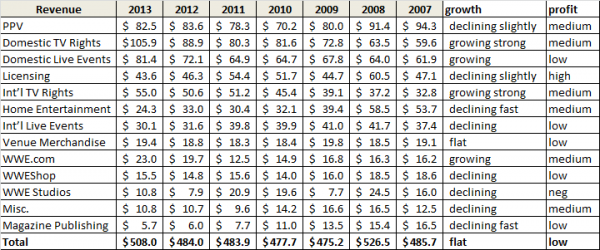
A very natural partner for WWE would be a Media Conglomerate. Ideally, WWE would want to be aligned with a company that provides internet access, run cable & telecommunication systems and programs television channels. While most wrestling companies were founded by promoters and charismatic wrestlers, there's actually a significant history of television channels starting, supporting and sustaining wrestling promotions. For instance, WCW (World Championship Wrestling) was bought by Ted Turner/Turner Broadcasting in November 1988. American Ring of Honor was sold to Sinclair Broadcasting in May 2011. Japanese promotion IWE (International Wrestling Enterprise) was run by a different TBS (Tokyo Broadcasting System) in 1968. In 2014, AAA is launching their American presence (television show, and future live tours) based on a partnership with new English-language Latino-focused television network El Rey. Honestly, it's impossible to be considered a true major player unless you have a national television contract. The death knell for WCW and ECW was the cessation of their television contracts. Similarly, the beginning of the end for wacky wrestling company Hustle and MMA organization Pride FC came when they lost their television coverage with Fuji Television (when it was revealed that promoter Dream Stage Entertainment had links to a major yakuza organization). Pride FC sold their assets to Zuffa (UFC's owners) a year later. There's a lot of natural fit: - Television Channels (Weekly Programming) = Domestic TV Rights are currently hovering $100M. Owning the product outright could prevent the wild escalation of product costs. One network could lock up the exclusive WWE rights in perpetuity for a fraction of what the lifetime contract would cost. - Multi-channel Video Programming Distributors (PPV) = Cable companies cut of domestic WWE PPV was roughly $40M in 2013. With the launch of the WWE Network, WWE is attempting to prevent PPV money from being split with MVPDs. Whether other MVPDs would continue to "play nice" with WWE or whether they'd stop carrying their PPVs all together is hard to say. - Internet (WWE Network) = Instead of WWE cutting out the Comcast and Time Warner Cables of the world from their cut of PPV pie, owning the WWE would enable the owner to both profit off the over-the-top model, as well as would provide an excellent gateway to bring the WWE Network as Premium Channel or Video on Demand service back to Cable. With lingering questions around Net Neutrality, theoretically the media conglomerate that owned WWE and controlled internet pipelines might be able to "push" the WWE Network service. Additionally, even a questionable segment such as WWE Studios makes a lot more sense when WWE is part of a larger media conglomerate. When you look at the WWE's most successful movies (almost a back-handed complement) were things such as 2006's The Marine starring John Cena or most recently Christmas Bounty starring the Miz. Depending on the partnership, there's many natural fits: Scooby Doo! Wrestlemania Mystery on Cartoon Network, replays of See No Evil on Chiller, Leprechaun: Origins on Showtime, the French-language Queens of the Ring on IFC, The Call on HBO and Disney's Touchstone Pictures creating the remake of The Fall Guy starring The Rock. Similarly, the WWE Magazine would find a solid home in a publishing
4. Internet Company
 Perhaps the premiere partner would be someone not from old media (Cable Channels) but from the new media. The WWE Network has received an enormous amount of buzz on the basis on launching an over-the-top service that's inspired by the success of Netflix and the growth from Amazon Prime streaming. It's available on your television via Apple's AppleTV, Microsoft's XBOX360 and Google's ChromeCast. WWE has their enormous library of content, which they completely own. It would make an excellent companion to an over-the-top network (Netflix, Hulu, Amazon Prime) or a dedicated channel on their device (AppleTV, Roku). These large internet companies have huge cash reserves. There are several different plays depending on the buyer. For Netflix or Amazon Prime, acquiring the WWE would provide an excellent way to obtain content for their already established streaming services (Netflix, Amazon Prime). Instead of spending billions on obtaining rights, they'd be able outright own the modern library and vast network of territorial libraries they've acquired already. Undoubtedly, WWEShop run by Amazon would be able to reverse the declining trend. In this scenario, the WWE Network may be collapsed into the already existing over-the-top network, perhaps as separate revenue-generating tier. Also, the WWE Studios films would presumably join their established streaming service. For cash rich companies such as Apple, Microsoft, Google or Facebook, they may see the WWE Network as an opportunity to customize their internet platform (gaming consoles, social media websites, video portals) with the WWE content. Already overseas, struggling All Japan Pro Wrestling (AJPW) was purchased by the IT Company Speed Partners/Red Wall Japan.

3. Crazy Billionaire
2. Live Event Producer
 An interesting suitor would be entertainment company Live Nation Entertainment. The combination of Live Nation, concert promoter, and Ticketmaster, ticket sales company, already sells WWE tickets for their live events. In recent years, Live Nation has acted as a promoter to many of the biggest touring acts (often where their deals don't actually include the copyright for the artist's future recordings). Live Nation, a publicly traded company with a market cap of 4.65B (about twice of WWE's 2.32B), has extensive knowledge and experience in promoting shows across the world. They'd be excellent partners with the WWE and could hopefully streamline arena booking costs, transportation charges and shore up their international presence. Live events are worth more than $110M, and in 2013 hit their peak in more than a decade. While WWE popularity is not near the high-point in the Attitude era, where wrestling has averaging more than 11,000 people/show, WWE has grown their live events business through increasing ticket prices and running more shows (WWE annually runs 100+ more shows than during 1999-2001). With an exceptional understanding of promoting live events, running merchandising and world class reach, Live Nation would make a valuable partner for WWE's future growth.
1. Private Money
A growing trend in Sports Franchises has been ownership by partnerships (seen in Baseball with the LA Dodgers, Philadelphia Phillies and San Fransico Giants) and companies (NY Knick's MSG Company and Toronto Maple LEafs owned by Bell Canada and Roger Communications). Before Guggenheim Baseball took control of the Dodgers from Frank McCourt, numerous private equity firms including KKR (famous for the 1989 RJR Nabisco buyout memoralized in Barbarians at the Gate) emerged as potential bidders. At one time the Toronto Rapters' were owned by the Ontario Teachers' Pension Plan. TowerBrook Capital Partners experimented with Hockey Team ownership with a 70% stake in the St. Louis Blues. It's possible that private companies and private money would want the WWE, or at least the WWE assets. There's certainly a growing marketplace for selling digitized old content and it's possible that a private seller could find a movie studio or home-entertainment division interested in the assets from WWE Studios. While Vince McMahon's media image is a combination of brazen trailblazer and goofy carnival promoter, leadership from experienced private equity professionals may bolster WWE's imagine on wall street and continue to open new avenues for investment from major banks and hedge funds as well as opportunities for serious partnerships with other media companies. A detailed evaluation and reorganization of WWE may provide some cost-cutting measures that could seriously boost WWE's net income and eliminate boondoggle projects from the books.CONCLUSION
 The popularity of WWE Stock has rocketed Vince McMahon back to Billionaire status. His company stands at an important cross-roads as they attempt to launch a successful over-the-top WWE Network and negotiate a massive rights increase for their domestic television programs. While a publicly traded company, WWE is not at risk of a hostile takeover as vast majority of the voting rights are concentrated in the family-owned Class B shares. Still, for the right price, at the right moment, perhaps the WWE would entertain taking on a partner. Mass media companies such as NBCU would offer the holy trifecta (USA network for Raw, Xfinity/Time Warner Cable for PPV and Comcast/Time Warner Cable Internet for WWE Network). Meanwhile, internet innovators such as Netflix or Google have plenty of cash and could easily build on the foundation of the WWE Network to integrate the product into their services and continue to push the cut-the-cord narrative. Then again, the perfect replacement for Vince McMahon may be another crazy billionaire willing to stick his thumb in the eye of his critics while laughing all the way to the bank. While television pays the bills, the lifeblood of WWE is the touring program and therefore a partnership with a live event promoter would be an excellent alliance to grow their weekly domestic and international business. Or the future for WWE may lie with corporate America - embracing private money and optimizing the company to yield highest returns from segment and selling off the business operations that aren't going to be profitable. Finally, there's dark horse candidates that haven't even been explored. Consider New Japan Pro Wrestling - originally founded by charismatic star Antonio Inoki in 1972, NJPW was sold to Yuke's Co. Ltd (the video game company that made the WWE Smackdown! series) in 2005. In 2011, Yukes sold their majority ownership in the wrestling company to Bushiroad (Collectible Card Game publisher). They've seen a significant improvement in the quality, reach (launching worldwide iPPVs) and business in the last few years. While neither of those owners (Video Game Company or Collectible Card Game publisher) may seem like a natural fit, NJPW has been surviving and now thriving. The lesson here is that there may be a lot of good fits for the WWE which don't immediately appear feasible until you dig a lot deeper. WWE says they are in the business of "puts smiles on peoples' faces". That's the business of producing and selling a marketable product. If someone can prove to Vince McMahon they're even better at that then he is, who knows - maybe he will turn over the keys to the castle.