10 Films That Were Too Shocking For Audiences
To avoid fainting, keep repeating, "It's only a movie...."

Even before a single cinema opened its doors, filmed entertainment had acquired a sleazy reputation courtesy of the Kinetoscope, or peepshow. Popular at funfairs and amusement parks, and such a novel invention that showmen didn’t require a licence to operate them, the little black boxes allowed the working classes to view such unforgettable tableaux as What The Butler Saw and Beware My Husband Comes.
At the beginning of the 20th Century, peepshows were eclipsed by movie palaces that projected two-minute (or shorter) moving pictures onto their walls. Actually, palace is too grand a word for the converted shops where Britain’s poor gathered to watch the earliest films. The rooms lacked lighting and often stank of urine, it being easier to relieve oneself in the dark rather than visit the outdoor conveniences.
The point seems worth stating: movies began as cheap entertainment for the poor who, unlike the upper classes, were transfixed by the new medium. Much to the chagrin of moral watchdogs, they wanted to see action, violence and sex, though not necessarily in that order.
In 1912, the idea for a British Board of Film Censors was proposed. Financed by the fees paid by producers seeking a certificate, it would effectively filter culture for consumption by the masses.
Over the years, several pictures were found unfit for exhibition. Here are 10 of them.
10. Maniac

Directed by the auteur behind the skin flicks Hot Honey and The Violation Of Claudia, Maniac is your typical story of a Vietnam veteran who places the scalps of his female victims on his assembly on mannequins. After clothing a mannequin, he carries it over to his bed and starts talking to it, pretending it’s his dead mother.
There’s gore galore as our “hero” goes about his business and because the effects are by Tom Savini, it all looks shockingly realistic. The BBFC thought so, and refused to grant the picture a theatrical certificate.
As late as 1998, the film was refused a video certificate, but it was finally released in 2002 with 58 seconds of cuts. A decade later, a much softer remake starring Elijah Woods appeared in cinemas. It was passed uncut.
9. Island Of Death

Claiming to be doing the Lord’s work, a married couple (who are later revealed to be brother and sister) go on a murderous rampage on the Greek island of Mykonos, ridding the area of its homosexuals, hippies and nymphomaniacs. For reasons known only to director Nico Mastorakis, there’s also a sequence where a character enjoys a moment of passion with a goat.
All of which proved “shocking” enough for the censor to cut 14 minutes from the film before it could be shown in UK cinemas. Issued as an uncertified video release in 1982, the film was quickly withdrawn, banned and successfully prosecuted for obscenity.
It was a quarter of a century before the film was resubmitted to the BBFC, and time had once again worked its magic. Conceding that the film was too silly to be taken seriously, the Board passed the film uncut in 2010.
8. Deep Throat

The most famous porn film of all time, Deep Throat was banned in the UK until 2000 – nearly 30 years after it was first shown in US cinemas. Given an R18 certificate, the uncut version was only available in licensed sex shops while a trimmed version saw a wider release.
At the US box office in 1971, Deep Throat was more popular than either James Bond or Dirty Harry, made more money than pictures directed by Stanley Kubrick and Sam Peckinpah, and became the first stag movie to be reviewed by Roger Ebert. The illicit had entered the American mainstream.
The New York Times coined the term “Porno Chic” to describe the burgeoning interest of middle class couples in hard-core, while in All The President’s Men, Deep Throat became the nickname of the Watergate whistle blower (the film won four Oscars and was credited by Ronald Reagan with losing the Republicans the 1976 election).
The illicit had entered the mainstream – at least, unless you were British.
7. New York Ripper

No stranger to violence, Lucio Fulci had three films on the British “Video Nasties” list in the 1980s: Zombie Flesh Eaters (1979), The Beyond (1981) and The House By The Cemetery (1981). New York Ripper trumps them all - after being denied a cinema certificate by the BBFC, the print was escorted out of the country by Her Majesty’s Constabulary.
Taking place in a New York full of the adult bookstores, run down porno theaters and live sex shows, the film focuses on “a maniac who likes to slash young girls to death”, and Fulci doesn’t exactly shy away from the violence. As women are stabbed with broken bottles or tied up and slashed with razor blades, his camera records the madness in full close up.
The film was finally released – with cuts – in 2002, by which time local government (with a little help from the Disney corporation) had cleaned up The Big Apple so that it no longer resembled the city portrayed in the movie. New Yorkers were appreciative, I’m sure.
6. Ilsa She Wolf Of The S.S.
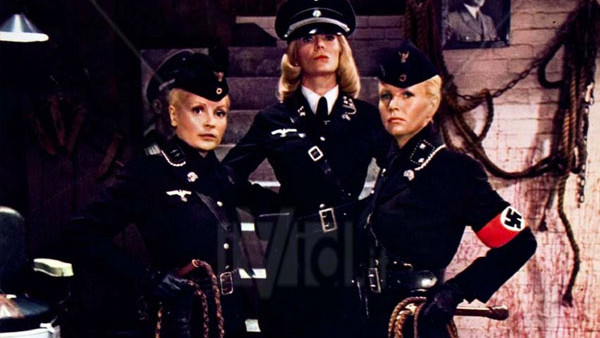
Rejected for theatrical exhibition in 1975, Ilsa She Wolf Of The SS is one of the few films that remains banned in the UK, which comes as something of a surprise considering that the sequels are freely available,
It’s your average story about a Nazi villainess who conducts experiments on her female prisoners, the kind that involve phallic implements and no clothes. She also sleeps with the men (castrating anyone who disappoints her), but eventually meets a prisoner who can withhold his orgasm and….well, let’s not get bogged down in plot.
Needless to say, the combination of Nazi imagery, torture sequences and softcore porn made the film a target for censors, and the film was banned in Australia and Norway. More surprising is the fact that its lead actress, Dyanne Thorne, later became an ordained minister and co-founded the International Science of Mind Prayer Circle in Las Vegas.
5. The House On The Edge Of The Park

This Italian version of The Last House On The Left – from the director of Cannibal Holocaust, no less – was never going to please censors, so to nobody’s surprise The House On The Edge Of The Park was rejected for theatrical exhibition in 1980.
After the uncertified video was withdrawn and prosecuted for obscenity in the early 80s, a truncated version (missing 11 min 43 sec) was released in 2002, excising the scene that offended the BBFC the most – a sequence where a naked woman is repeatedly slashed with a razor.
The Board commissioned a research screening of the film in 2006 that had the unintended effect of inspiring laughter when the main villain died in amusingly cheesy slow motion. The movie was subsequently re-released with only 46 seconds of cuts.
4. I Spit On Your Grave

This notorious rape-revenge movie first came to the attention of moral watchdogs when, having bypassed cinemas, it appeared as an uncertified video in the early 80s. That meant audiences were able to view the picture’s 25 minute assault sequence in its entirety, something they would be prohibited from doing in the future.
The video was ultimately withdrawn and prosecuted for obscenity, and it wasn’t until 2001 that a heavily cut version emerged. In order to justify cutting 7 minutes from the film, the BBFC quoted the Human Rights Act, which it claimed required its examiners to “take a proportionate approach to any perceived dangers in a work.”
In 2010, the censors concluded that these cuts were “excessive” and re-released the film with 2 min 54 sec trimmed, reinstating any material “that emphasized the horrors of sexual violence.”
In the same year, the remake passed with only 43 seconds trimmed, proving that they really don’t make them like they used to.
3. Cannibal Holocaust

With its scenes of sexual and physical violence, Cannibal Holocaust swiftly acquired a reputation as “The most controversial movie ever made”, although being banned in a rumoured 50 countries (including Italy and Norway) probably didn’t hurt either.
In the UK, the film bypassed cinemas because it was an open secret that a movie where pigs, racoons, turtles, monkeys and snakes were slaughtered for real would not sit well with the censors. They would probably also take a dim view of a documentary crew being torn to pieces by cannibals while their camera records the ordeal.
Instead, the film appeared on video in February 1982, sporting outrageous cover art that showed a native eating intestines. This promptly brought the film to the attention of the authorities and in July 1983 it was withdrawn from distribution and prosecuted for obscenity.
The picture wasn’t available again until 2001, when it was released in a heavily edited version that excised several scenes of sexual violence and animal killings.
2. The Last House On The Left

After collaborating on the Marilyn Chambers picture Sensual Paradise (“The most important film ever made on sex relations!”), Wes Craven and Sean Cunningham regrouped to make an extreme exploitation movie tentatively titled Night Of Vengeance, which took inspiration from Ingmar Bergman’s The Virgin Spring.
In 1974, the first of many battles with the BBFC began when examiner Stephen Murphy rejected the film for theatrical release. He wrote: “We can find no redeeming merit in script, in acting, in character development or in direction which would lead us to feel that this muddly [sic] film is worth salvaging….Maybe we are wrong. But if we are to go into this area of sexual violence, it will have to be for a film in which we detect greater merit than this.”
A decade later, the situation escalated when police seized uncertified VHS copies of the film, which was banned and successfully prosecuted for obscenity. After years of disputes and appeals, the movie finally became legally available to watch (with cuts) in 2002, but it remained unavailable in its uncut form until 2008. By an extraordinary coincidence, a bigger-budgeted remake hit cinemas exactly one year later. It was passed uncut.
1. The Texas Chainsaw Massacre

Even though Tobe Hooper’s movie played in America’s Drive-ins without causing riots, BBFC Secretary Stephen Murphy felt that the focus on “abnormal psychology” would be too much for British audiences and refused to issue an X certificate, effectively banning the picture.
In 1975, Murphy was succeeded by James Ferman, who refused to certify a film he described as “the pornography of terror.” The picture remained in limbo until it was sneaked out as an uncertified video in the early 80s, but when the Video Recordings Act required that home entertainment be brought into line with theatrical exhibition the film again disappeared into obscurity.
The movie wasn’t available legally until 1999, when in the wake of Ferman’s departure from the BBFC, the Board re-examined the film and concluded that the movie was “less likely to disturb adult viewers, many of whom would feel the film to be dated and feeble compared to modern horror offerings.”
25 years after first being submitted for classification, The Texas Chainsaw Massacre was finally screened in cinemas and was subsequently released uncut on home video.