10 Great Films That Lost Money On Ambitious Sets
Why spend £5 Million on Tom Cruise when you could have tons of concrete and stone?

Part of the filmmaking process is, of course, venture capitalism. Producers attempt to have some control over directors and ensure profit. Directors, in turn, often only pay lip service about the initial agreements.
Perhaps a filmmaker has paid his dues: he's worked with limited resources and made the studios good income. Now he can ask for a bigger budget. While a filmmaker doesn't exactly want to damage his career, he may see above all an opportunity to finally achieve his vision, without financial constraint.
It's one thing to pour money into big name stars, but where things get really interesting is when filmmakers spend copious amounts on lavish sets and other production elements. If the movie fails commercially, these monuments can seem like castles made of sand. In other cases, they actually linger as ghost towns after the film died. But for every Waterworld there's a Cleopatra.
Sometimes you have to go big or go home...
10. Heaven's Gate (1980)

At first glance, the set of Heaven's Gate, director Michael Cimino's release two years after The Deer Hunter, may not necessarily stand out--a drab, limited, old west town. The attractive panoramics the film truly has to offer are built by nature: mountains and flattened fields of Montana's Glacier National Park. What's concealed, however, is the obsessive, taxing attention to detail in constructing the town itself piece by piece.
Auters are notorious for their exacting demands and innumerable takes, and Cimino was no exception. His style is almost a fable regarding neglected details, teaching us to pay attention the art of a dirty road perfected even to obscure its design.
As a matter of fact, the story goes Cimino demolished the first town thoroughfare his crew built. Though made to his specifications, he said it didn't look right. The film was originally budgeted at £8.5 million, but that ended up quadrupling. Camino built a massive irrigation ditch in order to beautify a battlefield. He even saw a tree that was perfect, except that nature had put it in the wrong place, so he had it chopped into pieces and reassembled.
Cimino's overindulgence and uncompromising approach was something of a joke, a hubris that justified critics' hatred. Time Magazine even included Heaven's Gate on its 100 Worst Ideas of The Century, somewhere between Prohibiton and thong underwear for men. Others saw, in a different light, dedication, and value that only a doctrinaire artist could yield, and appreciation for the film has since grown.
9. Big Trouble In Little China (1986)

John Carpenter was no stranger to success, particularly when it came to a high gross on a shoestring budget. Halloween reeled in over 200,000 times what it cost. While obviously that film relied on affordable but highly effective atmosphere, Carpenter had also proven his skills to orchestrate cheap but attractive special effects in his sci fi film. By the 80s though, thrift was no longer necessary for Carpenter, and the explosions in Escape from New York, for instance, were noticeably larger.
Big Trouble in Little China had a budget on par with any contemporary, big production. After all, though the film followed a playfully cheesy martial arts aesthetic, expenses were not spared in the sets and other production to achieve the desired effects. Little China itself was a rigorous construction, though it appears to be an actual outdoor location. According to Carpenter, this was necessary to help control the stunts and special effects.
The obvious sets themselves are as opulent as those of their kung fu inspirations. The chief set designer for the film was John J. Loyd, who got his start in television, for such programs as The Munsters, which could have been the origin of his eye for the fantastic.
Big Trouble didn't do terribly, but it didn't come close to covering its cost and was quite a disappointment. Carpenter attributes this in part to the concurrent release of Aliens.
8. Ran (1985)

By the 1980s, Japan's film industry was not doing well. TV had mortally wounded cinema, and a number of major studios had either gone under or were on their way out. The nation's vanguard director Akira Kurasawa had faced a long dry spell himself, but his career was revived by and large at the hands of super fan George Lucas. As Japan's film industry shrank, the films of one of their most prized directors became more lavish than ever.
Ran is Kurosawa's most expensive film, and was the most expensive ever made in Japan at the time. In scenes where some may have opted for miniatures, Kurosawa instead erected castles, in addition to barricaded villages and other elaborate sets, for this King Lear adaptation. Pressure was often high for the actors, who would have one take, as many sets were destroyed as part of the battle segments.
Money was not spared for the grand-scale of costumed extras or other heaping proportions. If movie blood is expensive by the liter too, or arrows by the grain, one would hope Ran bought wholesale. For one magical scene, which didn't even make the final cut, Kurosawa even had a field sprayed with gold.
Ran was widely acclaimed upon release but was not particularly successful in terms of money. Kurosawa, however, was regarded highly enough that, essentially, wealthy patrons allowed him to make his art.
7. Mutiny On the Bounty (1962)

What do Gone With the Wind, Ben Hur, and Dr. Zhivago have in common besides being epic historical dramas? They made lots and lots of money. It's so surefire: giant stars, big budget, and extended running time, and then wait for the money to roll in. But even with Marlon Brando, the success of the source novel, as well as the popularity of an earlier film adaptation of the 1930s, Mutiny on the Bounty sank.
The films mentioned above have one other thing in common: they're all MGM productions, and Mutiny was too. The studio had little cause for insecurity. Therefore, the utter failure of this film was unforgivable. Though its director, Lewis Milestone, had an illustrious career beginning at the start of the century, he would never make another movie.
The Bounty itself was reconstructed faithfully for the film and sailed to Tahiti. Furthermore, the village and other sets constructed on land were regularly subject to violent storms, and had to be rebuilt. Naturally, Brando's eccentricities didn't make matters any easier: he actually started bullying and practically directing the film himself.
Its true Mutiny is not a good movie, but it's Brando, and it's vibrant, wide-screen MGM. It's also enjoyable knowing what a mess things were behind the scenes. One can try and guess in which scenes a principal actor is completely blotto. Brando elected to perform his death scene on a mattress filled with ice, having to take breaks when his skin turned blue.
6. Brazil (1985)

Though in many ways Brazil is an achievement of mesmerizing production and set design that stretches beyond its budget, the film was not inexpensive. It actually cost about the same as Back to the Future, released the same year. For a film made by the director of Monty Python and the Holy Grail, cowritten by the author of Rosencrantz and Guildenstern are Dead, and featuring an actor from a few adequate films like The Godfather Part II and Taxi Driver, Brazil lost a lot of cash. It hardly recovered half of its cost.
Like Playtime and Metropolis, Brazil relied on its set design to depict a theme of cold, isolating modernity. Some of the allure of the set is simply due to great location scouting, but many of the memorable scenes required fairly monumental set design. Some were used for extendedly, like the massive, grey-domed and steel-latticed interrogation room. Others appeared only for a moment, such as transportation terminals and doorways, though even these persist in the memory after viewing for their splendor.
Of course, plenty of set materials were quite cheap as well, such as the chintzy and low-tech, but futuristic plastic tubing littering the protagonist's apartment.
Universal was not exactly pleased with Brazil, but a few years later, Columbia gave Gilliam another chance, and nearly four times as much money, for The Adventures of Baron Munchausen, which also flopped.
5. Dune (1984)

Dune had experienced several false starts, beginning in 1971. Its first producer passed suddenly, and then a few years later it was again picked up, slated to be directed by Alejandro Jodorowsky. After a few more hiccups, David Lynch was recruited to create the film at last. His final cut was three hours long, and the producers took rein and pared it down, also adding new footage. Though today the film has a cult following, it was not well received, and Lynch has disowned it, saying he was divested of artistic control.
Gene Siskel even criticized the film for having cheap special effects and an ugly appearance. Dune, however, remains for many fans an achievement of composite scenery and special effects, in the vein of Star Wars and 2001: A Space Odyssey. After all, although Lynch was still a very new director, he'd just been offered directorship of Return of the Jedi around the same time.
Matte backdrops may at times be obvious, as well as soundstage sets, replete with artificial water and weather, but that doesn't mean the results are unattractive, albeit often monochrome and bleak. The visual crew created miniature ships and architecture, as well as full scale models, and many in-between--cityscapes 8 or 10 meters high.
Dune actually was number two in the box office its release week, but it just never made enough back in the long run.
4. Popeye (1980)

Popeye is amazing, but from a financial standpoint, studio capitalists were ill-advised in choosing an unorthodox director. Musical adaptations were huge. Grease had just been released a few years prior, regaining it's production cost in under a week. Robert Evans of Paramount, lost the bidding war for Annie, but retained the old rights to Popeye. He and Disney soon had slot-machines for eyeballs.
It was an especially odd time to elect Altman, who had recently been abstruse. 1980's Quintet was slow, laborious, and to some even unwatchable. They gave him money, though, and lots of it--around £45 million. Altman had an entire coastal village constructed in Malta for the main set and even installed a 70 meter breakwater for protection, all of which took 7 months to build. His appropriation of the budget for personal enjoyment, and the substances required, is somewhat legendary. Popeye Village, or Sweethaven, still stands as a tourist attraction, with Popeye characters and other amusements.
Popeye actually did well financially by most standards, but not for its producers, and the failure would damage Altman's reputation for some time and force him to create more independently. Also concurrent was Evans' drug trafficking scandal and embroilment in a murder case, all along the inglorious road from Chinatown to How to Lose a Guy in 10 Days.
3. The General (1926)
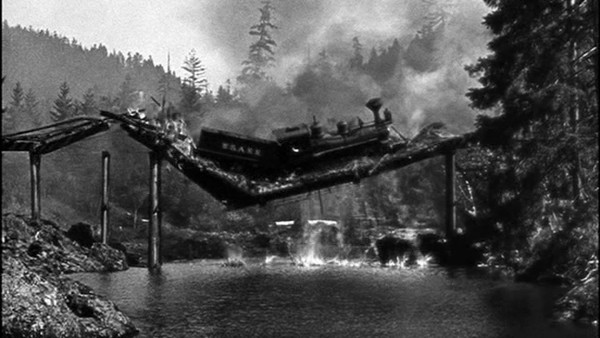
Nowadays, The General is regarded as one of Buster Keaton's finest works. Orson Welles even called it the greatest ever made. In 1926, however, it was panned, and resulted in Keaton's termination from United Artists.
It's challenging to understand why exactly critics and audiences were so underwhelmed at the time, but the cause may in part have been contemporary expectations of comedy. The General is in some ways a naturalistic drama, despite its gesture characteristics of the silent age. Its differences from its contemporaries, and the causes of its public failure are subtle: while melodrama, such as Chaplin's madly successful The Kid, was congruous with comedy and its overstated pantomime, The General was often sombre and understated. It also depicts relatively grim visions of war: masses of weary-looking troops and horses, terrified victims, and insensitive colonels.
Keaton was furiously inspired, and had enough power to demand more and more money from the studio. He made lavish purchases, such as a few authentic Civil War locomotives, and hired massive a crew to construct and manage epic sets over a lengthy production. He was meticulous with mis en scène, even constructing a dam in order to adjust the water level of a river.
Several fires broke out on set, costing an additional £40,000. Not to mention, several of Keaton's train stunts, with one false move, could have easily killed him. Ultimately, he would lose the rights to his previous work to cover his losses.
2. Metropolis (1927)

Yes, Metropolis is the first of Fritz Lang's groundbreaking films, and its legendary commercial failure did nothing to halt his career. It did, however, bankrupt Ufa, its studio. It took nearly two years to film, and is estimated to have cost £1 million in 1927, an amount only rivaled by D.W. Griffin's grand-scale Intolerance.
The studio sought to reach an American audience, and they succeeded, but could never recoup the costs. Lang employed cinematographer Eugene Schüfftan, who had created a mirror technique for superimposing actors into miniatures. It might seem deflating to realize that the imposing architecture of the film is only small scale, but the process was painstakingly elaborate and still massively expensive.
Some of these shots included small planes and other vehicles, shot in stop motion, meaning achieving the right footage was a challenge. Due to some of film's proneness to damage at the time, a successful scene might be lost, and would have to be done again and again. The film also featured expensive costumes, such as the iconic robot suit, as well 40,000 extras.
Behind the film was a great drive and ambition to, yes, profit, but also to create something the likes of which had never been created before. Ufa fell briefly into difficult times, but kept afloat and soon thrived making propaganda films under the Nazi regime.
1. Playtime (1967)

In the annals of film criticism, Jacques Tati and failure are hardly to be found as a pair. In terms of cost versus profit, however, the magnum opus Playtime was not exactly a cash cow.
The film cost over £13 million to make, around £4 million more than its high-production contemporary 2001: A Space Odyssey. It bankrupted Tati, and even forced him to sell his rights to his previous films. The movie took over three years to make, with the elaborate set consisting of apartments, storefronts, and office buildings, roads, an airport, and scale, but still massive skyscrapers. The little city, dubbed Tativille, even had its own little power plant to keep its lights on.
The opportunity to construct the entire set meant of course total control of mis en scène, which in the hands of a master meant magical results, and a film that is nearly silent and relies on humor built into its alienating, modern spaces.
Playtime is a great example of an artist willing to make great sacrifices to produce his vision. Though the film didn't make enough money to cover its costs, Tati observed that the set was after all the star of the film, and cost about the same as Elizabeth Taylor.