Star Trek Beyond: 5 Ups And 3 Downs (The Science Edition)
Star Trek smashes it out of the park for science.
Whilst a lot of sci-fi plays fast and loose with the laws of physics and the limits of technology, Star Trek has always had a reputation for not only throwing in some genuinely good science, but actually predicting a lot of future technology.
It might be my slightly weird crush on Zachary Quinto's Spock (it's the eyebrows), slightly less weird lust for Sofia Boutella's Jaylah (digging pale chicks) or my completely understandable passion for John Cho's Sulu (oof), but I really liked this movie. This is in no small part due to a lot of the very classically Trekkie nods to real world science.
Something that they do often, and they do well, is taking a concept that is just emerging right now, and developing it to the nth degree. Whilst it's impossible to truly predict the future of science and technology, this tactic probably goes a long way to helping that uncanny knack Star Trek has for accurately depicting some of the things the future might hold.
However, nobody is perfect, and there are still a couple of science clangers in there. Granted, science fiction has to employ the odd bit of artistic licence, or movies would be an exercise in tedium, but it doesn't stop science nerds like me gleefully calling them out on it, and it certainly doesn't stop us enjoying the film.
So, here are 5 ups and 3 downs (and one I couldn't decide on) of the science in Star Trek Beyond.
(Spoilers ahoy. Obviously.)
The Ups:
5. The Swarm fleet
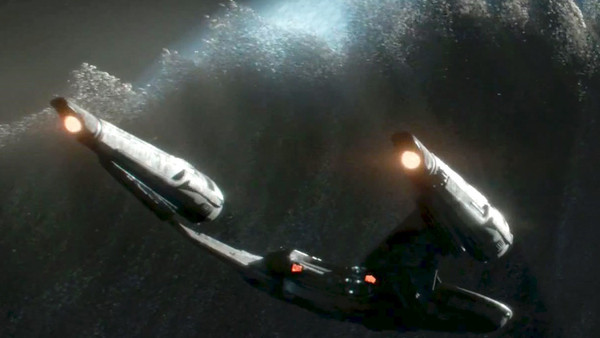
Straight up, one of the "daaamn, science" moments in this movie was the use of a swarm battle fleet.
Not only was it a refreshing take on the "formidable foe" format, it's also pretty on the money with the future of warfare. Swarm systems are set to change the face of conflict because, as we see in Star Trek Beyond, they're so difficult to attack and defend against.
Swarms work as a great, collaborative, modulating whole (something that is pretty at-odds with Krall's vendetta against the cooperative peace of the Federation - perhaps he didn't see the irony) and if one part is hit, there will always be another to take its place. Fighting such a force with a lumbering starship such as the Enterprise is like trying to swat bees out of the air with a sledgehammer.
The "unified cyberpathic coordination" that the swarm uses to perfectly synchronise its movements is also pretty legit. A murmuration of starlings (those breathtaking displays by flocks of birds) is able to twist and turn and move as one as though controlled by some kind of hive mind. They aren't telepathic, however, and achieve this feat through each bird simply watching and responding to the movements of its six nearest neighbours. This way, movements from one side of the flock or fleet can be transmitted to the other almost instantaneously.
Love a swarm.
4. Invisibility Cloaking
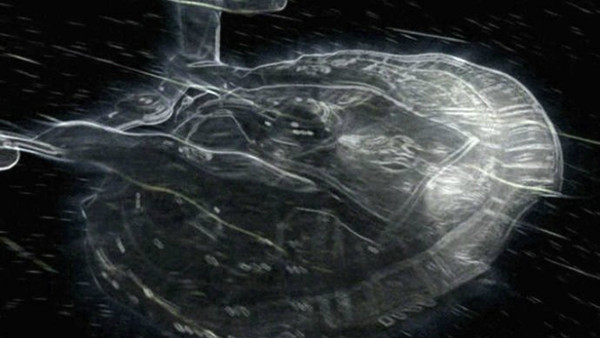
Cloaking devices are pretty much a holy grail of military technology, as well as a stalwart of Star Trek lore - you can't target something you can't see, after all.
Generally speaking, current invisibility technology is working on the concept of bending light, or even sound, around an object in order to render it invisible, or using metamaterials to absorb and manipulate wavelengths of light to cloak objects. This is perfectly possible, in the sense that the laws of physics don't forbid it, but it's definitely tricky with objects any bigger than a coin.
Jaylah's camouflage in Beyond, however, is described as a “holographic camouflage”, suggesting that it has more in common with the projection based invisibility cloaks that we've also seen in the real world. This would take an image of the surrounding environment and project it either onto the surface of the object you wish to hide or, as in Jaylah's case, as a hologram around it, completely shielding the object from view.
3. Starbase Yorktown
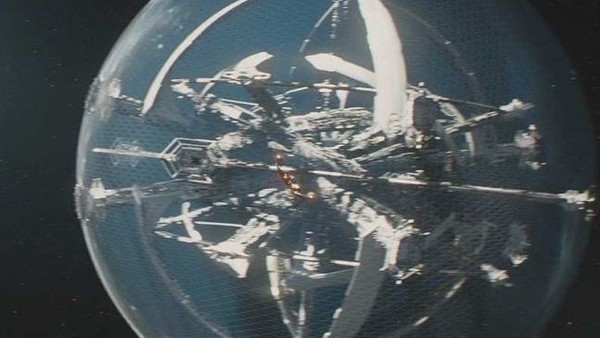
Space habitats have long been one of those things that get science nerds and sci-fi geeks alike, hot under the collar.
Beyond's space habitat, Starbase Yorktown, is located right on the frontier and has some pretty sweet features. Granted, the gravity situation in there is a bit screwy, given what we currently know about creating artificial gravity environments. Generally speaking, space scientists are steering towards the idea of using centrifugal force in a rotating space habitat to "stick" the inhabitants to the outside. The random tree-like branches of the Yorktown base don't exactly lend themselves to this, and the lack of screaming civilians stuck to the outer wall suggest they've used something different.
Perhaps they've discovered the graviton, perhaps they've unified the theories of quantum and relativistic gravity, perhaps they've had some breakthroughs in Gravitomagnetism, who knows? But the first thing I'd do if I had the ability to manipulate gravity would be to build a whacking great skyscraper and stick it upside down in an M. C. Escher painting of a space station because, screw it, without the constraints of gravity, you can build as high and as weird as you want.
2. The Universal Translator

Whether it's Star Trek, Doctor Who or Hitchhiker's Guide, this issue of language barriers has to be addressed at some point.
Usually movies establish the idea that, although we hear people speaking in English we're actually hearing the translated version of their mother tongue. Nice and easy and we can then carry on with the plot.
The universal translator in Beyond, however, was a nice touch as, not only could we hear the native speech beneath the translation, but we caught a glimpse of the language analysis process that allowed it to translate in the first place.
Universal translators are particularly exciting to tech geeks, as we're so close to having them as a reality in the near future. The Pilot translator will even sit in your ear like an electronic Babelfish and translate speech in real time for you.
1. The Warp Bubble

Unfortunately, many party pooper physicists have put the kibosh on the possibility of ever achieving FTL travel, for trivial reasons like, "It abhors the laws of physics," and "It completely demolishes Relativity" or something. Pah.
So FTL is impossible if you like your spacetime linear, but the warp drive circumvents this by bending spacetime back in on itself in the Trek universe. Picture it like an ant trying to get from one end of a sheet of paper to the other. It can either travel along the paper, which would take a long time, or it can roll it into a tube and simple cross that part where the two ends meet, cutting out the middle man.
One effect of warping spacetime, however, is that it can have a lot of horrible relativistic time dilation-y effects, so the FTL ships in Trek are wrapped in a warp bubble of normal spacetime to prevent this. Another effect of this is that it can tend to make spacetime look a little, well, warped.
In Beyond, we were treated to a glimpse of the Enterprise travelling through subspace whilst cocooned in this bubble. In the real world, we have gravitational lensing which is, for all intents and purposes, the same thing. An object with a gravitational field powerful enough can bend spacetime around it so much that it can also cause the light from objects behind it to bend around it, creating a lens effect.
Unfortunately, the bubble can have some pretty disastrous effects of its own (namely, destroying whole star systems), but we'll give them a pass because gravitational lensing and warp bubbles are exciting.
The Downs:
3. Scotty Just Breathin’ In That Alien Air

It's a tiny gripe, literally a single moment in the film, but this happens with such frequency in sci-fi that it poked me in the eye like a toddler with a paintbrush.
Rule #1 of space travel (okay, probably not, there are lots of rules), is try your best not to take a huge gulp of alien atmosphere without checking that it's not pure sulphur dioxide. This is an unknown planet in an unknown part of space beyond the frontier and you just go and take a nice deep breath, Scotty. You are part of the Federation man, do they not cover this in training?
So often in sci-fi, we see our heroes strolling about alien worlds with suspiciously Earth-like gravity and a perfectly proportioned atmosphere, unless it's clearly supposed to be a planet we know to be uninhabitable like Mars or it makes a handy plot point.
Granted, this is because it's much easier to shoot and, my god, would movies be tedious if everybody followed protocol. But still, safety first.
2. OMG They Are So Dead From That G-Force

It's a thrilling set piece as the action ramps up - jump starting the Franklin by dropping it off a cliff. Presumably, those engines are supposed to get a kick start from some kind of gravitational slingshot in when in orbit and dropping it off a cliff is essentially the same as bump starting your old Morris Minor by rolling it down a hill, either that or Pegg confused terminal velocity (which is arbitrary anyway) with escape velocity, allowing them to get off world.
Anyway, we digress.
Something that would make it slightly less (or maybe more, I'm not a Hollywood director) exciting is a smash cut back to the interior after the engines kick into action to find the entire crew unconscious, dead or bleeding profusely from their eyes, ears and nose. All thanks to the wonders of G-force.
G-force is basically the force acting on the body as a result of acceleration. You know what G-force is. It's the thing that makes you feeling momentarily heavier when the plane takes off.
The human body has been known to withstand a fair amount of G-force but, eventually, that sh*t will catch up with you. Whilst it's tricky to calculate exactly how much would be required to kill a human, as duration is a big factor here, the Euthanasia Coaster is a hypothetical rollercoaster designed to kill its riders by exposing them to 10Gs for over a minute, forcing the blood away from their heads, cutting off oxygen to the brain.
Now I don't know exactly how fast the ship was going, but I'd hazard a guess that the terminal velocity of a starship under Earth-like gravity is what is known in the biz as Pretty Damn Quick.
The Franklin may well have had something built in to counter the effect but I doubt it, and I doubt it for two reasons: 1. it's a starship and was never designed to operate under the influence of gravity like that and, 2. It was switched off.
1. That. Effing. Nebula

Right, there was a lot that was good in Beyond, it's Star Trek of course there is, but I just can't let that nebula slide. Here, we have the same problem that we so often have with asteroid belts: Scale.
One of the central plot devices is that this nebula is uncharted and dangerous. We're treated to gorgeous visuals of pretty clouds of gas and precarious asteroid fields and it is established in the Trek universe that nebulae are difficult to navigate.
Unfortunately, the writers have failed to take into account just how big space is. What looks like a great cloud of prettily coloured gas through our telescopes is actually a vast region of space, sometimes hundredS of lightyears across with virtually nothing in it. Many nebulae are actually less dense than the most perfect vacuums we can produce on Earth and you have to look through all kinds of filters and lenses just to see the damn things.
In the same way that flying through an asteroid field would likely be a relaxing, incident-free day, you probably wouldn't even notice if you flew through a nebula. Sorry.
Bonus: It's A Sabotage
The customary Sabotage scene - not realistic but gets a pass because it’s just plain cool.
This is neither an up nor a down, but the Sabotage climax of the movie? Still into it.
So the idea is that the 90s jam would interrupt the "unified cyberpathic coordination" systems of the swarm. The sound waves are converted into VHF (Very High Frequency) radio waves (bonus points for using the correct term there) because, obviously, sound can't travel through space. So far so good.
Okay technically, to convert it into radio wave frequencies, the three minute long Beastie Boys song would be shortened to a fraction of a second and technically you could have broadcast any old noise. And okay, it's a bit ludicrous that super advanced spacecraft would burst into flames/crash into each other upon contact with VHF waves, seeing as it's the frequency we broadcast television in.
But Star Trek has always been a bit dorky, and if they want to go along with the idea that, not only is Sabotage the most badass song in the galaxy, but it can destroy fleets in a technobabble kinda way, then it's all the the trekkie spirit and I'm with them all the way.
What did you think of Star Trek Beyond? Let us know in the comments.
You could write for WhatCulture Science! Click here to find out how you could get paid to write about what you love.
If science gives you the warm fuzzies, like us on Facebook or follow us on Twitter to stay up to date.