10 Incredible Games From Lost Developers
 We are living in a Golden Age of gaming. Never before in the history of our hobby have there been so many great games coming out at such a fast pace. From the biggest-budget AAA titles down to indie games made by one-man teams, the amount of quality gaming goodness out there is simply staggering. Yet in the midst of all this, many of these success stories have been bittersweet. As the gaming industry thrives like it never has before, it is also approaching a crossroads. The costs of developing, producing, and marketing video games, particularly those of the AAA variety, are the highest they've ever been, making it more and more difficult for these games to meet their publishers' (aka investors') expectations. As a result, the industry has seen an unprecedented amount of studio closures following the release of games that don't reach the astronomical expectations that are put forth on them. There seem to be only two certain ways to stay afloat nowadays: go indie, or have "Call of Duty" printed on the game case. In the end, the gaming industry is a business, and it's a rough climate out there. It is with this in mind that we look back on 10 excellent games from developers that are no longer with us today. Some of them were shut down, some were absorbed into other companies, and some just disappeared into the wind. Regardless of how they went out, these developers left a legacy with these games, and for that, those involved in their creation should always be proud.
10. Psi-Ops: The Mindgate Conspiracy
 Developer: Midway Games There are certain game companies whose mere mentioning of their name brings back warm feelings of nostalgia to gamers of a certain age, and Midway is one of those. If you are old enough (read, fortunate enough) to have had the opportunity to spend a significant amount of time in video arcades in the 1980's and early 1990's, chances are you spent a good amount of time pushing coins into a Midway arcade game. From seminal early releases such as Ms. Pac Man and Rampage, to early 90's staples such as NBA Jam and Mortal Kombat, as well as the many games it licensed and distributed from other developers, Midway's cabinets were fixtures in video arcades worldwide. It is this presence in the video arcade scene that has given Midway its most enduring legacy. A less-known tidbit of gaming history, however, that Midway took numerous stabs at software development for home consoles as well. While few of their games managed to make any substantial impact, they did release a gem of a game in 2004 in the form of Psi Ops: The Mindgate Conspiracy, a third person shooter for the PlayStation 2, Xbox, and PC. Psi Ops was a game that started off seemingly as dull and run-of-the-mill as you can get. The story was cliched, and the shooting seemed sluggish and somewhat antiquated by the standards of the day. But it wasn't before long before the game's magic trick was revealed in the form of the amazing "PSI" powers wielded by the game's protagonist, Nick Scryer. A series of ever increasing and evolving psychic powers, combined with tight controls, revealed what was not only one of the most immensely gratifying gameplay experiences of its day, but a stellar showcase for creative use of physics in console games, a rarity at the time. The telekinesis power you received first was the most fun and useful, allowing you to pick up objects from across the environment and hurl them with precision accuracy at enemies with ease. Eventually, you gained several other powers such as mind control and pyrokinesis (yes, you could hurl walls of flames at people with your mind). The ease at which these powers could be combined with one another, as well as how smoothly they were integrated into the gameplay mechanics, made Psi Ops a memorable adventure for those who played it, and one that still stands out today. Any developer looking to create a good Star Wars game (RIP LucasArts) in the future that involves Force powers should look towards Psi Ops as a starting point. Its playground of physics-based powers is still really fun to play today. If you can find a copy of this at your local used game store, and still have a working sixth generation console in your home, don't pass this one up!
9. ActRaiser
 Developer: Quintet Japanese developer Quintet released a number of excellent games for the Super Nintendo Entertainment System in the early 90's. While they are perhaps most fondly remembered for their Soul Blazer trilogy, it is their debut game on the SNES, ActRaiser, that caught the attention of this author perhaps more than any other early game for Nintendo's legendary console, including Super Mario World. ActRaiser was a stunning game in it's presentation right from the get go. It had some of the prettiest graphics that had ever seen on a home console at the time, with a unique visual flair that fully harnessed the Super Nintendo's Mode 7 scaling and rotation abilities. The music was absolutely killer, and the game's soundtrack still ranks among the best in the entire SNES library. But what made, and still makes, ActRaiser a one-of-a-kind gaming experience is the way it somehow successfully fuses together two genres that should never conceivably be fused together: side-scrolling action platforming and city-building. In ActRaiser, you are God. Seriously. You play as a divine being who was defeated by another dark being of power known as The Evil One, and after your defeat in battle, The Evil One took over your lands and corrupted your people. As you slowly rise from your slumber that inflicted you after your defeat, it becomes your goal to defeat The Evil One once and for all and win back your lands. The catch is the only way you can restore your power is to replenish your peoples' faith in you. This is done in two ways: defeating the minions of The Evil One (via the 2D action segments) and helping your people restore their lands so that they can be happy once again (via the city-building). The city building portion of the game, which is overseen by a cherub that is your servant, is very streamlined and nowhere nearly as complex as other games of the era like SimCity and Civilization, and this is a good thing. Playing as the faithful cherub servant, you help guide the people of the world restore their farms, homes, and mines while taking care of pesky invading demons with your bow and arrow. As the peoples' land begins to become more and more fully restored, their faith in you increases, which increases your power as well. Every so often, the people become unable to proceed their restoration efforts due to the interference of one of the minions of The Evil One. It is then where you take control of a statue of an ancient warrior and proceed into the beautifully-rendered labyrinths to destroy these minions and allow your people to keep advancing, who in turn become happier and more faithful. It's an addictive system that works incredibly well and leads to some very exciting gameplay moments. Watching your civilization flourish is just as satisfying as slaying the sinister bosses in the dungeons, and it's remarkable how Quintet was able to balance these two entirely different genres into a cohesive, fully-realized, and extremely fun video game. Whenever anyone asks me what franchise from the past I'd like to see rebooted, I always say ActRaiser. For some reason, thinking about more modern city-building simulators like Tropico and modern action games like Darksiders and Devil May Cry makes me giddy at the possibilities of what ActRaiser could become today in the hands of the right developer. Quintet went on to release a sequel to ActRaiser on the SNES, but it completely excluded the city-building elements for a full on action game, which ironically was a much weaker action-platformer than its predecessor. Hopefully, we haven't seen the last of this very unique franchise that is still ripe with potential.
8. Kingdoms of Amalur: Reckoning
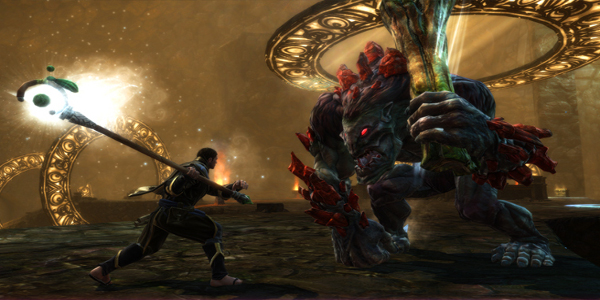 Developer: Big Huge Games & 38 Studios The dramatic collapse of former American baseball superstar Curt Schilling's 38 Studios may have been the biggest, most dragged-out story of the gaming industry in 2012. Defaulted loans, government involvement, mass auctions, lifelong fortunes lost, the state of Rhode Island now owing the Amalur IP (!) - the saga had the highs, lows, twists and turns of a Hollywood movie. Now that the dust has settled somewhat, it is possible to look at the game at the center of all of this in a fair and reasonable light. Because despite it's flaws, Kingdoms of Amalur: Reckoning is a very good game. Let me address the game's two biggest flaws right off the bat: the game's level cap is too low, and the dialog scenes between the player and the NPC's are incredibly wooden and emotionless thanks to a cluttered interface and wooden animations. It really is a shame about the poorly done dialogue sequences, because Reckoning's fantastic voice acting performances really highlight the unique lore of Amalur, which is something the game didn't really get credit for. Turning the usual RPG trope on its head, the game has you heading towards the goal of actually fighting against fate and destiny in order to become free. Interesting literature, locations, and the occasional talking stones paint a picture of a fascinating world with a deep history and lots of potential for future iterations. The game world is beautiful, bursting with color and surreal landscapes, and its "zoned" open-worlds make exploring a bit less daunting than something like The Elder Scrolls V: Skyrim. The real reason you want to play, Kingdoms of Amalur: Reckoning, though, is for the combat. Not only is the combat accessible, visceral, and extremely satisfying, but it's also extremely flexible. Broken across the 3 categories of Might, Stealth/Finesse, and Magic, your skill points gained from leveling up feed directly into your combat abilities and allow you to create the absolute perfect fighting machine of your choice with an unprecedented amount of control and customization. Once you discover the perfect blend of styles that you like, you can evolve your character in that direction and take him/her into the field to lay waste to enemies of all varieties. The actual combat mechanics in KoA:R are fantastic: significantly deeper than something like God of War, yet not requiring the steep learning curve and pinpoint precision of something like Bayonetta. It is a fine blend of action and role-playing that hadn't really been seen before. That low level cap? No need to worry. A good chunk of Reckoning's miscellaneous side quests aren't essential, and you can have a excellent experience playing through the main game's story quests, all the factions (don't miss these), and a decent amount of additional side quests in about 60 hours. Even if we never hear from this franchise again, Kingdoms of Amalur: Reckoning is a fascinating look at a studio's attempt to innovate and revitalize combat in Western RPG's in a way that could be accessible to non-RPG enthusiasts. While the game didn't quite reach every ambition it had, it is still an excellent game with some of the very best combat mechanics to appear in a WRPG. A fascinating document of a studio that came and went in a flash, Kingdoms of Amalur: Reckoning deserves to endure for far longer than its creators.
7. Super Dodge Ball
 Developer: Techns Japan Developer Techns Japan was already in the process of cementing its legendary status in the video arcade industry by the time they began to bring games over to Nintendo's Famicom in 1987. Karate Champ was already immensely popular in arcades and was paving the way for the fighting game craze that would hit the planet in the 1990's and beyond. Their 2D co-op brawler, Double Dragon, would soon follow Karate Champ and was equally influential in defining a genre as well. While their impact in the console space may not have been as loud, their trilogy of "Kunio-kun" games that hit Western markets were particularly beloved by those who had the good fortune to play them. The first title, Renegade, was one of the earliest beat 'em ups that could be played in the home, and the third title, River City Ransom, remains one of the most enjoyable co-op experiences on the Famicom and NES. However, it is the second game in the trilogy, Super Dodge Ball, that may actually be the best of the bunch. A great two-player competitive game (a single player campaign is also included) that has you playing 7 on 7 matches of dodge ball is undoubtedly the best reason to play this game, as the gameplay is surprisingly deep for such an old game, a characteristic River City Ransom also shares. After selecting a country to represent, you duke it out across various maps from all over the world. Players on each team have strengths and weaknesses, and perfect timing will allow you to catch an opponent's ball and hurl it back at them as they retreat. Also, having teammates on the out-of-bounds area on your opponent's side allows for a whole new set of tactical gameplay to open up. Super Dodge Ball is one of those games that still plays amazingly well, even 25 years after its release on the Famicom. Its basic simplicity is its strength, and it reveals its intricacies slowly to the player, especially if you can get a friend to play a match with you. Released on a console that had so many great player vs. player games, it's a testament to Super Dodge Ball that many gamers still consider it to be the best competitive game on the Famicom. Techns Japan slowly faded away from consciousness once the 90's rolled around, but the gems they left in their wake will always be remembered as some of the most enjoyable and influential games of their time. Super Dodge Ball is easily the most underrated of them all.
6. Betrayal At Krondor
 Developer: Dynamix As Japanese role playing games were beginning to seep into the gaming consciousness of Western audiences during the early 1990's, the PC gaming market, which was much more niche at the time than it is now, had been enjoying a particularly fertile period of RPG gaming goodness of its own for quite some time. RPG's that were exclusive to the PC (known as Computer role playing games, or CRPG's) were typically much more Tolkien-esque in flavor than their Japanese counterparts, taking more influence from Dungeons & Dragons as opposed to manga. Betrayal At Krondor, developed by Dynamix and coming at the tail end of this particular glorious period of PC gaming history, was one of the best of them. Set in the world of Midkemia, which is the setting for the novels of fantasy author Raymond E. Feist, Betrayal At Krondor was structured much like a traditional fantasy novel. There was a narrator who sounded very much like an audio book reader, the game was broken into chapters, and cut scenes were used at key transitional parts in narrative. The game had an excellent, stand-alone story that eventually became official canon in the world of Midkemia (even though Feist didn't write the game) and the digitized character models really helped convey the sense that this was a work of fantasy literature come to life. Betrayal At Krondor is also notable for its fantastic gameplay, which was allowed to be the game's primary focus due to the wonderfully streamlined user interface (UI). The UI was non-intrusive and very simple to use. Looting dead enemies, leveling up your character's abilities, and managing inventory was simple while never lacking depth. And because you were able to navigate your menus so efficiently and quickly, you were able to spend the majority of the time focusing on what was the best part of the game: combat and exploration. Your party could explore the huge game world either in the first person perspective, or using an overhead view on the game's map. The combat was superb, integrating a grid-based plane organically into the game environment that never felt overly-restrictive despite being very much a turn-based system. Your party was composed of a mix of fast, sneaky fighters, sword-wielding tanks, ranged fighters, and mages, keeping every combat scenario feeling tense and exciting. It was a refined, tight RPG that worked well in putting its strengths on the forefront of the experience. Dynamix remained a prolific developer throughout the 90's before wrapping up their legacy with the awesome Tribes series and being shut down by their parent company Sierra in 2001. As for the Krondor series, fans finally got their wish when the sequel, Return To Krondor, was released in 1998. Development duties were handed off to a different developer, and reviews were mixed upon release. Return To Krondor obviously didn't live up to the original game's stature, but it is the opinion of this author that Return was also quite good despite its flaws. Both games are available on gog.com, and it's Betrayal At Krondor in particular that demonstrates why the CRPG has been so beloved for over 30 years.
5. SOCOM II: U.S. Navy SEALs
 Developer: Zipper Interactive Before Halo 2 came around in 2004 and revolutionized online multiplayer gameplay on consoles forever via Xbox Live, PlayStation 2 owners were quietly enjoying some of the finest competitive multiplayer tactical shooters to ever be made. Sony in-house developer Zipper Interactive had released SOCOM: US Navy SEALs in 2002, a third person, team-based shooter that pitted US Navy Seals vs. teams of terrorists in a series of objective-based battles. It was the first game on the PS2 to utilize real-time voice chat via a microphone headset, and its tense, strategic battles that absolutely required good team communication sunk its hooks into PS2 owners worldwide and created a surprise hit for Sony. For its next outing the following year, SOCOM II, Zipper kept the main formula in tact while making things a whole lot better. SOCOM II contained every map from the original game and then more than doubled that number with new maps, which added up to a huge amount of content in the game. SOCOM II also added a number of different game modes, new weapons, modifications to the original maps from the first game, and strong technical support from the developer in the form of online maintenance and patches. One of the distinct features of competitive SOCOM was the lack of respawning after death, something that would be a much harder sell in today's multiplayer market. It forced you to be extremely careful in your tactics, coordinate with your team, and discouraged Call Of Duty-style running and gunning. The maps were amazingly well-designed, with some of the larger ones containing multiple breach points, turrets, and air strike positions. Then there were the little things. Before and after each match, players from both teams were all put into a lobby, where some very memorable trash talking would take place. Turning friendly-fire off was not an option in SOCOM II, so lots of laughs, and sometimes bouts of rage, were had when incidental same-team kills took place. If you happened to get a troll on your team who purposely team killed, he could be voted off the team and banned from the lobby immediately, a feature that this author greatly misses in most modern mainstream competitive games. SOCOM II was an early microcosm of the console world that got the online multiplayer competitive gaming experience down just right. It offered loads of content, superlative gameplay, easy-to-use and well-implemented online systems, and harbored a fantastic, vibrant community of dedicated players. As someone who poured hundreds of hours into SOCOM II's multiplayer, I still regularly find ex-SOCOM fanatics in various online communities who are still always excited to talk about their time spent with SOCOM II a decade later. As for Zipper Interactive, they sadly were unable to recapture the magic of SOCOM II in future iterations. SOCOM 3 had flashes of brilliance, but was much too flawed to be a worthy successor. By the time SOCOM 4 came around in 2011 for the PlayStation 3, it had lost nearly everything that had made it great in the first place, instead opting to move towards the faster-paced, less tactical gameplay of the many other shooters out there trying to get a slice of the Call of Duty pie. To its greater misfortune, SOCOM 4 also released immediately before the great PlayStation Network crash, effectively wiping out any chance for the game to earn a dedicated, early following. Zipper Interactive was closed down by Sony in 2012 shortly after the release of their final game, Unit 13 for the PlayStation Vita. Zipper may not be around anymore, but the great memories had by that dedicated core audience who comprised the SOCOM community will always exist.
4. Parasite Eve
 Developer: Square Counting Square (aka SquareSoft) among the ranks of "lost developers" may be pushing the interpretation of the phrase a bit, but let's not lie to ourselves: as a developer of video games, Square is no longer who they once were. Looking at the company that is Square Enix today, it can sometimes be difficult to remember that they were once one of the very best developers of video games that this industry has ever seen. Although Square made some fine early games for the NES and Famicom, it was during the 16 bit era when they began to demonstrate that they were the real deal. Many of the brightest luminaries in the Japanese video game industry made Square their home during this era, and the output they released for the SNES/Super Famicom reflected this. When Sony's deal with Nintendo to create a CD-ROM-based console backfired, resulting in Sony setting off on their own to make their own gaming console, one of their biggest coups was securing exclusive rights to Square's games. The Square/Sony partnership turned into one of the most fruitful that this industry has ever seen. Square became a famous name worldwide upon the release of Final Fantasy VII, a hugely successful game that created a generation of lifelong RPG lovers. Along with Final Fantasy, Square created some of the absolute best games of the era for Sony's PlayStation console, and one of the very best , and most under-appreciated, of the bunch is Parasite Eve. Parasite Eve was the result of a developer who was not only in a midst of a very fertile period of video game craftsmanship but also one who was willing to take chances. Parasite Eve's unique blend of strong narrative, action RPG mechanics, and sci fi/horror was a potent blend that hadn't been seen before. The player takes control of Aya, a police officer in New York City who witnesses a horrifying incident and works to uncover the seemingly supernatural mystery of why people have been spontaneously combusting. The increasingly creepy environments were striking, and the battling the horrifying enemies was incredibly fun with the game's real time combat that was fused with Square's token Active Time Battle system. Combined with fantastic music and excellent pacing, the game was smaller than many of the other epics being released by Square at the time, but Parasite Eve was easily in the same league with those heavy hitters when it came to quality. Parasite Eve represents the output of a major player in the video game industry who was not only making great game after great game, but also conveyed a sense of risk that is all too rare in today's AAA video game market. Not long after the game's sequel, Parasite Eve II, was released, Square's output became less prolific and arguably lower in quality, which many gamers coincide with the company's merger with Enix in 2003. SquareEnix remains a major player in the industry today, serving as a publisher for many fine games across several platforms, but few would argue that their in-house development studios have made anything in the last decade that even approaches the greatness of their output for Nintendo and Sony in the 1990's. As for Ava, she made a return in the form of The 3rd Birthday, a more shooter-centric action RPG for the PlayStation Portable in 2011 that received a mixed reception from gamers. Perhaps, one day, Square will rise from the ashes, return to game-making glory, and give her the true hero's welcome that she deserves.
3. Baldur's Gate: Dark Alliance
 Developer: Snowblind Studios Sometimes a game comes along that so neatly fills a void in the gaming universe, that it almost seems to come straight from the gamer gods themselves . Baldur's Gate: Dark Alliance was one of those games. In late 2001, Diablo II had been conquering the PC gaming world with its phenomenally addictive multiplayer gameplay, and console gamers were itching for a similar experience. Video game consoles were obviously a perfect platform for a game like Diablo II, where the game's local cooperative multiplayer features could really shine. Meanwhile, also over in PC Land, a couple of CRPG's known as Baldur's Gate and Baldur's Gate II had revitalized the genre and were spawning a slew of fantastic new CRPG's like Planescape Torment, Icewind Dale, and the soon-to-be-released Neverwinter Nights. Whoever had the idea of combining these two distinct game styles for a co-op action RPG for the PlayStation 2 deserves a medal. Baldur's Gate: Dark Alliance took the addictive hack n' slash/loot n' level game mechanics of Diablo II, streamlined them for console interfaces, and set it in the classic D&D universe of the Forgotten Realms, the same world as its PC predecessors. While this had the potential to be a disaster, the end result was a surprisingly fantastic game. It was arguably the best looking PS2 game at the time of its release, with superb character animations, lighting and spell effects. The voice acting was top notch and the variety of enemies you'd do battle with always kept things fresh. The gameplay was satisfying and very fun to play with a friend. Even though the game may have been too short and a bit too easy (your character becomes extremely powerful by the end), it was still a very memorable ride that game console gamers that fix that they were looking for. And for the Baldur's Gate veterans who picked this game up, the incarnations of characters and locations from the PC games was quite the treat. Snowblind Studios, the developers of Baldur's Gate: Dark Alliance, didn't stop here. They upped the ante a few years later with the superb Champions of Norrath, a similar, yet evolved, action RPG that took place in the EverQuest universe and allowed for online gameplay. It's sequel, Return to Arms, was even better. Snowblind Studios became a beloved developer in the PlayStation 2 community after this trio of titles, and expectations were high heading into the seventh generation of consoles. However, their debut game for the 360 and PS3, Lord of the Rings: War in the North, was widely considered a disappointment. Soon afterwards, Snowblind was disbanded and merged with some other studios under the WB Interactive flag. This is a real shame, as quality dungeon-crawling, co-op action RPG's have been scarce on the PS360, and it's unfortunate that Snowblind wasn't given another chance to rectify this. However, it's unlikely that Diablo III would be seeing the light of day on consoles later in 2013 if Snowblind hadn't paved the way for this type of game on the home console platform. For that, Snowblind, we salute you.
2. King's Quest VI: Heir Today, Gone Tomorrow
 Developer: Sierra Most commonly known as Sierra On-Line back in its heyday, Sierra was the undisputed king of point & click PC adventure games. Starting way back in the early days of PC gaming and continuing well into the 1990's, Sierra On-Line produced some of the finest and most beloved PC games and franchises of all time. Despite the majority of their games following the point & click formula that they made famous, the variety of content found within these games was staggering. From the raunchy humor of Leisure Suit Larry, to the odd yet successful incorporation of RPG elements into the genre that was Quest For Glory, to the gritty realism of Police Quest, there was something for everybody under the Sierra umbrella. However, the series that arguably personifies everything that was great about Sierra On-Line was also one of its first: the wonderful King's Quest series, written and designed by the brilliant mind of Roberta Williams, the co-founder of Sierra. The King's Quest games revolved around a recurring group of characters that were part of the royal family of the Kingdom of Daventry, a magical place that always found a way to surprise gamers. Despite displaying a core set of characteristics that was present in every game, each subsequent King's Quest title evolved significantly, upping the ante with more fantastical worlds, characters, and plot twists. The magnum opus of the series, and probably the ultimate manifestation of what the Sierra On-Line adventure game was all about, came in 1992 with King's Quest VI: Heir Today, Gone Tomorrow. Right from the start of its stunning opening cinematic, showing Alexander, the prince of Daventry, being shipwrecked in the Land of the Green Isles (the story's setting), King's Quest VI was a breakthrough. It was one of the most gorgeous and artistically creative video games that had ever been seen. The motion-captured character animations meshed perfectly with the hand-crafted backgrounds, and the music was rich and fit the game's various moods perfectly. It was the finest written entry in the series as well, featuring a script chock full of wit, humor, emotion, and a grand sense of adventure. The game was written by the duo of Roberta Williams and newcomer Jane Jensen, who would go on to create the fantastic Gabriel Knight series under the Sierra banner. King's Quest VI was a lengthy game that visited some of the most memorable settings to be committed to a video game, and featured multiple endings depending on how the player chose to reach the final goal. It was a masterpiece, through and through. As the late 90's approached, change was in the air at Sierra, as the company underwent numerous and complex changes to their core business. Roberta and her husband, Ken, who had been the pillars of the company from the very beginning, left in 1996, leaving the suits at Sierra to absolutely butcher what would be the last entry in the King's Quest series, Mask of Eternity (aka King's Quest VIII). The company stuck around for a long time in name only, as the glory days of Sierra releasing great game after great game never returned due to most of the talent moving on to greener pastures. But Sierra's influence is as strong today as it ever has been. The flourishing modern indie game scene has seen a revitalization of the point & click adventure genre, producing some of the finest games the genre has seen since Sierra's heyday. As for King's Quest, it's still up in the air. Numerous game companies have expressed an interest in reviving the franchise over the years, most recently with Telltale expressing an interest, but unfortunately nothing has materialized. However, several of the brilliant minds behind some of Sierra's greatest games, including Jane Jensen, have recently begun Kickstarter campaigns to bring their new visions to a new generation of gamers. Could a new Roberta Williams game be in the cards someday? One can only hope.
1. Okami
 Developer: Clover Studio Clover Studio was not just one of Capcom's most talented studios during the early and mid 2000's. The studio consisted of some finest developers in all of Japan. Prior to Clover's official formation, members of the studio had originally solidified their reputation for combining incredibly fun gameplay and unabashed creativity with the two under-appreciated, yet excellent, Viewtful Joe games for Nintendo's GameCube and the PlayStation 2. When Clover Studio formed, the team was joined by legendary Japanese luminaries Hideki Kamiya (Devil May Cry) and Shinji Mikami (Resident Evil 4), each of whom took control of a PlayStation 2 project for Clover. Mikami went on to direct the excellent God Hand, and Kamiya became the lead designer of one of the console's absolute crown jewels, Okami. Okami is one of the most breathtakingly beautiful video games ever created. The art style, heavily drawn from Japanese folklore, looked like a watercolor painting come to life. Objects in the game swirled and flowed as if they were actually being painted on a canvas as you moved through the game. The colors popped off the screen, and the game's majestic score complimented the sublime visuals perfectly. In a game where you play as a god in wolf form, Okami is a textbook example of video game art direction in perfect harmony with its subject matter. In area after area, you will be surprised and stunned by the things you see. When you hear CEO's of modern game companies argue that photorealism is a necessity to create the most immersive video game experiences possible, visions in your mind of games like Okami quickly cause you to disregard any of these so called "truths". Okami delivered on the gameplay front as well. Yes, Okami is hugely inspired by the 3D Legend of Zelda games, and it really doesn't try to hide it. You traverse a series of open areas in search of "dungeon"-type sub-environments. You engage in combat with dark enemies roaming the landscape. And you even have an occasionally-annoying small companion who accompanies you on your journey, giving you hints and constantly reminding you of your purpose of saving the world from darkness. But Okami is unique enough in it's mechanics where it truly feels one of a kind. The Celestial Brush, a divine paint brush that lets you actually paint objects into the world, was a stroke of genius. You used the brush to restore life to a land that was dying by restoring sacred trees and bringing light to a dark world. Seeing classical Japan slowly come to vivid, effervescent life again is as satisfying as video games get. Not only did the Celestial Brush work in the overworld, but also in the intense combat scenarios, where you could use it to paint an ever-expanding arsenal of weapons such as bombs and slicing blades directly into battle. Okami was a rousing, masterful achievement, but like God Hand, it didn't sell enough to meet Capcom's criteria, which eventually led to the dissolution of Clover Studios. However, this crop of talent didn't go anywhere. Most of them went on to form the independent studio Platinum Games, which has continued Clover's tradition of excellence and has delivered some of the most creative, well-crafted, and exciting action games to be seen on the PS3 and Xbox 360. As for Okami, its popularity with gamers has endured. It was one of the first games to be ported to the Nintendo's Wii, where it effectively implemented the Wii's motion controls to control the Celestial Brush. But the ideal way to play Okami today is with the recently released version on the Playstation Network, where the game's beautiful graphics have been remastered in high definition. You'll quickly see that Okami remains one of the most beautiful video games available, and it probably always will be. The next time you are having that transcendent experience that only a great video game can deliver, be sure to take a moment to think about the brilliant and hard-working talents that were behind the creation of your game. It is through their genius and dedication that we are able to enjoy this incredible hobby of ours, and their efforts should always be acknowledged and appreciated. Happy gaming!!