8 Video Games That Did More With Less
These bite-sized games won't ever be forgotten.

In the modern gaming era, it sure feels like most video games are all about more, more, more - developers are forever chasing more mind-bogglingly photorealistic graphics and players want more and more content to justify their spend, resulting in dev times that are often totally nonviable from a commercial perspective.
And so, there's something to be said for the merits of games which make an impact while remaining stridently minimalist, with their short length, simple gameplay, clean art style, and so on.
While it's incredibly hard for even good games to stand out in the sea of quality indies releasing every month, these games absolutely did by virtue of offering so, so much in such a small package.
These games didn't need hundreds of team members nor a decade to cook in the kitchen - they thrived off their simplicity, by finding a compellingly straight-forward gameplay loop or impactful emotional beat and basically hanging the entire experience off it.
It's extremely tricky to pull off, but when it works it really works, and typically proves far more gratifying than yet another also-ran AAA open world behemoth...
8. Thomas Was Alone

Thomas Was Alone is one of the most strikingly memorable puzzle-platformers of the last 15 years, no matter that all the central "characters" are nothing more than coloured rectangles of various sizes.
Despite the deceptively simple gameplay consisting of little more than transporting the various shapes to their respective end-points on each level, the masterful narration from Danny Wallace imbues the journey with an unexpected amount of feeling.
Wallace's words alone will make you feel a whole hell of a lot for these otherwise unremarkable entities, which have no expressive hallmarks whatsoever like faces or even eyes.
But players are encouraged to fill the empty spaces with their own imagination, which in conjunction with the deeply charming narration, make this a game which is boiled down to just the few "basic" elements it needs to make an impact with players.
Though Thomas Was Alone remains fondly regarded today, if you haven't played it you owe it to yourself to change that, like, right now.
7. Vampire Survivors

The moment many took a peek at Vampire Survivors, they probably assumed it was yet another roguelike packed to the gills with complex builds and all manner of trial-and-error strategy.
But there's a reason that the game has been a pure sales juggernaut - it cuts through all the flabby tosh and gets right to the heart of the matter.
Vampire Survivors is a game just about anyone can understand in a matter of minutes - all you need to do is move around, with the game auto-attacking the hordes of enemies which come your way.
Without maddening skill trees and the such like, it's a perfect low maintenance game - intensely accessible and ridiculous addictive, and so it's little surprise that key developer Luca Galante has a background in the gambling industry.
It may look and feel simple, but that also lends the game a zen-like quality, as absurd as that might sound for an experience that's fundamentally entrenched in the bullet hell genre.
Proudly eschewing a conventional narrative and tedious tutorialising in favour of to-the-point mayhem and player discovery, Vampire Survivors is a monument to the joyous thrills of fat-free, no-nonsense gaming.
6. Portal

Portal is perhaps the example of a game that, despite being developed and published by one of the biggest gaming outfits on the planet, has the spirit, ethos, and economic design philosophy of a scrappy indie.
Portal is basically the antithesis of a bloated, verbose open world game, given that it's an intensely constrained experience where every single moment feels wholly purposeful and motivated.
Across its mere three hours, Portal has players working their way through a series of ingenious physics-based puzzles, which prove so enthralling that the aggressively stark, minimalist - some could say "boring" - environments somehow work against the odds.
The game is also a masterclass in sprinkling lore and characterisation throughout the play-time, managing to be intensely memorable even though the focus is primarily on mind-bending puzzles.
It's easy to picture a version of Portal that's far "meatier" and yet decidedly less iconic, bogged down with other gameplay mechanics, longer levels, and a more involved story.
Instead, it's a fiercely efficient romp without a shred of fat on it.
5. Her Story

When a new game is touted as offering a groundbreaking spin on video game narratives, you probably imagine something extremely complex. But Her Story - an FMV detective game from future Immortality director Sam Barlow - basically goes in the other direction.
Players are tasked with investigating a man's disappearance by sorting through a database of police interview video clips, primarily with his wife.
Beyond the video clips being of low quality, enough that anyone with a camcorder could basically pull them off, Her Story ditches fancy technical bells and whistles and instead encourages the player to do a most unexpected thing - get a pen and some paper out.
Given that you'll spend most of the game searching for words which might be spoken in the interviews, you'll want to keep track of everything you've searched for, and also note down worthwhile information which is usually offered up in non-linear fashion.
Her Story's lack of an in-game note-taking system paradoxically proves more involving, as players end up getting more into their character through the tactile experience of taking actual notes for real. It's a feat of sly genius, really.
4. Papers, Please

Papers, Please is a game that could've potentially been a preachy disaster were it designed differently, but developer Lucas Pope had the good sense to appreciate that a no-frills, monotony-heavy approach was precisely what it needed.
This is a game where players take control of a border-crossing immigration officer in a fictional dystopia, and their sole job involves sitting at a desk and reviewing travellers' documents while satisfying the increasingly bureaucratic rules of the state.
It's a shining example of a game whose straightforward mechanics belie its loftier thematic concerns, as it asks the player to make difficult choices, balancing empathy for the average citizen with their own need for survival.
Pope himself has said that he consciously chose a simple retro art style and didn't even consider voice work or cinematic cutscenes, as he felt those elements would force him down a more overt storytelling path whose themes would be more blatant and less interesting.
Instead, by focusing on the repetition of processing travellers' documents, we're able to hone in on the finer details of an interaction, where even minor factors can be surprisingly significant.
What Papers, Please lacks in visual flair or technical polish it more than compensates for with its emotional complexity and bluntly effective examination of life under totalitarianism.
3. Gone Home

Gone Home is a game whose pared-down approach actually became a bone of contention upon launch, given that many assumed the walking simulator - which sees the protagonist returning to her empty family home - would be horror-themed.
And so, the eeriness of traipsing around this house left many waiting for the genuine terror to ramp up - and yet, it never does.
It's a masterstroke for more open-minded players, honestly - subverting our most base preconceptions as players by swerving away from the expected genre, offering up none of the stock gameplay mechanics like combat or puzzle-solving, and instead focusing solely on exploration.
And yet, Gone Home still delivers an affecting and well-wrought experience, and one that's still passionately discussed over a decade after release, largely thanks to its gorgeous single setting, emphasis on environmental storytelling, and refusal to kotow to what players typically expect.
It's an exercise in pure atmosphere, where it feels like the developers kept subtracting and subtracting until they had the purest distillation of their idea possible.
2. Journey

Despite rocking the sort of portentous title you'd expect to see slapped over a 50-hour epic RPG, Journey is a ruthlessly to-the-bone adventure game you can easily beat on an extended lunch break.
This gorgeously artful game conveys enormous emotional depth not through a verbose plot, but through sheer feeling.
Players are given a simple task, to reach a mountain in the far distance, while all extraneous particulars are stripped away - there's no spoken or written dialogue, and the UI is designed to be as non-invasive as possible, maximising the immersion of the game's serene visuals and goosebump-raising music from Austin Wintory.
One of Journey's most revered features is its expectation-defying approach to multiplayer, whereby other players on their own journeys can intersect with your own.
However, conventional communication is prohibited, ensuring an air of mystery exists between you and the others you encounter.
It all adds up to a game whose mystery only enhances its sense of awe and beauty, and were it, say, 6 or 8 hours long instead of 90 minutes, it probably wouldn't have reached quite the same iconic, sweepingly accessible status.
1. Sayonara Wild Hearts
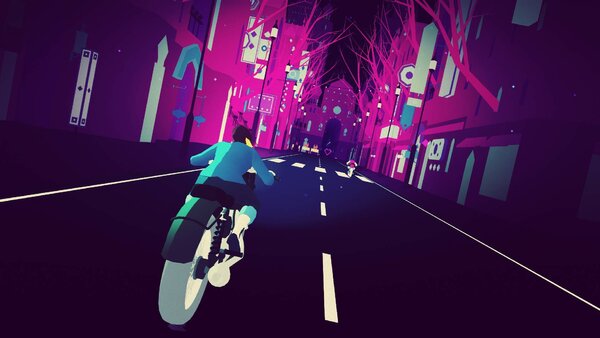
And finally, we have Sayonara Wild Hearts - a rhythm game which can be pretty effortlessly powered through in about an hour, but that hour offers up such a soul-shaking surge of adrenaline that you'll surely want to revisit it again and again.
Far from the tendency for rhythm games to be nerve-wracking experiences reliant on lightning-fast reflexes, Sayonara Wild Hearts is a wonderfully simple ride that, with its not remotely punishing difficulty, instead allows players to enjoy the eye-wateringly kaleidoscopic visuals and fizzy pop music soundtrack.
Some have even called it less a video game than an interactive music album, but by eschewing the twitchy requirements of most of its genre brethren, Sayonara Wild Hearts is able to transcend its most obvious label and become a far more emotional, impactful experience than, say, the Guitar Heroes of this world.
It's simple, short, focused, and visually clean - and all the more memorable as a result. Above all else, it confirms that vibes can take a game one hell of a long way.