9 Ways 2017 Has Changed The Future Of Video Games Forever
Nothing will ever be the same.
You're going to hear the statement "2017 has been one hell of a year" a lot from here to Christmas, because seriously, we've had landmark release after landmark release, seeing the industry recover in every possible respect from a weirdly half-baked start to the generation.
Fantastic-playing games are just one part of the equation though, it's what they mean to the industry and wider world that will affect the future. Specific trends, innovative business strategies, new genres and everything in between - it might feel as like, when we've got games like Destiny 2, Shadow of War, Agents of Mayhem and Star Wars Battlefront 2, the industry has doubled down on being stuck in a microtransaction-fuelled rut, but that couldn't be farther from the truth.
Indeed, take a step back and you'll see a medium flexing in increasingly experimental ways - approaches that not only put it leagues ahead of Hollywood when it comes to knowing what people want, but also making countless strides to ensure video games earn their spot as the most lucrative source of entertainment on the planet.
9. Lootboxes Are Finally Being Outed As Gambling

You know it, they know it - we've all known it. All it took was one truly insulting example to tip the scales, and the whole world essentially goes "Oh now come on, we've all had our fun, but... this?! This is too much."
Such is the case with Star Wars Battlefront 2. EA's attempt to charge full price at retail for a game whose progression is still completely random i.e. what you'd find in a free-to-play mobile game, was too insidious to let slide. The only way to bypass said progression is to throw more money at it, hoping you somehow happen upon the equipment, characters and items you actually want.
Truly, it's the first time we've had a bonafide pay-to-win mentality prevalent in a triple-A product, and that didn't go down well with the world's investigative gaming bodies. Not.at.all.
At time of writing we've seen loot boxes branded as gambling by the Belgian and Hawaiian's governments, alongside a multitude of other outlets. All zero in on the duplicitous, predatory nature of reward systems that badger you to have another spin of the wheel, and the backlash has been so sever, it's going to brand all loot box systems as anti-consumer for the foreseeable future.
8. Microsoft Begin Shifting To A Fully Streamable Distribution Model

Though it's barely been talked about as Microsoft focus on the launch of the Xbox One X, they're actually looking into transforming the very way we consume video games.
Aiming to upend the physical retail model and surprisingly, ditch the idea of having a console whatsoever, Head of Xbox Phil Spencer noted that "Microsoft will probably debut a streaming service that doesn’t require a console for some types of content". This takes what they've perfected on the Xbox Game Pass (Microsoft's monthly fee that lets you download a selection of games) to the next level, using Azure's cloud functionality to maintain a stable connection.
Not for nothing, this is the exact same idea as Sony's PlayStation Now tech, which despite being powered by Gaikai's tech, is still an unreliable, frame-dropping mess. Still, Microsoft also getting on board proves that the industry wants to pipe games into your home in much the same way as Netflix or other streaming services.
Can you imagine a world where a "games console" is just a controller paired with your TV?
7. Ubisoft Continue Working On Their Older Games Like No One Else
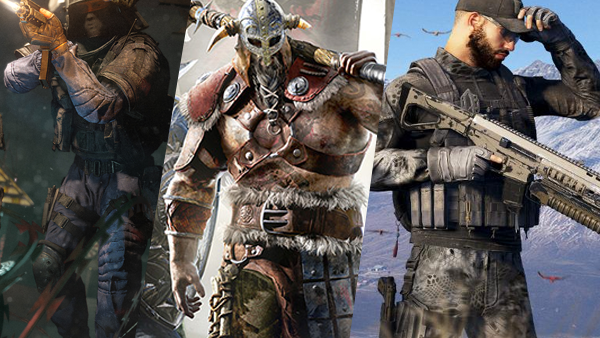
Whilst EA, Warner Bros. and Activision are being repeatedly skewered for trying to siphon as much money from the public as possible, Ubisoft are... doing the same, but in a far more consumer-friendly way.
Surprisingly, they've been revisiting many older titles and focusing on releasing DLC, multiple patches and free updates, rather than just funnel cash into their latest release. Rainbow Six: Siege, For Honor, Ghost Recon: Wild Lands and even The Division have all been touched up considerably. Siege is now one of the most intense tactical shooters of the generation, For Honor has far more stable servers with more rewarding loot, Ghost Recon has a new PvP mode and The Division will be getting a sizeable update this December.
All of this has seen Ubisoft get back in peoples' good graces, increasing the amount of revenue from each title, as well as bolstering the idea of a "game as a service" in a way that rewards fans who stick around.
Considering the sheer size of Ubisoft and many other publishers, this is how "content platforms" should be done - not released, milked and forgot about after launch like the majority.
6. Nintendo Switch Sales Prove Gameplay Is Infinitely More Important Than Graphics

In case you need a reminder, the Switch is selling like nothing else (the "fastest-selling console in Nintendo history", no less). And why? Because it prioritises the game part of video games, rather than just the visuals.
Whilst the two "bigger" consoles have prioritised half-step hardware cycles and resolution differences you have to be side-by-side and squinting with a magnifying glass to notice, the Switch's approach is a breath of fresh air. You don't need ultra-glossy background details and clothing where every thread is visible when you've got DOOM on the go or Link felling a skyscraper-sized Ganon at the close of a phenomenally well-intentioned game.
Simply put: Gameplay trumps graphics. It always will.
The industry has always had a hand in graphical prowess. It's how you turn heads, build hype and get people involved. But the games must deliver on the other end.
Nintendo's all have, and while titles like Battlefront II and Assassin's Creed are immediately jaw-dropping, if the actual meat of the experience isn't going to hook you for hours on end, why make a video game in the first place?
5. Xbox One Backwards Compatibility Shows Past Generations Can Be Profitable Again

Another string on the gameplay bow, Microsoft's approach to backwards compatibility has more than shown there's a way to do it without making the consumer pay for a forced "remaster" or emulation.
Simply by emulating the Xbox 360 or original system inside the Xbox One, it's allowed everything from Star Wars: Knights of the Old Republic to Red Dead Redemption to be playable, simply by dropping the disc in.
Brilliantly, a surge in older titles actually turned profitable as April saw Call of Duty Black Ops 2 re-enter the charts five years after release. It's more than enough to show that past titles are worth supporting through backwards compatibility, and alongside Ubisoft's mentality, could usher in a world where various companies license DLC or updates for games far older than what's currently on the market.
Think about it: Why don't companies put out premium DLC for games everyone can pick up for a pittance? We'd certainly pay a decent amount for new levels or story elements added to our old-school favourites.
4. Team Ninja Show How To Make An "Indie Game" That Contends With Triple-A Production

The "indie" label has gone from only being associated with side-scrolling platformers like Super meat Boy and Limbo, through to more impactful narratives a la Gone Home or Everybody's Gone to the Rapture, to now essentially being the new "B-tier" of game development.
Titles like Rocket League, Inside, Cuphead and more show that as more complex design software has been made available for free, the general bar of production quality has gone way up for a fraction of the price.
The latest and most impressive example is Hellblade: Senua's Sacrifice, Ninja Theory's introspective action-focused masterwork that explores psychosis by way of the titular character's descent into madness, accompanied by a Norse mythology backing. Ninja Theory stayed far away from consumer testing or designing anything with "mass appeal", and it shows: Hellblade is a monumental achievement, pairing a risky subject matter with gorgeous graphics and an action focus that paid off with solid half-million-in-three-months sales, justifying this model forevermore.
Whenever you read about triple-A developers stating that any more graphics-intensive games are "too expensive" and thus require microtransactions, look to Hellblade as proof that less is more.
3. "Battle Royale" Is The Next Big Genre Staple For Every Multiplayer Shooter

Set to drop on Xbox One on the 12th of December, PlayerUnknown's Battlegrounds has already become a runaway success on PC. The 100 player scavenge-to-survive deathmatch comes into its own by adding a constantly-shrinking play space, forcing everyone together as every match turns out differently, ending anywhere from the middle of a field to the corners of a village.
Having millions of players battling it out concurrently has drawn the attention of many rival companies, who are now putting together their various "spins" on the formula, set to be released for the rest of time. Want proof of PUBG's popularity? There are 2.5 million people playing right now.
The most notable copycats right now are Rockstar's Dawn Raid mode for GTA Online (which again features parachuting in, an ever-reducing arena and a last man standing ethos), and Fortnite's Battle Royale, which... is literally ripping off Battlegrounds in every possible way.
As a set of rules and general sensation of play, knowing you're up against 99 other players running around, arming up and camping out to make it out alive is one HELL of a rush, and will definitely be in every major multiplayer mode from now on.
2. Take Two Commit To Having Microtransactions In Everything
Calling it "recurrent consumer spending", Take Two (Rockstar's parent company) announced that simply because GTA Online has made such a stupid, exorbitant amount of money, they'll now be putting similar "models" into every future title.
Honestly though, whilst blind loot boxes are the work of the devil, Rockstar have found a good balance with GTA Online's Shark Cards - at least, enough to clearly please the majority, as they make around $5 million a day from them alone.
Perfectly, Shark Cards are completely optional, with every major content pack being released for free. It's the best way to satisfy full price payers, whilst giving those who want to shell out more to buy cars, clothes, ammo etc. the ability to do so.
With a ludicrously high revenue stream and solid relationship with their community, you almost can't blame the company for doubling down. It forms the basis for how other studios should implement microtransactions, and highlights just how worlds apart GTA Online is to something like Battlefront 2, which continues to have no idea what it's doing.
1. Sonic Mania Showed How Fan-Modders Can Save An Ailing Franchise

The middle-ground between Kickstarter projects lead by ex-developers and official releases, Sonic Mania was headed up by prolific fan-modder Christian Whitehead, who Sega recruited after decades of work making his own homebrew sequels.
Reminiscent of that time a fan once made a 25 hour expansion to apply for Bethesda (only to be snapped up by Bioware), the fantastically positive reception of Sonic Mania - alongside it being an immaculate product - proves that oftentimes, if the official studios have had their wells tapped, recruiting some fan-power can be the way forward.
Lord knows the fans could do a better job of remaking Final Fantasy VII than the current action-heavy, episodic version we're getting from Square Enix, and as things like Pokemon Uranium and Star Wars Knights of the Old Republic II's fan-overhaul have proven, reinvigorating love for a specific property often works best when coming from an outsider perspective.
Honestly, I don't think we can expect once-prolific studios to always deliver using the same level of drive, passion and dedication, so why not look further afield? Sonic Mania proves this is more than viable.
Here's to the next Mass Effect being helped along by a number of people who know exactly what to do.