InFamous: Second Son - 10 Reasons It's Dividing Opinion

It's been a few weeks since Infamous hit store shelves, tearing the critics in half. But is it a must-buy or a mediocre followup?

InFamous: Second Son was a hugely anticipated game for the PlayStation 4. Developed solely for that platform, expectations were high that the infamous Sucker Punch would deliver a genre-defining next gen experience. However a look at Metacritic shows that while some reviewers have waxed lyrical about every aspect of the game, some have been less than enthralled and a large chunk flounder in the no-man€™s land of mediocrity. So let's look at the reasons behind this polarity, at the expectations we all had for the game, and examine what sucker Punch got right, and where Second Son became second rate. Pre-launch to the new consoles both Sony and Microsoft had one simple job to do: Make everyone want to buy their console. The hype train breeds not just enthusiasm but excitement, a feeling that we gamers will be heading into a new promised land where we will be literally blown away by the much heralded new generation of gaming. It's very easy to get caught up in the wheels of this train, as if it wasn't marketers wouldn't do it. The downside to this is that although we rush out (and boy did people rush out!) to leap aboard, when we take a look around the ride is a little bumpier than we would have liked. The first bumps will always be apparent as the technology is new, developers still getting to grips with the demands and capabilities of such new technology will not yet be maximising the potential of the new consoles. The PlayStation 3 had some good games at launch, but nothing to even remotely compare with The Last Of Us or Grand Theft Auto V. This generation will undoubtedly repeat that pattern. Is it unfair then to hold InFamous: Second Son to the standard set by the pre-launch hype?


10. Pick 'N' Choose Morality

InFamous games are defined by the Good or Evil dichotomy. The clear, unambiguous choice of fighting the good fight or the down 'n' dirty whatever is needed to get the job done. If that means killing a few civilians along the way, well, it'll learn 'em to not get in the way. Some reviews argue the case that choosing whether to go evil or good has too little impact on game progression or abilities, that the InFamous world has a too defined, unambiguous world of right and wrong, good and evil, whereas 'real' life is a multitudinous world of countless shades of grey. There is legitimacy in the argument, but sometimes we just want to bask in the golden sunshine of our virtual virtue, or laugh like maniacs hitting the nitrous oxide. Despite criticism received in this regard, there are definite gameplay returns to the choices made. Walking (or flying) the 'good' path will reward your methods of dealing with enemies accordingly; non-lethal takedowns and rescuing citizens from various predicaments will quickly and repeatedly reward the player with iconic ultimate powers and your meritorious actions will subsequently make your abilities reflect this, way more than in previous games. Playing Second Son with a voluntary restraint on smashing up the beautifully rendered Seattle neighbourhood is more meaningful and ultimately more rewarding than doing so because it pays dividends with greater powers or a metaphorical pat on the back, and conversely being an out and out couldn't-care-less-get-outta-my-way psychopath rewards an exhilaration all the more impactful if you have previously played the 'good' route. Second Son was never going to satisfy those wishing for a deeper, profound look at morality, the choices for being good or evil are never motivated by anything deeper than 'this will rank up my karma', it is, as they say, what it is.

9. Main Man Delsin Rowe Is An Acquired Taste
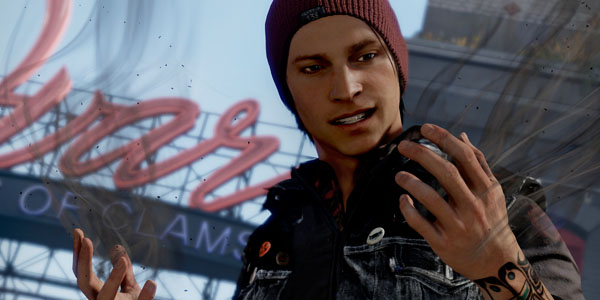
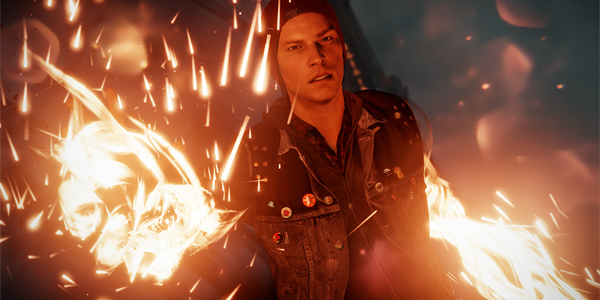
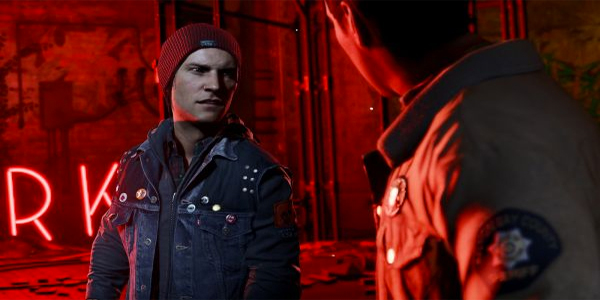
Once again, opinions seems divided, this time on the likability of protagonist Delsin Rowe. Delsin is played by the eponymous Troy Baker. This incredibly talented actor is best known for his voice work in Bioshock Infinite, Final Fantasy XIII and his perhaps greatest role of Joel in The Last Of Us. In Second Son Troy reveals the full gamut of his acting ability through extensive facial animation and motion capture, delivering a consummate performance that favours nuance over exaggeration. Maybe it's a soft spot for anti-authoritarianism, maybe it's a longing for the lost glory days of youth, but this writer found Delsin eminently likeable, even if his actions or dialogue occasionally make him seem a bit of a jerk. Occasionally being a bit of a jerk is human; it is our flaws that define us as much as our more positive traits. A character without human frailty is a character without humanity. Delsin is portrayed with a realism towards both his Native American lineage and his sibling rivalry. The relationship with the (equally well-portrayed) Reggie, voiced by Travis Willingham, is believable and convincing and a considerable advancement from earlier games in the series. Although some weak humour is occasionally allowed to slip through the generally satisfying dialogue, there are genuinely chuckle-worthy moments with one particular mission guaranteeing to either make you laugh out loud or groan inwardly, this writer definitely did the former. The cut-scenes and dialogue make much more sense when on the 'good' playthrough, providing another reason to play this arc first, on your second playthrough you'll be more interested in just killing everything, including Reggie's police cohorts, and although you'll notice how Reggie seems to pay no heed to you wiping out his law enforcement buddies, you'll shrug it off and get on with the mayhem. Lastly, it is extremely refreshing to have a main character deviating from the 'everyone-is-white' theme, but not only do we have an ethnic minority as our main character, we have an ethnic minority character who just 'happens' to be who he is. No resorting to stereotypes, clichés and tired-out overused hackneyed memes. Even if an Assassin's Creed III-style tomahawk would have been cool!

8. Travel Powers

Obtaining and using powers is where the real meat of the game is served up, and what a tasty dish it is! Each set of powers follows broadly similar lines, each power-set boasting a travel power with some variations. This aspect of Second Son surprisingly still attracted some discord amongst the reviews, despite it often featured in the game's positive reception even when reviewers were less then overwhelmed. Some reviews described clunky, ungraceful movement, finding traversal a chore rather than an enjoyable aspect in its own right. Some criticism is valid; a movement skill of being able to super-jump from cars becomes worthless when getting on top of them to use it is a distinctly hit 'n' miss affair, and certainly unviable in the heat of combat which is when it would be of most use. Finding much needed air-vents can either be a pain in the proverbial or a challenge depending on your point of view, and some of the air-control abilities seem pretty pointless when we consider the short amount of air-time each use will afford. This writer found the travel powers to be incredibly fun in themselves, even without the adrenaline rush of combat. Spectacular transformations beautifully harness the power of the PlayStation's graphics while you initiate the travel abilities making them a joy to use, make traversal of the city a cinch, and deliver a whole new paradigm for conflict resolution. Smoke abilities give us blisteringly fast but short bursts of movement and the fastest way to reach the top of buildings, neon gives us a blindingly bright never-ending breakneck spurt whether sprinting across the terrain or ascending skyscrapers. (There are two other groups of powers but we acknowledge Sucker Punches wishes for no spoilers here). Rest assured that the variation of abilities offered are unique in conception and implementation and will leave every gamer sighing with pleasure as they show their dominion of the landscape with their favourite means of traversal.

7. Conflict With Combat

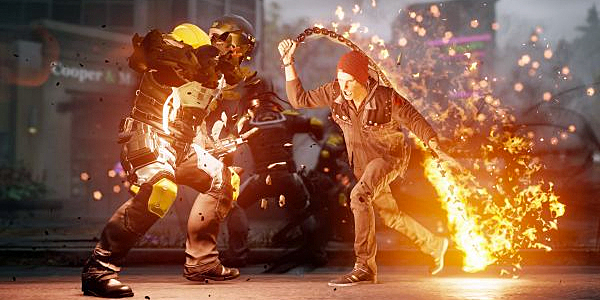
Combat in Infamous was undoubtedly fun, and improvements in Second Son definitely take it up a notch. Enemies are more likely to take cover (or even make their own cover with their abilities) and provide so much more of a diversion than simply being sitting ducks on a target range. A spectrum of abilities at our disposal allows a smorgasbord of choice, with options to hold enemies in the air before shooting them, choke them with smoke, hover and shoot, slow time to line up shots, using will-o'-the-wisp rapid movement tactics or take cover. Or just going flat-out crazy with a combination of rapid fire and heavy attacks - there is not only something for everyone, there is plenty of choice for everyone. However, some reviewers still had reservations, citing enemies that have a seemingly laser-like homing ability based more on precognition and a see-through-walls second sight than artificial intelligence that made sense. This writer found combat a lot of fun. So much fun it was easy to forget there is a mission to do, a narrative to the story, and would posit that gamers will happily find themselves within that gaming nirvana of 'just one more go before bed', instead finding themselves bleary eyed as the sun comes up and another eight hours are sacrificed to the capricious Gods of Gaming.

6. The Story Was Bland

Several reviews were disparaging to the story, claiming it to be bland and formulaic, with plot devices replacing actual plot. The story necessarily strays beyond norms, while still making sense in a superhero comic book way, but there is a subtext to be found for those wishing to look a little deeper. Now bare with us here. Even democratic governments have a track record of increasing their powers and control over the people they 'represent' when under attack, whether by opposing armies or by terrorists. Legal concepts such as 'innocent until proven guilty' and 'habeas corpus' (you may have the body) translates in practice to a suspect having to be brought before a court and released if there is insufficient evidence against them. However these ideas fly out the window if a government feels they can demonstrate a greater threat from external sources. History and current events show us that many a democratic government has suspended these rights, detaining suspects without trial indefinitely, taking away the citizenry€™s freedoms in the name of the freedom it takes. Back to Second Son though, and although you'll have to play the game to fully understand the comparisons being described, the correlation isn't forced, it is simply 'there', and many players probably won't give it a moments thought. But underneath the apparent simplicity, there is an enjoyable and unexpected depth and subtlety to Delsin's tale.

5. Seattle: The Emerald City

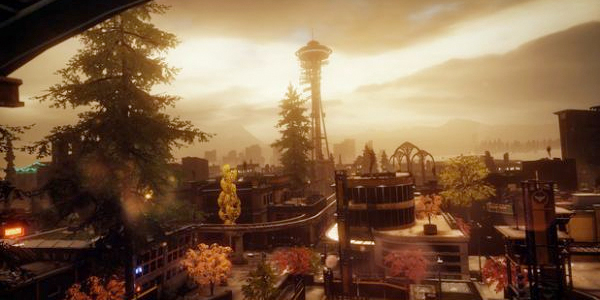
A definite polarity in reviews here, and sad to say, justifiably so. The real world Seattle is home to over half a million city residents, with the metropolis numbering circa 3.5 million. Either the D.U.P. have been incredibly successful at keeping everyone indoors or our game world population is only a few hundred. One could take this portrayal of Seattle and drop it into a corner of GTA V or Assassin's Creed IV where it could fit in nicely as a suburb. Seattleites appear to have little to do with their lives beyond providing a few side-missions for Delsin, and the impact of their dystopian existence seems to cast no shadow. Much like no shadows are cast by any citizen, enemy, or Delsin himself. The city exists purely as a playground, a fun playground as long as the player maintains a healthy willingness to suspend disbelief, but once the cracks show, they become increasingly difficult to ignore. There are half a dozen or so side missions in about a dozen districts, fairly generic in nature but fun nonetheless. Procedurally generated diversions seem to be limited to a D.U.P. vehicle roaming the streets, or occasionally popping into existence mere yards from the player. Players can be diverted by saving suspected bio-terrorists or attacking D.U.P. Patrols, or simply blasting a street-entertainer to smithereens, although this rightfully denotes you as evil; sadly there is no 'good' equivalent of blasting people who take too long deciding what to get at the deli counter. Despite some elements being lacking, such as areas that could have done with more detail and a greater diversity of environments, we have some visual goodness to be found. Draining the neon powers is incredibly aesthetically pleasing, with a peculiarly satisfying weight and 'realness' to it. In the same way that gaming addicts sometimes find it difficult to pass crates without smashing them open to see if there's health packs inside, we may find ourselves feeling oddly foolish and foolishly odd as we will soon be standing outside our local Starbucks with the building to urge to suck some energy from the neon sign.

4. Art For Art's Sake

The graffiti mini-games are... well a bit strange. In some ways it feels like a tacked on extra for showing off the movement sensor in the PS4 controller. As do the swipe movements on the touchpad, and the changing colours of the lightbar (seriously, watching a blue or red reflection in my television screen adds absolutely nothing to immersion in a game). One is left wondering who these tagging mini-games are actually aimed at, it is difficult to imagine any gamer enjoying the challenge (there isn't any), or finding the implementation anything but intrusive and distracting. The prototypical fly on the wall at a planning meeting would probably have overheard something akin to: Sony Suit: "So guys, have you put in something that uses the controller features, touchpad, light bar, motion sensor etc?" Developer: "Er yeah...there's this mini-game where they have to shake it and then point it around the screen. Oh and the light bar changes colour depending if they're good or evil." Sony suit: "That's genius! Make sure to chuck in something that uses the touchpad, maybe opening a door or something? I'm off to the bar anyway. Coming?" Criticism of the implementation apart, the many opportunities for graffiti and the finished pictures demonstrate the validity of the argument that this urban expressional media is an art form. An art form capable of free expression from political dissidents, a statement of a changing zeitgeist that liberates the oppressed masses from feelings of helplessness, placing real-world art within the purvey of the proletariat. No pictures of man or lady-parts then. Lack of genitalia aside, the stages where the tagging is revealed layer by layer is unambiguously a joy to watch, and actually prompts the player to feel 'Hey, I can do that!' Just don't go blaming us at What Culture if you become inspired to take it up!

3. Trophies Or Atrophy?

Game Trophies can either be an uninspiring collection of nonentities merely collected from completing a game in a meandering 'go from A to B' fashion, or a worthwhile addition that encourages players to try tactics and strategies they hadn't considered previously, all the while adding interest, challenge, or pure fun. Amongst the trophies this gamer will enjoy (and repeat) are: Double Smoke Stack Attack €“ Dash through two air vents without touching the ground and then Comet Drop on an enemy. Cough Drop €“ Comet Drop on three coughing enemies. Total CARnage €“ Destroy five cars in five seconds. Kicking and Screaming €“ Finish off ten wounded soldiers or civilians. And what is probably one of the best trophies ever: Excessive Force €“ Use a Karmic Streak Attack (the game's city block-levelling move) on precisely one enemy. So Second Son's Trophy list has thankfully hit the right spots, even for those who might not normally even look at trophy requirements. Second Son's trophies seem designed to make players explore all of the game and enhance value, rather than the dreary unimaginative contractual fulfilment seen too often.

2. Face Off

The facial detail and animations are stunning. We expected an improvement from the PS3 iterations, what was less expected was how these improvements may impact on our emotional involvement. It is so much harder to choose the 'evil' route when the character on your screen has a visual fidelity that shows every wrinkle, every micro-muscle movement, every fleeting expression. Humankind is fundamentally a communicative animal, and the most impactful communications are those that occur face to face, even in this world of internet communications with many battles being fought by anonymous keyboard warriors, visual contact is king. Why? Because that incredible computer called the brain is analysing in great depth every single muscle movement, every posture, every fleeting expression no matter how small. In fact communication experts understand that often the tiniest eye movement, postural or facial expression is that which carries the most important detail - even though the expressions and interpretations will all take place on a level below conscious thought (think Tim Roth in Lie To Me and you'll be in the right ball-park). What's jaw-dropping is that Sucker Punch have nailed it, and most people won't even notice, (reviews seem to have missed this aspect entirely), precisely because it does take place below a level of conscious thought. Start watching the cut scenes as if you were playing the part of Tim Roth and award yourself a pat on the back when you spot the micro-expressions that most people will miss. Allow yourself to be drawn into the excellent characterisation, this will increase your immersion in the story, and make some of the plot-holes and lack of sub-plots just that bit more forgiveable.

1. Boss Fights Are A Chore

The gaming world, like any other, is made up of a continuum of incredibly talented gods at one end, and inept stumblers unable to cross the street in Call of Duty without looking for street names at the other. Your reviewer, I regret to say, is in the latter. There are undoubtedly many players out there who jeeringly display their contempt and laugh derisively as yet another barely-beatable boss crumbles at their feet, whereas the rest of us mere mortals will rage at the screen, tear hair out, intermittently throw teddy in the corner and spit out dummies while ranting about godlike enemy AI, unethical levels of adversarial accuracy, lack of health or cover, and blaming everyone but themselves and their woeful inadequacies. Boss fights in Second Son are largely a war of attrition. Hiding behind cover will see the cover quickly destroyed or circumvented by the enemy. The players lightning-fast evasive moves will see a heavy area-of-attack move knocking them flying away from cover or platforms to stand on, dropping into lava. The players view on boss fights will depend on which camp they sit in, some will view them fondly, refer to 'classic' memes of gaming, whilst others will reflect that a 'new generation' of gaming simply means a new set of clothes for the emperor. To the Godlike giants of gaming out there we salute you, but on this one last point we will leave you to enjoy your fun, as we'll slog through the interminable grind then jump back to stomping on the street entertainers! InFamous Second Son is a good game. It is no more, and no less, than that. The timing of it's release was beneficial to its sales; hitting the shops during a dearth of new games whilst gamers are desperate to justify the purchase of their new console with a pure 'next gen game', but equally detrimental to the reviews, which were looking for the poster boy for the PlayStation 4. Gamers willing to accept that Second Son is neither genre-defining nor bearing the banner of the next generation will enjoy, trade, and forget. What did you guys think? Still on the fence? Staunchly opposed, or flying the flag? Let us know in the comments!

Contributor
Contributor

When not overthrowing governments MuddledMuppet can be found on youtube making mockery of life with slightly better than average gameplay. https://www.youtube.com/user/muddledmuppet