10 Biggest Unexplained Mysteries Of The Universe
There's no such thing as space and time? They're just... one... thing? WHAT.

The universe can be mind-boggling at the best of times and a lot of its explanation you just kind of have to accept than attempt to comprehend it lest you turn your brain into rice pudding.
If you've ever tried to learn about quantum mechanics, for example, chances are your lecturer or whatever wikipedia article you stumbled upon probably started with FORGET EVERYTHING YOU KNOW ABOUT LOGIC AND REASON. Even if that warning doesn't put you off trying to understand the immensely complicated world around us, then good luck when you get to Special Relativity: There's no such thing as space and time? They're just... one... thing? WHAT.
While the cleverer people in the world have managed to get past these barriers and have been able to make sense of a lot of the crazy space jargon, there are still a number of things in the universe that scientists still haven't got an explanation for...
10. The Fermi Paradox

We've all fantasized about the idea of other worlds with other lifeforms living fun alien lives and some even believe they've had an encounter with extra-terrestrial beings, most of which are really into probing for some reason.
Outside of the conspiracy theories, there's no evidence that these intergalactic space perverts actually exist but there's a wealth of evidence that would suggest life has to exist elsewhere in the universe, and that is exactly what the Fermi Paradox explains.
Named after Italian-American physicist, Enrico Fermi, it puts together that there are billions of galaxies in the universe and there are billions of stars in each galaxy, most of which will have at least one Earth-like planet orbiting around it and therefore, just by sheer probability, must have something living there.
Many of these stars will be much older than the one we're currently in a very one-sided relationship with, which would suggest that the life on those planets would have developed far sooner than that on Earth, and surely have the means to complete interstellar travel.
Despite the seemingly impossible chance that we are all there is, we still have no hard evidence that there is anyone else and no-one really understands how or why.
9. ‘Oumuamua
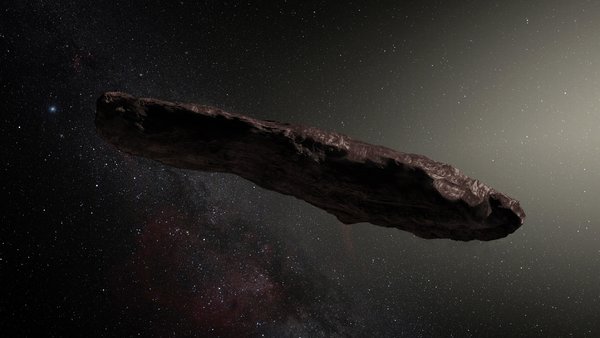
Even if we have no hard evidence that there is other life in the universe, that doesn't mean there aren't suggestions for it.
In 2017, astronomers in a Hawaiian Observatory spotted an unexpectedly quick object hurtling through our solar system. It didn't look like a regular asteroid and didn't have any of the properties that would suggest it was a comet, yet it was accelerating past us and around the sun, where it will continue traveling until it leaves our little corner of space.
Calculations made about its speed and trajectory suggested that it could have been knocked out of the Sun's deep orbit or that it could have been the remains of a comet from outside our solar system, but in all of these theories there was something that didn't add up.
Naturally this led speculators to think about the possibility that it had other origins, perhaps being some form of solar-powered alien spacecraft. At first that might sound like just another conspiracy theory but the evidence put forward by Avi Loeb of Harvard University has convinced many scientists that this may actually be the case.
In July 2019, other astronomers reported that 'Oumuamua was of "purely natural origin" but that hasn't stuck with a lot of Loeb's followers.
8. Hoag's Object
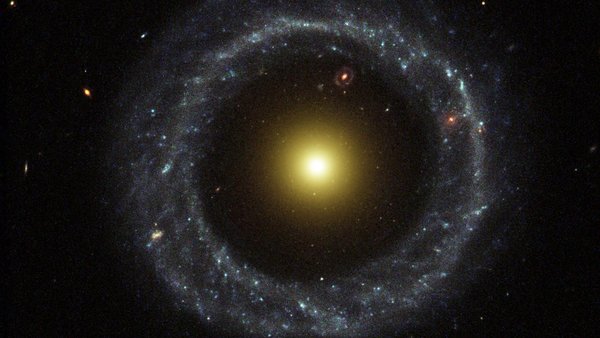
Generally speaking there are two types of galaxy in the universe. You've got spiral galaxies like the one we're currently outstaying our welcome in, which consist of multiple distinct 'arms' orbiting around a supermassive black hole in the middle; and elliptical galaxies, which is essentially just a hot mess of stars in a ball.
Hoag's Object looks, at first glance, like a galaxy but instead of conforming to the norms, it's taken the shape of a doughnut.
Similar in size to the Milky Way, this monstrosity was discovered in 1950 and which category it falls into has been defined and redefined over and over for the last 70 years. Many still dispute whether it's a galaxy at all, hence why its name has been relegated to 'object'.
On top of the mystery of what it actually is, scientists are also baffled as to how it would have come to be. It's the only example of any object that looks like this anywhere in the observable universe so it's still unknown how or why this space-donut exists.
7. Planet Nine

Planet Nine is not so much a mystery, but a theory to explain a mystery.
In our solar system, there are a number of things that just don't add up, which, as we've discovered so far, is apparently not that uncommon.
The orbits of objects really far out in the solar system are noticeably skewed to one side, leaving a massive gap on the other side of the sun. This could only really be the case if a larger object was, in effect, pushing everything to the opposite side, which is the main argument for the existence of a ninth major planet.
Add to this a sprinkling of regular, periodic extinction events on Earth and a dash of gravitational irregularities, you've got a recipe for a new planet, which astronomers still have yet to prove or disprove.
A great number of scientists are convinced it must exist, and so experiments and observations are still being made. Who knows, there could be a new character introduced to "The Desperate Houseplanets" any day now!
6. Tabby's Star
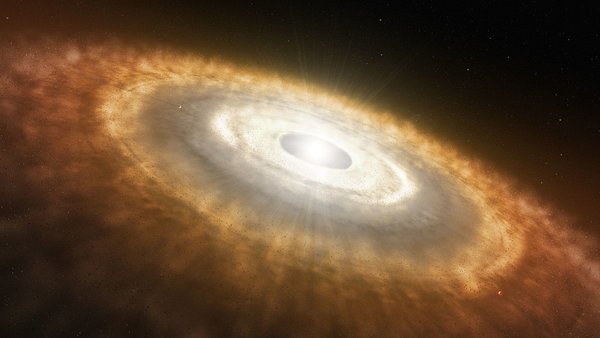
If you go outside tonight, you might be lucky enough to see some of the billions of stars in our galaxy twinkling in the night sky. Unless, of course, you live in the UK, in which case, check out them clouds.
All stars have an apparent 'flickering' to them, but one star in particular fluctuates in light so much you'd be forgiven for thinking someone had left the lights on at their space rave.
Sitting in the constellation of Cygnus, Tabby's Star gives off an almost strobe effect that has been baffling scientists since it was first noticed in 2015. Several theories as to what is causing this broken light bulb effect have come and gone since then. Star is being obscured by orbiting planets or dust? NO. Changes in the star's internal temperature? NO. An interstellar giant doing shadow-puppets? Now you're just being silly.
Tabby's Star is still being studied today in the hopes that we can find the actual reason for this abnormality, and the idea that it could be the result of interference from alien lifeforms has not been taken off the table.
5. The Bermuda Triangle Of Space
Whether you believe it or not, there is a lot of conspiracy around the area of the Caribbean known as the Bermuda Triangle. Over the years, it's been said that a number of aircraft and ships have gone missing without a trace, including the USS Cyclops which supposedly just vanished with all its crew and cargo after entering that part of ocean.
Though the majority of claims about the Bermuda Triangle have proven to be inaccurately reported, embellished by writers or just plain rubbish, there turns out to be a interstellar equivalent for conspiracy theorists to sink their teeth into.
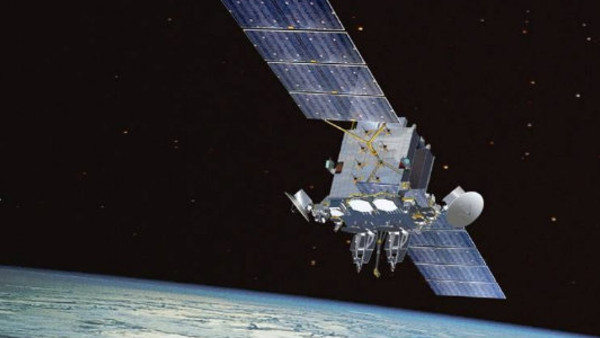
Though spacecraft aren't going missing, the satellites that traverse this portion of space that stretches above the South Atlantic Ocean between Chile and Zimbabwe encounter serious disruption to their onboard computers that has occasionally caused significant problems for both equipment and astronauts. Some astronauts even claim to seeing flashing white lights before alarms start blaring.
Formally titled the South Atlantic Anomaly, scientists are pretty confident that this phenomenon dubbed The Bermuda Triangle of Space has something to do with the shape of Earth's magnetic field, but with no finite answer, it's still an absolute mystery.
4. Boötes Void
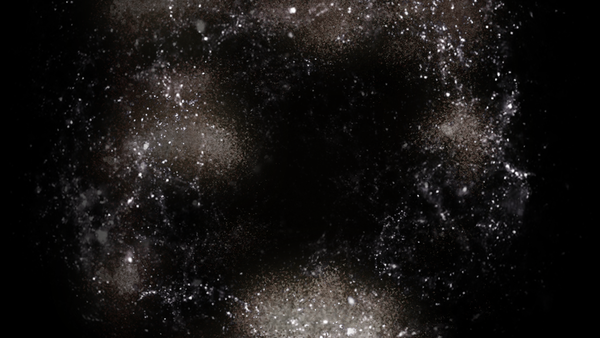
Aside from a few anomalies, the universe is relatively uniform. Across any region of space, you can more or less predict with decent accuracy how many galaxies there will be in said region.
That being said, there are sections of space where there simply aren't as many galaxies as there should be. These are called voids, just to hammer home the terror that comes with a section of the universe being missing.
Boötes void is one such void that is particularly empty. In an area of space where there should be 2000 galaxies, exists just 60. This is why Boötes void has also been referred to as The Great Nothing.
The reason that this section of space only contains 3% of the matter it should is still unknown, with theories ranging from the merger of smaller voids to create one big void like smaller bubbles combining to become one big bubble, to a huge intergalactic explosion that either destroyed everything or just pushed everything aside.
3. The Singularity

Black holes are arguably the most intriguing objects in the entire universe and have been a subject of fascination for scientists and science-fiction writers for the last 100 years.
Black holes consist of two main features: the event horizon, the bit you can see (or rather can't see), which is the point at which light can no longer escape the pull of its gravity leaving behind nothing but a black circle; and the singularity, the inside of the black hole, the stuff that lies beyond the event horizon.
The difficulty with black holes is quite simple: you need light to see. When you have something that sucks in all of the available light, it makes it pretty hard to see what's going on inside. As such, no-one has any idea what is happening on the inside of a black hole.
Thanks to the late Professor Stephen Hawking, we understand that black holes radiate energy and therefore slowly lose their size over extremely long periods of time, so whatever is going on in there is using up its fuel.
One such prediction for what happens in the singularity is the idea that information breaks down on an atomic level, i.e. the rules of physics don't apply anymore. This could mean that, if you somehow were able to survive getting inside, you wouldn't be able to tell the difference between a planet and a banana.
2. FRB 121102
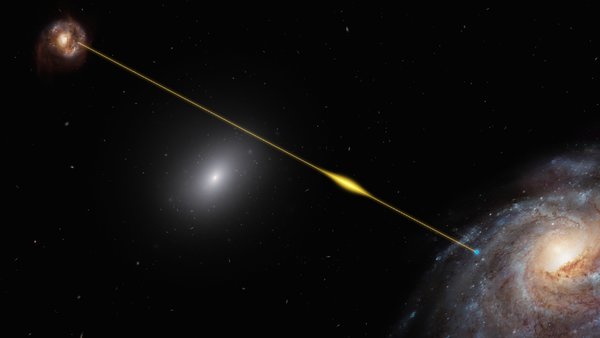
For a reason that scientists are yet to understand, some objects in the universe emit a sudden pulse of radio waves, which supposedly releases as much energy in one millisecond that the sun puts out in 3 days, and that is quite a lot.
Fast radio bursts or FRBs have been detected a number of times in the last 15 years or so. Though we're able to pin-point their point of origin, we have absolutely no idea if they are being caused by fast-spinning black holes, stars going supernova or if they're the result of alien intelligence.
It would be quite easy to discredit the claims that these impulses are alien broadcasts given that they are normally quite random, but three of these bursts have actually repeated a number of times, including the title character of this story, FRB 121102.
Astronomers have been able to accurately state which galaxy FRB 121102 is coming from, but have no hard explanation as to why it's occurring at all, let alone on repeat like its E.T.s dial tone.
Maybe these pulses are targeted at us, as though something is reaching out into the void for hope of contact...
1. Dark Energy/The Universe Horizon
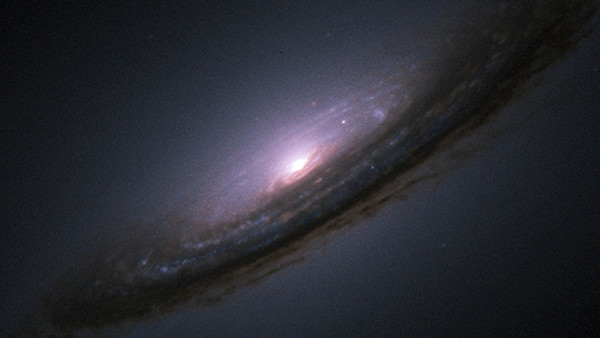
If you've heard the phrase Dark Matter, then you may have heard of Dark Energy. Though still technically a theory and not solid fact, it is widely understood that dark matter is what makes up 85% of the universe. The black bit, the bit you assumed was just empty, is actually a something, it's just a something that we can't see. It explains how galaxies can hold their structure as well as a nod towards why the universe is expanding, which is where Dark Energy comes in.
Dark energy is essentially the energy that is pushing everything outwards, and is the explanation as to why the speed with which the universe is expanding is actually accelerating, instead of slowing down or remaining constant as would be expected.
Again, this is still a theory, so we could discover that it's something else entirely but the current thinking behind dark energy suggest that at the edge of the universe, the expansion is starting to accelerate beyond the speed of light, which up til now was thought to be the speed limit of the universe.
If this is the case, then what if there is more beyond the 'edges' that has been expanding faster than the light within it can reach us, meaning we'll never see it? These are the sorts of things that keep scientists up at night. There could be a universe we'll never see.