10 Famous Authors Who Show Up As Characters In Their Own Work
Shameless self-promotion.
Every author draws from reality in some way, whether it's constructing a narrative through personal experience, borrowing characteristics from real people or channelling a specific emotion. Nevertheless, it's odd when a writer tears down the wall of illusion that stands between author and reader, outright inserting themselves into their own work. This transparency is often no more than a bluff, intended to serve some sort of meta literary function or so readers like to tell themselves. What's also true is that writing is an act of narcissism, at least when the end goal is the desire to have that writing read. Is it possible that sometimes nothing more than pride is at play? While there have been many examples over the years of artists showing up in their art, there's nothing quite like a writer turning up in their own story. Film and television cameos are a lot more fleeting - they require little effort and often go unnoticed. Take Martin Scorsese as a passenger in Taxi Driver for example, or Quentin Tarantino's many questionable roles in his films - crucially neither played themselves. But writing yourself into a story is a laboured process, one that requires thought and dedication, and it feels more like a weighted statement. To what end, then, is it done? Vanity? Self-promotion? A comment on the mortality of the artist? Probably a bit of all three...
10. Bret Easton Ellis - Lunar Park

Speaking of vanity, Bret Easton Ellis is notorious for his out-spoken personality (in the last couple years he has publicly slammed fellow writer David Foster Wallace, director Katherine Bigelow and Alfonso Cuaron's Gravity) he rocketed to fame with the release of his debut novel Less Than Zero, published when he was just twenty-one years old and still at college.
In Lunar Park Bret Easton Ellis is a writer who rocketed to fame with the release of his debut novel Less Than Zero, published when he was just twenty-one years old and still at college. Sound familiar?You do an awfully good impression of yourself. Jayne said this after she looked me over with a confused expression and asked pointedly what I was going as to the Halloween party we were going to that night, and I told her I'd decided to simply go as 'me'.Opinions on why Ellis wrote himself into Lunar Park will likely depend on whether or not you're a fan of the man himself - though it's hard to get behind a person who tweeted in celebration of J.D. Salinger's death. Regardless, as author of American Psycho, it's impossible to deny he's been an influential figure in the writing world.
9. Paul Auster - The New York Trilogy

The New York Trilogy is weird - awesome, but undoubtedly strange, and since he's known for his combination of absurdity, existentialism and crime, Auster's cameo makes more than a little bit of sense. Comprised of three separate tales about mysterious urban goings on, Auster pops up in City of Glass, a story about a detective-fiction writer named Daniel Quinn who becomes a private investigator - which sounds a bit like wish fulfilment.
It gets weirder when Quinn reaches a dead-end in a case and attempts to contact the detective known as Paul Auster, the man whose case it was originally supposed to be. Quinn tracks Auster to an apartment where he finds not Paul Auster the detective, but Paul Auster the writer, who claims to have no idea what Quinn is talking about.
I came here looking for Paul Auster, the private detective. The what? Auster laughed, and in that laugh everything was suddenly blown to bits. I' m afraid you've got the wrong Paul Auster.Pretty confusing.
8. C.S. Lewis - Perelandra
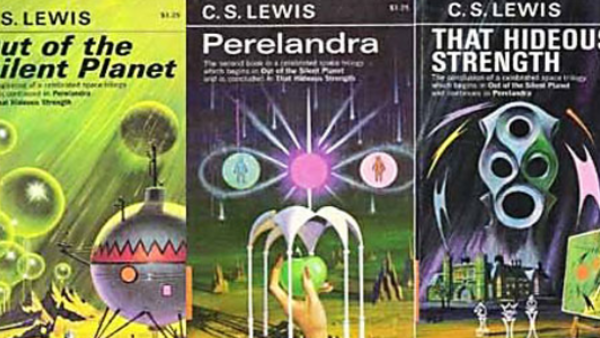
Who knew C.S. Lewis wrote science-fiction? Att the start of Perelandra the second book in Lewis's Cosmic Trilogy the protagonist Ransom invites Lewis round to his home to tell him the plot of the story. Nose bleeding yet? Lewis actually has to ask his own fictional character whether or not the book's villain is real.
But, look here, said I. This isn't child's play. Are you quite certain that this Dark Lord, this depraved Oyarsa of Tellus, really exists? Yes. If you remember, before I left Malacandra the Oyarsa hinted to me that my going there at all might be the beginning of a whole new phase in the life of the Solar System the Field or Arbol.After they finish chatting, Lewis blindfolds Ransom and he travels naked into space, the blindfold ensuring his vision is not scorched by the sun and his lack of clothes due to the fact they are't required on Venus. When Ransom returns a year later he is met by Lewis and a friend. Ransom tells the two the remainder of the book's plot, with Lewis occasionally interrupting to clarify details and comment. Weird.
7. Geoffrey Chaucer - The Canterbury Tales

And thus in Southwark one spring day / At the Tabard, where I lay, / Ready to journey from the place / And seek the holy martyr's grace, / A merry group arrived to dineAt times accused of being naive, at other times for knowing too much about his fellow pilgrims, Chaucer's function seems to fluctuate as and when he needs to progress the story. Significantly, Chaucer is the only one of the pilgrims who manages to tell two stories, the first which is lambasted and the second which is warmly received.
6. Jorge Luis Borges - The Aleph

The Aleph is a short story by Argentinian writer Jorge Luis Borges, who was famously continuously snubbed for the Nobel Prize for Literature. It's one of several stories in which Borges can't be bothered coming up with character names and just uses his own. The story describes an Aleph as "one of the points in space that contains all other points", which sounds pretty trippy.
In the story, Borges meets an overly-ambitious yet mediocre poet named Carlos Daneri, who basically wants to write a poem about every single thing on the planet ever, using the Aleph he claims is hidden in his basement to gain omniscience. Borges detests Daneri, yet demands to see the Aleph for himself, basically because it sounds pretty sweet. When he arrives at Daneri's house, he is left alone in the darkness of the basement, and begins to fear Daneri is planning to kill him. But then, as if materializing from nowhere, he sees it.I saw the Aleph from every point and angle, and in the Aleph I saw the earth and in the earth the Aleph and in the Aleph the earth; I saw my own face and my own bowels; I saw your face; and I felt dizzy and wept, for my eyes had seen that secret and conjectured object whose name is common to all men but which no man has looked upon -- the unimaginable universe.Damn. Infinitely cunning, when Borges exits the cellar he pretends to have seen nothing, an attempt to convince Daneri he's actually insane.
5. Martin Amis - Money

I tell you, this Martin Amis, he lives like a student. I had inspected his flat with an adman's eye, mindful of outlay and lifestyle, of vocational expenditure. And there was nothing, no tape recorders or filing cabinets or electric typewriters or word processors. Just his pastel portable, like an ancient till. Just biros, pads, pencils. Just two dust-furred rooms off a sooty square, with no hall or passage.
4. Orhan Pamuk - My Name Is Red
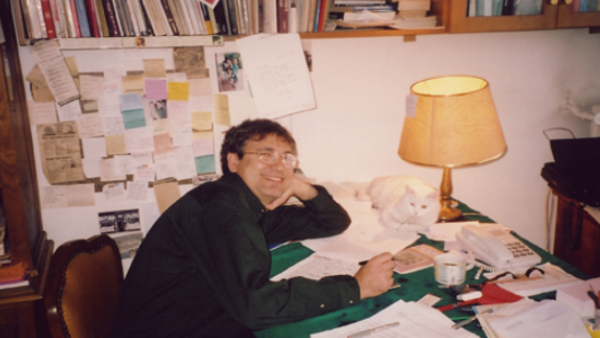
"Orhan lied to the master binder," Shevket said. "He left me there to do all the work."Orhan is known for his interest in post-modern meta-fiction, so it seems natural that he would insert members of his actual family into his work. The book has since been wildly successful, with a translation existing in over 60 languages.
3. Grant Morrison - Animal Man
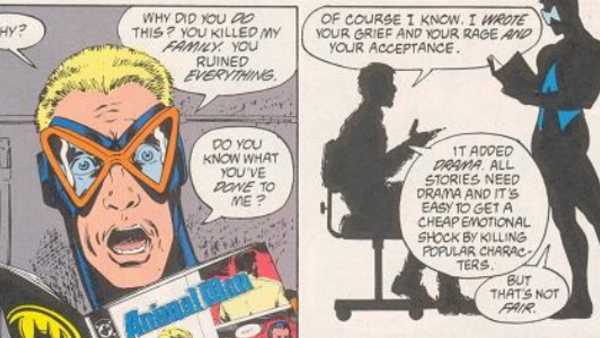
2. Philip Roth - The Plot Against America
I wonder if I would have been a less frightened boy if Lindbergh hadn't been president or if I hadn't been the offspring of Jews.
1. Stephen King - The Dark Tower

"Stephen King's not the water, Susannahhe's only the pipe the water runs through."Whatever you say, Roland. Did you enjoy this article? Share your thoughts in the comments thread below.