10 Historical Figures You Might Find At A Gatsby Party
A crazy cocktail of Gangsters, Actresses and Eloping Evangelists.
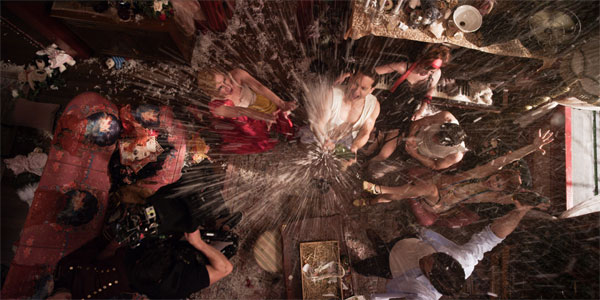
F. Scott Fitzgeralds 1925 novel The Great Gatsby was published to great acclaim at the height of The Roaring Twenties. Today the book is still regarded as a literary classic and has been widely adapted into films, ballets and even computer games.
The novel paints a vivid picture of 1920s New York, a world inhabited by flappers, moonshine and wild parties. A central part of the books plot revolves around the extravagant parties thrown every weekend by Jay Gatsby in which people from all areas of society went to drink, dance and mingle. The character of Gatsby is an eccentric and mysterious man whose obsession for his lost love, Daisy, drove him to become a self made millionaire in a strategically orchestrated bid to impress her. Gatsbys parties were all thrown in the hopes that Daisy would one day walk through the door.
The parties were wild and decadent and all were welcome. Each weekend a mass migration of all manner of different types of people from central New York to Gatsbys gigantic house would occur.
This article takes a collection of 10 real life historical figures who you might have found at one of the Great Gatsbys parties, a crazy cocktail of Gangsters, Actresses and Eloping Evangelists.
10. Al Capone - Notorious Gangster
Gatsbys parties werent all innocent fun and games, aside from the many affairs unfolding beneath the cover of Jazz and cigar smoke, Gatsby also kept some very disreputable company in the form of gangsters. Al Capone is one of the most well known gangsters in American history and chances are he would at some point have encountered Gatsby were he real.
Capone was born in Brooklyn in 1899 and grew up to become an active member of the notorious Five Points Gang in New York City. In his early 20s, Capone moved to Chicago to serve as mob head Johnny Torrios bodyguard. After Torrio retired due to gun shot injuries, Capone rose up to become his successor as head of the crime syndicate. The business that Capone inherited dealt with bootlegging alcohol, the same profession to which Gatsby belonged.
Had Gatsby been real it is likely that word would have reached Capone about his dealings with various gang members in New York City. Perhaps this would have prompted Capone to seek out the illusive Gatsby at one of his parties in the hopes of forming a business partnership and bootlegging links to his former home town.
9. Jimmy Walker - The Mayor Of New York City 1926 To 1932

During the 1920s, the manufacture, transportation and sale of alcohol was criminalised in the United States thanks to Prohibition. Gatsby took advantage of this and made his fortune through bootlegging and befriending many gangsters along the way. Many of these gangsters, as well as other rogue business men are sure to have attended one of Gatsbys many parties.
So where does the Mayor of New York City fit into this? Jimmy Walker was a member of the Democratic Party who was elected Mayor in 1926. The reputation of decadent parties such as Gatsby's and the unsavoury characters they attracted would have likely been a concern for most Mayors.
However, Walker wasnt most mayors and in 1936 he was forced to resign from office following a scandal in which it was revealed that he had been accepting large amounts of money from businessmen in exchange for municipal contracts.
Given the reputation of Gatsbys parties and the characters who gathered there, it is likely that Mayor Walker would have dropped by to network and maybe pick up a few new scandalous business transactions.
8. Dorothy Parker - Writer And Poet
Dorothy Parker was a woman who perfectly encapsulated the lifestyle and mindset of 1920s New York City. She was a writer and poet best known for her sharp wit, satirical style and love of alcohol. Parker was also a keen supporter of womens rights, believing in equal pay and an end to conservative attitudes towards sex. Parker led a troubled life, falling in love with a married man and suffering a string of unsuccessful relationships. She attempted suicide multiple times and became increasingly dependant on alcohol.
Parties to the magnitude of Gatsbys would have been unable to keep her away and she would likely have been found drowning her sorrows with a strong martini about which she wrote: I like to have a martini, two at the very most. After three Im under the table, after four Im under my host." Although as nobody ever saw Gatsby at his parties the final part of Parkers poem was unlikely to have come to fruition.
7. Clara Bow - The Original It Girl

Gatsbys parties were a playground for the young and beautiful, attracting many modern and free thinking flapper girls. For actresses fresh off the screen, the parties would have served as the ultimate scene to be seen in and few actresses came bigger than the decades reigning sex symbol, Clara Bow.
Bow rose to fame after staring in an array of silent films including the hugely popular It in 1927. The films success and Claras performance as shopgirl Lou Spence earned her the nickname It girl and popularised this expression around the world.
Regardless of whether Bow remained on her best behaviour at Gatsbys, it is likely that the tabloids would have circulated stories telling of her alleged wild antics at the party. During the height of her career, Bow fell victim to many scandalous rumours including allegations of drug addiction, incest and exhibitionism. The source of these rumours was eventually discovered as a magazine producer when he attempted to black mail Bow for $25,000 in order for the rumours to stop. However his plan backfired and after an investigation by federal agents he was sentenced to eight years in prison.
6. F. Scott Fitzgerald - Author Of The Great Gatsby
The author of The Great Gatsby was no stranger to New Yorks social scene. Friend and fellow writer Edith Wharton wrote to Fitzgerald to praise him for his accurate portrayal of the 1920s party scene. Fitzgeralds account were probably so accurate because he had taken inspiration for Gatsbys parties from real life events he had attended. So in a paradoxical turn of events, Fitzgerald would likely have found himself as the guest of his most famous creation searching for a muse amongst the waves of intoxicated party goers dancing the Charleston.
Fitzgerald would most probably have brought his wife Zelda along to the party. Although the pair remained married until Scotts death in 1948, the Fitzgeralds were both rumoured to have engaged in extra marital affairs. Zeldas most publicised affair was with a handsome French pilot named Edouard Jozan, an event that caused a great amount of strain on the marriage. Zelda blamed the affair on the fact that Scott was so absorbed in his work that he neglected to pay any attention to her.
So while Scott circulated the party looking for inspiration, Zelda would have circulated looking for anyone willing to put her ahead of their work.
5. Babe Ruth - Pitcher For The New York Yankees

Babe Ruth was born George Herman Ruth Jr in Baltimore, 1895. At the age of 19, he was signed to the Baltimore Orioles baseball team by then owner, Jack Dunn. Ruth was referred to as Jacks newest babe' by his teammates which was eventually shortened to Babe and became his nickname. Babe Ruth played well and was eventually sold to the New York Yankees in 1919.
During 1921, Babe's sporting career climbed to amazing heights when he scored a staggering 59 home runs, turning him into a celebrity. So, were he to have attended one of Gatsbys parties he would have been found surrounded by fans telling tales of his many sporting achievements and maybe signing an autograph or two. Babe would also have circulated the party in search of pretty women he could woo with his fame and charm. Babe had married a girl named Helen Woodford in 1914 but following rumours of Babe's numerous affairs the couple were separated in 1925.
Perhaps the many women who attended Gatsbys parties would have lured the sports star in. Babe is famously quoted as having said I'll promise to go easier on drinking and get to bed earlier, but not for you, fifty thousand or two-hundred and fifty thousand dollars will I give up women, they're too much fun.
4. The Paul Whiteman Orchestra
The 1920s was known as the Jazz Age and no high flying party would have been complete without a band. Dancing formed a central part of 1920s social events with many new dance crazes such as The Charleston, The Shimmy and The Foxtrot becoming highly popular. The success of a dance based party lay with the skill of the band provided the music.
Paul Whiteman was a popular conductor and musician who wrote more than 3000 musical arrangements over the course of his career, collaborating with some of the best musicians and vocalists of his day. He even recruited the talents of Bing Crosby, Harry Barris and Al Rinker, who would become known collectively as The Rhythm Boys, to record songs with his orchestra.
Whiteman and his Orchestra were one of the most popular dance bands around during the 1920s and Whiteman was even awarded the nickname The King of Jazz by the 1920s media. Gatsby would not have settled for having anyone less than music royalty playing for his guests and Whiteman and his orchestra would likely have been hired to play one or more of Gatsbys many lavish parties.
3. Sister Aimee Semple McPherson - Evangelist

Sister Aimee Semple McPherson was an American Evangelist who found fame after founding the Foursquare Gospel Church and building the Angelous Temple. Despite her religious work, Aimee found herself at the centre of a highly publicised scandal during the spring of 1926. After reportedly going out for a swim of the coast of California, Aimee disappeared. The Coast Guard launched an extensive search but no trace of Sister Aimee was found leaving her followers distraught and confused.
The fact that Sister Aimee was presumed drowned shocked the nation and gained vast media coverage. However, as her body was not found, a number of rumours began to circulate over the next few months as to Sister Aimees real whereabouts. One such rumour involving a married radio engineeer named Kenneth Ormiston began to gain particular attention. Ormiston worked very closely with Sister Aimee on her regular radio broadcasts and rumour had it that the pair were romantically involved in the months leading up to Sister Aimees disappearance. The fact that Ormiston also disappeared at the same time as Sister only added fuel to these rumours.
After five weeks had past, Sister Aimee turned up in Arizona claiming that she had been kidnapped. Interestingly, no trace of the alleged kidnappers was found and Ormiston also miraculously reappeared in parallel to Sister Aimee. If the rumours were true and Gatsby were real then his wild parties would have provided the perfect place for Sister Aimee and Ormiston to elope to and lay low.
2. Bessie Smith - Blues Singer
Bessie Smith was a blues singer who, along with the likes of Louis Armstrong, is regarded as one of the greatest singers of her day. She was the highest paid black entertainer during the 1920s and was nicknamed the Queen of Blues by Columbia records, a title that was soon upgraded to Empress by the media. Her lyrics suggest that she would have felt right at home at one of Gatsbys parties. In one of her songs she sings about buying bootleg liquor, champagne and wine, all of which flowed freely at Gatsbys.
Were Bessie Smith to have attended one of Gatsbys parties she would have made full use of the drinks on offer. Bessie would then have probably treated the other guests to a song or two, maybe singing a soft blues song from her highly popular discography as the party goers began to stumble home to bed in the small hours.
1. Harold Ross - Founder Of The New Yorker

Harold Ross was a New York based journalist who founded The New Yorker Magazine in 1925. He served as the magazines Editor in Chief from its first publication until his death in 1951. Ross was also a member of the Algonquin Round Table, a group of writers who met everyday for lunch at New Yorks Algonquin Hotel.
Perhaps fellow Algonquin member and close friend Dorothy Parker would have brought Ross along with her to Gatsbys party and the two would have spent the evening drinking and satirically commenting on the social habits of the other guests.
On the other hand, Ross may have attended the party alone in order to seek out the elusive Gatsby. His reputation would certainly have reached Ross and what better way to gain publicity for his new magazine than to score an interview with New Yorks most secretive, generous and misunderstood millionaire, The Great Gatsby.