10 Places Most Likely To Harbour Alien Life
4. Gliese 667 Cc
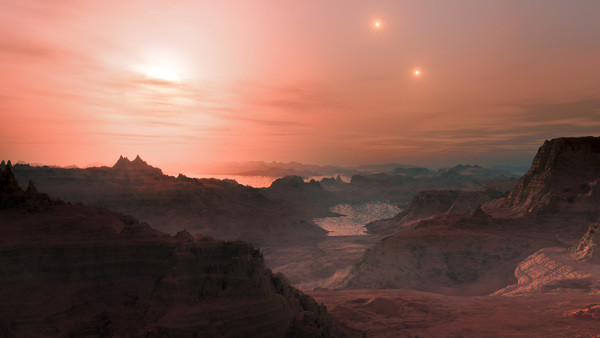
Despite the fact that Gliese 667 Cc is located in the habitable zone of its host star, life on the surface would be very different to life on Earth.
The star that it orbits is actually a red dwarf and most of the light that reaches the planet's surface is in the infrared part of the spectrum. This would mean that if anything there managed to evolve anything like eyes, they would be more adapted to detecting this part of the electromagnetic spectrum. Light visible to us would plunge the surface of the planet into a perpetual twilight.
It is also possible that, due to the planet's proximity to its host star, it would be tidally locked, much like our moon is to the Earth. This means that one side of the planet would be constantly facing the sun and bathed in eternal daylight, whereas the other side would be covered in permanent darkness.
Most extraordinarily of all, the star Gliese 667 C is part of a triple star system. These would not appear quite so huge in the skies of Gliese 667 Cc, but they would be very prominent. It would also be possible to see our own sun as a distant star as it is only 22 light-years away from us.
Life would be tough for anything living on the surface of Gliese 667 Cc due to the likelihood of regular solar flares from its red dwarf host, bathing the planet in radiation. We do know of lifeforms here on Earth that are capable of withstanding these kinds of conditions, however, such as the virtually unkillable Tardigrade or "waterbear", so it is perfectly possible that these kinds of organism could have evolved on a world such as Gliese 667 Cc.