10 Real-Life Archaeologists More Badass Than Indiana Jones

They have the hat, the gumption, the Nazi-punching...plus they're actually real.

Look, nobody is debating that Dr Henry Walton €œIndiana€ Jones isn't impressive. He's pulled off some major feats in his career, from discovering lost treasures like the Ark Of The Covenant, the Holy Grail, and whatever it is he was after in Temple Of Doom (Hearts? Monkey brains? A small Asian boy?). There's even that more recent expedition nobody likes to talk about. Along the way he bested the burgeoning Nazi party at every turn €“ and gave the USSR a good what-for as well €“ and bedded a bevvy of beauties, all whilst finding the time to return to the University of Chicago and give lectures that were presumably somewhat more dry when discussing archaeology, cutting out the bits with the whips and the snakes and the snakes used as whips. The only problem is...well, he's not real. Indiana Jones is a composite character of every pulp hero, every star of an old movie serial, every story of real-life adventurers Steven Spielberg and George Lucas devoured growing up, a fallible human being who was also a mythic legend. What's more impressive than that? Well, the people who did it all for real, for a start. The character has a number of real-life inspirations, predecessors, and even modern-day adventurers who follow in his footsteps (and choice of headwear). From the man who tricked the Nazis into helping him find the Grail to the two-fisted archaeologist still alive today, here are ten real-life archaeologists more badass than Indiana Jones.


10. William Montgomery McGovern Fought Nazis, Found Artefacts

Unbelievable though the early life of Indiana Jones may be, William Montgomery McGoverns beggars belief to a even more ludicrous degree €“ and he's the one who really existed. By the age of thirty he had already explored the Amazon, climbed through uncharted parts of the Himalayas, survived the Mexican revolution, disguised himself to enter a hidden Tibetan city and studied at Oxford and the Sorbonne. It was after all those adventures that McGovern became assistant curator of the anthropology department at Chicago's Field Museum of Natural History, not unlike the stuffy lecturing job Indiana settled down in. Oh, but that's also forgetting his war time activities. No fighting Nazis to retrieve the Holy Grail, sadly, but McGovern was a correspondent in Japan during World War II, producing a top-secret newspaper read by President Roosevelt and the Joint Chiefs based on what he'd learned behind enemy lines. And like Indiana Jones, his progeny seem wholly disappointing in comparison to his exploits: his granddaughter is Downton Abbey's Elizabeth McGovern.

9. Donald Miller Had More Treasure Than Most Museums

Indiana Jones is very much a product of a bygone age. Namely an age where you could just waltz into a foreign country and steal all their stuff without fear of reparation. Whilst there are still some institutions that haven't quite caught up with the times (looking at your, British Museum), it's generally regarded bad form for a former colonial power to make off with treasures that don't belong to them. Which means that when tomb raider Donald Miller €“ who, no joke, lives in the state of Indiana €“ had managed to amass quite a collection of precious artefacts, he wasn't treated as a hero. Instead, the 91-year-old had the FBI raid his home early last year in order to retrieve all of his loot. Miller didn't face any charges for his collection, which he put together having travelled to over 200 countries, archaeologists and other experts began rifling through his artefacts €“ including Native American items, and objects from China, Russia, Italy and Greece, amongst others €“ so they could identify the stuff that needed to be given back. the €œcultural value of these artefacts is immeasurable,€ said the special agent leading the raid.

8. Lecturing, Adventuring, Archaeologist Robert John Braidwood

Whilst Robert John Braidwood has often by cited as a possible inspiration for Indiana Jones €“ both taught at the University Of Chicago, and would have been contemporaries with their adventures and discoveries €“ he might actually have a far more important last legacy. He is considered one of the founders of scientific archaeology, meaning he paved the way for how most archaeologists work today. Okay, so being one of the pioneers of now-routine practises like carbon dating isn't quite as exciting as the two-fisted archaeology performed by Dr Jones, but he did get to visit some exciting locales during his career. He, too, was part of the American war effort between lecturing €“ working for the Army Air Corps before getting his PhD. In 1971 the Archaeological Institute of America awarded him the Gold Medal Award for distinguished archaeological achievement, partly down to his pioneering work; also because a lot of that pioneering work happened in even more politically fraught countries than Indiana Jones frequented, carrying out ground-breaking (literally and figuratively) digs in Iraq, Iran and Turkey, moving on each time when war broke out, smuggling his discoveries and tools along with him.

7. Danny Douglas Finds Treasure In Enemy Territory

Now you're getting into real Raiders Of The Lost Ark territory. It involves a treasure hunter, Nazi treasures, intrigue, and defying Cold War tensions to retrieve a priceless artefact. Also: spies and femme fatales. It all began at the end of the Second World War, when the Reliquary Of St Maurus €“ said to contain the bones of John The Baptist €“ was lost as its owners were stripped of their assets, said to be Nazi collaborators. Not quite the Ark Of The Covenant, but the Shrine was certainly grand and important enough. And for years it stayed missing, until Danny Douglas took it upon himself to track the darn thing down. A well-connected businessman, Douglas was enlisted by the Czech Beaufort-Spontin family who had previously held the Reliquary. It lay in Communist territory, buried beneath the floorboards of a forgotten church, before Douglas went in to retrieve it. Visiting the country under the auspices of business meetings, he raced to discover the location of the Shrine as the local secret police did the same, also planning to perhaps torture Douglas for information, or setting a honeytrap. In the end they found it together, but Douglas never got any credit for his work.

6. Tudor Parfitt Tracks Down The Ark, Keeps His Face

He wore a leather hat for a while. He uncovered the lost Ark Of The Covenant (or at least, something a lot like it). He travelled the globe, exploring the unexplored corners of the globe. He has a stupid name. The one thing that Tudor Parfitt doesn't have in common with Indiana Jones, in fact? He's British. Still, he's an adventurer and archaeologist that lectures at an American university (Florida), and he's real. One up on Indy right there. Formerly a professor of Jewish Studies at the School of Oriental and African Studies in London, Parfitt has undertaken any number of research trips which have seen him discovering one of the lost Jewish tribes that had migrated to Africa, visited the previously cannibalistic Gogodala tribe in Papua New Guinea and €“ oh yeah €“ the Ark thing. Rather than discovering the remains of the potentially apocryphal container for the Ten Commandments in Egypt, as in Raiders Of The Lost Ark, Parfitt tracked it down to a storage shelf in a museum in Zimbabwe €“ meaning it had something with that aforementioned Jewish-African tribe. He never carried a whip, but otherwise? He's a real-life, still-living Dr Jones.

5. Otto Wilhelm Rahn

That's the Ark Of The Covenant dealt with, what about the other Biblical treasures that Harrison Ford's pulp hero tracked down? Step forward Otto Wilhelm Rahn, a writer and medievalist who researched grail mythos. Oh, and also polar opposite to Indiana Jones in a lot of ways: he was a Nazi to the point that he believed in the occult powers of the Aryan race, and was a first lieutenant in the SS. Urk. Obviously nobody wants to suggest that Indiana Jones, American hero, is less badass than a literal Nazi. But it was Otto Rahn who got closer to the Grail than anybody else, and his alliance with the SS was always an uneasy one. €œA man has to eat. What was I supposed to do? Turn Himmler down?€, he said, in explanation of his political allegiance. In fact he was both openly gay and anti-Nazi, even whilst being a member of the SS. And yet he managed to keep these two key personality traits under wraps as he allowed the Third Reich to fund his trips across the world to track down the grail, during which time he found any number of treasure troves and networks of caves hidden beneath old castles. He never found the grail, true, but at least he died trying.

4. Roy Chapman Andrews, Dinosaur Hunter
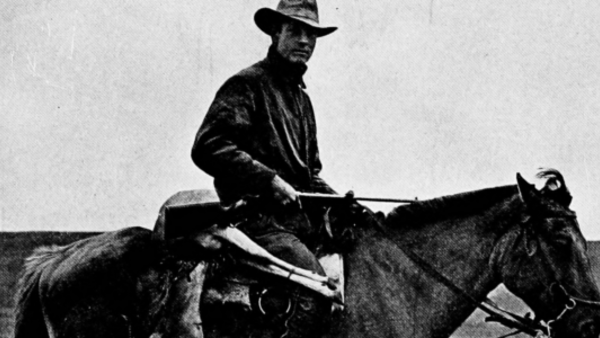
What is it that makes Indiana Jones who he is? Well, it's mostly the dichotomy between his stuffy establishment day-job and the free-wheeling, death-defying adventures he goes on to facilitate that archaeologist profession he has on his passport. It's a dichotomy that Roy Chapman Andrew also straddled, as he spent time as both director of the American Museum Of Natural History and as a nine-year-old with a shotgun. An early interest in hunting and taxidermy lead to his later career as a naturalist, which saw him leading a series of expeditions through the China into the Gobi Desert and Mongolia €“ where, amongst other things, he discovered what are considered to be the first-known fossil dinosaur eggs. Andrews is apparently the main inspiration for Indiana Jones, being an impeccable performer who had many of his adventures filmed €“ so he was on the big screen a good half century before Harrison Ford. He was an explorer, hunter, and archaeologist who ventured into some of the most dangerous territories of his age, fighting off Mongolian attack, apparently a crack shot with a pistol.

3. The Man Who Found Machu Picchu

There's not many people who can say to have discovered an entire lost civilisation. Indiana Jones did it in Kingdom Of The Crystal Skull, although most audiences wish he hadn't have bothered. Hiram Bingham III, meanwhile, made public the existence of the Quechua citadel of Machu Picchu, Peru in 1911. With the help of local farmers, admittedly. But Alfred Molina played his part in Raiders... Despite lacking any formal training as an archaeologist, Bingham lectured on it widely, and it was a research trip during his time at Yale that yielded the discovery of Machu Picchu. He set out to find any number of other unexplored Inca cities, and discovered a huge haul of artefacts as he did. Artefacts which Peru is now, quite rightly, petitioning to have returned to them. But boy, does his collection rival that of Dr Jones and then some: the Machu Picchu site alone was where he found an estimated 40,000 artefacts, including mummies, ceramics and bones. Not bad. And unlike Indiana Jones, he wasn't bad at flying €“ in fact, he commanded the Air Service's largest training school for a spell.

2. Frederick Mitchell-Hedges And The Kingdom Of The Crystal Skull

When you can actually cop to the fourth Indiana Jones film existing, you're also going along with all the stupid, nonsensical crap that put in there. Like a fridge being capable of protecting you from a nuclear blast, ancient aliens building old temples, and the Janitor from Scrubs being high up in the American intelligence services. One ludicrous part of the film not invented by Spielberg and Lucas? The titular crystal skull. The first of which was discovered by FA Mitchell-Hedges, an English adventurer, traveller, and writer who found it under a collapsed altar inside a temple with his adopted daughter in 1920s Belize. It was more of a normal skull, but very much crystal, and very much priceless (if you believe they didn't make it up, anyway). Mitchell-Hedges was perhaps unlike any other real-life Indy in that he believed in all sorts of fantastical, mythical concepts, including a desire to find Atlantis. He did have his head screw on to some degree, mind, working as a spy in Mexico, and he broadcast stories of his adventures where he discovered lost civilisations and fought jaguars on the radio. Stories which begat the pulp heroes which begat Indiana Jones.

1. The Modern Indiana Jones

Mitchell-Hedges and his ilk may have served as a template from which Indiana Jones was eventually birthed, but 1. They're all dead now, and 2. A lot of them were douchey imperial colonialists with a propensity for exaggeration. Slovenian archaeologist Ivan Šprajc, though, is the real deal €“ and even today, he's uncovering amazing discoveries hitherto unknown to humankind. He does all the requisite Indy things €“ hacking through undergrowth with machetes, avoiding poisonous snakes, wearing a hat €“ and along the way has made a career of finding lost Mayan cities. Recently he found civilisations that date back to the 8th century, his archaeological journey beginning when war stranded him in Mexico. Šprajc's stay in the country was lengthened considerably by the outbreak of war in Yugoslavia in 1991, although now he's attached to the Slovenian Academy of Sciences and Arts. During his expeditions he has dealt with snakes, jaguars, and dangerous locals...and over the course of several decades he's avoided death at the hands of them all, finding the hands-on approach works better than using satellites or whatever. €œI€™ve said to myself quite a few times that this is the last season, because it is so difficult. But it is such a reward when you find a new site,€ he says. €œIt€™s tough work, but it€™s dead romantic.€ Never has a more Indiana Jones thing been said.

In this post: 
Indiana Jones
 
First Posted On: 
Contributor
Contributor

Tom Baker is the Comics Editor at WhatCulture! He's heard all the Doctor Who jokes, but not many about Randall and Hopkirk. He also blogs at http://communibearsilostate.wordpress.com/