We all like to think that we are in control of our lives. It's discomforting to think that some of the decisions we make are not our own, and almost everyone can agree that having the freedom to make choices is an important value. But like all living creatures, we are often slaves to our own biology. Sometimes you have to go to the bathroom in the middle of a movie, sometimes you eat questionable Mexican food at 2 AM because no other places are open and you're hungry, and sometimes you check your Facebook account without really thinking about it. Does that last one seem different than the others? It shouldn't. According to Dr. Susan Weinschenk of Psychology Today, social media provides us with instant gratification in the form of dopamine and opioid. Basically, when you receive a text, notification, RT, or an excessive amount of notes on Tumblr, your brain shoots off and tells you to look for more of that sweet anonymous and distanced human interaction. Our addiction to the byproducts of social networking may be left unsatisfied (you check your Facebook and find no messages nor notifications), but that only makes the desire to check again larger. This is because, as Dr. Weinschenk says, "brain scan research shows that the brain has more activity when people are ANTICIPATING a reward than getting one." And, as Cheap Trick says, "I want you to want me, and that's good enough because my dopamine response to the anticipation of you needing me is greater than if you were to actually need me." If you think that giant companies like Facebook are unaware of these studies, you would be wrong (and a little dumb). In fact, they tailor their site experiences towards the needs of their users, namely getting a nice dopamine high off of their supply. This list is comprised of five (fairly recent) tools that websites use in order to make you want to use their site again and again. These features all seem to be practical, but their existence doesn't actually enhance the experience that social media provides. Rather, it makes your decision to use their product again a foregone conclusion. Some of these things may seem obvious, but it seems helpful to point out just a few of the seemingly millions of features tech giants use to strip us of our autonomy. And if you like the article, share it with your friends on Facebook, Twitter, and/or GooglePlus.
5. Facebook Mobile's News Feed Notifications
This feature is exclusive to smart phone users with a newer version of the Facebook application, so to explain it for the people who haven't yet bought into the system entirely: Facebook now gives notifications (in the same, probably trademarked, colour of red with a number next to it) based on posts in your newsfeed that you have not read yet. This basically means that if any of your friends (friends in the looser, internet definition) post something to Facebook it treats it the same way as if you had received a personal message or notification that someone has either tagged you in a post or commented on a thread you had already commented on. To go back to Dr. Weinschenk again, Pavlovian cues trigger the dopamine centers in your brain and excite you like you were a hungry dog looking at a juicy steak. She writes, "So when there is a sound when a text message or email arrives, or a visual cue, enhances the addictive effect." Facebook knows that your second cousin posting a passive aggressive status update about how unfair his teacher is it does not necessarily impact you personally, but it also knows that making you aware that there are new posts on their website will force your body to have a response. They have carefully trained all of their users to identify with their brand imagery regarding notifications, so now when they tell you new things appear on your page it feels like those new things are explicitly about you. Aren't you special?
4. How Many People Are Following Me?
This isn't exactly a new feature, in fact it has been a selling point for social media since its inception, but it still says a lot about the ways in which we are goaded into using the internet as a form of attaining a greater social status. Remember when Myspace was a thing? Every seventh grader would brag about how many friends they had, even going as far as adding the complete strangers of your least intimate complete strangers in order to fulfil a need to have their identity validated by a quantifiable and large mass of humanity. But websites like Twitter, Youtube, and Tumblr focus less on being forums for interpersonal connections and more on building a legion of followers and admirers. It has gotten so that celebrities can identify their popularity based on the figures of the people who are following them, but more importantly it has created an environment in which people think that they can attain a certain level of celebrity through the media channels that serve as the basis of quantifying popularity. Youtube sent out a message to every email account of people who had watched Ylvis's "What Does the Fox Say?" video to let them know when they watched that annoying video for the first time, and what percentile they fell into in relation to the rest of the people who saw it. It was a blatant attempt to make people excited that they jumped on a trend before other people, but also to let them know that worldwide fame was only a bad song and a funny video away for anyone. Maybe it will be you?
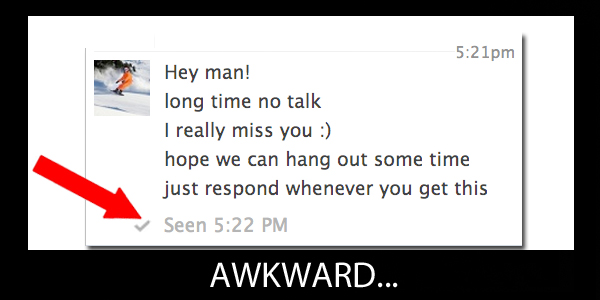
3. Facebook's "Message Seen"
This is easily the most annoying feature on any social networking site. When your Facebook messages are seen by another person without that person responding, Facebook will let you know that person has seen it. On first glance, that doesn't seem like that bad of an idea: if that message was something along the lines of "Meet me there at 6" and the person read it but didn't respond, it's helpful to know that. But save for a few relatively uncommon circumstances, what the "message seen" feature does is make it so that people no longer read messages when they are delivered. Another aspect that is standard with social media is making sure that other people don't think you are constantly on social media, even though you definitely are. One can read into that response, or lack thereof, from a psychoanalytic point of view. The receiver of the message instinctively prolongs the anticipation of the return of the message to the sender in order to sustain the anticipation (and thus activating the dopamine trigger) the sender has for the return message arrival. So you allow messages to pile up in your inbox, aware of their existence but hesitant to actually click on them (and thus let the other person know you have seen it), which inherently limits the experience that social networks are supposed to provide. If we use Facebook to communicate with other people more efficiently, and then choose not to communicate with them as efficiently as we're provided the opportunity to, what's the point? Furthermore, it makes people consistently self-conscious about their messaging in relation to other users. If one sees that they have sent six messages which have all been read and not responded to by their Facebook friends, then the cycle of anticipation and reception has been broken. This theoretically could lead to a user abandoning the site, but the genius of Facebook is that it recognizes its ubiquity and uses that to its advantage. Almost everyone you know is on Facebook, the people you sent messages to aren't responding, so it's time to message someone new in order to get your fix of anticipatory dopamine again.
2. Mass Personalization
This is another trait of social media that is not exactly new, but it plays an important role in how we view ourselves in relation to the social network machine. Sites like Twitter, Tumblr, Wordpress, and Instagram allow users to personalize their pages in order to "make their mark" on the website they are taking part in. Facebook does not allow users to change the style of their page outside the cover photo, so users instead create a web of interests surrounding the pages that they like in an effort to construct a distinct identity through the osmosis of different pop culture works that "define" you. What's problematic about this isn't that there is an obvious irony in seeking to establish a unique identity on websites that are in their very nature conformist, it's that social media is (somewhat) tactfully finding ways to quantify and monetize the ways you identify yourself to the world. It's common knowledge that Facebook sells personal information to companies in order to advertise to individual users more effectively, but what people don't consider is their active participation in propagating that system. If the greatest trick the devil ever pulled was convincing people that he didn't exist, the greatest trick social networks ever pulled was convincing people that they were interested in your personality for anything other than data mining.
1. Person Overload
There are like, a lot of people on this planet. An insane amount, in fact. Probably too many really. Everyone knows an almost incomprehensibly small portion of the overall population of planet Earth. What social media does is to take that knowledge away and make everyone feel like they are a part of something larger than themselves. Tumblr, Tickld, and even Grindr try to foster a sense of community with their users, and the fact that the community is largely imagined (meaning that users will not be directly aware of the other users distinct and identifiable existence) only serves to enhance the seemingly limitless scope of the possibilities of the internet. Tumblr has millions of users, and those millions of users experience certain trends en masse and largely in unison. This is probably part of the reason why receiving information or pop culture artefacts before others has become such a notable part of the social experience now (derisively referred to as hipsterism), because self-identifying within internet communities is a dangerous prospect. Connecting yourself to such a large group of humans without knowing what those other people are like will likely cause people to relinquish their standing on certain websites that are no longer in vogue, like how no one is on Myspace anymore, or how LiveJournal is now based in Russia. Social media sites know that you need constant stimulation in order to keep returning, to keep mindlessly checking your page despite there being nothing new to look at. So they use the vast expanses of people on their networks to constantly update and tweak their sites in order to satiate the endless desire for more content. Do you remember that guy who sat kind of close to you in grade nine? Well he's on Facebook, and you should probably talk to him. If not him, there are millions of others desperate to receive something from the great unknown that is the internet, and social media has you thinking that you wanted this for yourself all along.
Bryan Hickman is a WhatCulture contributor residing in Vancouver, British Columbia. Bryan's passions include film, television, basketball, and writing about himself in the third person.