7 Simple Questions That Scientists Still Can't Answer

You think we'd know why yawning is contagious by now.

"Ahh, but science doesn't know everything", says your slightly batty uncle when you try to explain why his homeopathic arnica isn't helping. Well, he's right I'm afraid, science doesn't know everything. What's more, some of the things it doesn't know are seemingly embarassingly simple. Like, we can unravel some of the most complex secrets of the universe, investigate the weird world of quantum mechnics, cure once-deadly diseases ... but we can't figure out the physics of muesli. Some might argue that scientists shouldn't be spending their precious careers studying muesli and moths when there are cancers to cure and planets to explore, but, you never know, understanding the little things might end up unlocking the secrets of the universe. Some of the greatest discoveries have been made by accident. That said, the relative unimportance of something in the grand scheme of things is no reason not to study it. We can't all be the first person on Mars, after all.

7. Is The Universe Very Big Or Very Small?
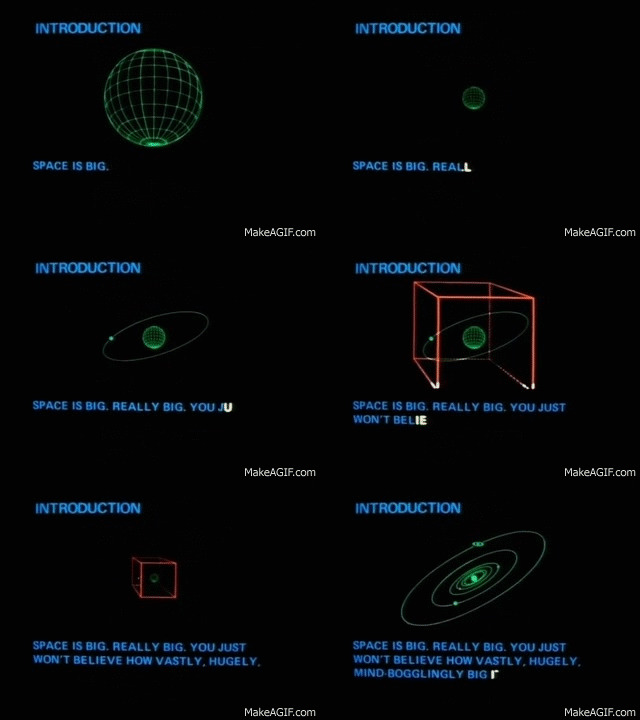
We can measure a lot of the things in the universe with astonishing precision. The Earth, the Sun, The Milky Way, we've got them nailed. Something else we can pretty accurately measure is the size of the observable universe. This is the portion of the universe that we can see, extending in a sphere around our planet for around 46.5 billion light-years. The thing is that, by definition, we can't observe anything outside of it. There is an impenetrable cosmic horizon that we just can't see past. Often when we talk about the size of the universe, the observable universe is generally assumed to be a tiny part of it. However, there's nothing to say that the universe extends any further than the cosmic horizon at all, this might actually be all there is. Of course, because the observable is centered on the observer, we could always set off from Earth to see what we can see - like sailing towards the horizon. Scientists suspect that the universe is indeed much bigger than it looks, largely because the cosmic microwave background is so uniform, as opposed to tailing off at the "edges". If this is that case then the universe is very big, perhaps infinite, but the observable universe, if that's all there is, is very small. It's quite probable that we'll never find out the answer.

6. Why Is Ice Slippery?

Seems pretty obvious, right? Ice is slippery because ... well ... because it's ice. It was thought until pretty recently that the slipperiness of ice was due to the pressure of your foot/skate/whatever was causing the top layer to melt. It sounds like a pretty convincing solution, but when somebody crunched the numbers, it just didn't check out. True, pressure will cause ice to melt, but in reality, even an above average-weighted person would not be able to exert enough pressure through a skate to make this happen. This led scientists to believe that perhaps it was the friction of the skate moving across the ice that caused it to melt. Unfortunately, this doesn't check out either, as ice is still slippery when you're stood still (although, granted, you are less likely to fall over because you're stood still). So with these two options ruled out, the solutions starts to get distinctly weirder. The best guess we have at the moment is that the layer that forms on top of the ice is not a liquid, but a "supersolid skin". With this skin, the bonds between the water molecules are stretched, but they remain unbroken (unlike in a liquid). It is the elongation of these bonds that supposedly generates an electrostatic field that causes the slipperiness by sort of "levitating" you off it. Others, however, remain unconvinced, but they all agree that this is way more complicated than it has any right to be.

5. The Brazil Nut Effect

Donald Trump is undeniable proof that the biggest nuts tend to rise to the top, but have you noticed the same thing happens to your granola? The "Brazil Nut Effect" is a phenomenon that seems frustratingly simple, but remains an unsolved mystery. In a many-body system, such as a bowl of mixed nuts, the largest ones will tend to rise to the top if it is disturbed. To begin with, this sounds counter-intuitive as you'd think that the heavier object would sink to the bottom. Then you might consider that the smaller pieces are falling through the cracks and trickling to the bottom. Some have observed that it is similar to a convection current or that it is even attempting to move from a high-energy state to a low energy state. This is all very well, but the thing is that we just can't seem to figure it out. So far, no computer programme or formula has been able to predict or reproduce the effect. Solving this isn't just about getting your muesli evenly mixed, scientists from all kinds of fields ranging from astrophysics to geology, would love to get this one sorted out once and for all.

4. Why Do We Like Music?

Music is one of those things that pretty much every hearing human will have experienced, it's so common that we don't often stop to question how weird it is. Like, there are certain ways of putting certain sounds together that sound good (or bad, lookin' at you Skrillex) to humans and can even elicit an emotion response. Like so many of the questions we can't answer, everyone seems to have a theory, but no one seems to be able to agree on an answer. There is one idea that music, in the words of the great Bard himself, really is the food of love. In the same way that many of our excessive behaviours stem from some kind of evolutionary pressure (i.e. live long enough to bonk something and pass on your genes) and that music evolved as a kind of mating call, like the audio equivalent of a peacock's tail. This would explain why musicians, no matter how greasy, turn so many heads. This, however, doesn't seem to quite tell the whole story. For example, you're probably able to enjoy a rousing chorus of Jerusalem without wanting to climb every choir member like a tree (well, unless they're these ones). It seems that there is something much deeper going on, and that's likely to be something extremely primal or, at the opposite end of the spectrum, associated with a highly-evolved mind. However, the existence of Insane Clown Posse would seem to contradict that second theory.

3. Why Do Moths Love Lights?

"Like a moth to a flame" is a phrase we all know, but why are moths drawn to artificial lights so much anyway? You would think that an instinct to dive-bomb a naked flame would be pretty swiftly removed from the gene pool by good old evolution, seeing as its pretty difficult to pass on your genes as a singed pile of moth-dust. However, the behaviour persists. It was thought for a while that moths use the light of the moon to navigate, and the artificial lights caused this internal GPS to go a bit haywire. However, this theory has a couple of glaring holes in it, the first of which being that moths probably don't use the moon to navigate. About 50% of moth species don't even migrate, so they wouldn't really need to. Another problem is that man invented fire over 400,000 years ago. In that time we've managed to evolve blue eyes and malarial resistance, so you'd think that moths would have evolved a "non-suicidal dive bomb" gene by now. It has also been put forwards that moths might be attracted to infrared light because it looks a bit like the pheromones given off by females. So, basically, to a moth, candles look like a sexy lady moths. Not buying it. Especially given than moths are actually more attracted to UV light, not infrared. We just don't know. Maybe moths really are just really, really sad and always want to end it all.

2. Why Is Yawning Contagious?

So, researcher have finally answered the question we've all been asking: Yawning is not contagious amongst red-footed tortoises. Phew. Okay, stupid as that seems, it does raise the question why it is contagious in humans? It's clearly not a universal phenomenon. There's something specifically human about replicating a yawn. Brain scans have shown that the parts of the human brain associated with theory of mind (that's the bit that lets you understand what others might be thinking or feeling) light up when we see other people yawning. It has also been observed that people with an underdeveloped theory of mind are less likely to find yawning contagious, so the ability to "catch" a yawn must somehow be tied up with our ability for empathy. That's all well and good, but why yawning? For a start, we don't really know why we yawn in the first place, let alone why it would be the kind of thing that would be socially advantageous to copy. It's more contagious that smiling or crying, two things that you would imagine are much more likely to evolve to be contagious. Often, even just the thought of yawning is contagious. I bet you've yawned at least once whilst reading this.

1. How Advanced Can Computers Get?

Technology is getting exponentially smaller, faster and more powerful, but is there some kind of limit to this? Moore's Law basically said that technology will get half the size* and twice as powerful every year or so, but most people these days think that's probably a load of dingo's kidneys and that it's probably a lot more complicated than that. However, many seem to agree that there's got to be some kind of upper limit on computing power. Advances in quantum computing may be taking us down a new, unexpected route and the advent of graphene superconductors is tipped to bring supercomputers to the masses, but some computer scientists appear to have hit some limitations of computing already in finding that there are some algorithms that are mathematically impossible to improve. Are there other ways to make computers? Are we going to have to hack our own brains to access its astonishing computing power? There is even a theory, known as the Transcension Hypothesis, that there will come a point where our technology becomes so small and advanced that it will actually allow us to leave the universe entirely. *It should be noted that Moore didn't expect everyone to be working with miniscule computers in the future, just that we could fit increasingly "more" computer into the same space. Want to write for What Culture Science? Click here to find out how you could get paid to write about what you love.Love all things science? Like us on Facebook or follow us on Twitter for your next fix.

In this post: 
Shia LeBeouf
 
Posted On: 
Contributor
Contributor

Writer. Raconteur. Gardeners' World Enthusiast.