7 Well-Meaning Inventions That Turned Evil

They had all the best intentions...

The road to hell is paved with good intentions" - St. Bernard of Clairvaux It goes without saying that technology itself cannot be evil. Until we get to the point of creating an AI with all the intelligence of human beings but none of the empathy, then we're safe from such an occurrence. Of course, there are some inventions - nuclear weapons, torture equipment, guns - that are only justified by the perplexing idea that they're there to protect us 'in the bigger picture', but the initial ideas behind even such heinous creations often started off with the best intentions. While the truism that each invention can be used for both good and evil isn't fascinating in itself, what's fascinating is the journey of an invention from something that should save humanity to something that destroys it, from a dye to a lethal explosive, or from a publicly available service to a terrorist battle-plan. The fact is that we don't know the full potential - for good or ill - of an invention until it gets exposed to the crazy, corrupting influence of people. That being the case, should we stop coming up with new ways of trying to improve life on earth just to negate the inevitability that things will go wrong? I think not, but you might beg to differ after you read this list of seemingly well-meaning inventions that have caused damage to humanity.

7. Leaded Petrol

Back in the early 20th century, industrialisation was the defining factor of human progress, and the environment was seen as little more than space for another factory. A key part of humanity's steady march to irreversible environmental damage was the discovery of tatraethyllead. This lead-based compound, when mixed with gasoline, was found to boost octane levels and help reduce 'knocking' of the engine in cars of the time. It was welcome as a miracle substance, and was soon being used in cars worldwide. Hindsight now shows us that putting lead in petrol was one of the worst mass poisonings ever carried out. For over 70 years (and still in some countries today), cars were emitting noxious fumes that were inhaled by millions of people around the world. Children were particularly vulnerable, and in some countries - such as India - governments estimated that as many as half of all children had suffered some degree of brain damage from inhaling lead fumes. The exact extent of the damage caused to people by leaded petrol is unknown, but its effects were global. Early warnings in 1954 from British chemist Derek Bryce-Smith about the dangers of leaded petrol were dismissed, but his ideas eventually gained traction. Leaded petrol started being phased out in the 1970s, and is illegal in most of the world today.

6. Trinitrotoluene (TNT)

When German chemist Joseph Wilbrand first made TNT in 1863, his intention was to create a honey-coloured yellow dye to be used in clothing. For some years, its explosive qualities weren't really picked up, and in the UK it was even removed from Explosives Act because it was so insensitive and difficult to blow up. However, it's this insensitivity that helped it become the explosive of choice throughout World Wars I and II. At the Battle of Jutland in 1916, the German army used TNT-filled explosives with a specially-designed fuse that meant they only exploded once they penetrated enemy ships, causing much more damage than old-fashioned lyddite explosives which blew up upon contact with the outside of the ship. TNT's use in military weaponry exploded after that, and it went on to be used in the majority of explosive equipment in World War II - including mortar shells, hand grenades, and atomic bombs. To think that all this started from a guy who want to dye his shirt (or trousers?) yellow...

5. The Internet Of Things

Aside from its infuriatingly vague and meaningless moniker, the idea of having hooking every appliance in your house up to the internet seems like a good one. Smart technology (or the Internet of Things) lets you control your home thermostat using your phone while you're out, watch your home security cameras over your phone, or use a smart fridge to... wait, why the hell would anyone need a smart fridge? Ah yes, to see what food you have in your fridge without the ordeal of opening the door. But already the Internet of Things has big problems other than its name. Any device connected to your home Wi-Fi network can easily be hacked if you have a bad password on your router (which, let's face it, most of us do). Hack attacks on smart tech have already happened. In December 2014, over 750,000 Wi-Fi devices - including TVs, media servers and of course a fridge - were hacked and turned into botnets, sending out millions of spam e-mails. Things get darker with 'smart' webcams, baby monitors and security cameras. Last year, a Russian site appeared showing live footage from over 70,000 hacked cameras in peoples' homes as a way of demonstrating how insecure devices in the so-called Internet of Things currently are. Don't want your smart dog door becoming an easy way in for robbers, or your smart egg tray (it actually exists) becoming a spam egg tray? Then make sure you have a strong password!

4. Nuclear Fusion

Humanity's relationship with nuclear power is perfectly analogised in Game of Thrones, and Danaerys Targaryen's relationship with her dragon; it's a potentially game-changing force once you harness it's power, but prone to really messing things up on a massive scale if left unchecked. When nuclear power works, it works nicely, producing virtually no carbon emissions, more energy than the more common coal or natural gas plants, and only a handful of waste, which gets placed in radiation-proof containers and hidden away (somewhere safe, we're told). Of course, things can go very wrong with nuclear reactors. As we witnessed with Chernobyl and Fukushima, large-scale leaks of nuclear waste can create widespread, long-term damage to people - we still don't know the total number of people affected by Chernobyl back in 1986. In the aftermath of the atomic bombings of Hiroshima and Nagasaki, humanity appeared to come to a mutual understanding that it's not cool to drop weapons of this sort on people (napalm, apparently, was fair enough). Its way of achieving this? Make hundreds upon hundreds of nuclear weapons, because if everyone's pointing them at each other, then no one will want to fire them. And so we arrive in today's global political climate of today, in which any interaction between world powers is underlaid with the threat of nuclear apocalypse. Great though nuclear power may be, the margin for error with it isn't terribly wide. And if there's one thing we're learning from this list it's that humanity's pretty error-prone...

3. The Loudspeaker

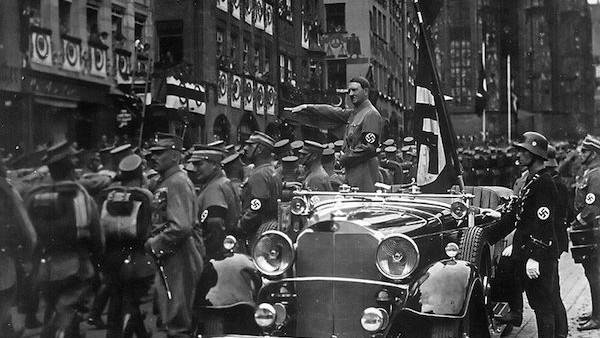
Invented in 1915 by Danish inventor Peter Laurids Jensen, the loudspeaker was - and for the most part continues to be - a pretty wonderful invention. But the loudspeaker (then called the Magnavox), which was first used to play opera music to a huge, happy crowd in San Francisco, played a pivotal role in bringing the Nazi party to power in Germany. Sure, the loudspeaker went on to bring us wonderful things like festivals, nightclubs, "I had a dream", and so on, but arguably its most effective and devastating use was by the Nazi party, partly because Joseph Goebbels came up with the idea to spread loudspeakers around public places so that no one could escape the speeches and announcements of Hitler and the Third Reich. In a world where loudspeakers were yet to be used on a large scale, people were more likely to be susceptible to the sheer, brainwashing loudness of Hitler's rants. It's only after the Nazis began utilising loudspeakers in their propaganda strategy that they gained majority support in Germany.

2. Google Earth

Thanks to Google's powerful satellite-view map app, we have access to spectacular detailed views of just about anywhere in the world (apart from North Korea and other restricted areas where killjoy governments have decided that they'd rather not have the whole world peeping). Google Earth has essentially granted worldwide access to the kind of perspective on the world that just 20 years ago was reserved for intelligence agenciesand governments. But a tool of such immense power has inevitably been appropriated for nefarious purposes. There have been several murder cases where the victims' homes or neighbourhoods were scoped out on Google Earth before attacks, most infamously in the 2008 Mumbai terror attacks, where it was found that the terrorists used Google Earth to plan the attacks. Several years ago, thieves in the UK used Google Earth to find out which churches had lead roofs, so that they could then steal the valuable metal and sell it on the lucrative metals market.

1. Zyklon B

The poisonous gas infamously used in Nazi concentration camps to kill around one million people was invented in Germany, but in the 1920s before the Nazi party came to power. Its predecessor, Zyklon (Cyclone) A, was a pesticide that released hydrogen cyanide upon exposure to water and heat. However, its similarity to a poisonous gas used by the Germans in World War I led to it being banned. In 1922, German chemical company Degesch found a way to package Zyklon into cannisters, adding to it a warning irritant that would prevent people from inhaling it. The resulting product was Zyklon B, which was used to delouse clothing and disinfect areas such as ships, trucks, and other cargo vessels. It was a big help to U.S. immigration authorities, who in the 1930s used it to delouse Mexican immigrants to combat the spread of typhus. Years later, the director of Degesch, Dr. Gerhard Friedrich Peters, was approached by SS senior officer Kurt Gerstein, who said that the German army needed Zyklon B - minus the warning additives - to assist in the killing of its enemies. Peters complied, and the rest is one of the darkest episodes in human history. Zyklon B's active - and lethal - ingredient, hydrogen cyanide was used even earlier still, as a way of fumigating citrus groves in California in the 1880s. The fact that hydrogen cyanide dispersed so quickly meant that it worked particularly effectively in contained areas, to the extent that tents were pitched in areas that were undergoing fumigation. This rapid dispersal is a big part of what eventually attracted the Nazis to the chemical.

In this post: 
Adolf Hitler
 
First Posted On: 
Contributor
Contributor

Gamer, Researcher of strange things. I'm a writer-editor hybrid whose writings on video games, technology and movies can be found across the internet. I've even ventured into the realm of current affairs on occasion but, unable to face reality, have retreated into expatiating on things on screens instead.