8 Awesome Ways Life Could Be Forming In The Universe
How would life evolve around a black hole?

If you listen to the hype, we’re always on the verge of discovering alien life.
Whether it’s coming from a NASA scientist that has just found evidence for running water on Mars, or a YouTube video analysing blurry images of what is almost certain space junk (Helpful Hint: One of these sources is more reliable than the other), you could be forgiven for thinking that we were on the brink of making first contact any day now.
But, in the absence of alien spaceships dropping out of the sky any time soon, many of the kind of people who like to think about this stuff - astrobiologists, physicists, science fiction writers - have been forced to use a combination of educated guessing, computer modelling and a healthy pinch of imagination, to try and build up a picture of what life might look like around the universe.
We've got a pretty good idea of what it looks like under Earth like conditions, largely due to the fact that we're surrounded by it, but that doesn't mean that it couldn't emerge in many weird and wonderful ways in all kinds of environments throughout the universe. Black holes? Gas giants? Even interstellar space? Life will (uh, uh) find a way.
8. Bacterial
Right, let's get the boring one out of the way for starters.
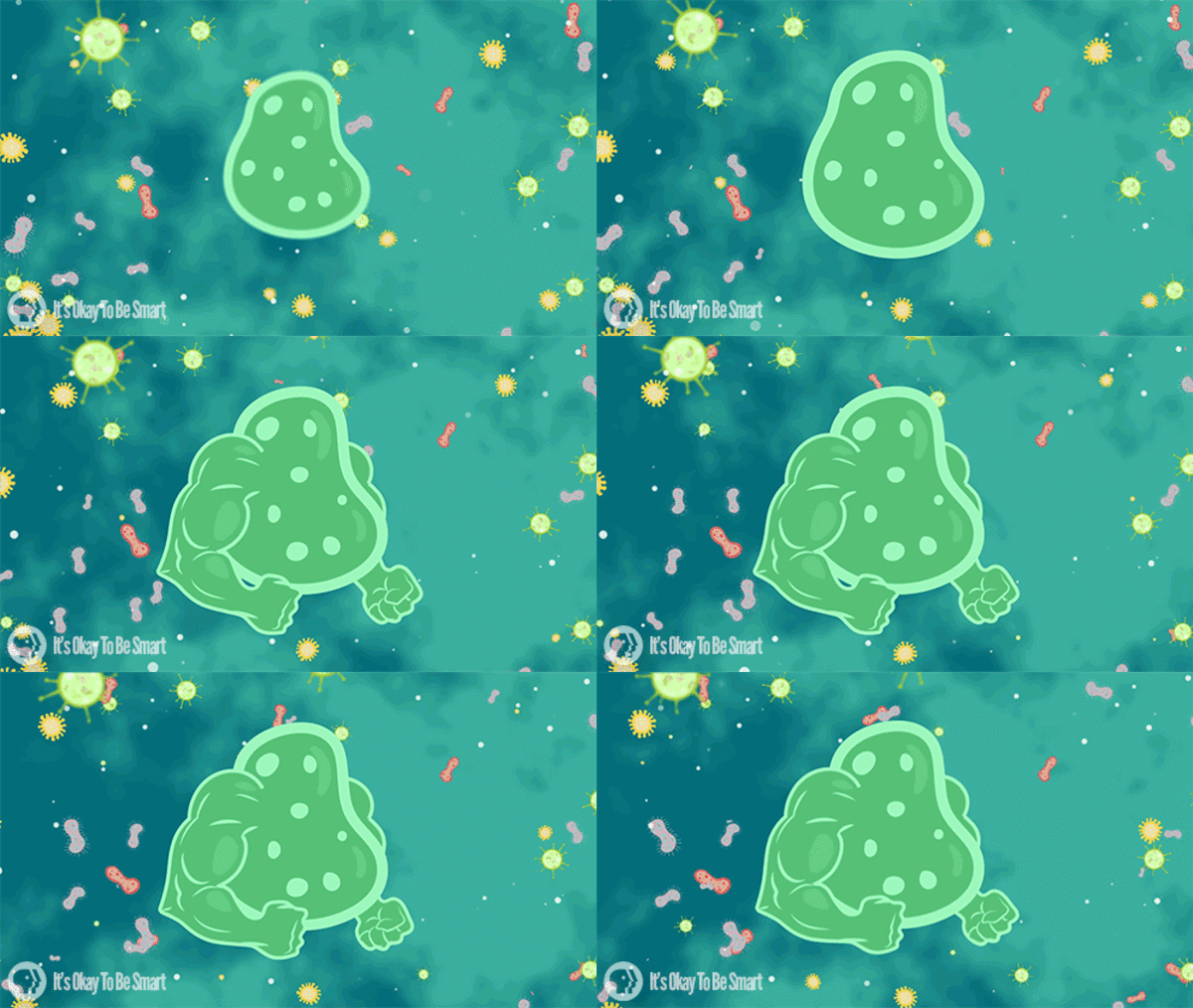
There's a good chance that if we do find alien life, particularly in our own solar system, then it's going to be in the form of single celled organisms. It seems pretty dull, but given the distinct lack of spaceships flying around, we can be relatively sure that there aren't any super-advanced alien races in our direct vicinity (unless, of course, they're so advanced that they're actually studying us as though we're the primitive bacterial life forms, we just haven't noticed yet).
Although it's hard to hold a conversation with the primordial soup, the discovery of a single, solitary bacteria originating from somewhere other than Earth, would be of supreme importance.
At the moment, we only know for sure that life can exist on one planet. That means that, say there were a quadrillion potentially habitable world out there, the odds for happening it are one in a quadrillion. If, however, we find that any kind of life had emerged somewhere else, that effectively halves those odds, making it more likely that life in the universe is common rather than rare.
So, whether it knows it or not, there's a lot riding on that little alien bacterium.
7. Extremophiles

We tend to bang on a lot about the Goldilocks Zone - the region of space that is neither too hot nor too cold for life. We do this because we happen to like a nice, 30°C summer afternoon. We know for a fact that life has flourished in these kinds of environs here on Earth and so we imagine that our best bet for finding alien life is to look for another planet just like it.
There are, however, certain organisms that are made of slightly tougher stuff, and they're called extremophiles. Extremophiles, as the name suggests, love an extreme environment. These creatures can flourish in boiling hot acid, chill at temperatures well below freezing, withstand blasts of ionizing radiation and basically thrive anywhere.
Even more complex organisms such as the Tardigrade, which aren't technically extremophiles as they don't actively exploit extreme environments, can survive at crushing pressures six times greater than at the ocean's deepest point, withstand temperatures from near absolute zero to well above boiling point, take ionizing radiation at doses hundreds of times higher than the lethal dose for a human, and survive the vacuum of outer space.
When you look at it this way, suddenly the frigid oceans of Enceladus look like a pretty cosy home for some alien life.
6. On A Gas Giant
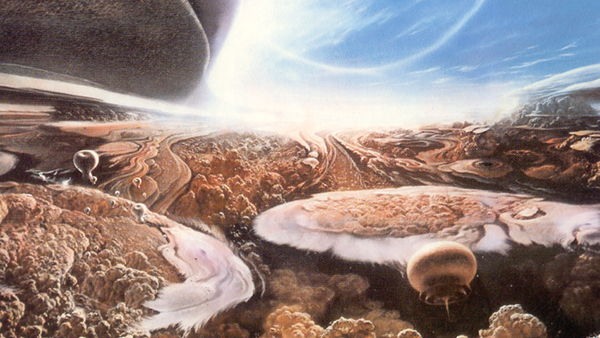
In our search for exoplanets, we seem to be finding an awful lot of gas giants - probably because they're much easier to spot. This is disappointing for a lot of astrobiologists, as we tend to limit our search for life to small, rocky planets much like Earth. There are, however, those who think this might be a wasted opportunity, and have hypothesized what life might be like on a gas giant.
Everybody's favourite space uncle, Carl Sagan, and astrophysicist Edwin Salpeter, considered the possibility of ammonia based life forms swimming about in the atmosphere of Jupiter. They thought that the Jovian ecology could be like that of an ocean here on Earth, with different types of creatures that they termed "sinkers", "floaters", and "hunters". These would all "swim" about in the thick, swirling atmosphere, some taking the form of great organic balloons, perhaps even growing to many kilometres across.
Whilst we now think that it's probably unlikely that great sky jellyfish are cruising around Jupiter unnoticed, it is possible that life could evolve on one of the many gas giants in the galaxy. The thick, turbulent atmosphere could act as a rich primordial soup, giving rise to complex life forms that would be born, live and die without ever touching solid ground.
5. Orbiting A Black Hole
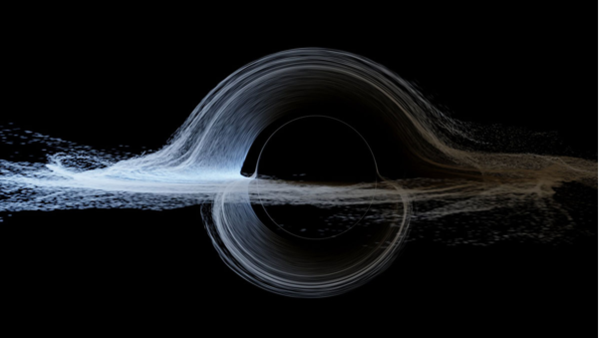
Given their reputation as the boogeymen of the universe, life orbiting a black hole might be more comfortable hat you might imagine.
Much like in the movie Interstellar, planets can orbit black holes much like they orbit stars and, what's more, some of them could probably support life. Despite the name, black holes are some of the brightest objects in the galaxy, thanks to its glowing accretion disk. A black hole emits light, but not much in the way of warmth, making it something of a cold sun.
So the black hole is cold but, by comparison, space is warm, with the radiation left over from the big bang permeating every nook and cranny. These days, the afterburn, or the Cosmic Microwave Background, comes in at a cool 2.7 kelvin (about -270 ˚C), which would actually be warm enough for simple life to form.
Earlier in the universe's history, however, the CMB was much hotter, perhaps around 300 kelvin (27 ˚C), making it perfectly possible for a civilisation to rise up under a cold black sun. Perhaps they'd be the goths of the Milky Way?
4. Non-Planetary Life
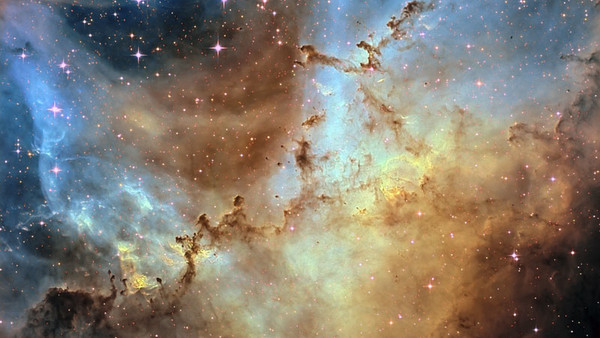
Okay, so we can just about conceive of life around black holes and on gas giants, but one thing we tend to cling on to is that all life needs a "home" - a planet, a space station, anything - but the universe is generally made up of a whole load of empty space, so would it be possible for life to form in the abundant nothingness?
There are some who say yes. Physicist Vadim Tsytovich and his colleagues have demonstrated through computer models that when you suspend cosmic dust particles in plasma and expose it to some kind of charge, it starts to behave in a very lifelike manner, self-organising into a helical structure and creating a kind of inorganic life in the spaces between stars. These strands of dust can even pass on characteristics to its "offspring".
Granted, this isn't exactly the spaceship-and-probe based arrangement that tends to spring to mind when we imagine alien life forms, but it goes to show that f we're going to look for our galactic neighbours, we might have to be a bit more imaginative.
3. Artificial Life

Although we tend to picture our aliens as greenish, humanoid and often some degree of slimy, there's a reasonable chance that they might not even be biological at all.
Whilst many thinkers limit their predictions for the technological singularity to the human race, whether or not they think it's a good thing, there's an argument for the notion that artificial intelligence is already living it up out there in the universe. In the paper Alien Minds, Professor Susan Schneider discusses the possibility that extraterrestrial "life" is more likely to be "post-biological", echoing the sentiments of many astrobiologists and NASA scientists.
The basic argument for artificially intelligent aliens is one of timescales. The human race has been around for the merest flash in terms of universal timelines, and we've already managed to create the first glimpses of AI. If civilisations have risen and fallen throughout the history of the universe, it's likely that many of them may have gotten much further than this, and have either been outlived by, or even evolved into, a synthetic thinking being many trillions of times more intelligent than we are.
Let's just hope they're friendly, WALL-E types.
2. Digital Minds

Sort of like the opposite of AI, there are some who think that one of the reasons we haven't made contact with aliens yet is that they're all plugged into a simulated reality. So rather than artificial minds living in a real universe, they could be real minds living in an artificial universe.
If we consider that an advanced civilisation would probably be more able to create a complete, immersive simulated universe before developing the technology to meaningfully explore the real one, then it could be that they decide to live in that one instead. Perhaps our ideas about climbing into spaceships and "conquering" alien worlds would have us laughed out of the room as woefully primitive.
Some thinkers are so wedded to the idea that they've even come up with a name for it: The Matrioshka Brain.
This is a great central computer, powered by a Dyson Sphere, that an entire race can plug their brains into a live out their lives - perhaps even multiple times - without having to mess about with building things like spaceships or schools or McDonalds.
Whether or not this is the exact set up, we could really be missing out on first contact, because the aliens are all too busy playing video games.
1. Just Like Us

We can come up with all manner of exotic alien looks in our minds, but there's a reasonable chance that if they do exist, they might look disappointingly familiar.
Although many assert that the emergence of the human form is the result of a total fluke of evolution, others may argue that it's definitely one that works and could therefore work again.
Although there are many different body types even just here on Earth, the majority of "advanced" organisms have bilateral symmetry. It occurs over and over again here, so why not in an alien race? There is also an argument to be made that our technological abilities that have led us to dominate this planet, is due to our big brains (made possible by warm-bloodedness) and our bipedal frames (which freed up our hands for tool making).
Our social abilities that have allowed us to build an advanced society are due, in large part, to our expressive faces and ability to communicate.
So, bilateral, bipedal, big brained and face-owning. Maybe the science fiction model of "humanoid with weird skin" is too far off the mark after all.
You could write for WhatCulture Science! Click here to find out how you could get paid to write about what you love.
If science makes your brain box tingle, like us on Facebook or follow us on Twitter to stay up to date.