9 Things The New Horizon Probe Has Taught Us About Pluto
What have we learnt about the brave little dwarf planet?
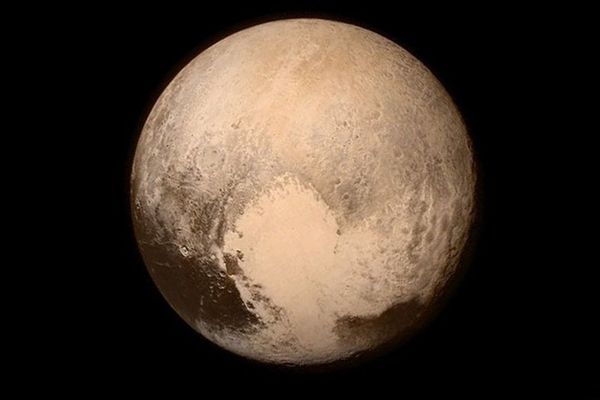
It's done it. Reports have come in that the New Horizons probe has officially "phoned home" to let us know that it safely completed its flyby of the much loved dwarf planet, Pluto.
This much-hyped mission has so far yielded some spectacular results and will continue to do so in the future, but what have we learnt? Well, let's begin with what we already knew.
Pluto is a dwarf planet located in the Kuiper Belt, a region of space beyond Neptune that is similar to the asteroid belt but bigger. It has 5 known moons, the largest of which is Charon. Pluto is 32.6 AU (astronomical units) away, and light from the Sun takes about 5.5 hours to reach it - far quicker than the New Horizons probe which has taken a leisurely 9 years after being launched in 2006. The probe managed to reach its destination within 72 seconds of the estimate NASA's original estimate - compare that to the delivery estimate for your Dominos pizza and you'll see how freaking accurate those boffins at NASA are.
So what can we take away from this frontier-pushing, history-making, super-punctual mission to Pluto? Bearing in mind that the the first encounter was only the beginning, and that we will continue to gather new information and come up with new theories in the coming months and years, what have we gleaned already?
9. Weve Finally Completed The Family Album
This pluto flyby has finally completed our collection of hi-res images of the classical nine planets in our solar system. The New Horizons mission was launched just before Pluto was "demoted" to a dwarf planet in 2006, its aim was to explore the last mysterious planet in our solar system, so for the purposes of this mission, Pluto has sort of become an honorary planet once more in the eyes of both the public and many scientists.
The flyby marks the 50th anniversary of the first Mars encounter by NASA's Mariner 4 probe back in 1965 when Pluto was just a glimmer in scientists' eyes. Pluto encounter marks the culmination of half a century of space exploration and goes to show just how far we've come.
8. Its Bigger Than We Thought

The mission allowed us to establish once and for all whether Pluto was indeed the biggest object in the Kuiper Belt. The discovery if another dwarf planet named Eris had a role to play in the demotion of Pluto from a planet to a dwarf planet and has since been dubbed as the "Pluto Killer" by many scientists. The New Horizons mission has bumped Pluto's numbers up another 50 miles or so, bringing it to a total diameter of 1,473 miles, but, strangely, Eris actually has much more mass.
This is exciting in a number of ways as it confirms that Pluto is still "King of the Kuiper Belt", but has also highlighted Eris as another fascinating world to explore in its own right. Perhaps we'll send another mission out in the coming nine years to explore the dwarf planet that knocked Pluto off its planetary pedestal.
7. Its Unlikely To Get Its Planet Status Back
Sorry, Pluto fans, but despite the confirmation of Pluto's larger volume, it looks unlikely at this point that Pluto will be reinstated as a fully grown "proper" planet, no doubt much to the internet's dismay. There are three criteria that a celestial body must meet to be classified as a planet, these are:
The object must be in orbit around the Sun The object must be massive enough to be rounded by its own gravity. More specifically, its own gravity should pull it into a shape of hydrostatic equilibrium (that's a posh way of saying spherical and stable) It must have cleared the neighbourhood around its orbit Where Pluto falls down is at that last hurdle. Even if it is the largest object in its neighbourhood by volume, it (a) is only the second largest by mass and (b) has failed to clear its orbit of the likes of that pesky Eris, meaning that Pluto is still not quite there in terms of being a "real planet".6. Its Actually Red
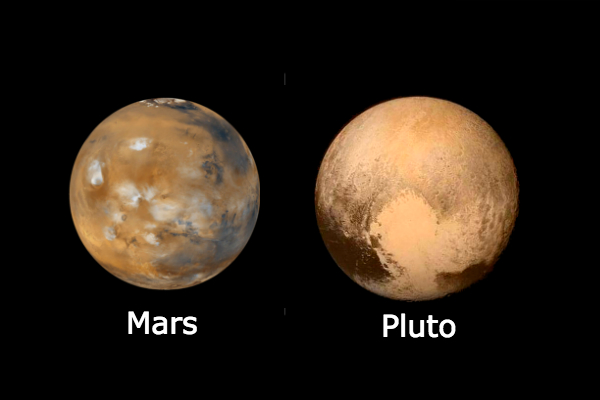
There have been many artists impressions of pluto over the years and pretty much all of them have depicted the little icy world as a sort of blue colour. Probably because it has an average surface temperature of -233°C and, in most peoples heads, blue = cold. Our first high resolution pictures of Pluto confirm it is in fact more of a reddish brown colour, similar to Mars (although Mars isnt actually red, but thats another story for another time).
The red colour may come from the interaction between the sun's rays and methane ice on Pluto's surface. As the sun breaks the methane down, it causes an ultra violet reflection that appears red. The red colour has been glimpsed before by the Hubble telescope, but never in so much detail.
5. It Has Mountains

As more and more information is beamed back to Earth by the probe, we are able to study the surface in unprecedented detail. One of the first images to come back to us was a close up look at an area just under the heart containing an impressive range of mountains.
The image was taken from roughly 47,800 miles away on Tuesday morning and reveals the mountains to be a similar height to the American Rockies - around 11,000 feet - casting long shadows over a large flat area. The flat plains appear to be relatively young, perhaps indicating recent geological activity on Pluto.
A close up photograph of Charon also reveals a canyon up to six miles deep (six times that of the Grand Canyon) and a large dark patch that is being informally referred to as Mordor (into which one presumably does not simply walk).
4. Its Current Inhabitants Include A Heart, A Whale And A Doughnut

As the surface has come in to sharper focus, we have been able to pick out features of various shapes. The "whale" (Pluto's homage to Hitchhikers' Guide to the Galaxy perhaps?) measures some 1,860 miles across and is one of the darkest regions we have observed.
The doughnut measures around 200 miles across, and at first glance looks very similar to the volcanoes and impact craters observed across the solar system. But, shadows can play tricks on the eyes and scientists are waiting for more detailed images to emerge before making their evaluation of the feature.
One of the largest features on the surface of Pluto appears to be in the shape of a heart or, as some people have pointed out, in the shape of Pluto The Dog. The heart/dog is a big, bright, relatively featureless area that may well be made up of solid nitrogen, methane and carbon monoxide ice as surface temperatures are so low, that these would exist in their solid state on the planet's surface.
3. The Heart Is Broken
As the colours were enhanced in the now famous image of the heart they have revealed that it is split almost right down the middle, with two different compositions on each side. These images are not what an observer could see with the naked eye, but by cranking up the saturation, we can pick out details on the surface that may have otherwise been missed.
Whilst everything we know about can and probably will change in the coming months, scientists are beginning to make deductions about the surface composition of the little planet. The thin nitrogen atmosphere extends far enough out in to space to be detected, but observations about the icy surface will have to be made from the detailed images and measurements that New Horizons is due to beam back to earth in the future.
2. Charon Is Just As Fascinating As Pluto

Well probably get lots of good information about Charon (pronounced just like your aunt Sharon), Plutos largest satellite. Charon, named after the ferryman who carries souls to Hades in Greek mythology, is a little confusing for scientists as the latest photos of Pluto have confirmed that the two bodies are drastically different from each other.
Because the centre of orbit lies above the surface of Pluto, some consider the two to actually be a binary system of dwarf planets rather than a planet and moon, meaning that the two bodies actually orbit each other around a common centre point.
New Horizons principal investigator Alan Stern said in a statement that "These two objects have been together for billions of years, in the same orbit, but they are totally different. This raises a lot of questions about the formation of both Pluto and Charon that scientists will be attempting to answer over the coming months and years as more and more information is beamed back to us from the New Horizons spacecraft.
1. The Best Is Yet To Come
New Horizons will soon transmit the highest resolution weve ever seen of Pluto. It will be 10 times the resolution of our best image so far and will be able to pick out detail the size of Central Park in New York. New Horizons shut down its communications with earth during its data gathering period as it flew past Pluto, but now that it has successfully "phoned home", it will continue to beam the data that it has gathered back to us over the next 16 months as it continues its journey deeper in to the Kuiper Belt.
We have already gained an astonishing amount of new information about the little dwarf planet on the edge of our solar system, and that knowledge is set to grow and grow as we continue to push that final frontier further out in to the universe.