Halloween: 10 Terrifying Things From The 90s
 The 90s is now distant enough that we can look back on it and say 'y'know what, that was a pretty decent decade'. It was the decade that brought us the Internet, Pogs and Salem the Cat. There were some great bands (Massive Attack, Nirvana, Whigfield), some great movies the Ernest series really hit its stride here and at least one great haircut in the 'Gunther'. If ten years could be summed up in one image, it might be Boris Yeltsin grabbing some brunch at the Seinfeld diner with the paperclip from Microsoft Word. Or just as easily, it might be an eight feet tall demonbeast screaming into an old lady's face. Or a much loved British chat show host possessed by a poltergeist. Or a maniacal talking orange. As much as it was a veritable carnival of Le Coq Sportif poppers and confused talking pigs, the 90s could also be a pretty disturbing decade, particularly if you were younger than nine and struggled with an episode of Sesame Street. When you switched on a television you were taking your chances with mass suicide, technological meltdown, cosy suburban murder, alien invasion or an anthropomorphic Chihuahua slowly losing his grip on reality. If you don't believe me, then you've probably repressed the memories. In which case, here are ten terrifying things from a decade that some of us can't forget, no matter how hard we try.
10. Bloody Aliens
 In the mid-90s, footage emerged of a supposed alien autopsy, recorded in the aftermath of a UFO crash near the New Mexico town of Roswell in 1947. The grainy black and white film was quite clearly a hoax, but proved convincing enough to fool the likes of, er, Fox News. As has always been the case, the media (and the hoaxers) was responding to the cultural mood of the time. And that mood was aliens. Lots and lots of aliens. Everywhere. By the end of the 80s, pop culture aliens were dopey, loveable figures, more likely to spout wisecracks or waddle around in your mother's hat than pose any serious threat to all human life as we know it. This began to change when President Clinton took office. He wasn't an alien, but it was about the only thing he wasn't accused of. A belief persisted that the President had made a deliberate effort to obscure certain facts about his personal life, namely his sexual and financial dealings. It wasn't such a leap to suggest the political establishment was suppressing other potentially sensitive information, such as the existence of UFOs. One of the most iconic shows of the 90s, The X-Files, took this notion and ran with it for nine series. In turn, it led to a boom in flying saucer sightings and Roswell literature and, eventually, the aforementioned tape, which pre-dates Danny Dyer's 'I Believe in UFOs' by about fifteen years and still has a more convincing alien puppet.
What did it all amount to? Not very much. A Mars Rover was launched in 1997 and managed to find some rocks. Alien rocks, but rocks all the same. The UFO fad had peaked a year earlier, when Babylon Zoo released the magisterial 'Spaceman'. 74 million copies were sold off the back of a Levi's advert, even though it only used the intro. Hopelessly cheesy as it is, I still defy you not to be a little unsettled by the sped-up vocals such things never sound right. If that doesn't have you reaching for the skip button in abject terror, then the following three minutes of sub-Pumpkins dirge rock should do the trick.
9. Ren & Stimpy
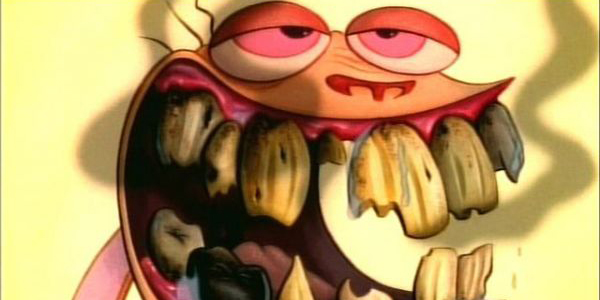 Something happened to kid's TV in the 90s, or should I say, something snapped. Before then, cartoons had been about animals acting like people talking, walking on two legs, wearing hats or ties, but never boxer shorts, for some reason. During the 90s, you got animals acting like people they suffered from insomnia, body dysmorphia or manic depression. Admittedly, most of those animals were the title characters in The Ren & Stimpy Show. As a feeble-minded nine year old, I enjoyed Ren & Stimpy, but I was aware that it was maybe more...extreme...than other kid's shows. Like most 'cat and dog' cartoons, Ren (a neurotic Chihuahua) and Stimpy (an oblivious feline) have a fractious relationship, but the conflict here is distressingly psychological. In an episode like 'Ren's Insomnia', Stimpy's innate niceness drives Ren to the brink of mental meltdown, and then right over it. When the slapstick comes in, traditionally rubbery cartoon physics are distorted and distended to the point where it seems less like Tom and Jerry and more like, well, straightforward abuse. The best example of this is the episode 'Ren's Toothache', which ranks as the most effective advertisement for dental hygiene ever. After Ren's teeth fall out, Stimpy tells him about the Nerve Ending Fairy. While you're thinking (or remembering) how this could play out, I should mention that one of the hallmarks of Ren & Stimpy's animation style is the occasional, unexpected transition to a more realistic look. For example, in 'Ren's Pecs', we track over Ren's hideously malnourished body, covered in liver spots and wiry strands of hair. Here too, nothing is spared as Ren opens his mouth and a haze of noxious green air wafts out. His nerve endings dangle raggedly from his gums, and with a tweezer, he slowly agonisingly pinches them out, one by one, in an act of self-abuse that loses none of its horror by being in cartoon form. If anything, it's more terrifying for that reason- those sound effects, like a piano string snapping, are ridiculous but wince-inducing all the same. I would've called it cathartic, if I hadn't been nine years old and confused sh*tless.
8. The Curious Orange
 British comedy in the 90s took a (HAHA) funny turn. It was no longer enough to provoke laughter the laughter had to be nervous, and it had to come between moments of outright terror. The League of Gentlemen and Chris Morris' Jam are the most obvious examples of the FearCom genre I just made up, but probably the scariest (certainly the most inexplicable) specimen would be The Curious Orange from This Morning with Richard Not Judy. For anyone outside the UK struggling with references to The League of Gentlemen and Chris Morris, nothing about the following paragraph is going to make sense. This Morning with Richard Not Judy was a late-in-the-day vehicle for the comedians Stewart Lee and Richard Herring (the title is a reference to the breakfast morning TV show This Morning with Richard and Judy, hosted by married news team Richard and Judy). It was a loose parody of weekend magazine shows, but it mostly functioned as a delivery mechanism for some industrial-strength 90s surrealism. Lee wore a puritan hat and talked about apostrophes. Herring ate cress and obsessed over Andrea Corr (singer in The Corrs- look, I told you none of this would make sense). This lack of filter was probably why the most utterly bizarre segment of the show, The Curious Orange, left such an impact. The Curious Orange was a curious orange. He asked banal questions about things that interested him ("This week, I'm very curious about this little conundrum..."), to Herring's delight and Lee's disdain. Episode by episode, it became clear that The Curious Orange was insane, at first demanding that he be allowed to sing, then escaping the studio and going on a killing spree, before finally taking the guise of a Davros-style tyrant ("One day you will all see my power!") Since humour is subjective, I'm not going to say that a talking orange is inherently funny. I am going to say that an orange biting a man's face off is on some level not a right thing, and because the show was broadcast around mid-day, tykes such as myself (alright, I was never a tyke) could easily switch channels in time to see that not right thing happening. Nonsensical it may have been, but it was done with such conviction that nothing in the world was more terrifying than a screaming maniacal citrus fruit. He still haunts my nightmares.
7. A Pixelated Lizard Dies Again And Again And Again
 The video games industry hit adolescence in the 90s with titles like Silent Hill, Resident Evil and Parasite Eve. Strides in console technology meant that these survival horror games were often as graphically bloody as their movie equivalents, inevitably causing an uproar in the popular media. The problem, in the view of our self-appointed moral guardians, was that games were supposed to be for children. What would happen to the squidgy, half-formed brain of Allan aged nine if he was exposed to a man made of pixels shooting some kind of plant/zombie hybrid also made of pixels? The whole panic was misjudged, because even the most innocuous of games think of Crash Bandicoot, Spyro or even bloody Gex portrayed the existential horror of death in harrowingly naked terms. The move to 3D gaming was a boon for developers. It allowed them the freedom to create new and unusual deaths for their loveable cartoon mascots. Take the first three Crash Bandicoot games in the original adventure, Crash can be squashed by boulders or exploded by TNT, but seconds later you're back in the game. By part the third, Crash can be sliced in half by broadsword-wielding b*stards, eaten by moral eels, impaled, bludgeoned, drowned incinerated or electrocuted, and the camera lingers helpfully, just in case you missed your adorable anthropomorphic pal dying horribly. A YouTube compilation of Crash 3 death animations runs to over 4 minutes, if you can get past the first. Worse, in every sense of the word, was Gex 3D. An awkward attempt to sass up the platforming genre, our hero (voiced, in the UK version by an audibly bewildered Leslie Phillips) told dirty jokes and made references to movies the target gamer would've been too young to know about. Aside from a surprisingly atmospheric horror world, the levels were standard fare. The only thing that really sticks in my mind (he says, deleting the Gex 3D 'Let's Play' videos from his browsing history) is the death screen. Should Gex come off the worse against fire, water or gravity, the image cuts to black, and our fly-munching lizard friend collapses face first to the ground, eyes shut, occasionally clutching a lily. That music as well nothing sounds more like existential failure than the Gex 3D death music. Perhaps aware that his life as a video game mascot meant nothing in the grand scheme of things, Gex always seemed resigned to his fate. He was one of many casualties in the Mascot Wars, tossed into an open grave with Bubsy, Croc, whatever the kid in Ape Escape was called and Baron. But it was Gex that I cared about, and every time he died, a little piece of my childhood went with him (said Emo Allan). You can keep yer zombies and yer killer cars- where was the moral outrage about that?
6. Advertising
 At their most basic level, adverts are supposed to work by making the viewer think 'oh right, so that new bodyspray will physically force women to copulate with me?' or 'so if I chew this unpleasant, flavourless gum, men will find my companionship marginally less terrible?' They're aspirational, establishing a link between the product and the potential social status of the purchaser. But what happens if the purchaser has nothing to aspire towards? What would adverts be like then? They would be terrifying is what. The 90s was a time of strong economic growth across the world, and certainly in the United Kingdom. The centrist policies of John Major and Tony Blair brought about an increase in living standards and disposable income, with the knock-on effect being the gradual disintegration of class boundaries. Oiks spent all their money on cars, coke and champagne, while toffs spent all their money on looking like oiks. 'Normality' was aspirational. In this sort of climate, advertisers had to be more creative to stand out from the crowd. The following examples achieve that, if nothing else. Dunlop's 'Tested for the Unexpected', directed by Tony Kaye (American History X) is a swirling phantasmagoria of decadent colours, bondage gear, out of control pianos and The Velvet Underground. It sticks in the memory, like any good advert should, but it does so with the aesthetics of an opium dream, with eerie faces looming at the viewer in almost subliminal fashion. The 'nightmare face' was a particularly popular trope in 90s advertising, best demonstrated in Sony's 'Mental Wealth' campaign. These depict a cheery Scottish girl blethering on in whimsical fashion about landing 'on your own moon'. It's vaguely inspirational or it would be, if the girl's eyes weren't on opposite sides of her freakishly wide skull. Digital trickery transformed a real person into a sprite straight out of one of Sony's games, and the result is a creature from the dark heart of the uncanny valley.
The worst part is when she giggles, and anyone flicking through channels at one in the morning would certainly be in need of some mental wealth after...whatever...that is.
The 'Judderman' series took a more old fashioned approach. Said fiend stalked a lowly Nordic shepherd, tempting him with the promise of a Schnapps-based alcopop beverage that inflicted judders on its victims. The commercials were gorgeously directed in the style of German expressionist cinema, but cinematography be damned, the Judderman was scary on a primal level, a malevolent 'spindle-limbed' creep who probably still follows you home every night, peeping in through your blinds. Whether they meant to or not, Bacardi succeeded in frightening kids off alcohol...for all of five seconds (am I right guys? Am I right? High five me!)
In the realm of print advertising, a beleaguered Conservative Party sought to win the 1997 General Election by painting Tony Blair as a tax-raising Socialist. Actually, scratch that. They sought to win by painting him as the Son of Lucifer:

Guess what? It worked (well, it was definitely scary. As for the election, the Conservatives lost it. They lost it in a landslide. Not an actual landslide though, that would be silly).
5. Meet The Wests
 Going back to that idea of 'normality', the worst serial killers of the 90s were a happily married couple with five daughters and a large house. The West family may have appeared perfectly normal to their neighbours, but 25 Cromwell Street was the setting for an extraordinary run of murders that only came to an end after Fred West made a particularly stupid joke. If the Wests didn't exist, then somebody would have invented them possibly Danny Boyle. His 1994 horror movie Shallow Grave follows three flatmates after they discover the dead body of their new lodger. The film mostly takes place in a flat in Edinburgh, which looks about the same as any other flat in any other major city- until Christopher Eccleston's character drills peepholes through all the walls. It's a mundane setting, which makes the trio's descent into paranoia and violence all the more shocking. No work of fiction could be as outlandish or as squalid as the life the Wests led, however. Fred grew up in the countryside, and as a boyhood rite of passage his father taught him the correct way to perform intimate relations...with sheep. A motorbike accident in 1958 put him in a seven day coma, after which he became prone to terrifying fits of anger (and apparently, psychic powers). West eventually met Rose Letts, who became his second wife. She killed Fred's first daughter and he ended up killing his first wife. These were the first of many victims, followed by female lodgers, nannies or drifters, most of them the unwilling focus of Fred and Rose's sexual overtures. The killings culminated when Fred murdered his daughter Heather (his alleged daughter- Rose's own dad was rumoured to be the father). The exact body count remains uncertain twelve for definite, though West admitted to thirty. West's offhand threat to his children that they would 'end up under the patio like Heather'- led, in 1994, to his arrest and imprisonment. He committed suicide on New Year's Day 1995, probably still regretting that he hadn't given them a clip round the ear instead. Underneath the tabloid sensationalism that soon gripped the British public, mundane details like that gave the story resonance. The iconic image of the Wests, the sort of photo that could have been taken in any supermarket or shopping centre, proves that the appearance of normality is not a guarantee of normality.
4. Ghost Watch
 Tired of found footage films? Join the queue pal. If you've seen one demon lurking at the edge of a blurry CCTV monitor, you've seen them all. Or have you? I'm not trying to be scary. The Blair Witch Project is commonly cited as the definitive 90s found footage film, but that legend properly belongs to Ghost Watch, a BBC production from 1992 that confused and terrified viewers across the UK. The genius of Ghost Watch was in presenting its fiction in the format of a light entertainment extravaganza, replete with a gigantic and horribly over-lit studio set from which a coterie of real life TV personalities chattered blandly to real life members of the general public. There was no winking to camera, no 'this is just a bit of fun' sort of business. Even though it was advertised and credited as a drama, if you switched on halfway through you really had no choice but to assume that real life TV personality Sarah Greene really was stuck in a really small cupboard with a really real poltergeist, and that it really was clawing her real eyes out. For real. That poltergeist, by the way dubbed Pipes by the (fictional) family, if you blink at any point during the 90 minute special you'll probably miss him. I don't want to give anything away, but he's in front of the curtains, no he's in the crowd, oh god bloody hell that's him in the lighting rig, sh*t! Ghost Watch worked and still does because it places no filter in front of the audience. In many ways, it's harder to pull that trick off in a movie. When we go into a cinema or (more likely) download a film, we know what we're watching is, unavoidably, a film, with all the layers of fiction that term implies. But when you're channel hopping and come upon the sight of real life TV personality Michael Parkinson speaking with the voice of an ancient psychic entity, you don't quite have that comforting frame of reference. Millions of irate viewers found this out the hard way.
Also, Pipes is behind you.
3. This Man
 Richard D. James, otherwise known as Aphex Twin, had released several albums of deeply unsettling electronica by the mid-90s, but they were positively sunny compared to the total sonic and visual assault of his 1997 single 'Come to Daddy'. Intended by James as a parody of The Prodigy's swaggering big beat yobbishness, the track was accompanied by a music video... The track was accompanied by a music video. A music video. Dear God. That music video. An old lady walks her dog through a rundown council estate. Somebody's dumped a TV outside. She goes over for a look...unaware that she herself is being watched, by a gang of kids. Kids with the face of Aphex Twin. These kids go on the rampage. They smash up a car, throw rocks at a guy with a pony tail and pull some sweet Kung-Fu moves. It's creepy but also weirdly funny. Hold on though- what's that in the TV? That strange figure forming out of static? Oh, nothing much. Just an eight foot hellspawn with the face of Aphex Twin. This abomination oozes out of the TV set, ribs showing through its pale, almost translucent flesh, and proceeds to SCREEEEEEEEEEEAAAAAAAAAAAMMMMMMMMMMMMMM at the little old lady. The poor biddy looks like she's trapped in a wind tunnel. The video ends with the creature, face frozen in a beardy leer, jerking spasmodically to camera, pure malevolence coursing through its distended veins. It is, to put it succinctly, the most terrifying thing ever to have been imagined by an apparently sane mind. But not the only terrifying thing. Director Chris Cunningham (who, it might un-surprise you, also gave us the Mental Wealth adverts) later directed 'Windowlicker', an almost equally gruelling masterpiece in which James' face is pasted onto the bronzed bodies of half-naked lady dancers. It manages to be funny and soul-crushing, but mostly the latter.
 But then, when that's the face you were born with, it's hard not to be soul-crushing.
2. Jesus Christ, Starship Captain
 For a lot of people, the 90s was all about the year 2000. This was to be the dawn of a new millennium, bringing with it the promise of flying boats, robot chimps and holograms that you could eat. 2000 also held particular significance for religious types, especially Christians of all denominations. It was to be the beginning of a new age of renewal, when Jesus would return to establish his kingdom on Earth. That is, if he wasn't already piloting a spaceship hidden behind a comet. This was the revelation that came to Marshall Applewhite, founder of the religious cult Heaven's Gate. Running it with his wife Ann (although they called themselves silly things like Do and Ti), their philosophy was a mess of New Age jargon and UFO geekery, essentially positing that Earth was about to be 'recycled' and that the only way to survive the impeding Armageddon was to ascend to 'the Next Level', leaving their bodies (which followers described as vehicles) behind. Heaven's Gate cannily used the internet as a means of recruiting members, most of whom came to live in the cult's San Diego compound. Presumably frustrated by the lack of an actual proper doomsday (and possibly also because male followers were expected to undergo castration), Applewhite decided that the close passage of comet Hale-Bopp to Earth in 1997 was the sign he'd been straining for. Obscured in the wake of the comet was a spacecraft, piloted by Jesus, who was actually an alien (to be fair, there's nothing in The Bible to contradict that...) The only way to reach Jessie's magic space bus was by committing mass suicide and so, sometime between the 19th and 26th March 1997, Applewhite and 38 acolytes (or Applytes, if you will) downed a cocktail of pineapple juice, cyanide and vodka, before snuggling down with plastic bags over their heads.
When the police found the bodies, the media went into overdrive, replaying Applewhite's final video message as well as eerie footage of the silent, empty compound. Amidst the lurid details, however, the real story was the tragedy of 38 credulous people killing themselves in the name of togetherness. The year 2000 tended to do funny things to a person. And I don't just mean religious cultists...
1. Yer Actual Proper End Times
 The 90s might have been a boom time, but having nothing to worry about is boring. Boredom is why Ren was compelled to brutally assault Stimpy. Boredom is why a man spent hundreds of pounds faking an alien autopsy. Boredom is why millions of people around the world started paying attention to the sub-literate musings of a French mentalist who died hundreds of years before Tazos were invented. For those millions of people, the year 2000 wasn't going to be a new beginning. It was going to be the year after the year when everything ended. Nostradamus, a 16th century scholar from Provence, left behind a series of prophecies that predicted, amongst other things, the rise of Hitler and the atomic bomb. As long as you don't pay any attention to any of the words he uses, it certainly looks like he nailed it. Tabloid editors, trying to pass the time after Clinton put his John Thomas away, seized on an especially tenuous sonnet that predicted:
'In the year 1999 and seven months, From the sky will come the great King of Terror.'
The rest of the prophecy goes on to refer to Genghis Khan as said Great King Terror, the same Genghis Khan who had been dead for 276 years before Nosters was born. Not wishing to spoil the little doomsday panic they were engineering, the tabloids omitted that sentence. In spite of the lack of cast iron evidence that 1999 was shaping up as the Apocalypse, there was a great deal of semi-serious, half-jokey 'I'm going to steal a police car and drive it all over the school playing field' kind of chat, and this slightly uneasy scepticism had a massive effect on me, naught but a simple tyke. I remember standing up in class one day and initiating a debate on the upcoming doomsday, before sitting down seconds later to a chorus of shrugs. I was almost disappointed to wake up on July 25th to find that my house hadn't been devoured by Genghis Khan. The tabloids, for their part, moved onto a new scare the Millennium Bug that turned out to be the biggest fuss over nothing in recorded human history. If only Nostradamus had predicted that, he might've saved us all a lot of faffing around with VCRs and digital clocks. If anything good came of the world not ending in 1999, it's probably that I'm able to write down all these amazing memories and relive what a fun and exciting time the 90s was. Oh wait, no. It was hell.