10 More Changes That Star Trek Hoped You Wouldn't Notice
Let's look at the biggest retcons and mistakes that Star Trek tries to ignore.

Star Trek has changed so much over the years, sometimes in obvious ways (like the redesign of the Klingons), but other times, these changes can be subtle enough to go unnoticed by most. Fortunately, there are thousands of dedicated fans like us who love to point out every tiny inconsistency.
We've already done one list going over small changes that the creators of Star Trek hoped we wouldn't notice, but there are still many more retcons and lore issues to go over. Starting with The Original Series, all the way to modern Trek, we're here to discuss changes that probably went over your head (even though many on this list imply some very interesting stuff about the Trek universe).
Regardless of whether or not these changes can be explained logically, we love Star Trek, especially its flaws.
10. Starfleet Was The UESPA

There was no mention of Starfleet in the early episodes of The Original Series. Prior to the first mention of Starfleet in the episode Court Martial, the Enterprise was said to be operated by the UESPA (United Earth Space Probe Agency). For decades, it was assumed that the UESPA and Starfleet were the same organisations, and the name change was a single retcon.
After Court Martial, the UESPA wasn't mentioned again for decades, until the Voyager episode Friendship One, which featured an earth probe by the name Friendship 1, with the registry UESPA-1 on its hull. This officially confirmed that the UESPA is still part of canon (even as far back as 2067, when Friendship 1 was launched). The registry, UESPA-1, also seemed to imply that this was the first vessel developed by the agency. The UESPA has also been referenced in more subtle ways throughout the franchise, like by appearing on dedication plaques on the Star Trek: Enterprise and Generations sets.
Today, it's assumed that the UESPA was in charge of coordinating the Enterprise's five-year mission from The Original Series, while the crew themselves included members of both Starfleet and the UESPA (as well as enlisted personnel, like McCoy). This could explain why Kirk chose to report to the UESPA headquarters in Charlie X, rather than Starfleet.
Much like the old look of the Klingons, the Enterprise working with the UESPA is actually canon, despite the fact that we know both changes started as retcons.
9. The Hardest Substance Known To Man
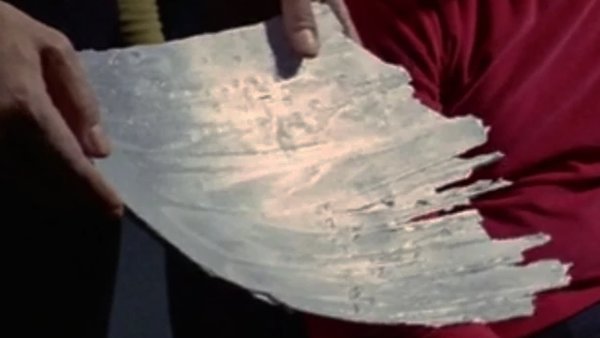
In the classic Original Series episode Arena, Kirk found a deposit of diamonds and referred to them as 'perhaps the hardest substance known in the universe'.
Aside from the fact that scientists in real life have now been able to synthesise substances harder than diamonds, this statement was also contradicted several times in Trek itself. In the episode Balance Of Terror (which aired before Arena), cast rodinium was called the hardest substance known to man. Then, almost a year after Arena aired, tritanium was described as 21.4 times harder than diamond in the episode Obsession.
There are countless other contenders for the hardest substance in the Trek universe, including neutronium (the material used in the planet killer's hull from the episode The Doomsday Machine), and monotanium (the material used in Hirogen ship armour). There's really no way to know which of them is actually the hardest.
8. The Bounty's Changing Bridge

If you've recently watched The Search For Spock and The Voyage Home back-to-back, you may have noticed that the bridge of the Klingon ship (the Bounty) changed significantly between the two films.
Several explanations have been suggested for why the bridge changed. Some believe that the Bounty actually had multiple bridges to specialise in different kinds of missions. Others say that the bridge was upgraded during the ship's stay on Vulcan after The Search For Spock.
The actual reason for the change was because the original bridge set was demolished after Star Trek III finished filming. When it was decided that the bridge would make a return in Star Trek IV, the director, Leonard Nimoy, decided to redecorate another available set for budgetary reasons, taking the opportunity to create a whole new aesthetic for the bridge, that carried over into the designs of Klingon bridges across decades of Trek.
7. The Tribble Origin Story

The Short Treks episode The Trouble With Edward is hilarious, and a real highlight of the series, but it introduced a very odd change to Trek history.
Tribbles have always been known for breeding extremely fast. In fact, new tribbles were born pregnant and, if they kept eating, they would spread at an exponential rate and totally infest any starship they came aboard. However, in The Trouble With Edward (set before The Trouble With Tribbles), the quirky tribble researcher, Edward, claimed that tribbles would make an excellent food source, if only they were faster at breeding. It was only after Edward infused a tribble with his own DNA that they started to breed at such insane rates.
This is a really funny origin story for the tribbles, but it's complicated by the fact that they were already established to be fast at breeding in the Enterprise episode The Breach.
In The Breach, Dr. Phlox fed a tribble to one of his other pets while explaining to Sato, 'All it's capable of doing, really, is eating and breeding. Problem is, they breed quite prodigiously. The only thing that keeps their population in check is the abundance of reptiles on their homeworld.'
6. Shuttlebay Force Fields

Nowadays, all the hangers we see aboard Starfleet ships are kept sealed with force fields that allow shuttles and other objects to pass through, while keeping oxygen inside the ship. This design is super common in other sci-fi works too (like Star Wars, for example), so it's easy to forget that this wasn't always how things were done in Trek.
In the Original Series episode Journey To Babel, we saw that the Enterprise's shuttlebay would actually have all of its air sucked out before opening the hangar doors. After the shuttle landed, the room needed to be repressurised. When Sarak and Amanda arrived aboard the shuttlecraft Galileo, Kirk, and the others had to wait for the room to refill with air.
This method was used throughout The Original Series, and also Enterprise, but, strangely, Discovery used a more advanced shuttlebay with a force field. While it's possible that this tech existed before The Original Series, one would think it would be installed aboard the Federation's flagship.
5. Zefram Cochrane's Age

Zefram Cochrane is perhaps the most famous scientist in Trek history. He invented Earth's first warp drive, which was detected by a passing Vulcan ship, leading to the official first contact between Humans and Vulcans.
He's remembered mostly for his appearance in Star Trek: First Contact, but we actually met Cochrane decades earlier, in the Original Series episode Metamorphosis. In this episode, it was revealed that at some point in his life, Cochrane chose to live on one of Earth's first extraterrestrial colonies in the Alpha Centauri system. At the age of 87, he realised that he was close to the end of his life, and chose to die among the stars. However, before he could meet his fate, Cochrane was saved by an energy being known as The Companion, who reversed his aging, made him immortal, and kept him company on the planet Gamma Canaris N, until the Enterprise found him in Metamorphosis, 150 years later.
Given that he was said to be 87 when he arrived on Gamma Canaris N, and waited 150 years before Metamorphosis—which was set in 2267—he must've been born in 2030, and arrived on Gamma Canaris N in 2117. Though, strangely, we saw in the first episode of Enterprise, Broken Bow, that he was still on Earth in the year 2119, suggesting that his 150-year stay on the planet was more of an estimate.
Now, his earliest birth year could be 2032 if we assume that he left Earth in 2119, but this would make him only 31 years old when he flew his first warp flight in 2063. No offence to James Cromwell, but he was 56 when First Contact was being filmed, and obviously appeared older than 31.
It's been suggested in the Star Trek Encyclopedia and the Pocket Books novel Federation, that Cochrane's older appearance was due to radiation poisoning from living in a post-World War III world. In reality, Brannon Braga (a co-writer of First Contact) has stated in a documentary featurette called The Legacy Of Zefram Cochrane, 'we decided to take a lot of liberty with the Original Series character', later adding 'we kind of ignored, to some degree, the Cochrane from The Original Series'. Apparently, this was the case when choosing Cochrane's age, but we still adore James Cromwell's portrayal of the character.
4. The Colour Of Klingon Blood

Vulcans are famous for having green blood, but Klingon blood is perhaps even more interesting.
Klingon blood has been shown as red in nearly every instance it has appeared (for example, when Worf cut his hand on Gowron's knife in the Next Generation episode Redemption, Part 1). Yet, it inexplicably appeared as pink in Star Trek VI: The Undiscovered Country. When a crew of Klingons were massacred aboard the Kronos One, we were treated to an extended sequence of early-CGI pink blood floating in zero-gravity.
The only other scenes where pink blood can be seen are in the Discovery episode Point Of Light and the Lower Decks episode wej Duj, which hilariously mocked this whole situation when a Klingon said, 'The empire still strikes terror. Klingon blood runs as reddish-pink as ever.'
The most likely explanation is that some Klingons have red blood, while others have pink blood, much like how Romulans from the north of Romulus are the only ones with head ridges.
3. Kirk Had A Holodeck

In the first episode of The Next Generation, Riker was extremely impressed by the holodeck technology aboard the Enterprise-D. He reacted as if he had never seen a more realistic virtual environment. However, in the Animated Series episode The Practical Joker, we saw that similar tech already existed a century prior.
In The Practical Joker, the Enterprise's computer was possessed by an alien prankster, who trapped Uhura, Sulu, and McCoy in the ship's rec room. In previous episodes, rec rooms were simply places of the ship where crew members could hang out and play games, but the rec room in The Practical Joker was able to generate fully immersive simulated worlds, just like a holodeck. We saw a forest simulation, a snowy blizzard, a beach, and a maze, complete with authentic weather conditions.
It's not clear how rec rooms like this were different from holodecks. Perhaps rec rooms were only able to generate environments, with no NPCs or storylines. While the three officers were trapped in the blizzard, Uhura explained, 'Look, this is still a room, no matter how it appears. If we can travel long enough in one direction, we're bound to reach a wall, then we can feel our way to an exit.' This didn't seem to be the case with the Enterprise-D's holodecks, so perhaps they were special for creating truly infinite worlds.
2. The Eugenics Wars And World War III

The timeline of the Eugenics Wars and World War III have always been pretty ambiguous in Trek.
When these wars were first mentioned in the Original Series episode Space Seed, Spock referred to the 1990s as the era of Earth's last world war, which was then described as the Eugenics Wars by McCoy.
Of course, when this line was written, no one believed that Star Trek would still be releasing new episodes by the 90s (let alone as far as the 2020s), so they didn't worry too much about making accurate predictions that far forward. However, as the years went on, the 90s came, and it became difficult to reconcile this bit of Trek history with reality.
According to showrunner Terry Matalas on Twitter, that period of Earth's history (from around 1990 to 2065) was extremely sketchy in Starfleet's records due to a series of EMP bursts kicking everyone back decades. This seems to imply that the Eugenics wars didn't kick off until decades later, and Spock was simply mistaken. Yet, given the fact that Starfleet ships routinely visit the 20th century (both accidentally and intentionally), this seems unlikely.
The story became clearer in the second season finale of Star Trek: Picard, Farewell, which was set in 2024. In it, Adam Soong opened a classified file titled 'Project Khan', that was dated 'June 7 1996'. This implies that the Eugenics Wars initially began as a secret government program involving renowned scientists like Dr. Soong, which resulted in the creation of genetically modified tyrants like Khan and the other first Augments. Apparently, this was only the beginning, and the continuation of the project after 2024 was what eventually led to the Second Civil War, another Eugenics War, and the official start of World War III.
This still doesn't explain why Khan was said to have controlled more than forty of Earth's nations from 1992 to 1996, but let's just assume it's because of one of those pesky EMP bursts Matalas mentioned.
1. 'Vulcan Has No Moon'

The number of moons orbiting the Vulcan homeworld has been the source of a lot of debate. In the Original Series episode The Man Trap, Uhura said to Spock, 'Tell me how your planet, Vulcan, looks on a lazy evening when the moon is full.' Spock responded logically that 'Vulcan has no moon.'
This statement has been ignored several times throughout Trek. First, a large moon-like object appeared in the Vulcan sky in the Animated Series episode Yesteryear, then, in the original cut of The Motion Picture, two were visible. Decades later, a moon was seen beside Vulcan (or Ni'Var, as it was now named), in the Discovery episode Unification III.
Some fans theorise that the objects we saw weren't moons, but actually small neighbouring planetoids that periodically pass near Vulcan. This is a bit of a reach, though. It seems more likely that the effects artists just thought that the moons would look cool.