6 Ups & 5 Downs From Star Trek: Discovery 5.6 — Whistlespeak
Star Trek Prime Directive conundrum; Burnham/Tilly thirsty for Progenitor clue; Culber's crisis.

Do not readjust or reboot your smart devices. This is an Ups & Downs for Star Trek: Discovery's Whistlespeak. You're not seeing, or rather reading, Seán Ferrick, but have no fear, he will be here with your regular programming! These Ups & Downs are something a little new, a side project if you will, for this writer's thoughts on the episode of the week. Seán and I have also fought phasers, not quite at dawn as that's far too early for the both of us, hotly debating our opinion of the episode. We often agreed, but when we didn't, well, that's what the stun setting's for!
In this week's episode, the search for the Progenitors' technology leads the crew of the Discovery to a world brand new to Star Trek lore — Halem'no. To find the next clue on the path, Lieutenant Tilly and Captain Burnham must beam down to the surface of the planet where they face not only a gruelling race to the 'high summit' — in fact an 800-year-old Denobulan weather tower — but also a Prime Directive dilemma.
Much slower in pace than the previous five episodes, Whistlespeak, like most of Halem'no itself, risks being left behind in the dust of the more memorable action and revelations of the season. It is saved, however, by some fine repair work and a good deal of effective character development.
So, let's get into it! And remember, if you don't agree with my Ups & Downs, that's fine. You can't blame it on the weather, but you can blame this particular weatherman!
11. UP — New World, New Civilisation

There is something we've been saying on the channel for a while now, about another series in particular (shout out to Tom on the Podcast!): Where are the 'strange new worlds?' To a large degree, Star Trek: Discovery has done well to introduce us to a range of new alien species — the Kelpiens, for one, the Osnullus, for my personal favourite — and its previous season was all about a mysterious, very alien, alien race, the 10-C. Nonetheless, the essence of Discovery, and this is a neutral observation, has not been to follow the 'new alien' and/or 'new planet' of the week model.
Whistlespeak had a notably different quality to it, however. When we sat down to discuss it in TrekCulture's very own 'Infinity Room' (a lot less tidy than the Kovich one!), Seán noted that he got "Original Series vibes". On the whole, Whistlespeak did feel like a classic instalment of Star Trek, applying the Kirk-ian (then Picard-ian, then Pike-ian) mandate "to seek out…" of the opening titles. Whistlespeak gave us both the previously unknown species, the Halem'nites, and their increasingly dusty planet, Halem'no.
In its premise, Whistlespeak also draws comparisons with episodes of Star Trek: The Next Generation, notably Who Watches the Watchers in which things go a smidge awry on Mintaka III. Whilst it doesn't quite reach the heights of that episode (literally, if you're a Halem'nite versus a Mintakan), Whistlespeak is a perfectly good Prime Directive episode, and a solid entry into the Star Trek canon.
10. UP — For Science, La Abuela, And Linguistic Xenoanthropology

There is little more that says Star Trek than opening on three glorious geeks analysing a vial of, as it turns out, still just distilled water ("… and wet," don't forget wet!). The brilliant amalgam of science and humour in this scene of Whistlespeak with Burnham, Stamets, and Tilly is worth the UP alone. Solving the clue might be proving challenging, but Captain Burnham seems invigorated by the quest: "If chemistry isn't the solution, try history, anthropology…" she tells Tilly and Stamets. "On it!" Tilly replies. Sheer science perfection!
In this episode, we also got to 'meet' (so to speak) Doctor Culber's previously discussed grandmother (his 'abuela'), who really deserves an UP just for herself, even if her appearance is only (and can only be at this stage) in the form of the "Grief-Alleviation Therapeutic Hologram" with "brainwave patterning" that her grandson is trialling.
As Culber opens up to the holographic representation of his grandmother about his feelings post-Trill, he at first believes she/the program has misinterpreted what he has been telling her. She corrects him, however, rather eloquently:
I also trained you to be a doctor, a man of science. How can we consider the soul, when you have not yet examined the body?
A neural scan a day, keeps the… Wait. Huh. No. I lost it.
Another absolute highlight of the episode was getting to see Burnham back in full-on xenoanthropologist mode, a role she had held as first officer of the USS Shenzhou. Burnham's passion for the subject is clear to see, played to perfection (as always) with wide-eyed wonder by Sonequa Martin-Green, as she pores over the Halem'nite whistlespeak linguistic data.
The scene was particularly fascinating for this language nerd, and it got me intrigued about all the extant whistled languages on Earth today. Not to get on my digital soap box, but you really "can learn so much about a society by the way the individuals speak to each other"!! 'Dust' as a synonym for 'pain' they might also want to note down for later!
9. DOWN — Marathon When It's A Sprint
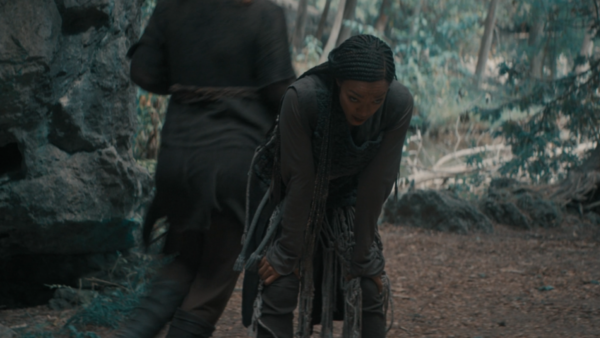
Star Trek: Discovery has had problems with intermittent pacing over its season-long arcs before, and Whistlespeak — as well as season five itself — is definitely not as slow a burn as that! Nevertheless, like all those gasping for water in the race to the high summit, this one did feel a bit lagging. Particularly situated as it is, following the stompingly fast and fisticuffs of Mirrors, Whistlespeak is slower and more (self-)contained — a bottle episode right upon an ocean of Breen.
Of course, to critique Star Trek for having a slower, more meditative, and episodic week is a bit like pointing out the live gagh is awfully squirmy. Slow and meditative has been part and parcel of Star Trek since the beginning, and one of the reasons we have loved it so. We have to judge Discovery on its own merits, however, that is to say, as a piece of serialised television (not alien to Star Trek either), even if this season has added a more episodic touch to the programming.
Therein lies the fine balance to be had: the on-going quest for the Progenitors' tech versus the desire to settle into a place and a people for a bit. Perhaps, and especially since the advent of streaming, we've all become a little too impatient to find out what happens next. There's no doubt that this fifth and final season of Discovery has done a brilliant job of keeping us thoroughly hooked on the main intrigue and the fascinating revelations about the Breen. Overall, however, Whistlespeak might have made for a better episode of Star Trek: Lower Decks or Star Trek: Prodigy — two series which can better afford the time to the first (and second) contacts.
8. UP — Doctor Kovich's Magnificent Pad

I'm not the first one to point out that Dr. Kovich's 'Infinity Room,' first seen in Red Directive, looks a lot like the 'Construct' from The Matrix — that is, if you'd taken both pills at once. Or that, if you whacked a bit of Vaseline on the camera and added the sound of a slow heartbeat, it would look awfully similar to Benjamin Sisko's favourite haunt — the Celestial Temple — or to where Q displays his tapestries. Still, copy-cat-isms aside, the new super-secretly secure, and delightfully theatrical for some, location is rather cool, and so is Kovich.
Towards the beginning of Whistlespeak, Captain Burnham beams away from Tilly and Stamets, who are hard at work with the distilled water that is still distilled water, only to be surprised to find herself with Kovich in the 'Infinity Room' (thanks for asking by the way). All Kovich has to say for the interruption is that it's "disorienting […] but you get used to it." Burnham, with the sharp comedic wit and playfully sarcastic tone that we have been delighted to see more of this season, merely replies, "Here I was thinking you were born in here."
Kovich proceeds to provide Burnham with his own clue as to the current watery wet clue. That's an interesting UP in itself, but what's even more fascinating is how the Doctor handed over his list of names of the 24th century scientists involved in the Progenitors project. He has actual real paper — "a bit eccentric of me" — that isn't replicated, but "a genuine 21st century legal pad". Now, just where (and when) on Earth did he get that?
Cue wild and wonderful speculation about the Temporal Wars, or perhaps Kovich's current access to supposedly banned time travel technology. Just what and how exactly is this new 'Infinity Room'? The look of the place — with nods to the Q and the Prophets/wormhole aliens — suggests to us that it might exist outside of time and space somehow. That certainly won't quell the rumours that Kovich is really 'Future Guy' after all. Maybe Section 31?
7. DOWN — Denobulan Tease
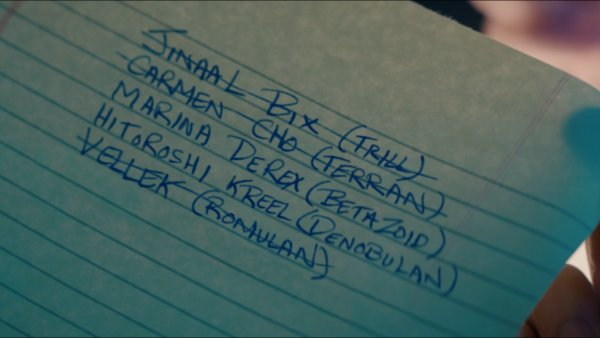
One of the names on Kovich's list, and current clue provider, we find out, is "HITOROSHI KREEL (DENOBULAN)" — "speciality," making it rain with "weather modification towers". The very mention of everyone's favourite Phloxian species very nearly got an UP, but for what came next:
Tilly: "So, we're going to Denobula?"
Overly excited, and very much hook, line, and sinkered, this writer squealed out "Whaaat?" at the screen before Stamets could get a word in:
Stamets: "Maybe not."
This might well have been the knowing-est of nods to the fact that we've never actually visited the planet Denobula on screen, and we know there are budget constraints (especially for depicting a planet so apparently populous), but no, don't tease us with Denobula! We've been waiting for that for far too long already!
Indeed, as recently as January 2024, Doctor Phlox actor John Billingsley told Cinemablend's Mick Joest:
I would love to go to Denobula. I would love to see what life is like on Denobula. […] I'd be curious to know how this culture has figured out how to live with incredible density and to have apparently adopted some sociosexual practices that would lead to an increased population.
Had Star Trek: Enterprise gotten that fifth season, then fourth season showrunner Manny Coto, who sadly passed away in July 2023, revealed all the way back in 2005 that plans had been put in place for a visit to Phlox's homeworld. Let's hope we do get to go there someday, rather than forever chasing the carrot of a planet on a stick.
6. DOWN — I Spy An Eye-Corder
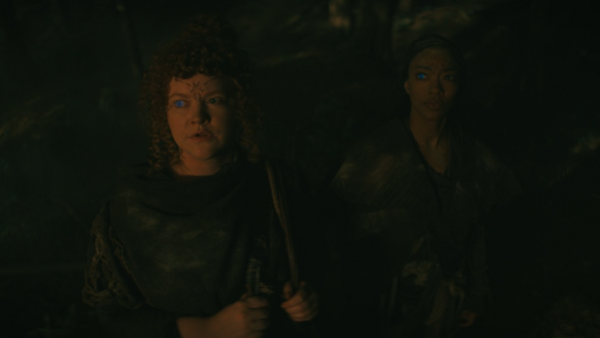
It's my first ever Ups & Downs, and I'm already drunk enough on power to be mean about tricorders. I've changed, but then so has Star Trek's famous three-pronged scanning device. This was tough, nonetheless, as I really wanted to like the new retinal tricorder mod — the eye-corder, it's an eye-corder! To be fair, and as Seán rightly noted, they are one of the most aptly futuristic things we've seen so far in Star Trek: Discovery after the time-jump, although not without a few problematic privacy issues!
I wonder if, despite now having spent quite some time with Discovery in the 32nd century, we are accustomed enough to the tricom badge to allow for another tricorder to enter the mix. Like your mobile/cell phone, which barely does any phoning, the badge does less communicating than it does the tri-odd other things — holoPADD, tricorder, and portable transporter. Perhaps it's just me who needs more and more time to familiarise with the new-fangled? I mean, I'm not saying I don't want one, nonetheless!
For me, the introduction of the latest in Starfleet wearable tech was just all a bit too quick and convenient to the plot. As Commander Rayner announced over the comm (tri- or otherwise), the new retinal tricorder mod that Ensign Tal has been playing around with "should come in handy if [Burnham and Tilly] need to be discreet". Funny you should say that Rayner, as there's actually a super discreet away mission they're about to go on! Well, at least they hung a lantern on it brighter than three warp core explosions!
5. LATINUM UP — Tilly-isms
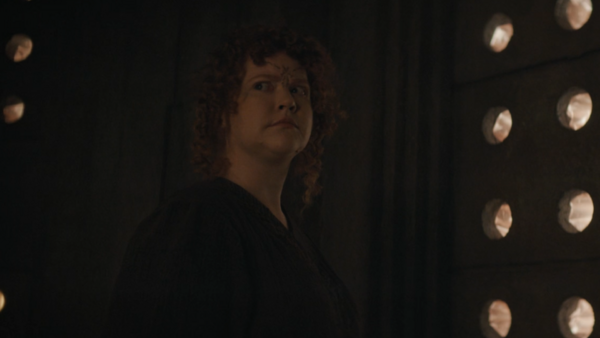
Tilly, Tilly, glorious Tilly — a buoy and a beacon of light for all those, including this writer, who are neurodivergent, and for anyone who feels just a little different. Seán has already quite rightly praised the lieutenant for her epic one-liners in his previous Ups & Downs this Discovery season, most notably for her delightfully literal (and distinctly relatable) interpretation of Captain Burnham's metaphorical "Tilly, we're losing out foot". Her reply: "What… Oh, my God, who lost a foot?"
In Whistlespeak, we are treated to a plethora of the sayings of Tilly, and it is magnificent. This might be finer detail rather than whole picture stuff (also relatable, if you know what I mean), but Tilly and her -isms are my LATINUM UP. Here is a mere sample from the smorgasbord:
To Burnham before beaming down:
Wow, you can take the 'xeno-' out of the anthropologist, but you can't take the anthropologist out of the… Huh. No, I lost it.
To Burnham again as she (Tilly) runs on in the race:
Go chase your moss. I'm the queen of endurance.
Very dehydrated, to Ravah:
You're a little shit, you know that?
From the corner of her mouth upon learning about the sacrifice in the tower:
Sacrifice?
Noting that the walls of the tower's vacuum chamber are solid tritanium:
If it's not one thing, it's another with this place.
Sarcastically, to Commander Rayner and Ensign Adira, who thought they were being helpful:
Oh, good. At least we won't get smushed!
One final, distinctive Tilly-ism is her caring nature, which in Whistlespeak translates through her concern for her student who is thinking of leaving Starfleet Academy. This is then calqued on to her concern for the young Halem'nite Ravah. Nearing the end of the run, Tilly returns to refill Ravah's bowl with water and then helps her up so that they can cross the finish line together. That does mean, however, that Tilly has unwittingly doomed her running partner to death. Later, Tilly cradles the young Halem'nite in her arms, comforting her as the oxygen drains out of the tower chamber.
4. DOWN — Aren't You A Psychologist, Too?

"Ever since Trill, I've felt more connected, more attuned to something greater than myself, greater than all of us. But if there's no scientific reason for it, then…," says Culber to Stamets after his neural scan has failed to produce the desired results. There's nothing wrong — physiologically — with Culber's brain, which is… good, but there is no explanation for the after-effects of the zhian'tara (the Trill memory displacement ritual) to pinpoint either.
This DOWN does not, of course, in any way apply to the spiritual interpretation itself. Star Trek, particularly Star Trek: Deep Space Nine in which we first saw the zhian'tara performed, made clear that each individual is free to seek out meaning in life as they so desire. However, as it stands, there is a certain lack of logic to declaring "there is no scientific reason…" In other words, isn't psychology a science, too?
If you'd had an alien consciousness take over your brain and body, wouldn't you feel a bit weird for a while after?! Not to engage in pop psychology, but this is literal transference we're talking about, and the human psyche never evolved to share itself with another. The rationale for Culber's feelings is already there, obvious for all to see.
Why spend so long seeking out a justification, when he could have just been left to explore the ramifications as he saw fit? No one seemed to have an existential crisis after Facets either. Following Wilson Cruz's exceptional performance in Jinaal especially, it just feels like Doctor Culber deserves to be given something more substantial to do. Then again, perhaps this is all leading somewhere. Pure speculation, but maybe Jinaal didn't leave Culber's body at all?
3. UP — Dynamic Duos

This week's episode did well to rely on the interplay between various variations on two of Discovery's main characters (and others down on the planet). Communication is in the title, after all. The crew might not have been literally whistling at each other, but, emotionally speaking, they did start out over great distances, only to come closer together through the power of words. Here are just a few examples of the dynamism of duos at play:
Tilly & Burnham
We were reminded back in Face the Strange of just how far this pair of friends and colleagues has come. When Captain Burnham goes to a season one version of Discovery's bridge, she tells Tilly, "You're a cadet who's frightened of rooming with a mutineer. You think I'm gonna knife you in your sleep because of your snoring. I won't, by the way." In classic style, that version of Tilly just replies, "Thank you."
In Whistlespeak, Burnham has gone from potential knife-murderer to mentor as she offers to listen and advise Tilly on the difficulties the now lieutenant is facing as teacher at the Academy.
Culber & Stamets
After the holo-program of his grandmother [abuela] has told him to be a "man of science" and consider the body first, Doctor Culber goes to enlist the help of husband Commander Stamets, because nothing says date night more than a neural scan! Somewhat surprisingly, the once curmudgeonly Stamets agrees without hesitation, but not without concern for his partner.
Rayner & Adira
At first, I had a few moments of hesitation over Ensign Tal's… hesitation. The time bug really wasn't your fault!! It also strikes as a little out of the frying pan, into the warp core, for Commander Rayner to have chosen this mission critical moment for Adira's first day of bridge work experience. Nonetheless, Adira comes through with panache in the end, and Rayner helps them get there with a frank, but true, reminder.
Culber & Booker
First and foremost, we all want some of that mofongo! Replicated or not, it looks delicious! And hang on a minute, was Book playing Asteroids in the shuttle? As tempting as it no doubt was, the pair don't spend the rest of their time playing a low tech video game in one of the most high tech ways possible. Over the mofongo, they settle in for an open and honest conversation.
Now, I might have given a down to what felt like the forced nature of Culber's "spiritual awakening," but that doesn't mean I didn't like its ongoing exploration, and partial resolution, here. The discussion between the two of them, as friends, is genuinely heart-warming, and Book provides some damn good and, ultimately, rather profound advice.
2. UP And A DOWN — Breaking The Prime Directive

Just to confuse things for you, this final entry is both an UP and a DOWN, neither, and somewhere in between. That it is somewhere in the centre is no doubt appropriate, as that's where the Captain who defies THE rule this episode sits.
Let's start with the DOWN so we can end on an UP. In Whistlespeak, once the planet Halem'no — with its pre-warp, pre-industrial civilisation — had been identified as the location of the next clue, Captain Burnham made it clear that the Prime Directive was, therefore, a concern. Later, when Burnham and Tilly are down on the surface tending to the rather sick Halem'nite with dust in their lungs, Burnham is insistent that they cannot break Starfleet's number one rule. When it did come to crossing that moral line by the end of the episode (which I happened to agree with), it all felt just a tad too telegraphed, and at the same time, not entirely earnt.
We know in the past that certain captains have so doggedly adhered to Starfleet's highest order that they have been willing to let entire civilisations perish (*cough Picard *cough*). In fact, Captain Picard was so well known for his diatribes on the subject that Doctor Crusher once had to insist, "Please, no lectures about the Prime Directive" (presumably temporal, in this case, in Star Trek: First Contact).
Here, I think it is safe to say that Captain Michael Burnham made the right choice to save Tilly and the young Halem'nite from certain death in the tower, even though that meant breaking the Prime Directive. High-minded moral imperatives are all well and good, but not if no-one's around to see them through. Plus, as Burnham herself said, the technology on Halem'no was going to fail one day, wiping out the civilisation with it. They might as well act now and save as many lives as possible.
Credit also goes to the conversation between Burnham and downwardly careered (but still awesome) Commander Rayner. It is a Number One's job to keep the Captain in check, and to provide a counterbalance and counter-opinion should the need arise. That is precisely what Rayner does, without over-stepping the mark, when he reminds Burnham, "You'll be revealing yourself to a pre-warp civilisation" and that, "We're going to have to answer for the Prime Directive violation." Once Burnham has made her decision, however, Rayner rightly knows that the debate is over. He does his job and follows orders. "Aye, Captain. Stand by."
Now, I think there might be quite a bit of paperwork to fill out!
1. CETACEAN OBSERVATIONS
In this, the written version of the Ups & Downs, we're going to do something a little different when it comes to Cetacean Observations. Seán will have the fine-eyed and exhaustive list of easter eggs and lore, but here, that might be too much for the poor whales to handle! We will pick a couple — or maybe even just one — that stand out and go into detail. In general, did the Trek track or not?
On the whole, Whistlespeak wasn't replete with references. The first that did stand out is the nub on which the rest of the episode rested: Denobulan Hitoroshi Kreel and some 24th century water towers that still used silver iodide (a chemical compound used in real-life today for 'cloud seeding')! The walls of part of tower three were also "solid tritanium," a material widely deployed in Starfleet starship construction as far back as the NX-01.
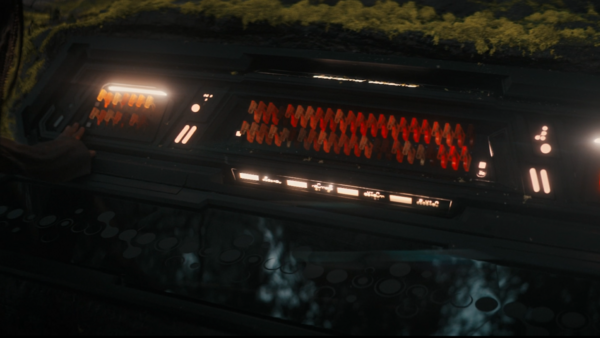
There were nods to several technologies — the replicator (for grandmother's mofongo), the "holodeck simulator" (where Book can always tell the ship is fake), and of course, to all those TRI-corders. A favourite, however, was the isolinear chips — a 24th century staple — used in the control panel for the weather tower. Adira's "Okay, Captain. I need you to bypass the auxiliary power circuits" was also a reference unto itself. '[Re-route] auxiliary power' might as well be the Starfleet motto! Adira's subsequent translation — "Yank it out, Captain" — was not only hilarious, it was Star Trekcondensed into one line. What officer/engineer worth their salt hasn't taken a page out of Seven of Nine's book at some point and tried a "radical dislocation"!