Star Trek: 10 Most Mind-Bending Spatial Anomalies
Solve for X, Spock! Solve for X!

I mean, duuuuuh! We all know the difference between a cosmic string and a quantum filament. One's a very long anomaly with a lot of mass; the other's a nearly massless very long anomaly. The cosmic string the Enterprise-D encountered housed a group of two-dimensional beings that 'short-circuited' Deanna Troi's brain, and the quantum filament the ship bumped into about a year later saw Data quite literally lose his head.
From that description alone, you might wonder why anyone ventures out of the Sol system in the coming centuries, although Earth and company are hardly a safe-haven, and it wouldn't be much of a star trek if they just stayed at home. Space is a vast and wondrous place, but it is also full of baffling irregularities and aberrations to its continuum that our tiny ape and lizard brains just aren't evolved enough to properly comprehend. Other species like the Vulcans seem to have a better time of it, but then again, they're not always as tough as they'd have us believe.
Perhaps Captain Janeway was ultimately right, nonetheless, when she said that there is little more impressive or scarier than watching a bolt of lightning split an oak tree on the plains of Indiana. Spatial anomalies truly exist all around us, ready to blow our minds at any second. Prepare to have yours just a little bit twisted!
10. Graviton Ellipse

Or the 'Kitchen Sink' Anomaly
You can call it what you want — 'spatial anomaly 521,' if you prefer the Borg designation, or the 'kitchen sink' anomaly, as Commander Chakotay nicknamed it — but a 'graviton ellipse,' as per the Federation database, will still be a giant glowing ball of subspace energy (30 million terrajoules' worth) that can emerge into normal space whenever and wherever it pleases. It's most certainly no solar flare, and it's definitely more than a little turbulence!
The most mind-altering aspect of this particular phenomenon is not its sheer size and intensity, however; as with all things in life and the 24th century, if you cut power and reverse shield polarity, the graviton ellipse will just drift on by. What is truly weird is that of all the graviton ellipses in all the quadrants of the galaxy, Voyager stumbled on the one that consumed the Ares IV command module over Mars in 2032. The same as in the teaser? Oh, yeah! Quite the coincidence!
What no one knew until then was that Lt. John Kelly, commander of the Ares IV mission, had survived for quite some time inside the graviton ellipse (humanity's first encounter with a spatial anomaly, no less). 31 years before the Vulcans (officially) showed up, Kelly also got the universe unravelling shock of his life when he saw the wreckage of an alien ship float past the window.
9. Spatial Interphase

Or the 'Shouty Chekov' Anomaly
The Original Series episode The Tholian Web is a wild ride (not least for Captain Kirk) and stands out as one of the best of its somewhat rocky third and final season. Of course, the mind-bending anomaly at its centre provided material for a set of episodes decades later — the Star Trek: Enterprise two-parter In a Mirror, Darkly. It was the Tholians in that universe who were responsible for creating the interphasic rift in the first place.
As regards Captain Kirk and crew, they were on a search and rescue mission for the missing USS Defiant (not that one!), which they find glowing a fluorescent green, trapped in an area of 'interspace' where our universe and the alternate overlapped. The Defiant doesn't even show up on sensors, but they beam over anyway to find that its crew have succumbed to a murderous rage. In Doctor McCoy's words, the Defiant then starts "dissolving" as it goes through another interphase, and Kirk is ultimately left behind.
The mind-altering madness then goes full-on crazier than a box of Nick Locarnos. The interspace starts affecting the "molecular structure of the brain tissues" of the crew of the Enterprise — Chekov has to be strapped to a biobed! That's not to mention Kirk's ghostly, floaty, interphasic apparitions after his memorial service.
8. Chronokinetic Spatial Rift

Or the 'Seska Never Stays Dead' Anomaly
Voyager seemed to be especially unlucky when it came to catastrophically world-warping anomalies. This time, how about one that looks like a gaping, angry wound on the otherwise smooth flesh of space, oozing large amounts of chronitons and neutrinos? The sudden chronokinetic surge this spatial rift spits forth then shatters the space-time continuum throughout Voyager and inside Chakotay as well. For a moment there, the Commander had "the liver of and 80-year-old man and the kidneys of a 12-year-old boy".
All that's just a regular day at the office compared to the Starfleet Christmas party of chaos that comes next. The whole thing is basically Voyager's greatest hits album — buy now before temporal realignment! On the bridge, Voyager is still in the Alpha Quadrant, whilst down in astrometrics, Naomi and Icheb are all grown up. Captain Proton is back… Captain Proton-ing (?), and there's even a macrovirus thrown in for good measure.
The most difficult thing to get your mind around when it comes to temporal anomalies is what happens next. Well, that and keeping the Antarian cider secret. As Captain Janeway puts it after the 'normal' space-time continuum is restored, "It's strange, thinking there's a piece of your life you don't know anything about". It sure is, but then, as all Starfleet officers should know, strange and weird are part of the job!
7. Subspace Divergence Field

Or the 'Harry Kim's Ghost' Anomaly
It could have been your regular trip through a plasma drift to avoid the local organ harvest, but it turned into something altogether out-of-the-ordinary. When a nasty bit of subspace turbulence hits Voyager, the warp engines stall and main power fails — they're leaking antimatter! Before B'Elanna can start a proton-burst infusion, the ship is hit with proton bursts. This is one freaky-deaky plasma cloud, and one hell of a cold-open!
Even more mind-bogglingly mind-bending, Kes disappears through a spatial rift on deck 15, Harry Kim dies, and Captains Janeway (Captain Janeways?) see "a ghost image" of each other on the bridge. We switch to another Voyager where everything is relatively normal, aside from the power drain and the extra Kes. Remember, if in doubt, run quantum-level and multispectral analyses!
Quantum theory has had some very real implications aboard Voyager here. Thank you Kent State University! The divergence of subspace fields — a "spatial scission" — duplicated every particle of matter, but not anti-matter, on the ship. If you can wrap your mind around it, both ships actually existed at the same point in space-time, pulling power from the same warp core. Physicist Richard Feynman reportedly once said, "If you think you understand quantum mechanics, you don't understand quantum mechanics". The episode Deadlock and its anomaly might be science-fiction, but still, I think it proves his point!
6. Delphic Expanse Anomaly (Twilight)

Or the 'T'Pol-Archer Hair Budget' Anomaly
This list could have been dedicated to all of the Delphic Expanse and its weird web of physics-defying anomalies. If you're looking to get anatomically inverted or have your favourite water polo ball fuse most permanently with the wall, this is the place in space to be! The most mind-bending Expanse anomaly — quite literally for poor Captain Archer — was surely the one that carried with it a collection of microscopic parasites in a state of interspatial flux. These little devils from another dimension lodged themselves inside Archer's hippocampus, impairing synaptic function, leading to anterograde amnesia. Things went from bad to crap to worse from there.
The Captain was unable to form new long-term memories post-infection and so was (eventually) relieved of command. Without his unique way of doing things, the mission failed; Earth was destroyed, then T'Pol grew her hair out and moved with Archer to some planet called Ceti Alpha V. Never heard of it!
That was until they discovered that Phlox's treatment, devised after years of research, had not only eradicated the parasites in the present but also in the past. (Although, if a parasite cluster was never there in the first place, how and why did they notice the change on the previous scans?) If your mind's not blown already, then get ready for the explosive, or rather implosive, warp core solution that rids Archer of the parasites and re-sets the timeline.
5. A Highly Localised Distortion Of The Space-Time Continuum

Or the 'Tossed Salads and Scrambled Eggs' Anomaly
It's one of the most mind-blowingly-est, starship-explodingly-est cold opens in Star Trek history, and it's all thanks to a spatial, and especially temporal, anomaly. If your brain isn't already bent out of all proportion at seeing the Enterprise-D summarily reduced to rubble before the credits roll, you should hang on a little tighter to the back of that chair at ops. It only gets stranger and more explosive from there!
The Enterprise-D is charting the Typhon Expanse, and the crew experience déjà vu all over again… and again… and again… and again… (nIb'poH or "The time is identical" in Klingon.) Dr Crusher's hearing voices and smashing glasses in her quarters, La Forge is feeling familiarly queasy, and ship's poker becomes particularly repetitive. It's Groundhog Day avant la lettre, as Brannon Braga was keen to point out.
At the end and the beginning of each temporal causality loop is Bateson on the Bozeman, emerging from the anomaly to collide with the Enterprise until Data finally realises that three really is a magic number! The Enterprise-D's chronometers are off by 17.4 days, but for a pre-Frasier Kelsey Grammer aboard the Soyuz-class, it's been 90 years!
"There's something we need to discuss," offers Picard. You're damn right there is! Captain Bateson is still in active service in 2381, but the adjustment to the 24th century must have been one hell of a mind-f**k for him and his crew!
4. Subspace Compression Anomaly

Or the 'Honey, I Shrunk the Runabout' Anomaly
We're in the middle of an intergalactic war with an enemy hell-bent on conquest, but let's stop off and investigate a weird anomaly. What could go wrong! It is important research, after all — enough for a Klingon poem in commemoration. This is the story of a little ship, that took a little trip…
As anomalies go, and without Rick Moranis on hand, little is more mind-bending than being miniaturised via subspace compression. I bet the shrinking of the space within your "subatomic structure" actually tickles a little, although Chief O'Brien claimed not to feel a thing as he was being condensed to half the size of a combadge. "This bloody tall, actually."
The trippiest part of this literal reductio ad absurdum is seeing the Runabout Rubicon and its Lilliputian trio whiz through the corridors and conduits of the now supremely oversized Defiant, itself the "tough little ship" of Star Trek: First Contact. Firing on the Jem'Hadar with an itsy-bitsy photon torpedo was a nice touch, before the plot takes a dive down the rabbit hole into the marvels of Star Trek Wonderland as one centimetre-tall O'Brien and Doctor Bashir beam inside a circuitry compartment to assist their commandeered crewmates.
3. The Nexus
Or the 'I Wish It Could Be Christmas Everyday' Anomaly
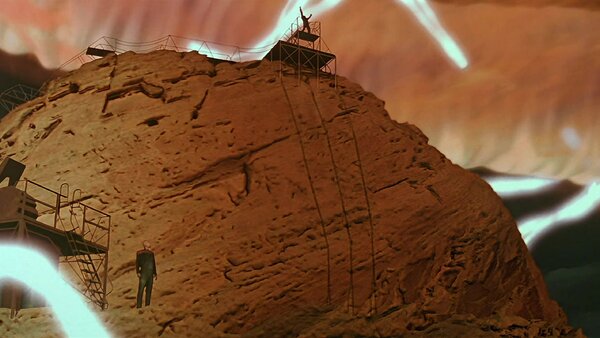
As we saw in Star Trek: Generations, the Nexus is an anomaly that doesn't merely mess with time and space — destroying ships and planets in its wake as it cuts a path through the Milky Way — it also screws with the minds of anyone unlucky enough to encounter it. Everlasting bliss wrapped up in a blanket of pure joy might seem like an enticing prospect, but if you surrender to it, it will drive you to obsession.
We don't know what Soran — the exact opposite of a good listener — experienced exactly when he was inside the Nexus, but it must have been damned good as he was willing to scheme and slaughter his way back to it. As member of a species with lifespans of countless centuries who apparently only age when they want to, Soran sure was overly tetchy about the possible ravages of time.
The whackiest part of the Nexus anomaly has to be Jean-Luc's 19th-century-style family Christmas with a remnant or "echo" of Guinan as a surprise dinner guest. Guinan is both on the Enterprise (D and B?) and in the Nexus at the same time. How the Nexus does all of this is never explained, but at least Guinan didn't go Soran-level insane in the process! And if Kirk could have gone back to any point in history upon leaving, why didn’t he make it a flippin' Tuesday?!
2. Subspace Fold

Or the 'Kling-Pop' Anomaly
We had to include the most recent, most anomalous of anomalies that cast Pike's Enterprise awash in the (mostly) dulcet seas of subspace rhapsody. "Why am I singing?" I don't know. You tell me! It's the musical episode. Get ready (ready!) — you've earned it!
This subspace fold (or fissure, if you prefer) really changes everything. Well, at least it could have. Eerily beautiful as it stretched away from the Enterprise into the infinities of the universe, the anomaly initially showed promise for drastically boosting the Federation's subspace communication capacities. However, rather than subspace broadband, it was (off[-off]) Broadway for the crew. Just be thankful it didn't happen on the Cerritos, or, with Dr T'Ana aboard, we might have got that 'butthole cut' of Cats.
The melomania only begins when Pelia suggests music as a test transmission method through the fold. Uhura's choice of 'Anything Goes' might as well be the title of the episode, but it's all in good fun. They've certainly no one but themselves to blame. One 'quantum uncertainty/improbability field' from the fold later and everyone's up singing and dancing their hearts out like it's the callback auditions for Julliard.
There is dramatic tension in amongst the high notes, too. As the improbability effect spreads, the Klingons threaten to destroy the subspace fold, but this would wipe out all the Federation and half the Empire with it. Of course, we are also treated to the highly hilarious, and impeccably choreographed, Kling-Pop number from General Garkog and crew.
1. Anti-Time Eruption
Or the 'Three Nacelles' Anomaly
To use a popular saying here at TrekCulture, what really 'burns our biscuits' is when the word of a Starfleet captain is not taken at face value. After all the years, decades, centuries of experiencing the oddest of anomalies, you'd think no officer would ever doubt a Captain's time-travel tale and just get right to the investigating. But noooo, Act One (or more) is often still spent telling them it's probably part of a syndrome and asking if it was all maybe, possibly just a dream!
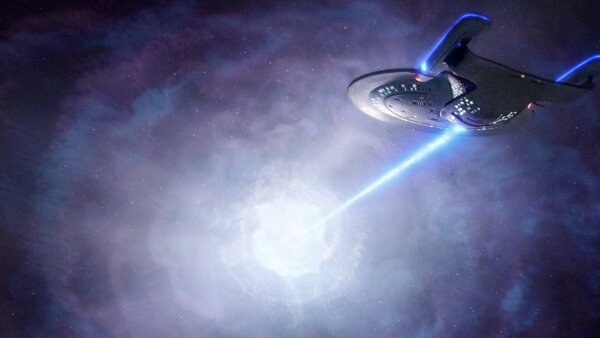
All Good Things… is no doubt the finest series finale there is, but the anomaly at the centre of its story is a lot to get your head (or static warp shell) around. This was an 'anti-time' eruption or a "multi-phasic temporal convergence in the space-time continuum" that was smaller in the future and bigger in the past. In fact, it was so large in the past (3.5 billion years in the past, to be precise) that it covered the entire Alpha Quadrant, preventing the formation of life on Earth.
On the USS Relativity, they'd probably call this a "Pogo paradox" in which "intervention to prevent an event actually triggers the same event". Picard intervened to stop the anti-time anomaly by initiating an inverse tachyon beam to scan it in the three different timeframes, but the convergence of the tachyon beams was the cause of the anomaly. Moreover, Picard couldn't have travelled in time to do any of it without the help of Q, but wasn't it the Continuum who ordered the 'trial' without the "helping hand" in the first place?!? No wonder Picard has his head in his hands by the end!