Doctor Who: 20 Best Nu-Who Episodes

11. The Unicorn And The Wasp

One of the best markers of success in having a historical figure on Doctor Who is when the episode they appear in perfectly encapsulates who they were as a person. In that regard, The Unicorn and the Wasp is a wonderful exploration of Agatha Christie, both as a writer and a woman. It's also a well-written murder mystery that's a throwback to the type of stories Agatha herself was famous for (in fact, that's a key plot point in the episode). It features probably one of the funniest scenes in Doctor Who history, with the Doctor and Donna playing a frenetic game of charades that is doomed to hilarious failure almost as soon as it begins. Overall, it's just a textbook example of how to do historical episodes -- The Unicorn and the Wasp feels firmly rooted in its era, rather than just an arbitrary time period chosen just to make a historical. We can't say the same for some of the Victorian stories we've been getting of late.

10. Love & Monsters

This is the one we're definitely going to get hate mail for, but we're secure enough in our status as Doctor Who fans to just come out and say it: Love & Monsters is a really good episode. Sure, the Abzorbaloff is a ridiculous monster and Peter Kay probably got a stomachache from chewing on all the scenery, but on the other hand, can you really hold it against the show that gave some kid out there the opportunity to create a villain for their very favorite television program? You have to at least give it credit for trying to do something different and experimenting with what the show is capable of. It does a fine job of exploring the lives of the people who are unwittingly affected by the Doctor, which is a point of view we don't often see. Elton is a likable and engaging character who brings a lot of genuine emotion to the proceedings. Something like Love & Monsters wouldn't work every week, but as a one off episode it's a welcome change of pace.

9. The Day Of The Doctor

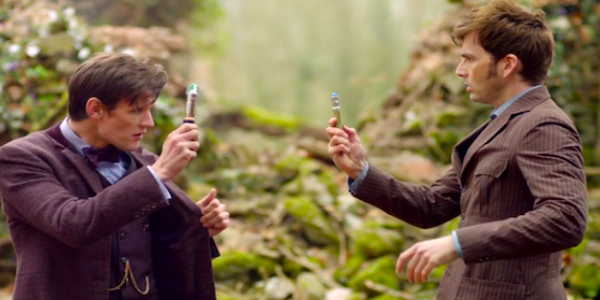
If we're being totally honest, liking The Day of the Doctor is a matter well out of our hands. You can hardly hate such a good-natured, lovingly made celebration of the show's fiftieth anniversary, after all. We're pretty sure they'd take away your fandom membership if you weren't at least a little bit charmed by the episode, even taking into account the impressive capacity of Doctor Who fans to complain. The simple fact of the matter is that the anniversary special was made first and foremost to reward Whovians, and that alone makes it worthy of appreciation, because it can get away with a level of fanwankery that would be unseemly in an ordinary episode. Where else are you going to see the Tenth and Eleventh Doctors working together and interacting with a mysterious earlier incarnation, played by the incomparable John Hurt? Or a cameo from Tom Baker? Or the return of Billie Piper (although not as Rose Tyler)? The fact that all these little goodies are strung together into a mostly coherent plot that actually adds positively to the show's canon is nothing short of miraculous.

8. Turn Left

We will always have a soft spot in our hearts for these kinds of alternate timeline stories. What would happen if you made one simple decision differently? How would the world be changed? In the case of Donna in Turn Left, the results are catastrophic. It's clear that a lot of thought went into this story, with all the ripples from this decision far-reaching and nuanced. Turn Left doesn't shy away from the darker implications of these changes, either. With the world in danger, we see societies become insular and increasingly less tolerant of perceived outsiders. There's a chilling shift in Britain towards the kind of fascism that allowed Nazi Germany to thrive. Turn Left is basically one big reminder of what has become Doctor Who's mission statement: the idea that any everyday person can be clever and brave and incredibly important to the world.

7. Blink

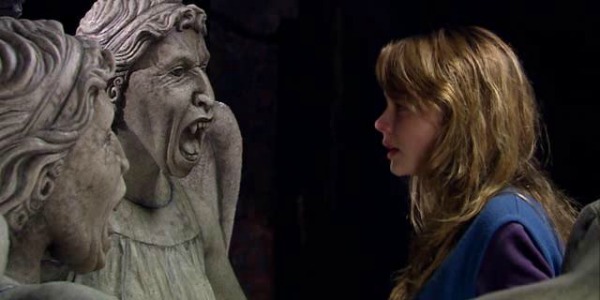
Interestingly enough, one of the most acclaimed episodes of Doctor Who barely even features the Doctor. He's present in a few very memorable video clips, and the very end of the episode. But for the most part, Blink succeeds on the strength of both its heroine Sally Sparrow and its truly inspired monsters. The one thing that Nu Who hadn't really cultivated until this point was an iconic alien enemy of its very own, and that's what the Weeping Angels accomplish. They're memorable, visually stunning, and we have a deeply rooted psychological fear of a threat that can only hurt us when we inevitably turn our back on it, so to speak. And they're never better served than they are here in their debut episode, when the director made the clever choice in having the audience never see the Angels move. Their impact may have been diluted upon subsequent appearances, but you can't deny that it became a little bit harder to trust statues after watching Blink.

6. The Empty Child/The Doctor Dances

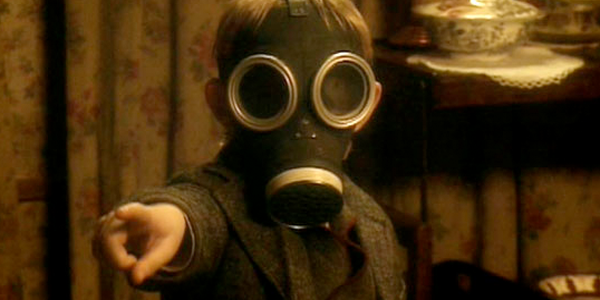
As good as Chris Eccleston is as the Doctor, a lot of the first rebooted series in 2005 is still the show figuring out exactly what it wants to be and what it can accomplish. Once the show gets to this two-parter, however, it's definitely firing on all cylinders. The really remarkable thing is that this story is able to tick so many boxes -- it's almost universally beloved because everyone, no matter how curmudgeonly and devoted to the original series, can find something to like about it. There's an engaging and emotionally evocative story set against a backdrop of London during World War II. There's a pretty gruesome element of body horror that to this day we have no clue how they managed to get past the BBC censors. And there's Nancy, one of the most interesting and well-developed female characters who has ever been featured on the show. What more could you ask for?

5. The Eleventh Hour

The writers of Doctor Who were in a very difficult situation at the beginning of season 5. First of all, the most iconic Doctor since Tom Baker had just retired after four long years on the program, and it was going to take something special to make audiences forget about him. And his chosen replacement, Matt Smith? A lot of fans weren't convinced he could pull it off. Now, of course, we know that he was an inspired choice, a talented actor if occasionally let down by his material. But in 2010, he seemed impossibly young, and many people thought the show would end up trying too hard to be hip and teenager-oriented. So it's fair to say that The Eleventh Hour was carrying quite a lot on its shoulders. And for the most part, it manages all the tremendously difficult things it's being asked to do. Matt Smith wins us over in the first five minutes of the episode, and Amy Pond presents a compelling, if not immediately lovable, new companion. The story is secondary to the character building, but the end result is a fast-paced, exciting story that endears us to the new Doctor and makes us very optimistic for the rest of season 5.

4. The Doctor's Wife

This is like that one time when the production team for Doctor Who tried to give us all a heart attack by naming an episode The Doctor's Daughter, except better than that in every conceivable way. Forget about Rose Tyler, forget about River Song, we're sailing the Doctor/TARDIS ship. No matter what they tried to do with the Doctor and his various love interests, the human embodiment of the TARDIS is the only relationship we really buy. They've been together for just this side of forever, and the Doctor depends on the TARDIS more than anything else in the universe. So The Doctor's Wife combines a really interesting concept with a heartbreakingly perfect execution courtesy of Neil Gaiman. It's a wonderful exploration of the one consistent relationship in the show's 50 year history, and one that is frequently overlooked.

3. Vincent And The Doctor

Vincent and the Doctor is an episode that speaks to anyone who has ever dealt with mental health issues. In many ways, its an unusually quiet episode, without a huge amount of action to the main plot. In fact, an argument could be made that they could have eliminated the alien subplot and the episode wouldn't have suffered, making it the first pure historical since Black Orchid way back in the Davison era. It's probably one of the most ambitious (and ultimately successful) explorations of a popular historical figure that Doctor Who has ever attempted. Tony Curran nails every aspect of his performance as Vincent Van Gogh, from his physical appearance to his temperamental nature, his moments of elated brilliance swiftly followed by a crushing despondency. There's a very touching and natural relationship that develops between Vincent, the Doctor, and Amy Pond -- anyone who was complaining about Amy being too harsh and unfeeling must have missed this episode. While some people might find the ending veering too far into cloying sentimentality, for us it hits just the right note. Depressive episodes are often characterized by feelings of worthlessness, so bringing Vincent to an art museum and showing him exactly how much his work meant to the world was the best gift the Doctor could have given him.

2. Human Nature/Family Of Blood

Human Nature/Family of Blood is a sumptuous two-parter that explores what happens when the Doctor isn't really the Doctor. After being chased by a family of intergalactic criminals hellbent on stealing his immortality, the Doctor is forced to hide his Time Lord consciousness and live as a human, a timid schoolteacher at a public school in pre-WWI Britain. We get to see the Doctor in a uniquely vulnerable position, where he doesn't know who he is, and quite frankly he's no use to anyone. This puts Martha, one of the most enduringly undervalued companions, firmly in the driver's seat. The casual, mean-spirited racism and sexism she encounters is jarring at first, but it serves to illustrate exactly what Martha's willing to do to keep the Doctor safe. The story also comes with a compelling statement on the nature of war, culminating in Son of Mine's monologue while on the attack. All this together adds up to a remarkably strong episode, especially for anyone with a soft spot for history.

Contributor
Contributor

Audrey Fox is an ex-film student, which means that she prefers to spend her days in the dark, watching movies and pondering the director's use of diegetic sound. She currently works as an entertainment writer, joyfully rambling about all things film and television related. Add her on Twitter at @audonamission and check out her film blog at 1001moviesandbeyond.com.