10 Fascinating WWE King Of The Ring 1993 Facts
In 1993, WWE welcomed a fifth member to the PPV rotation.

By the early nineties, WCW expanded their PPV calendar to five or six events per year, and would end up holding seven in 1993. For their part, WWE stuck to the big four that they had established in the late-eighties, save for a novelty event here and there.
That changed in 1993, when King of the Ring was employed by the company to bridge the five-month gap between WrestleMania and SummerSlam. The concept was previously used as an annual house show special in the New England area, and would now be spun off into a piece of what was officially WWE's "big five".
The 1993 event came with its share of controversy, particularly in the World Championship scene. The defending champion was none other than a dusted-off Hulk Hogan, who had hastily regained the gold at WrestleMania 9, before skipping out on the television product for the next ten weeks, a development a 15-year-old Minnesota farm boy may have made note of.
Hulkamania on that night would be crushed under the weight of the mammoth Yokozuna, a curious booking decision in the mind of Bret Hart, who had been told he would be defeating the Hulkster for the belt at SummerSlam. The three-way political battle between McMahon, Hogan, and Hart would have been far more interesting than the PPV, had it not been for Hart's three excellent matches.
Here are ten facts about the 1993 King of the Ring you may not have known.
10. The Phrase "Heartland Of America" Was Used In Place Of The Location

The 1993 King of the Ring emanated from the Nutter Center in Dayton, OH, the sixth largest city in "The Buckeye State", and the birthplace of baseball legends Mike Schmidt and Roger Clemens. Tell that to WWE officials, who apparently felt insecure running a pay-per-view out of a veritable B-town.
Perhaps you've noticed on certain Raw episodes from time to time that no mention is made of what city they're in. This happens when they're in a smaller city like Fort Wayne, IN or Lafayette, LA or Columbia, SC. It's been said that Vince McMahon feels his product comes off as second-rate when associated with the littler towns, and nixes the mentions of them.
Add Dayton to that list, as announcers Jim Ross, Randy Savage, and Bobby Heenan would often use the catch-all phrase, "We're in the Heartland of America!" during the broadcast, instead of just saying Dayton.
9. The USWA Title Was Defended In The Dark Match

In 1992, WWE had struck a partnership with the Memphis-based United States Wrestling Association. In the early days of the collective, Jeff Jarrett appeared on a number of local house shows, while Jerry Lawler joined the broadcast team, wrestling occasionally.
In trade, some of McMahon's talents would appear at USWA shows, and would even populate the Heavyweight Championship scene. Papa Shango, who was fairly directionless in WWE by this time, won the belt from Lawler on May 3 of that year.
In something of an unorthodox move, Shango actually defended the belt in King of the Ring's untelevised pre-show bout, taking on a still-babyface Owen Hart. Shango won the match, but dropped the belt to the youngest Hart sibling eight nights later in Memphis. Other WWE luminaries, such as Randy Savage and Tatanka, would end up with the belt before year's end.
8. The Commentary Experienced Technical Issues

Jim Ross made his WWE debut at WrestleMania 9, partnering with Bobby Heenan and Macho Man Randy Savage. Togas aside, Ross seemingly meshed well with his new partners, striking up a rapport with Heenan's comic musings, playing the role of earnest straight-man. The three-man crew joined up once more for King of the Ring, where their performance wasn't as well-received.
Contributing to the somewhat-tepid showing from the trio was the fact that all three reportedly had a hard time hearing each other over their headsets, due to a technical issue. As a result, Ross, Heenan, and Savage's collective timing was off, due to all three men occasionally interrupting each other.
it's certainly a far cry from the modern-day WWE, where three man commentary teams patently suck, whether the headsets are working properly or not.
7. Bret Hart Wrestled For More Than A Half Hour The Night Before The Show

Across his three matches at the 1993 King of the Ring pay-per-view, Bret Hart wrestled 47 minutes and 32 seconds, carrying the heavy end of what would've been a mediocre show at best without his craftsmanship. Hart actually worked all three bouts with an injured ankle, sustained the previous evening. And what was "The Hitman" doing one night earlier? Working his hands to the bone at Madison Square Garden.
Instead of working a basic house show match, Hart and fellow babyface Bob Backlund put on a clinic inside the Garden, during the course of which Hart sustained a noticeable ankle injury. The match went more than 32 minutes long, with Hart coming out on the top. It was Backlund's first pinfall loss ever at the Garden.
In all, Bret Hart performed four matches totaling 1 hour, 19 minutes, and 53 seconds across a 24 hour stretch, 600 miles apart.
6. The Treacherous Photographer Was A Recognizable WWE Employee

The WWE Championship bout pitting Hulk Hogan and Yokozuna had to follow what was probably the company's best match of 1993, Hart's semi-final bout with Mr. Perfect, and there was no chance they were going to top that masterpiece. A plodding heavyweight battle would've been arduous enough to sit through without the hokey finish that the fans were given.
In the closing moments of the match, a heavily-disguised photographer jumped to the ring apron and somehow shot a fireball out of a gimmicked camera that rendered Hogan prone for a Yokozuna leg drop. Montreal wasn't the first time a contentious champion lost to their own move.
That mysterious paparazzo? It was none other than manager Harvey Wippleman, who would be passed off as a Japanese cameraman in on the fix with Yokozuna and Mr. Fuji. For purposes of the story, his true identity was never mentioned on WWE programming.
5. Hulk Hogan Still Performed For WWE, Even After King Of The Ring

A common misconception is that Hogan flew the WWE coop after dropping the WWE Championship to Yokozuna at the June PPV, but that simply wasn't the case. Hogan still appeared at numerous events over the ensuing couple of months, but his WWE future was indeed a cloudy one, especially as no more mentions were made of Hogan on television.
Shortly after losing the belt, Hogan pulled out of a number of scheduled dates, save for some late June house shows in Chicago and Boston. Hogan also performed as scheduled for a sizable tour of Europe in late July/early August, working WWE Championship bouts with Yokozuna in front of packed houses.
Hogan's official last match with WWE before eventually jumping to WCW took place Friday, August 6, 1993, defeating champion Yokozuna by disqualification in Sheffield, England.
4. Bret Hart Angrily Confronted Hulk Hogan During The Show

Hart had been led to believe by McMahon that Hogan would be dropping the WWE Championship to him at Summerslam. Previously, Hart claimed that following WrestleMania 9, Hogan had told "The Hitman" that he would be happy to return the favor down the line and put Hart over.
Shortly before King of the Ring, in what Hart summarized as some twisted game of political chess, he founded out that Hogan was apparently reneging on that promise. McMahon had told Hart that Hogan was refusing to do the honors.
After Hogan returned to his dressing room following his loss to Yokozuna, Hart stormed in and confronted him over Hogan's apparent change of heart. As Hogan "stood there speechless", Hart finished off his verbal torrent by telling Hogan that he could, "go f--k himself."
3. Jim Ross Alluded To IRS' Past As Mike Rotunda

In the early 1990s, It was par for the course for recognizable veteran wrestlers to be painted over with over-the-top gimmicks in WWE, with no mentions of their prior lives. The Iron Sheik became Colonel Mustafa, Ricky Steamboat was streamlined as simply "The Dragon", and Mike Rotundo was reincarnated as Irwin R. Schyster, a role that is likely his most well-known.
Jim Ross went back a ways with Rotundo, calling his matches in NWA/WCW, and JR damn sure knows his wrestling history. As a fountain of facts, Ross revealed during an eight-man tag at the King of the Ring that Schyster was a four-time WWE World Tag Team Champion (later five time) with three different partners, although that was erroneous: he meant two partners.
In addition to his reigns with Ted Dibiase in Money Inc, Schyster had two prior reigns with Barry Windham in 1985 as The US Express. In the kayfabe era, this is the only known connection ever made between the Schyster/Rotundo identities.
2. Bret Hart Became The Only Two-Time King Of The Ring Winner

The King of the Ring concept, as said before, dates back to untelevised house shows that WWE would run in the New England area in the 1980s. Therefore, the tournament has some lesser known victors, including Don Muraco in 1985, Harley Race in 1986, Randy Savage in 1987, Ted Dibiase in 1988, Tito Santana in 1989, and even Bret Hart in 1991.
When Hart won the first televised version in 1993, he became the first (and to date, only) man to win the tournament twice. His 1991 run to the top was less auspicious than his brilliant 1993 path, including wins over Pete Doherty (the Boston-based ring veteran, not the Libertines front man), Skinner, before felling Irwin R. Schyster to end the night.
1. Jerry Lawler Legitimately Injured Bret Hart During The Coronation Attack
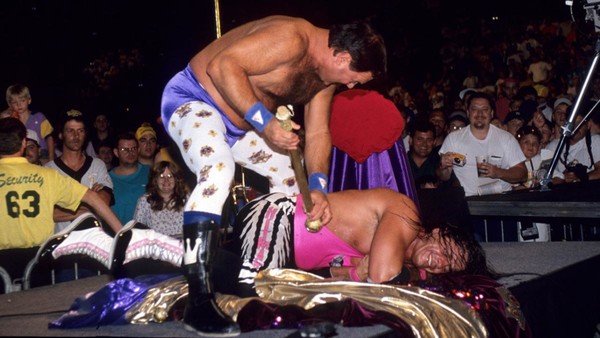
Hart's consolation prize for losing out on the Hogan match turned out to be a critically-acclaimed feud with veteran Jerry Lawler, waged over dishonor toward one's family. The story began at the PPV's conclusion, during Hart's coronation after defeating Bam Bam Bigelow. Lawler confronted Hart with a claim that he was the only true King in WWE.
After Hart served up a rejoinder, he was jumped from behind and assaulted with the royal props that were on the staging area. At one point, Lawler lifted up the wooden throne and threw it down forcefully onto Hart, leaving Hart in a crumpled heap. By Hart's recollection, he would have a hard time taking a deep breath without pain for months after the altercation.