10 Fascinating WWE Survivor Series 2001 Facts
RIP Invasion - we decreasingly cared about ye.
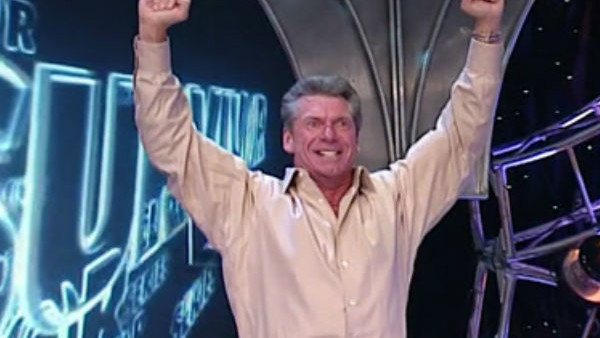
Spend more than two minutes thinking about the lost opportunities of the 2001 WCW invasion, and you'll just get irritated all over again. What should have been a slam dunk, a paradigm-shifting presentation of WWE vs. WCW in toe-to-toe fights for supremacy, ended up a colossal disappointment. From the time Shane McMahon announced that he'd swooped in and bought the remnants of WCW, to Vince McMahon standing tall at the end of Survivor Series 2001, eight months hadn't even passed. Given how poorly the entire angle was executed, maybe it should've been put out of its misery sooner.
It's not that the 2001 Survivor Series was a bad show; in fact, it was pretty enjoyable, making 2001 probably the only year in WWE history where each Big Five pay-per-view was at least "good". It's just that for a night waged over high stakes, the event didn't quite live up to those lofty standards. In fairness, that's because the show was compromised by just how fetid the Invasion was prior to 18 November.
Perhaps that's the biggest reason why Survivor Series 2001 is buried in the dustbin of history: solid as the show was, it's marked with the scarlet letter of WWE's biggest fumble.
Here are ten facts about Survivor Series 2001 you may not have known.
10. Tickets Were Still Available Two Days Before The Show

You'd think that if the Invasion were handled better, as the ultimate in wrestling civil wars, tickets would've been as coveted as gold. Two and a half years before Survivor Series, WWE held their 1999 King of the Ring inside the same building - The Coliseum in Greensboro, NC. That event brought in just a shade under 20,000 fans (19,761 to be exact) at a time when WWE could do no wrong.
Fast forward to the end of the now-sterile WWE/WCW war, and Survivor Series 2001 could only bring in 10,142 fans to the same venue. To make matters worse, Figure Four Weekly reported that only 8,030 of those fans paid, meaning more than 2,000 fans got in for free. F4W also reported that $300 tickets were still available as of the Friday afternoon before the pay-per-view. Clearly, the boom was long over.
9. A Low Number Of Invasion "Originals" Took Part In The Show

In all, 48 different wrestlers took part in a match at the 2001 Survivor Series, the show in which, you'll recall, invading forces were attempting to take down the WWE establishment. As it turned out, the true number of "invaders" among the belligerents was minuscule.
Only 12 of the 48 wrestlers on the show made their debut within the Invasion angle itself. Nine of them were relegated to the "we have nothing better for you" battle royal: Tommy Dreamer, Diamond Dallas Page, Lance Storm, Billy Kidman, The Hurricane, Chavo Guerrero, Hugh Morrus, Shawn Stasiak, and Chuck Palumbo. The other three were Jazz, Booker T, and Rob Van Dam, who took part in the ensuing matches.
This list doesn't include Alliance defectors, such as The Dudley Boyz, Raven, Steve Austin, et al - just those who officially entered the company in order to take part in the angle. It goes to show just how little authenticity there was in the story, after numerous WWE-brand performers were booked to water down the heel side by joining them.
8. There Was Originally Supposed To Be A Cruiserweight Unifier

The 2001 Survivor Series featured a pair of unification matches designed to lighten the championship load. United States Champion Edge faced Intercontinental Champion Test, while The Dudley Boyz and The Hardy Boyz waged war over both sets of Tag Team belts.
The show was also to have featured WCW Cruiserweight Champion Tajiri facing WWE Light Heavyweight Champion X-Pac. The match ended up being scrapped when Sean Waltman was pulled from the road in late-October 2001 with injury.
Shortly after Survivor Series, the Light Heavyweight belt was abandoned in favor of the Cruiserweight lineage. Upon returning to action in March 2002, X-Pac was apparently billed as Light Heavyweight Champion in a handful of house show matches with Spike Dudley, but the belt never returned to television.
7. Edge Injured Himself During Rehearsal That Day

Edge's singles push continued in earnest with a victory over Test in the Intercontinental/United States titles unifier. The match was rather heated down the stretch with wild false finishes, and the Greensboro crowd were buying into each one. In the end, Edge countered a full nelson slam into a rolling pinning combination to unify the straps.
Edge notes that earlier in the day, he and Test rehearsed that spot, and the first attempt didn't end well. The future "Rated-R Superstar" came straight down on his noggin while executing the elaborate roll. Edge adds that he was "out of it for the rest of the day", and had some mental lapses during the match itself.
Owing to the chemistry he shared with Test, and his own consummate professionalism, Edge got through the match with nobody being the wiser.
6. The Women's Title Hadn't Been Used In Six Months

Trish Stratus captured the first Women's Championship of her career, winning a six-way match over Lita, Molly Holly, Jacqueline, Ivory, and the debuting Jazz. None of those five were champion going into the match, as the belt had been vacant and forgotten for some time.
The previous champion was Chyna, who was last seen in a WWE ring at the Judgment Day pay-per-view that May. Reportedly, Chyna had become increasingly difficult to deal with. Additionally, she was unhappy about being put in the women's division, after the company came to see no value in her working overly-choreographed matches with the male wrestlers. Her and Triple H splitting up in real life did her no political favors.
Chyna never lost the belt, and instead just disappeared from WWE canon. The division moved on with a new crop of stars, and Stratus as the face of the lot.
5. It Was The First Survivor Series To End With An Elimination Match In Eight Years

From 1987 through 1993, only one Survivor Series did not have an elimination match close out the show: the 1992 edition, where Bret Hart and Shawn Michaels competed for the WWE Championship. Between 1994 and 2000, every Survivor Series ended with a non-elimination match, most of which were for the top belt. The novelty of the event had greatly eroded.
Of course, when the big blow-off to the Invasion angle, where one side would be excommunicated, is a five-on-five elimination bout, you'd almost have to end the show with that match, right?
Indeed, Team WWE vs. The Alliance was the first elimination match to end Survivor Series since The All-Americans vs. Foreign Fanatics match from 1993. Little tidbit: The Undertaker was in both matches. If Vince McMahon had gone to the trouble of buying out some WCW talents' Time Warner contracts for the angle, maybe Scott Steiner could've been in both matches, too.
4. Big Show Replaced Vince On Team WWE

Shane McMahon was one of the five men on the WCW side, and based on original plans, he would have been opposed by his father in yet another battle of McMahons. Vince himself was supposed to take part in the match alongside partners The Rock, Chris Jericho, The Undertaker, and Kane.
Somewhere early on in the event build, Vinny Mac was swapped out for The Big Show. Most reliable sources indicate that McMahon had an injury of some sort at the time.
Vince had last competed on Raw three weeks before the pay-per-view in a match with Shane, which was where Kurt Angle turned heel, defecting to The Alliance. It's unknown if the injury occurred there, or took place during one of the boss' routine seven-hour weight-lifting sessions.
3. Booker T And Rob Van Dam Were The Only True Invaders On Team Alliance

If you could fantasy book what Team WCW would have been at Survivor Series 2001, within realistic parameters, what would you come up with? If you avoid wrestlers that were more "WWE" than "WCW", you'd probably go Ric Flair, Diamond Dallas Page, Sting, Booker T, and Goldberg, or some slight derivative, right? Match them with Austin, Rock, Undertaker, Foley, and a healthy Triple H, and that's a main event.
Because WWE (read: Vince) lost so much faith in WCW guys for "not knowing how to work" (and for having the audacity to be anything but WWE guys), most of the true invaders were buried in the undercard, or sent to developmental to learn how to work.
WCW original Booker T and ECW mega-star Rob Van Dam were the entire outsider representation on the villains' team, partnered with WWE cash cow Steve Austin, WWE creation Kurt Angle, and the WWE owner's son, Shane McMahon. Given how crappy the entire angle was, this seems to be a rather fitting conclusion.
2. It Was The First Time The Rock Had Ever Pinned Stone Cold

The fates of WWE and WCW hung in the balance once the grand elimination match boiled down to just The Rock and Steve Austin. The designed "swerve" of Kurt Angle double-crossing Austin paled to the bigger swerve: Rock actually got to pin Austin for once.
Since the first time the two WWE megastars locked horns in 1997, it was Austin that always came out on top against Rock. WrestleMania XV, WrestleMania X-Seven, house shows, you name it: 'The Great One' had never gotten a pinfall or submission victory over Austin prior to Survivor Series 2001.
Rock polishing off a wounded Austin off at WrestleMania XIX (for good, it turned out) is often lauded as 'The People's Champion' finally settling the score. That doesn't change the fact that Rock dropped Austin with a Rock Bottom and pinned him sixteen months prior.
1. Much Of The Disbanded Alliance Were Wrestling For WWE The Following Weekend

And this is why fans are less apt to take wrestling stipulations seriously. With the exception of "immune" members of the Alliance faction (those with belts, or, like Test, had won immunity challenges), the rest of the group was supposed to be cast out of WWE. Obviously, they weren't going to be let go in real life, but it was alarming how fast many of them returned to action.
Just five days after Survivor Series, at a post-Thanksgiving house show in Daytona Beach, FL, eight Alliance castaways worked: The Hurricane, Molly Holly, Shawn Stasiak, Raven, Tommy Dreamer, Steven Richards, Hugh Morrus, and Diamond Dallas Page. Jazz and Booker T were back with the other half of the touring group the next day in Philadelphia.
It would be some time before most of the vagrant wrestlers returned to television, but it didn't take long for house shows to undermine the game-changing stipulation.