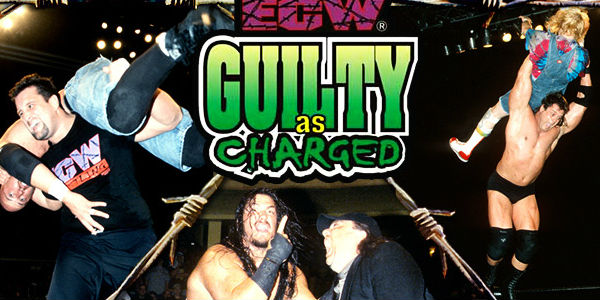
10 Times ECW Purposefully Lied To The Fans

Paul Heyman's one rule at ECW was never to lie to the fans? Not quite.

In being the most willful of con-man schemes (pro wrestling basically involves cheering wildly and being actively engaged in a "competitive" match with a predetermined finish), pro wrestling is nothing short of being one of the world's biggest lies. As a promoter of pro wrestling, the need to base the lie in truth (while oftentimes still telling a lie) is important. For the purposes of Paul Heyman's hyper-realized Extreme Championship Wrestling, the need to lie was based in the idea that the action in the promotion oftentimes appeared so "real" that the ability to slip in a lie every so often was much easier to do there than in any other promotion in history. Guys were really bleeding, women were really naked, bones were really broken, and yes, that absolutely was barbed wire. But, with a promotion so often based in truth, there existed numerous times wherein Paul Heyman absolutely lied, ultimately because one lie wrapped inside of nine truths equals ten ideas that are all equally believable. In a situation as unique as what existed in ECW, shamelessly lying to the fanbase added to the promotion's mystique, and ultimately allowed ECW to separate itself further from WWF and WCW, companies still stuck presenting pro-wrestling as either "lock-up and arm drag" battles or cartoonish buffoonery. Here are ten of (the many) times ECW purposefully lied to the fans.

10. ECW Hated The WWF

The initial premise upon which the viral success of Extreme Championship Wrestling was built was that Paul Heyman was the booker of a rag-tag crew of professional wrestlers not wanted by "hated" mainstream wrestling organizations. While yes, WCW dislike was a major issue in ECW (given the fact that Heyman sued WCW for damages upon his firing from the company), WWF hatred was largely cooked up as a way to engender "smart mark," "pure wrestling" and Internet fan support for the promotion. One need only look back into Heyman's own pro wrestling history to note that any perceived ill will had by a Heyman-led ECW toward WWE was baseless conjecture. Heyman's first pro wrestling job came from working with the WWWF as a Madison Square Garden photographer in the 1970s, with Federation heel managers Grand Wizard, Freddie Blassie and Captain Lou Albano being the individuals credited with "breaking in" Heyman in the wrestling business. As well, there's the fact that at a certain point of the mid-90s, it was impossible to tell WWF's developmental and the ECW roster apart, as between Brakkus, Justin Credible and more, two companies that hate each other can't exchange that much talent with any level of heat between them.

9. Paul Heyman Was Not On The WWF Payroll

On the Ladies and Gentlemen, My Name is Paul Heyman DVD, Paul Heyman carefully explains the unique nature of how he worked with WWE in the mid-90s, but he himself was never on the WWE payroll. The idea that Too Cold Scorpio moving rosters from ECW to the then- (where Scorpio became Flash Funk) was as simple as Vince McMahon paying HHG Corp (ECW's shell ownership group) and not Heyman himself $1000 (the cost of Tommy Boy Records' company sponsorship tied to Too Cold Scorpio) is highly entertaining. Stating that the money went into production and development fees for ECW (and not into Heyman's pocket) is not they same as Heyman himself getting paid is one of pro wrestling's biggest "chicken and egg" arguments ever. So, yes, Heyman wasn't paid directly by WWE, and not on their payroll. But, monies earned by ECW from WWE went into developing a promotion in which Heyman was invested as an on-screen character and off-camera promoter, meaning that production improvements could lead to an increase in monies earned by Heyman. While yes, Paul E. wasn't literally, on the WWF payroll in fact, he was certainly figuratively there.

8. The Fans Got ECW On Pay-Per-View

For as much as the "Strictly ECW" fan-led campaign to gain ECW PPV clearance worked insofar as clearing the initially balking Premiere service, ECW on PPV as a fan-led movement failed when 1997's Barely Legal was under consideration for both Viewer's Choice and Request TV. Viewer's Choice ultimately decided against airing ECW's initial PPV, and after Heyman met with the group, Request TV decided to air ECW's inaugural PPV offering. For the purposes of creating an engaged indie-to-mainstream fanbase, telling the fans that "they" got the company on pay-per-view is an amazing carrot to dangle. It kept the fans working hard and spreading the gospel through viral channels and creating a strong independent buzz. In a case of the truth being stretched into a lie, this may ultimately be one of wrestling's best examples thereof.

7. ECW Was Blocked From Getting Another TV Deal By The WWE

Ecw Hardcore Tv After cancellation in October 2000, ECW went without a national television program until its April 2001 closure. Of the many rumors floated to ECW fans regarding the issues surrounding ECW's inability to secure a national television deal was that Vince McMahon and WWE were "blocking" ECW from airing on other networks. For as awesome of an idea as it is for ECW to possibly dig back into the "we hate WWF" animosity, also consider the fact that at that moment, ECW was a company with massive debt and numerous creditors. As well, ECW had very few marketable stars with mainstream awareness at that point, and would be a TV brand using its library of matches featuring talent now appearing elsewhere as a draw. Thus, for even as true as Vince McMahon possibly being anti-ECW is, the more likely story is that for as much as Paul Heyman could hustle, ECW had very little of value to offer a national cable brand in the way of mainstream cache for ECW's potential broadcast content.

6. Tod Gordon Was The "WCW Mole" In The ECW Locker Room

https://www.youtube.com/watch?v=IrVkX2r8U5U It's September 1997 and the Monday Night Wars are getting hot and heavy. The WWF and WCW are exchanging talent between each other, and in all likelihood, WCW President Eric Bischoff is aware that there is an existing talent sharing relationship existing between the WWF and ECW. Is it possible that Bischoff - in wanting to one-up Vince McMahon - decided that siding with then ECW primary owner Tod Gordon was the answer, to the tune of siphoning talents including The Pitbulls, Stevie RIchards and possibly the likes of Shane Douglas and Tommy Dreamer? Maybe. However, what is more likely is Gordon's own explanation years later that the €œECW mole€ story was merely a work created to help ECW save face when they started losing so much talent. Always one to keep the pot of subterfuge and "evil empire" belief boiling, casting WCW as an outside invader (while yes, WWF were a far more friendly and cash infusing-to-ECW company) definitely makes sense.

5. Mike Awesome Was Unjustified In Signing With WCW As The ECW World Heavyweight Champion

Being the World Champion of a globally-recognized pro wrestling promotion is not exactly the best time to consider signing with another, competing national pro wrestling promotion. However, in April 2000, Awesome left ECW suddenly, and appeared on WCW Monday Nitro, attacking Kevin Nash in his debut. Of course, but a week later, there was Awesome back in ECW in the ring at a house show losing the ECW Championship to the then-WWF signed Tazz. It was an ultimate burial, the kind of move in pro wrestling that's reserved for the worst of the worst at doing business. However, in interviews after the closure of ECW, ex-ECW wrestler and friend of the now deceased Awesome, Lance Storm has stated that Awesome was justified in leaving ECW because he was owed back monies and rightfully took the stance that he refused to be champion of the promotion if the money he was owed for appearances was not paid in full prior to him continuing his relationship with the company. So yes, while losing to Tazz was petty terrible, Awesome being unpaid was likely much worse.

4. Living Dangerously Is Scheduled For March 11, 2001

Ecw Living Dangerously ECW had their final in-ring show on January 12, 2001 in Pine Bluff, Arkansas. However, until February, die-hard ECW fans were holding out hope that the still-scheduled March 13, 2001 pay-per-view event would take place. Of course, that never materialized, and on March 5, 2001, Heyman debuted in Washington, DC as a color commentator replacing Jerry "The King" Lawler on Monday Night RAW. Of course, this was six days prior to the scheduled March date, which should have given ECW fans hopeful for one last hurrah all of the information they needed to know regarding the company's future. Leaving the company's possibly future hanging on the line until the last possible moment? A lie tied to a truth that if it ever came true would have likely been a miracle.

3. Shane Douglas "Threw Down" The NWA World Heavyweight Championship

Any story involving wrestling promoters Dennis Coralluzzo and Paul Heyman should likely be considered in the same vein as stories that begin, "hey, there's a bridge in Brooklyn that I'd like to sell you." Coralluzzo was the New Jersey-based promoter of the resurrected National Wrestling Alliance, the famed company re-started by Jim Crockett after the no-compete he signed when he sold his controlling interest in the NWA to Ted Turner in 1988. The NWA's Philadelphia-based Eastern Championship Wrestling held an NWA Title tournament, a tournament won by the largely ECW-booked Shane Douglas. https://www.youtube.com/watch?v=Pi6MOHFZEBc There are those who believe what Coralluzzo believed, which is that Crockett and Gordon were in collusion, and the throwing down of the ECW title was a slap in Coralluzzo's face. As well, there's the idea that Gordon and then-ECW booker Heyman didn't care about Crockett either and wanted ECW to secede from the NWA. Of course, in all of this, there's no mention of Crockett himself, who, if made aware of ECW leaving, could see the value of Shane Douglas throwing down the NWA title as either Crockett realizing the folly in his plan of resurrecting the NWA name, or believing that the level of intrigue surrounding the angle could have potentially been a boost to the NWA, too. But Douglas "surprising" the NWA with his move? More than likely not even possible.

2. Taz Has A Mixed Martial Arts Background

Somewhere between Taz playing football, studying judo and choking out one-time mixed-martial arts fighter Paul "The Polar Bear" Varelans, the association between Taz and mixed-martial arts left many ECW fans believing that if Taz were to enter into a shoot-fighting competition, he'd have a more than fighting chance of succeeding. However, nothing could likely be further from the truth. The genius of ECW's booking and presentation of Taz was to have him use many parts of MMA's mythology, including brutal suplexes, the kata hajime submission, tap outs, his "Team Taz" fight team and as well, the fact that he rarely ever lost in using his MMA style in a professional wrestling ring. In a strange allusion to the present belief by many one-time pro wrestling fans that MMA is "better" than pro wrestling, in using "MMA" in wrestling, Taz differentiated himself from the pack, won matches and became an ECW superstar. But was he a legitimate mixed martial artist? Absolutely not. In marrying a lie to the truth, ECW created a unique alternative universe for pro wrestling that has been oftentimes approached again, but not quite reached in the same manner as during Taz's legendary run.

1. The Sandman Is Blind

The Sandman 1980's most box-office successful pro-wrestling angle was in the Mid-South territory and involved the Fabulous Freebirds blinding the Junkyard Dog with their hair-removal cream. For months, the Dog was presumed legitimately blind by fans in the territory because he was not seen locally. As well, when announcers mentioned that JYD's wife had given birth to their first child, the seemingly blinded Junkyard Dog mentioned that he hadn't even seen the birth of his newborn daughter! Of course, when he returned (miraculously with vision), the box office draw was immediate, and led to a well-attended card at the Louisiana Superdome for the angle's blow-off. Similarly, in 1994, The Sandman was believed blinded after a lit cigarette was accidentally pushed into his eye by Tommy Dreamer during an "I Quit" match with Tommy Dreamer. The Sandman disappeared from TV, the streets and general public view, while in the ring, his manager Woman turned on The Sandman. In what was believed to be a shoot, The Sandman appeared at the ECW Arena claiming that due to the injury, he would be forced into retirement. Brave, yet saddened babyface Tommy Dreamer then decided to dedicate the remainder of his career to The Sandman, which was met with positive response by a crowd thinking that The Sandman was legitimately impaired. When Tommy Cairo began mocking The Sandman, Tommy Dreamer severely beat up Cairo in a match at November to Remember. Of course, when Sandman's retirement ceremony occurred during November to Remember, Sandman was threatened by his ex-manager Woman, who assaulted Sanddman's wife Lori Fullington, prompting Tommy Dreamer to make the save. Of course, once in the ring (and to the complete shock of the crowd) Sandman revealed he was never blind in the first place, and attacked Dreamer. In this case, lying to the fans made The Sandman ECW's top heel, made Tommy Dreamer into even more of a sympathetic babyface, and led to great business for the promotion.

Contributor
Contributor

Besides having been an independent professional wrestling manager for a decade, Marcus Dowling is a Washington, DC-based writer who has contributed to a plethora of online and print magazines and newspapers writing about music and popular culture over the past 15 years.