10 Worst Wrestling Stables Of The '90s
Back in the '90s, these stables should have been put out to pasture a lot quicker.

Stables are one of the most effective ways to get several wrestlers over at once. From the Four Horsemen to Evolution to The Shield, many stables throughout wrestling history have used the diversity of their members and the strength of their numbers to captivate audiences and generate success.
The '90s saw several unique and memorable stables across various companies. From smaller outfits such as Shane Douglas' Triple Threat or Raven's Flock to the giant merch-moving monsters such as D-Generation X or the New World Order, these groups served as fertile ground for the advancement of several careers.
However, not all stables were created equal. While many enjoyed a great deal of success, others weren't so fortunate. Be it through bad booking, a bad gimmick, or just the fact they had bad wrestlers, these stables from the '90s are not in the same conversation as DX or the Nation of Domination in terms of greatness.
Of course, some of these groups weren't outright bad, but even if everything on the surface appeared peachy with them, there was a bit of rot to be uncovered from behind.
10. Los Boricuas

In the primordial stage of the Attitude Era, WWE was infatuated with faction warfare. Before the Nation of Domination/DX feud of 1998 that jumpstarted both Triple H and The Rock into the main event picture, WWE had a much lamer stable feud labeled "The Gang Wars", in which three or four teams of boring, interchangeable, mediocre wrestlers competed in endless tag team encounters. It started in 1997 with the dissolution of the original Nation of Domination, and Los Boricuas were some of the major players. And they were quite bad.
Founded by ex-Nation member Savio Vega (no, I have no idea why a Puerto Rican was allowed in the militant black separatist group), Los Boricuas were essentially the NOD, except Puerto Rican. Consisting of Vega, Miguel Perez, Jesus Castillo, and Jose Estrada Jr., the Boricuas had no defining characteristics aside from the fact that they were all from the same territory of the U.S. They were all very much interchangeable aside from the fact that Savio Vega had been a presence on WWE TV for several years, and Miguel Perez had a very hairy back. Seriously, go watch their matches - one of the few things fans chanted was “Shave your back” at Perez.
Given the fact that Savio Vega was never over in WWE, it’s a wonder why they thought giving him three equally boring clones would have added intrigue.
9. The Disciples Of Apocalypse

So you know that entire spiel I just wrote about why Los Boricuas didn’t work? I’m more-or-less about to say the exact same thing with the DOA. Hey, if WWE were lazy enough to copy/paste with their stables in 1997, that gives me license to be the same 20 years later.
Founded by ex-Nation member Crush (no, I have no idea why a white dude was allowed in the militant black separatist group), the Disciples of Apocalypse were essentially the NOD, except a biker gang. Consisting of Crush, “Skull,” “8-Ball,” and "Chainz", the DOA had no defining characteristics aside from the fact that they came the ring riding motorbikes.
Unlike the Boricuas, however, all four members of the DOA were on WWE television before the stable formed. Crush obviously had maintained a steady presence and was consistently a flop, “Skull and 8-Ball” (AKA Ron and Don Harris) were once the “Blu Brothers” (and they flopped), and “Chainz” was Brian Lee, AKA the Fake Undertaker from 1994. Wanna guess how he did?
However, like the Boricuas, everyone in the DOA was a boring, bad wrestler, and the endless series of tag matches between the two groups from 1997 to 1998 was a key factor in making WWE’s undercard nigh unwatchable.
8. The Truth Commission

Last group from the late ‘90s gang wars, I promise.
Born out of the USWA, the Truth Commission was not-so-subtly named after the Truth and Reconciliation Commission from South Africa. Except while the T&C Commission was designed to mediate trials and provide amnesty in the wake of the abolishment of apartheid, The Truth Commission were presented as palette-swapped Nation of Domination (i.e. they were a militant white separatist faction). Why anyone thought people would want to watch this in a wrestling program is beyond me.
Originally led by "The Commandant", a South African actor who had befriended Bret Hart, the Commission won the USWA tag titles three times before being called up to WWE, where they would soon find a new leader in the Jackyl, AKA Don Callis. Much like the Boricuas and DOA, The Truth Commission’s fatal flaw was simply that none of them were good at wrestling. Callis mainly cut promos for the group, and the wrestlers themselves included the former Mantaur, the future Bull Buchanan, and Kurrgan. Such lack of ability was evident at Survivor Series 1997, where in their 8-man match against the DOA, the best worker out of the entire bunch was Crush.
Thankfully, the Commission would quickly fade away, with Callis and Kurrgan moving onto a much... odder team.
7. The Odditites

The Oddities are looked on with a bit more fondness than other groups on this list. That’s likely because they were present at a time when WWE was white hot and could do no wrong. Still, with the benefit of hindsight, it’s clear these guys stunk up the joint.
Featuring the aforementioned Don Callis and Kurrgan, the group was pitched as a sort of freak show, featuring the former Earthquake John Tenta (now the masked Cartman enthusiast Golga), Luna Vachon, the Insane Clown Posse, and Giant Silva. Callis has mentioned in shoot interviews how the inclusion of Silva was a mistake, since as he was taller than Kurrgan, and that diluted Kurrgan’s status as a giant monster.
However, that was really the least of the group’s problems. The fact is: they were all quite bad at wrestling, performing, or whatever else their roles in the group were. Sure, John Tenta was a great big man back in his prime, but by 1998, he was well past that. Silva and Kurrgan were of course lumbering big men who couldn’t work, and the Insane Clown Posse were to wrestling as they are to rap music: a plague (any potential Juggalos in the comments may direct their ire to someone who cares).
The Oddities were just another entry in a long line of bizarre Attitude Era gimmicks that, while over for a time, aged about as well as ICP music.
6. The York Foundation

Let’s take a break from dumping on WWE and head down south to WCW.
Credit where credit is due, The York Foundation was, and still is, an interesting concept for a wrestling stable, but in terms of execution, it was a bit of a flop with the audience. The stable began when Mike Rotunda turned heel and became Michael Wallstreet, a rich New York yuppie who aligned with Alexandra York (played by Terri Runnels). Wallstreet won his matches thanks to York’s computer program which gave him the best strategy to defeat his opponents.
When Rotunda left WCW, York recruited Ricky Morton, Terry Taylor, and Tommy Rich, now Richard Morton, Terrence Taylor, and Thomas Rich, as well as Mr. Hughes to serve as their bodyguard. The group, however, would not last long, as by late-1991, the members became enhancement talent, and by 1992, had all gone their separate ways.
The idea of using computer analysis to give a wrestler a strategic edge is a compelling idea for a group of heels. However, where the York Foundation likely suffered was that the mix of suited cosmopolitan millionaires with such a high-concept gimmick didn’t mesh with the more down-to-earth, southern style of WCW. The group felt more like late-80s Justice League villains than a wrestling stable. Perhaps if WWE were to try a similar concept today, it would get over more.
5. The Dungeon Of Doom

If the York Foundation felt more fitting in a late-80s DC comic, then the Dungeon of Doom definitely felt more at home in a late-70s Scooby Doo cartoon.
When Kevin Sullivan took over as the booker of WCW in 1994, he knew he had to gain the trust of the all-powerful Hulk Hogan. To satiate the Hulkster, Sullivan created an angle that Hogan was comfortable with: an evil faction of big heels who would do the job for him. Initially, the "Three Faces Of Fear", consisting of Sullivan, John Tenta, and Ed Leslie, were the only ones standing in the way of Hulkamania. However, by 1995, the group rebranded itself as the Dungeon of Doom: one of the most comically shameless acts of the decade. Intentionally tongue-in-cheek, the group cut ridiculous programs from a mysterious cave lair and posed about as big a threat to Hogan as Bray Wyatt does to [insert whoever].
They reached their apex at Halloween Havoc 1995, where not only did The Giant win the WCW title, but they revealed their most iconic member: the Yeti. Or, as Tony Schiavone insists he’s called: the Yetay. The group would not last long into 1997, as the nWo quickly eclipsed them as the #1 heel act in WCW. While the Dungeon of Doom was definitely bad, they were also amazing... but mainly bad.
4. The Union

The Union was very short-lived, and it did not leave many fond memories. The group was formed after Shane McMahon ousted Vince from the Corporation and merged with the Undertaker’s Ministry of Darkness. Now led by Shane, the Corporate Ministry was not something many Corporation members were too keen on. Test, Ken Shamrock, and the Big Show would defect from the group and align with Mankind in a real who’s-who of “midcarders we don’t really have anything for at the moment.”
What was the name of this brave group standing up to such an authoritarian force? The Union of People You Oughta' Respect, Son. AKA U.P.Y.O.U.R.S. Now, you might be asking “Hey, where’s the U in yours? This acronym doesn’t make any sense!” Well, if Jim Cornette is to be believed, Vince Russo legitimately couldn’t spell well, so that might be your answer (or it could be the 'U' in 'Oughta').
The Union did little of note in their brief run. Their sole PPV match was at Over the Edge 1999, which of course is only known for the Owen Hart tragedy. Most morbidly, it was after the Union and Corporate Ministry’s tag match that Jim Ross informed the viewers at home that Owen had passed away. Ultimately, the Union faded after Mankind went away to get surgery, and now all they’re known for is a really stupid acronym (and 2x4s).
3. The West Texas Rednecks

WCW in 1999 were big fans of throwing anything at the wall to see what stuck. However, unlike WWE at the time, who would have saw what stuck and gone with it, WCW would see what stuck, rip it off the wall and smash it with a hammer, lest it make them money or change their fortunes. Such was the case for the West Texas Rednecks, a stable/country music band led by Curt Hennig, and joined by the Windham brothers, Bobby Duncum Jr., and near the end, Virgil (he played the tambourine, because of course that’s what Virgil would play).
Pushed as heels, the Rednecks’ major feud was with the No Limit Soldiers, a group of non-wrestlers led by rapper Master P. The problem was that the Rednecks were positioned as the heels, but as the No Limit Soldiers greatly outnumbered them, they did not get the sympathy of the people. Furthermore, the Rednecks' 'Rap is Crap' single went over big-time with a largely Southern crowd who shared very similar sentiments.
Rather than go with how the audience was reacting and capitalizing on their success, WCW continued to push the Rednecks as heels before disbanding the group by October. It was certainly a silly gimmick for a stable, but it could have avoided this list had WCW not... well, WCW’ed the whole thing.
2. The Million Dollar Corporation
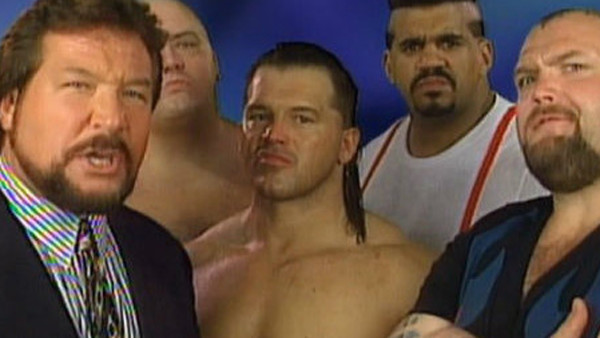
While the Dungeon of Doom were just a group that served as cannon fodder for WCW’s top babyfaces, at least they were entertaining in a campy fashion. The Million Dollar Corporation, WWE’s glorified jobber heel stable from the mid-90s, did not have that going for them.
Led by Ted DiBiase, who was great at his own character, but not that good at managing other people, the group included such powerhouses as Nikolai Volkov, King Kong Bundy, the fake Undertaker, Irwin R. Shyster, Kama, Sid, Tatanka, and others... oh, did I say powerhouses? I meant utter dregs. Even more than the lousy wrestling ability of its members, the group had a miserable record on PPV, regularly jobbing out to Shawn Michaels, Diesel, The Undertaker, and even Lawrence Taylor at WrestleMania XI.
Such a bad track record can be attributed to the fact that there was absolutely no story surrounding the group. DiBiase and his posse just wandered aimlessly from feud to feud with various babyfaces, and the only connecting thread between any of them was “DiBiase is rich and therefore evil, and he has these heel henchmen because they are also evil.” The group had no motivation besides randomly antagonizing the faces because... evil!
Sure, during this time, DiBiase managed great workers such as Bam Bam Bigelow, the 1-2-3 Kid, and Steve Austin, but none of them really needed him, and it’s safe to say the Corporation won’t be a highlight in any future Million Dollar Man video packages.
1. The New World Order

Yes, the nWo were an instrumental part of wrestling history in many positive ways. It was their ascendance that created a boost in WCW’s ratings and forced WWE to raise the creative bar, thus sparking the Monday Night Wars and the late-90s wrestling boom. The nWo shirt, logo, and theme are all iconic pieces of wrestling culture and played a major influence on future groups such as Bullet Club. But seeing as how WCW is no longer around, it would be intellectually dishonest to not point out the damage the nWo caused.
Rather than rise and fall with a satisfying conclusion, the group trudged along for years, adding one jabroni after another, steamrolling over various babyfaces, and of course, keeping Hulk Hogan on top despite fans’ protestations. Almost every major terrible booking decision in WCW from ‘97 to ‘99, from the finish of Starrcade 1997, to Goldberg’s streak ending, to the Fingerpoke of Doom, was linked to the continued push of the nWo at the expense of everyone and everything else.
Eventually, WCW fans had seen enough, and either switched to WWE or stopped watching altogether. Now, there’s only one wrestling company on top, and many would say things have been stagnant ever since. WCW owed their highest peak and lowest valley to the nWo, but it was the latter that ultimately doomed the company.
Are they iconic? Undoubtedly. Were they the worst stable of the ‘90s? Looking at what happened, it’s hard to argue against that idea.