5 WWE Superstars Whose Careers Actually Benefited From Injuries
 Wrestling injuries have always been a common element of the trade. At the height of the territory system, stars would continue to wrestler through their injuries (need that paycheck). Many became defeated and broken men in their older years due to the pain (and pain pills) that dominated their older years (if they made it to their 50s at all) Luckily, the WWE in the 90s changed all that. Men who became injured started to be granted time off to heal. Recently, mega star John Cena and main-eventer Sheamus both became injured. Both men are off television and out of the minds of the fans. History has shown this can be a blessing or it can be a curse. In WWE's modern history of injuries, we have examples of men who benefited after returning from injuries (or in some cases during their injuries) and became huge successes. Here's is the list of the top 5 superstars who benefited from injuries.
5. Rob Van Dam

4. Mankind
 Mick Foley was of the last generation of territory based performers. He paid his dues in independents, WCW and ECW before being given the chance to shine in the WWF. He was saddled (and I mean saddled) with a gimmick, which in the hands of a lesser man, would have floundered (anyone remember Papa Shango) Mankind was a wild man, a sadistic, maniacal madman. He scored victories over the Undertaker and even had a championship match against Shawn Michaels. So did Vader. History tells the tale often of a heel pushed to main event and subsequently buried. Foley easily could have followed Vader into mediocrity. His act got tired in 1997 mostly due to that the WWF never believed him to be a main eventer. Foley was then given a multiple personality disorder gimmick. Again Foley flourished appearing three times in the Royal Rumble as Dude Love, Cactus Jack and Mankind in one of the most memorable moments in Rumble history. He even had a tag team title run with Terry Funk (as the ridiculous Chainsaw Charlie) Yet the top prize and the respect were still out of his hands. In 1998, Foley turned heel once more to be Austin's first challenger for his newly won WWF title. Yet, no one believed Foley was going to get the title. Like many unique and strange characters, he was there to help others get over. Cut to June 1998. Hell in a Cell, Mick Foley became a superstar. He also got severely injured. The scene of Foley falling 30 feet off the cage onto the announce table below is one of the most shown scenes in WWE's history. It was also the moment that made Foley. (Many tend to forget Foley's second fall through the cage almost killed him, literally. It was also not planned) In that match, Foley did two major things (other than getting injured). He proved to management his toughness and willingness to do anything for his craft. But he more importantly, proved to the fans that he was a superstar. From that point on, Foley is God signs started to appear. A WWF championship was not far behind.
3. John Cena
 In 2007, John Cena was on the top of the wrestling world. Cena, along with Batista and Triple H were the combined faces of the company. The time was a transitional period for the organization as the Ruthless Aggression Era began to fade. It was the last official year of TV 14 ratings (all the sex, blood and raciness which accompanies that). John Cena had finished a successful first run with the championship and was being positioned at the top of the heap. He was fighting monsters (Hulk Hogan) in Umaga and Great Khali. He defeated Shawn Michaels at WrestleMania and really was gaining popularity. And yet there was a fear. Could Cena, make it to the next level or would he suffer from the dreaded Hogan fatigue. WWE only had one top star in their history that remained said top star (without any help) for over 3 years. That was Hulk Hogan. Yet starting in 1990 Hogan's popularity started to wane. Cut to 2007, and Cena was starting to get boos. (The fatigue historically happened quicker in later years) WWE had seen it with Bret Hart, Diesel, Triple H, Undertaker and many more. Therefore most eras from 1995 had two main stars. It was Austin/Rock or Angle/Lesnar. Even 2005 was the beginning of Cena/Batista. (With Batista on top, this of course worked out great when he was injured over and over again) Still, 2007 was a successful year for Cena. He had the longest reign with the WWE championship in a decade and was slowly positioning himself at the top. Then it happened. During a match with Mr. Kennedy (poor Mr. Kennedy), John Cena tore his pectoral muscle right off the bone. This is not a minor injury. His championship was over and John Cena was gone, supposedly through WrestleMania the following year. Of all the superstars to return from injury, John Cena's return at Royal Rumble 2008 was the most surprising. No one expected Cena's music to hit at number 30. I remember watching this live and thinking it was a joke. But there he was, in Madison Square Garden, winning the 2008 Royal Rumble. And the crowd went wild. The kids loved it. The adults loved it. John Cena was the man. And from that point on, he never looked back. Shortly after this, The Marine came out, Cena started being the modern day Hogan and WWE went PG with John Cena as their poster boy. Cena avoided the Hogan fatigue by getting injured and then became him. (2012-2013, Cena has definitely been enveloped by this fatigue. We'll see what happens when he comes back in January)
2. Triple H
 Triple H is one of the most polarizing figures in the history of the WWE. No one can deny his talent or his perseverance. He came back from a large punishment in 1996 (after Curtain Call at MSG) and truly succeeded on his merit in the organization. Also nepotism, yup there was that too. Frankly, Triple H has never been one of my favorites. I've always felt he was extremely overrated. John Cena is a star. Steve Austin was a star. The Rock was a star. Triple H was a good hand who made it into the main event. And his BFF status with Shawn Michaels helped his career exponentially. In 1999, during the height of Attitude, WWE needed a large number of main event talent to toss the title back and forth like a hot potato (to give the you never know what's going to happen feel). With Foley basically retiring, Austin dealing with injuries and Big Show not really working out, Triple H stepped in. It's impossible to deny that he was a student of the business. He also worked really hard. His first and second title reigns, while unmemorable, attached him to a very important person in the WWF, Stephanie McMahon. And while Steve Austin was injured in 2000, Triple H was given the time to shine with the storyline focusing of the McMahon-Helmsley "Era". By the point, HHH was the Game ("tribute" to Owen Hart, who was originally supposed to get the gimmick) and the Cerebral Assassin. He moved into position three in WWE as the top heel. He reached the pinnacle as an unlikable heel. His Two Man Power Trip tag team with Austin was the closest Austin got to actually getting booed during Austin's terrible heel run after WrestleMania X8. It appeared that Triple H was going to be the top heel/close to top heel for another few years at least. And then the injury occurred. Triple H tore his quadriceps muscles in his leg. This injury has been ended the careers of many professional athletes and is very difficult to come back from. And to Triple H's credit he did work hard to heal and get strong again and come back even stronger. Why is Triple H so high on this list? Because during his long absence from television (May 2001-January 2002), his real life relationship with Stephanie McMahon flourished. They had already started dating. I am insinuating that this real relationship had something to do with Triple H's success. Wrestling is notorious for nepotism. It is accepted. (Greg Gagne, David Flair etc. etc.) During his time off, his relationship with Stephanie got stronger, and lasted. Now, do I mean that Triple H would not have gotten married to Stephanie if he hadn't gotten hurt? No, I still think they potentially would have. But as my uncle taught me, there is nothing a woman likes more than a wounded warrior. Triple H's mighty return in 2002 easily could have fizzled (especially after losing the Undisputed title after 30 days to Hulk Hogan of all people) but Triple H was in. By 2003, he was a McMahon, then literally handed the world title and started making up for all the WCW guys he couldn't squash during the invasion by squashing the careers of Goldberg, Booker T and Scott Steiner. And now he runs the company. Yay for you. Triple H. Huzzah.
1. Steve Austin
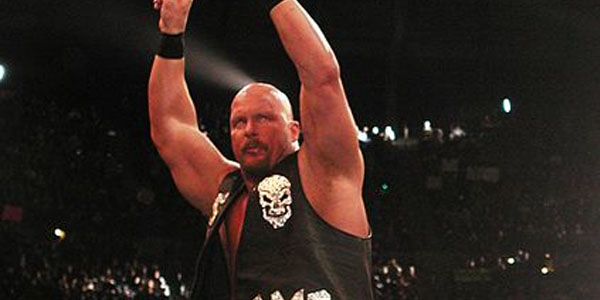
 Steve Austin was the biggest star of the Attitude Era. Yet, He was also almost didn't have the opportunity. Starting in 1996, Austin became the rattlesnake and the response was epic (similar to Daniel Bryan today). Austin's catch phrase Austin 3:16 took fire with the fans and in a double turn at WrestleMania 12, he succeeded in becoming a fan favorite on his way to the main event. Now back in 1997, the IC title was still useful. It hadn't been downgraded to nothing (see Curtis Axel). So it made perfect sense for Austin to win the IC title on the way to a potential world title reign. Cue Owen Hart. Hart was a good worker and a perennial upper mid card talent. In July 1997, he was to drop the IC to Austin. Fate stepped in the way and a botched sit-down pile driver later, Steve Austin's career almost ended before it ever started. Austin, in a moment of sheer will, "rolled" Owen Hart up for the victory and the title. But there was a problem. Neck injuries are some of the hardest injuries to recover from. The neck is the connection between the brain and the spine. Austin not only damaged his neck but he had the potential of never being able to wrestle again. This would have been catastrophic for the WWF as Austin was being transitioned and positioned in the organization. Now back in 1997, many wrestlers were still in old school mentality of fighting through injuries. But the WWF wanted to be smart. They did not want to permanently lose Austin. So something happened. Steve Austin was severely injured, but Steve Austin was on television. He just didn't wrestle. Austin did a slow burn character build. It was him versus the company. And slowly he would stun Sgt. Slaughter, Jim Ross and eventually Vince McMahon (in a shaky performance) as part of one of the greatest builds to a character in a generation. If Austin hadn't been injured, how would his matches actually gone. Would he have been thrust into the main event quicker (especially with Bret Hart leaving and Shawn Michaels being injured) Could Austin have had as big of a career without the injury? I don't believe so. His injury allowed him a type of character development which was 100% character and 0% wrestling. The WWF's entire focus was on making the audience love Stone Cold Steve Austin. It was a successful transition and a successful injury. In the history of wrestling injuries, many have flourished in spite or even because of them. What will happen with Sheamus or John Cena? Only time will tell. Check back soon for the 5 Superstars who floundered after injuries.