8 Biggest Talent Exoduses In Wrestling History
Few things change a company's fortunes quite like a sudden outflow of talent.

TNA currently find themselves in the midst of one of the biggest states of upheaval in the company's history. New owners Anthem have been ruthless in cutting costs ahead of their new era, and the past few days have seen some of the company's biggest stars move on to pastures new.
Wrestlers like Drew Galloway, the Hardys, and Mike Bennett have found themselves out the door. Others are sure to follow. With an influx of new talent set to move in and take their places, Impact Wrestling's roster will soon be unrecognisable compared to what it looked like a year ago.
Wrestling promotions have always been susceptible to such high turnover, however. Major talent exoduses are nothing new for the sport, and some of wrestling's boom periods were kicked off by swathes of wrestlers moving on at the same time. The Golden Era and Monday Night Wars were both characterised by big talent raids, and with WWE entering another period of major international expansion, more are surely on the horizon...
8. WWE Raid NJPW

As New Japan Pro Wrestling’s answer to WrestleMania, Wrestle Kingdom 10 was a huge success. Highlighted by a blockbuster pair of main events in AJ Styles vs. Shinsuke Nakamura and Kazuchika Okada vs. Hiroshi Tanahashi, it took place on January 4th, 2016, and set an impossibly high bar for the rest of the wrestling calendar.
Before fans even had a chance to let the night’s action sink in, however, some earth-shattering news broke. Just a few hours after WK10, it was announced that four of NJPW’s biggest stars - AJ Styles, Shinsuke Nakamura, Karl Anderson, and Doc Gallows - were on their way out of the company. Their destination? WWE.
It was a massive story, particularly as Nakamura and Styles were considered among the company’s cornerstones. Gallows & Anderson, meanwhile, had been a steady presence in their heavyweight tag division for years All four would leave a gaping hole on NJPW’s roster.
It proved to be a good move for all involved, however. AJ Styles has become SmackDown’s franchise player and a former WWE Champion, while Nakamura has accomplished similar feats in NXT. Gallows & Anderson, meanwhile, are the current Raw Tag Team Champions, and NJPW are doing just fine on their end.
They’d probably rather still have the quartet on their roster, but the exodus allowed them to build new stars in Kenny Omega and Tetsuya Naito throughout 2016, and business has barely wavered.
7. WCW Snatch ECW's Finest

Scott Hall and Kevin Nash jumping to WCW to form the New World Order with Hulk Hogan in 1996 was an obvious turning point in the Monday Night Wars. It helped propel Nitro to 84 consecutive weeks of success in the ratings battle, redefined WCW as a promotion, and put the WWF’s long-term future in real jeopardy. It wasn’t the only reason for WCW’s turnaround, however, and even when the company’s main event scene was at its most contrived and ridiculous, you could usually rely on the exciting midcard to deliver.
WCW’s ECW raids were a huge reason for this. ECW was the most buzz-worthy underground promotion in the world, and their independent status allowed them to bring in multi-talented freelancers like Eddie Guerrero, Dean Malenko, and Chris Benoit without tying them down to contracts. Sadly, the lack of contracts made ECW extremely susceptible to raids, and all three joined WCW in summer 1995.
The likes of Rey Mysterio, Psicosis and Chris Jericho followed suit the following year, and WCW’s high-workrate midcard soon resembled an old ECW show. But WCW were never able to harness the star power that the likes of Jericho and Mysterio would exude later in their careers.
The company’s tendency to push ageing plodders like Nash and Hogan over their exciting young stars was one of their greatest failings, and ironically led to another exodus as each of these wrestlers eventually jumped to WWE.
6. The Independents Feel The Sting
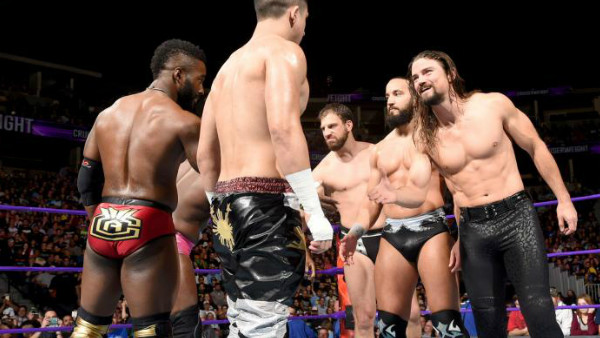
Smaller wrestling promotions have been keeping larger companies stocked with fresh talent for decades. It’s a sad inevitability of independent wrestling that standout performers will eventually attract mainstream interest, and most likely depart for pastures new. An up and coming prospect can’t be expected to curb his/her ambition by staying on the indies forever, after all, and WWE were particularly aggressive in their independent acquisitions last year.
WWE plucked dozens of wrestlers from around the world in 2016, but two promotions had it worse than others. Ring Of Honor saw Cedric Alexander, Roderick Strong, Steve Corino, and Nigel McGuinness leave for WWE, with current champion Adam Cole expected to depart when his contract expires this May. Aside from this, ROH had already waved goodbye to ACH, Veda Scott, and former champions Kyle O’Reilly and Michael Elgin last year.
EVOLVE, meanwhile, is barely recognisable from this time last year. WWE took full advantage of their working relationship with the company to scoop up guys like Johnny Gargano, Drew Gulak, Tony Nese, Lince Dorado, TJ Perkins, and Chris Hero, who has returned to NXT as Kassius Ohno.
The indie talent pool is always in a constant state of flux, but things definitely accelerated in 2016. The scene has never seen such a wide-scale exodus, and if recent reports are to be believed, WWE show no signs of slowing down in 2017.
5. WWE Clean The NWA Out

The WWF spent much of the 1980s snapping up territorial wrestlers on their mission to drag wrestling from its former status as a niche form of entertainment. Some of the company’s biggest names arrived from the territories, and while the mid-80s produced the biggest upheaval, one of the largest exoduses took place from 1988 to 1989.
With Tully Blanchard, Arn Anderson, Barry Windham, and manager JJ Dillon on the roster, the WWF were just a Nature Boy away from having the whole Four Horsemen stable at one point. Ron Garvin and Terry Taylor had already jumped ship by that stage, Dusty Rhodes was on the verge of joining them, and there was even talk of Sting, who was one of the NWA’s fastest rising stars, jumping ship.
This gave the WWF's roster a strong territorial feel in 1989, but none of the above reached their old NWA heights. Windham toiled in the midcard, Blanchard and Anderson rather made up the numbers in the tag scene, while Dusty and Taylor were saddled with polka dots and the Red Rooster gimmick respectively.
Regardless, the NWA was already in deep decline by this point (Ted Turner’s WCW aside), and the last big talent exodus only accelerated their downfall.
4. Mitsuharu Misawa Guts AJPW

Giant Baba’s All Japan Pro Wrestling dominated the puroresu scene in the 1990s.
Legendary matches between their Four Pillars (Mitsuharu Misawa, Kenta Kobashi, Toshiaka Kawada, and Akira Taue) and gaijin like Stan Hansen created a legendary run that’s still considered a benchmark by many wrestling fans today - but their decline was steep and devastating.
Baba passed away in January 1999 and his widow, Motoko, inherited control of AJPW. Misawa, the company ace, was appointed president, but he grew increasingly disheartened with Motoko’s proposed direction for the company. This ultimately led to Misawa departing to form his own promotion (Pro Wrestling Noah) in May 2000, taking the vast majority of the roster with him.
All but four members of AJPW’s roster followed Misawa to NOAH, and the new company prospered. NOAH became Japan’s second biggest promotion very quickly, and with AJPW floundering, Misawa’s company were seen as the true continuation of Baba’s legacy. Bolstered by a tremendous junior heavyweight division, NOAH was named the Wrestling Observer’s top promotion in 2004 and 2005, and drew an astonishing 62,000 to the Tokyo Dome for Destiny ‘05 (in contrast, NJPW’s Wrestle Kingdom 11 drew 26,000 earlier this year).
AJPW were eventually taken over by Keiji Mutoh, but their run on top was over. Misawa crippled them, and while NOAH hit their own decline with their founder’s death in 2009, AJPW have never truly recovered from the exodus.
3. Vince Jr. Gets Aggressive

Vince McMahon Jr.’s World Wrestling Federation had started taking over the wrestling world by 1985. The era of Hulkamania was in full flow, and with the biggest star in wrestling on their books, Vince’s dreams of taking wrestling to the mainstream were about to be realised with WrestleMania I. Other companies started panicking, and, unable to compete with McMahon’s financial clout, they decided that the only way to compete with the WWF was to join forces.
This decision was hastened following a wide-scale talent raid that saw a number of major players depart the territories for the WWF over previous years. The AWA initially lost guys like Ken Patera, Adrian Adonis, and Jesse Ventura, with personalities like Bobby Heenan and Gene Okerlund soon following. The NWA, meanwhile, lost Roddy Piper, Greg Valentine, Ricky Steamboat, and Bob Orton, many of whom would become major stars in WWE.
The NWA and AWA combined their talent in the aftermath, with the first SuperClash card drawing 20,000 fans in 1985. While initially successful, however, the union was short-lived. The AWA’s Verne Gagne accused David Crockett of poaching his wrestlers for the NWA, and while those organisations toiled, the WWF soared.
McMahon’s company soon became an unstoppable juggernaut on the back of the NWA/AWA talent exodus, with a number of these wrestlers (and further acquisitions like Junkyard Dog) playing integral roles.
2. The Monday Night Wars

Though the Monday Night Wars were too vast and far-reaching to be classified as an individual talent exodus, it acts a perfect banner for a number of smaller scale talent raids throughout the 1990s. It seemed like barely a week would pass without at least one wrestler jumping between WCW and the WWF in those days, with WCW particularly aggressive in their acquisitions.
The early 90s saw WCW draft in some of the WWF’s biggest former stars in Hulk Hogan, Randy Savage, and Jake Roberts. Each experienced a varying level of success in WCW, but their signings represented a huge statement (Hogan in particular), and set the tone for the years that followed.
The Wars kicked off with Lex Luger jumping ship on the first episode of Nitro, with wrestlers like Scott Hall, Kevin Nash, the Steiner Bros, and Bret Hart following over the coming years. The WWE were not shy on raiding their competition, either, and specialised in taking discarded midcarders like Triple H and Chris Jericho and turning them into megastars.
Literally dozens of wrestlers switched between WWE and WCW during the Monday Night Wars. Given WWE’s current lack of competition, it’s extremely unlikely that we’ll ever see this kind of drawn-out, multi-year talent exodus again.
1. The Invasion

As far as singular talent exoduses go, nothing even comes close to the Invasion.
Sure, the outflow of WCW and ECW talent was enforced by those company’s failings (and Vince McMahon’s acquisition), but American wrestling has never seen so many wrestlers jump ship at one time, even though some of the era’s biggest stars were absent.
WCW headliners like Scott Steiner, Goldberg, and Sting opted to stay at home and sit out their lucrative WCW deals instead of accepting McMahon’s pay cuts. This lack of star power played a huge role in the Invasion’s eventual failure, but the WWF was still able to secure dozens of ex-WCW talent. Booker T and Diamond Dallas Page stood as the biggest names, but they were joined by popular midcarders like Billy Kidman and Chris Kanyon and up-and-coming stars in Sean O’Haire and Chuck Palumbo.
On the ECW side, major players like Sabu and The Sandman were missing, but WWE still recruited talents like Justin Credible, Rhyno, and the hugely popular Rob Van Dam. WWE had never seen such a concentrated influx of talent. Their roster was left bigger and more bloated than ever before.
The Invasion eventually flopped, and without competition, the business hit a steady decline that it has never really recovered from. Some of the WCW/ECW imports prospered, but most floundered in the presence of pre-established WWE stars.
The whole affair remains one of the biggest missed opportunities in WWE history.