Every Cinematic Wrestling Match Ever - Ranked!
Welcome to the "new normal".
In a way, WWE's use of cinematic-style wrestling matches is a lot like buses. You wait years for a genuinely good one, and then all of a sudden two crash through your living room wall on successive nights, and render you unable to speak for hours afterward.
As I say, in a way.
This new(ish) style of match is one that largely takes the action away from the ring and allows for cuts, retakes, visual effects, and other cinematic wizardry that's just not possible in front of a live crowd. While boiler room matches and even the Hollywood Backlot Brawl were all spiritual forerunners to this new genre, only very recently have wrestlers thrown the contests purely into the realms for filmmaking and, so far, to incredibly mixed results.
Speaking ahead of WrestleMania (but no doubt having seen the incredible features that would be contained within) Triple H spoke of WWE never getting "back to normal" after all this. "I don't think that's going to happen, I think that it will get back to some normalcy, but the new normal will be what is normal. It's not going to be what it was before. The opportunity of doing WrestleMania with these off-site shoots will open our eyes to different ways of doing things. Maybe it will change the product for the better in the long run."
That means we can expect a lot more of these contests in the coming years but, with them at the forefront of everyone's minds right now, let's examine their storied (and incredibly varied) history...
11. The House Of Horrors Match

I promised my therapist I would never speak of this match again but, thankfully, this past weekend appears to have put a few of these particular ghosts to rest. WWE's House of Horrors was, when it aired during Payback 2017, one of most divisive matches the company had put on in recent years.
Not divisive between "was it good?" or "was it bad?", divisive between whether or not it was a poorly-executed response to Hardy's Final Deletion that had blown up in their face, or just a giant rib on the part of a company that had given up even pretending to care. The truth, as it normally is for WWE, lay somewhere in the middle.
So for those of us who've spent hundreds of pounds trying to securely memory-hole this one, let's reminisce. Randy Orton arrived at a haunted house (you knew it was haunted because there were dolls in the window) whereupon he was attacked by a manic Bray Wyatt. They brawled through the building, filmed entirely in a schlocky quasi-horror style, before Wyatt tipped a fridge on his opponent and left in his limo.
Somehow Orton beat him back to the arena, Jinder Mahal got involved, and Wyatt won. One of the most unwatchable, nonsensical segments WWE have ever put together and a wonder that it didn't immediately kill off this style of match for good. That Wyatt's managed to recover his aura, and indeed talk the top brass into having more gos at this, is arguably his greatest achievement in a WWE ring.
10. Half-time Heat

This one sort of counts, but really only in terms of its finish.
Back in 1999, WWE was on the cusp of major pop-culture penetration. They'd just worked with Mike Tyson, their 'Attitude' direction was getting them over with working Americans, and they were absolutely throttling WCW in the Monday Night Wars. What they needed, was a slice of the Superbowl TV pie.
Thus they devised of an Empty Arena Match between The Rock and Mankind for the WWF Championship. It was pre-recorded following an episode of Monday Night Raw at the Tucson Convention Center, and aired on the USA Network during the normally popular Superbowl half-time show. The hope was that the company's more "edgy" audience would prefer this to Gloria Estefan and Stevie Wonder who were keeping the crowd going during Super Bowl XXXIII.
The match is... a mess. Shane McMahon introduces the thing and shouts "Vinnie Mac" about 6x louder than is ever necessary, before Vince gets behind the commentary desk and reminds everyone why he's got absolutely no business whatsoever telling someone else how to do that job. They brawl from the ring, where it's just a regular wrestling match, before heading backstage to get things "cinematic".
After fighting through catering, Mankind successfully lowers a forklift onto the prone body of The Rock who, whilst not incapacitated in a wrestling sense, is physically unable to kick out of the fall. This was, genuinely, how the WWF Championship changed hands and included a laugh-out-loud spot of "oh nooooooo" acting from a man who would somehow go on to dominate Hollywood.
Oh, and at one point The Rock answers a ringing telephone, informs that caller that Mankind can't talk right now because he's a little "tied up" and then chokes him with the chord. Actually, maybe it is brilliant.
9. TNA Slammiversary 2017
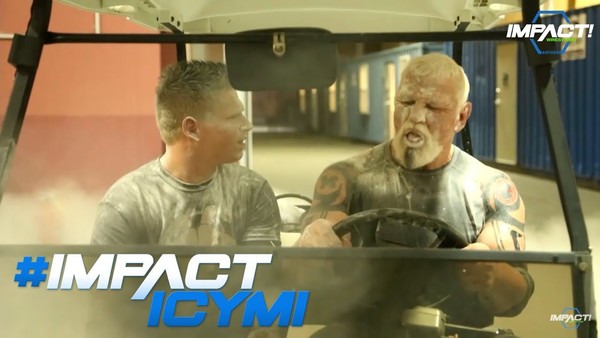
Look, I'll keep this brief. Scott Steiner knew fine well that, at the age of about 54, he didn't have it in him to single handedly drag a tag-team match containing two commentators to a satisfying 10-minute runtime. So, ingeniously, they shot the middle seven minutes backstage ahead of time, and just aired it between brief altercations in the ring.
Featuring a golf buggy and the Big Bad Booty Daddy saying "fat asses" about 800 times, it should be a complete disaster but it's not without its charm. Plus, if nothing else, it's preferable to seeing a man his age struggle around in the ring with two people who aren't regular workers.
8. The Wyatt Family Compound Brawl

Very much the forgotten child of both WWE's endeavors into these things and of Braun Strowman's entire career, the Wyatt Family Compound was arguably the first time the company turned proper cinematic production values onto a wrestling match.
Not good ones, mind you. The entire thing was all jumpcuts, shaking cameras, lens flares, and whatever else first-year film students usually throw in to try and disguise the fact they actually wrote the story the night before. This was WWE spending a lot of money just to make something look a bit cheaper.
Coming so soon after Hardy's infamous Final Deletion, the comparisons were as obvious as they were well-earned. WWE not even bothering with subtly by referring to the Wyatt family home as a "compound", it wouldn't have surprised anyone of Big E had thrown a small boat.
After brawling through the woods, the groups dangled over a car, through some shrubbery and even into a tree. With nobody able to get a clear advantage in the situation the area was suddenly surrounded by car headlights, and then a row of people, all in sheep masks, holding lanterns. Deciding discretion was possibly the better part of valour, The New Day just... left?
Rather than the payoff to a long-running feud, this encounter was merely part of the programme building to that year's Battleground where many had predicted the breakup of the New Day; Woods routinely looking like he was about to turn on the group with Wyatt in his ear. In the end, it was a routine victory for Bray and the Boyz, and everyone just got on with their lives.
7. Tag Team Apocalypto

Arguably the most ambitious project on this list is an example of just how much creative freedom Impact was happy to afford Hardy during the latter part of his career there. As well as handing over the reins to an entire PPV in the shape of Total Nonstop Deletion, they also allowed him to produce a 45-minute long, 23+ man deep, tag-team main event.
Tag Team Apocalypto again took place at the Hardy Compound and saw The Helms Dynasty, The Rock 'n' Roll Express, Decay, The Bruiserweights, The Ugly Ducklings, Showtime, Aaron Biggs, Mecha Mercenary, The Bravado Brothers, Rockstar Spud, Swoggle and the Broken Hardys fight it out in in a near hour-long closing segment.
There are too many individual spots in this to sufficiently detail, but if you're imaging nonsensical carnage where absolutely everybody gets a chance to shine then you're about half-way there. It ends with a successful title retention and a giant burning effigy of the Hardy logo. That's about all your need to know.
6. The Great War / Delete Or Decay
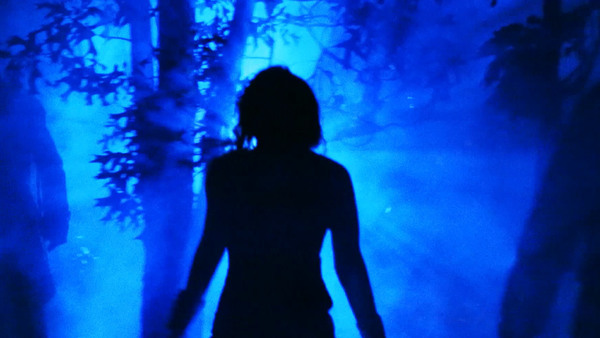
The oft-forgotten follow-up to the Final Deletion, The Great War saw the reunited Hardyz teaming up to fight off the team of Abyss, Crazzy Steve, and Rosemary - collectively now known as Decay. While our heroes had a Tag Team Number 1 contenders' match to justify this, their adversaries announced they would be taking King Maxel if they won.
The feud comprised two separate events, both following the same narrative through-line. The first, Delete or Decay, had precious little in the way of actual wrestling and played out more like a short horror movie that culminated in Matt Hardy simply absorbing Rosemary's mist and spraying it back into her face. Also there's a suplex into a pool.
The Great War, by contrast, at least started as a conventional wrestling match, seeing the tag team titles defended at Bound For Glory. After a few minutes inside the ring, things spilled backstage and into the cinematic. Matt set his hands on fire, Jeff transformed into Willow, but before long we were back in the ring where a 400ft Swanton through two tables settled the contest. While it wasn't a global phenomenon like some of Hardy's other work, it's arguably the best-combined use of in-ring and cinematic match structure to date.
5. The Ultimate Deletion

Vince McMahon wanted absolutely nothing to do with The Final Deletion, except the baffling amounts of money it was going to make. Thus he rehired the Hardy Boyz and, in 2018, begrudgingly allowed the elder to sculpt his own version for an episode of Monday Night Raw. His opponent this time was Bray Wyatt, but Vanguard 1, Señor Benjamin, and the word "dilapidated" - all staple poppers from the Final Deletion - returned for the sequel, and if anything the silliness was turned up from its starting position of 11.
After a match that included, of all things, a Benny Hill-esque chase scene through a field of handmade 6ft symbols, Hardy took Wyatt into the Lake of Reincarnation... where he vanished. While he wasn't directly reborn as The Fiend it's as good a metaphor as any I guess.
While the match divided the audience, there was at least praise for WWE sticking it in the main event slot and allowing Hardy and Wyatt near-total creative control over the thing. They hired a man to enact a vision, and then eventually got out of his way to let him do it. Surely if they could do that for Hardy, they could do that for Wyatt as well somewhere down the line...
4. Lucha Underground

It is impossible to praise the achievements of both WWE and TNA, without acknowledging the work done by Lucha Underground in all of this. While they never put on a match in quite this vein, they made pro-wrestling a cinematic art form in ways never before seen in any company. In a formulaic age, they pushed the boat out further than anyone had dared do so previously.
They approached their weekly show not as a wrestling event that needed to be shot for television, but as a television show that needed to be shot for wrestling. This meant using the full gamut of TV production, adding high-level soap opera drama, and not being constrained by the "realism" of trying to maintain kayfabe.
Every week saw the show pushing forward as a Days-Of-Our-Lives style drama, packed with elements of the supernatural, with all the feuds settled in a wrestling ring. Produced by Robert Rodriguez (yep, that Robert Rodriguez) it was arguably the WWE's most exciting competition until its announced closure in 2020. I mean, Drago once got turned into a literal dragon FFS.
3. The Final Deletion

As I say, Vince McMahon wanted absolutely nothing to do with The Final Deletion. In Matt Hardy, he saw little more than a very average worker who'd fallen down the industry into much smaller promotions and was now putting out some career's-worst work in a desperate attempt to stay relevant. Worst still, he had three things Vince would have no idea how to use: a drone, a lawnmower, and Jeff Hardy.
However, the match became, rightly, the biggest thing in professional wrestling. It was an overnight viral sensation, endlessly-quotable, and made Hardy the hottest property on the independent scene for the better part of an entire year. Vince wanted nothing to do with any of it... except the huge amounts of money it could potentially make.
The drone attacks, the garden vandalism, the baffled referee, the fireworks, the dilapidated boat, all of it, this should have been an industry-wide laughing stock but somehow, someway, Hardy pulled it all off. The match catapulted him and his brother to heights they'd not visited since their TLC days and, within a year, they'd returned to WWE in one of the biggest WrestleMania pops of all time.
2. The Boneyard Match
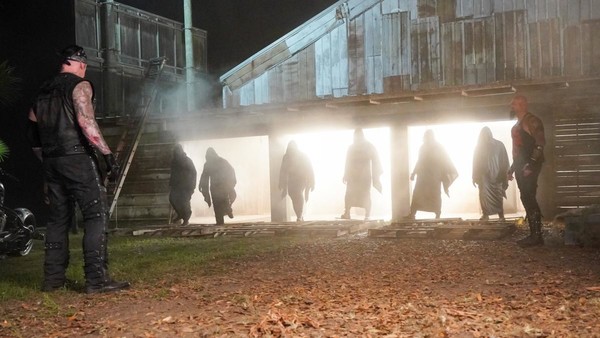
For about 24 hours, this match looked like being a cinematic piece of wrestling that WWE would likely never be able to top. Something that took the patented Hardy formula, injected it with a far more believable story, and gave it to two men who, between them, were (or at least were once) light years ahead of most normal wrestlers in regards to actual wrestling.
Despite the hokey nature of the way it was unveiled, AJ Styles and The Undertaker put on over 30 minutes of improbable, entertaining, career's best, it-has-to-be-seen-to-be-believed, sports entertainment. It owed a lot to the various Deletions, but also to The Walking Dead, Sons of Anarchy, and a host of iconic TV shows.
The idea was simple. Neither man was going to benefit from going 5-6 minutes in an empty arena to allegedly settle a "blood feud". Styles calling out Michelle McCool and both men using each other's real names meant that if this was settled by a ropey big boot and botched chokeslam the audience would (ironically) crucify the whole thing. So WWE did what they do best in a crisis, and just handed all creative power over to the talent.
Their solution was to head out to a disused factory, and shoot a brutal fist-fight with as many retakes and breathers as they needed. This masked The Undertaker's near unworkable age and immediately brought back his aura as a man who can do all his talking with his fists. The decision to ditch the undead gimmick and have him roll up on a motorcycle was, while obvious, still inspired.
They fought across the ground, they ran each other through walls, they used every implement to hand to beat each other and, when it finally looked as though Styles had his opponent where he wanted him, The Undertaker used those old teleportation powers to suddenly appear behind him in a blinding flash of light. This was pure TV, and the audience loved every single second of it.
And yet despite all of this, despite the universal acclaim and professional acknowledgments, despite both men raising the bar to a level few thought could ever be met, it doesn't even make the top spot on a list written 36 hours after it aired...
1. The Firefly Funhouse

Have you tried to describe this to your friends yet?
A 42-year-old man dresses up as Hulk Hogan, a rapper, and his 24-year-old self to battle a magical children's entertainer/ demonic clown. In the end he beats up a puppet of a hungry pig and it's the most profound piece of long term, nuanced storytelling the company has done in years.
Entire essays will be written about this match. For decades to come, it'll be a moment that's harked back to as proof WWE are capable of giving their audience credit and not, as they have done so relentlessly, feeling the need to chew their food for them and dribble it slowly back down their mouths. They can just let performers tell a story that's been gradually, quietly written over entire careers, not spelled out in one promo a week before a show.
And that story is this: John Cena is a hero to millions, but always was a privileged, insecure, piece of s**t. He was handed every opportunity by a powerful man who thought he could make a lot of money off the back of him, never had the courage to challenge either himself or the status quo, and in the process buried an entire generation of talent beneath him. This has been the narrative around his career for years and now, working with a Bray Wyatt on the crest of a creative golden period, he's been brave enough to turn it into unmissable pro-wrestling theatre.
Arriving as Prototype John Cena to recreate his debut defeat against Kurt Angle, having his failed relationship with Nikki Bella referenced, then being unable to deviate from bad rhyming promos as the Dr of Thuganomics, before coming out as nWo Hogan to show how he could have revived his career by turning heel, this was a tale 18 years in the making. His fears and his failures, both professional and personal, built us to the eventual reveal of The Fiend, who arrived to put him out of his misery.
It necessitates discussion, it demands rewatches, and it's the absolute best of both cinema and pro-wrestling.