Hiroshi Tanahashi Vs. Kenny Omega: The Essential Battle For NJPW
Styles Clash.

Japanese wrestling legend Mitsuharu Misawa, one of the greatest of all time by any metric, died in a shocking in-ring incident on June 13, 2009.
He lost consciousness, and was later pronounced dead after taking a routine suplex from Akitoshi Saito in a tag team bout also involving Go Shiozaki and Bison Smith. His death was initially thought to have resulted from cardiac arrest, before police reports indicated that a cervical spinal cord injury was likely the real cause. We'll never know for sure: his family opted to invoke a clause under Japanese law not to release it.
While the cause of death is disputed, there is no doubt that his years pioneering the King’s Road style were a significant—if not the sole—factor. The King's Road was punishing. Those who trod it were depicted as superhuman, able and more than willing to administer and absorb ludicrous punishment. Infamous for its reckless, neck-centric offence—Misawa's Tiger Driver '91 super-finisher remains the most wince-inducing your writer has ever bore witness to—it made cripples of its gladiators.
The wear and tear crept up on Misawa in devastatingly tragic fashion, but it wasn't so patient with Steve 'Dr. Death' Williams; world class just three years earlier, by the time he joined the WWF in 1998, Williams was a husk of the warrior he was in the East. The style had caught up with him so rapidly that he is now best remembered in the mainstream, dispiritingly, as a punchline: an Attitude Era footnote as a result of his Brawl For All humiliation at the hands of Bart Gunn.
Though the style was popularised in and mostly associated with All Japan Pro Wrestling in the nineties, the quintessential example of its quality—and unsettling legacy—can be seen in Misawa’s seminal March 1, 2003 GHC Heavyweight Title defence against Kenta Kobashi from Pro Wrestling NOAH, revered in many circles as the best pro wrestling match of all time….
…before its dangerous bones were exhumed years later. But we’ll get there.
CONT'D...(1 of 6)

Those who hold it in the highest regard do so not just because of its awe-inspiring content, but because it exceeded both its own expectations and the quality of their previous matches, not one of which was anything less than blinding. Both men were already utterly battle worn at this point. Topping their previous five-star classics was thought to be inconceivable—but top them they did. Astutely structured in meta fashion to mirror the challenger's career trajectory and Ace credentials—Kobashi would go on to reign for two years as champion—his early promise was brutally thwarted time and time again by the old master, before he dug deep within himself to complete the arc.
The match was as physical as it was cerebral. They knew expectations were low, and were determined to smash them, and in doing so, they battered each other with even more force than their fans were accustomed to. The King’s Road did not meander. There was no scope to work smarter. Its fans, and even more so, its practitioners, would not allow for it. The only way to sate the collective appetite was to work harder. In the match’s most jaw-dropping spot, the two warriors jostled for position on the entrance ramp looming some three feet over the concrete surrounding the ring. An already spent Misawa then hooked both of his opponent’s arms. What followed is difficult to watch, knowing what would happen to both men years later—and much like the final ascent on a rollercoaster, the sinking feeling is somehow worse than the drop.
Misawa drilled Kobashi from the ramp to the concrete, neck-first, with a devastating tiger suplex—but in reality, both men absorbed the brunt of the impact. Long-term wrestling fans have been desensitised. We’ve seen bumps from daredevil heights. We’ve seen glass, saws, and explosives employed as weapons. We’ve see blade jobs so porous they required blood transfusions. The cumulative effect of the King’s Road style, however, was far more devastating, and this relatively unspectacular spot is far more harrowing in retrospect than even, say, Mick Foley’s famous Hell in a Cell bump. One can almost feel Misawa’s upper vertebrae disintegrating.
The style effectively died alongside its premier practitioner. Then GHC Heavyweight Champion, Jun Akiyama, himself thoroughly war-torn, heeded the sobering warning and retired the next day. He would return. In wrestling, everything does. Kobashi, Misawa’s years-long partner and rival, was also obliterated physically, so much so that, give or take the odd ill-fated comeback, he was essentially inactive from 2006.
It was as if his body had spared him.
CONT'D...(2 of 6)

Informed by the tragedy, consciously or otherwise (Hiroshi Tanahashi has expressly cited his loathing of NJPW’s trademark “strong style” as the launching point of his wrestling ethos), there was a subsequent and definitive shift away from the reckless abandon with which the old gladiators of All Japan laid into one another. A new road was being paved by the soon-to-be-resurgent New Japan Pro Wrestling, and its future ace, Hiroshi Tanahashi.
Trained in the fabled New Japan dojo, Tanahashi was mechanically sound almost immediately, as one would expect from a prodigy. Branded as one of the new ‘Three Musketeers’ ready to lead the charge away from the company’s MMA misadventures in the early 2000s, Tanahashi was a more story-telling, technical counterpoint to the strong style leanings of Shinsuke Nakamura and Katsuyori Shibata. Tanahashi has since spoken at length about the importance of timing and selling, providing insights on his traditional-yet-progressive approach between the ropes. Tellingly, he told Sports Illustrated in 2016 that "the ROH style is too fast; [You need to give the audience time to cheer]."
He sheds further light in his autobiography, ‘Why Hiroshi Tanahashi was Able to Change NJPW’. Bemoaning the grip strong style held on the flailing New Japan and its alienating impact on a future generation of young fans, he also condemned what he has coined "the McDonaldsisation" of pro wrestling. Tanahashi aimed to achieve a level of nuance wrestling had lost in a bewildering haze of "excessive use of moves" and punches thrown so hard they’d make wrestlers "cough up blood". In short, Tanahashi wanted fans to once again appreciate the "space" that one of his idols, Ric Flair, once created in between moves.
He achieved that by selling the effects of moves better than any wrestler had before.
CONT'D...(3 of 6)
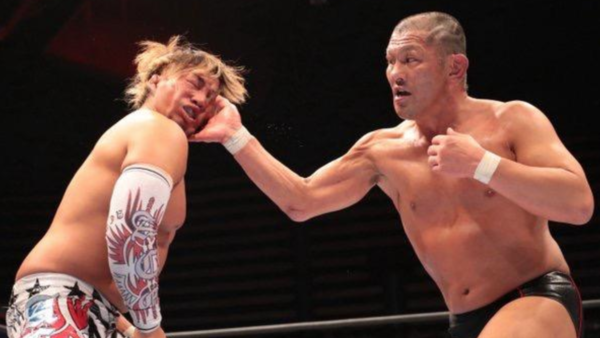
Tanahashi developed this new style, which, per his objective, was indebted to the old, by consciously scaling back on the frequency and force with which moves are struck and taken. Using his classic October 8, 2012 King Of Pro Wrestling match with Minoru Suzuki as an example, the opening exchanges were tentative, and logically so; when faced with a particularly fearsome opponent, especially a title challenger, a champion should be in no rush to put them away. Their exuberance could be easily punished.
From there, heat was generated and story crafted through the targeting of limbs and creative submission escapes (Suzuki’s intent, seemingly, was to maim Tanahashi as much as it was wrest away his title) rather than the excessive use of flashy impact moves. This is not to say that Tanahashi’s matches aren’t stiff, or exciting: the ring ropes and barricades were employed inventively throughout in order to expand the slow-burning, grappling-based through-line. Forceful strikes were used, but withheld until the crowd was sufficiently engaged, so as to maximise the reaction to them. The effect was such that, when Suzuki smashed Tanahashi with a simple dropkick to signal the onset of the finishing sequence, the fans were out of their seats.
That finishing sequence was Tanahashi’s most inventive and influential contribution to pro wrestling. All great wrestling matches are crafted to peak at the finish. This is nothing new. Tanahashi, and then Kazuchika Okada, deviated from the in vogue signature move trade-off device by instead implementing a defensive mind-set. The rush comes not from the kick out, but from the anticipation of the bomb blast. Where previously, the crowd may have reacted to a kick-out with a half-hearted gasp, they instead, under Tana’s spell, produced a nervous cacophony, as if he was scrambling to dig his fingers back onto the cliff edge. The drama of Tana’s finishing sequence intensifies as escapes and counters are exchanged. When the sequence reaches an intoxicating crescendo, the impact of just one move is received as if the preceding decades of excess never happened.
As you may have deduced from the lack of references to this year or last, the bulk of this article was written in 2016. We have used and adapted the original to highlight both the cyclical nature of the industry at its heart, and the fascination underpinning Wrestle Kingdom 13.
Tanahashi’s road has forked in the previous two years.
CONT'D...(4 of 6)

Since 2016, one Kenny Omega has evolved the wider NJPW style. Or devolved, depending on your interpretation. Omega raced up the heavyweight ranks following the departures to WWE of Nakamura and AJ Styles, and in doing so, shaped it in his own image.
At Wrestle Kingdom XI, in a seminal match, Omega challenged, unsuccessfully, for Okada’s IWGP Heavyweight Title. He was successful in restoring an element of danger and spectacle not seen in Japan since Pro Wrestling NOAH’s heyday. In that match, perhaps fatalistically built around the destruction of Okada’s neck, Omega struck Okada with a truly disgusting top rope dragon suplex, and narrowly evaded a gruesome fate himself following an over the top rope table bump. Okada went over Omega, but content won over space. That match, rated an ultra-rare ****** from the Wrestling Observer, changed pro wrestling once more.
This new road, to unprecedented critical acclaim, was paved with danger.
Soon, the likes of Tetsuya Naito, mobilised by this new ethos, ramped up the danger level in his matches. He took a DDT to a ring post in his 2017 G1 Climax finals win. Kota Ibushi required no such encouragement; only the platform. This new ethos poured into the Junior Heavyweight division; with the new status quo set, the likes of Will Ospreay and Hiromu Takahashi now define their careers literally chasing Omega’s dragon. “Careers” should be singular, if that. Takahashi remains on the shelf with a broken neck, whereas Ospreay has suffered something so awful even he can’t wrestle through it. This may, one would hope, trigger another cycle of puroresu’s evolution. Then again, the 2018 G1 Climax took place after Takahashi broke his neck, and in that tournament, Naito and Ibushi in particular willingly absorbed countless terrifying neck bumps.
CONT'D...(5 of 6)
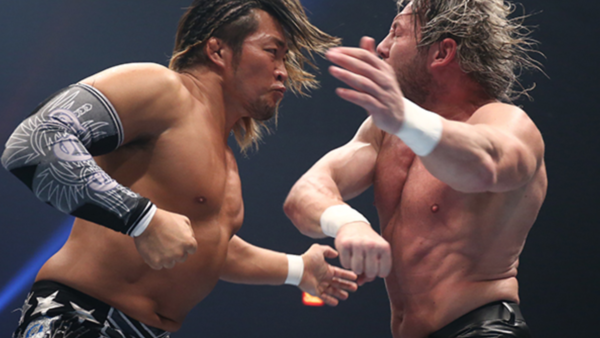
As did Omega. His new philosophy is a brutal subversion of Tanahashi’s finishing sequence; where Tanahashi did everything possible to avoid the rain, Omega unleashes a spectacular but treacherous cloudburst of big, big moves.
Fascinatingly, Tanahashi and Omega meet in the main event of Wrestle Kingdom 13. The programme has taken on a meta layer of intrigue. To Tanahashi, and there’s demonstrable truth in this, Omega transgresses upon the pure art of wrestling storytelling. To Omega, and he’s only working, Tana is a boring old man wrestling an antiquated style.
At Wrestle Kingdom 13, more is at stake than the IWGP Heavyweight Championship.
It’s perhaps no overwrought exaggeration to state that a generation depends on the outcome. Omega possesses the potential to genuinely star in WWE, and acclimatise to its safer ring style, leaving only a grim precedent behind. The generation in thrall to him may not. Tanahashi, meanwhile, is in the twilight of his career. Nobody can follow his genius, that much is certain; the way he hobbles to the ropes, feigning knee pain, is so heart-wrenching and authentic that he could sell Vince Russo to Jim Cornette. Tanahashi has endured a great deal of punishment throughout his career, but will surely close the door on it in a reasonable state of health.
Many have predicted one last big euphoric Dome win for the Ace.
It would represent, in more ways than one, the ultimate babyface victory.